Can multivitamins prevent cancer?
Posted: October 20, 2012 Filed under: Uncategorized | Tags: cancer, diet, nutrition, vitamins Leave a commentA multivitamin a day keeps the doctor away to prevent nutritional deficiency and indirectly reduce cancer risks. Although most previous research studies have not demonstrated whether vitamin supplements are useful in the prevention or the treatment of cancer, the recently published randomized control trial of 14,641 male physicians in the Journal of the American Medical Association demonstrated that a multivitamin a day significantly reduced the incidence of cancer. The participants started taking the vitamin or placebo at about age 50 and continued for eleven years. This study, Multivitamins in the Prevention of Cancer in Men- The Physicians’ Health Study II Randomized Controlled Trial, is different from most previous studies. It is one of the first randomized controlled trial in which the participants did not know whether they took a multivitamin or placebo daily. Even though the effect is small, the study finds that taking a multivitamin daily reduces cancer risk.
To promote health, take a multivitamin a day; however, the benefits gained by taking a multivitamin imply that:
- We are affluently malnutritioned as our daily western industrialized processed diet is deficient in nutrients that support our immune system and health. It would be better to eat an organic food diet with lots of vegetables and fruits. Even The President’s Cancer Panel Report, Reducing Environmental Cancer Risk: What We Can Do Now, published by the National Cancer Institute, National Institutes of Health, U.S. Department of Health and Human Services, recommends to consume to the “extent possible, food grown without pesticides or chemical fertilizers.” Eating an organic hunter and gatherer diet would include many other essential vitamins and minerals –some which we do not yet know—that are not included in a single multivitamin.
- Start eating a healthy diet from birth since it will have more impact to prevent cancer than adding a multivitamin a day at age 50. Most epidemiological studies have shown that a predominantly vegetable and fruit diet is associated with lower cancer rates.
- Implement a health promoting life style to support the immune system. Begin now by practicing stress management, incorporating exercise, performing self-healing strategies, and eating organic vegetable, fruits (no processed foods). For more suggestions see our book, Fighting Cancer-A Nontoxic Approach to Treatment.
Cancer and what you can do. Youtube interviews of Erik Peper, PhD by Larry Berkelhammer, PhD
Posted: September 29, 2012 Filed under: Uncategorized | Tags: cancer, health, hyperthermia 1 CommentErik Peper, Fighting Cancer: A Nontoxic Approach to Treatment
Psychophysiologist Erik Peper, PhD, discusses the book he co-authored with cancer researcher Robert Gorter, MD. He describes a novel, promising, nontoxic treatment for cancer, the results of which, have been quite exciting. In line with the actual pathophysiological process of all disease, these authors view cancer as a failure of the immune system. This is because we all have cancer cells growing in us all the time, but a healthy immune system kills them off before they have a chance to make us sick. Dr. Peper teaches people how to live in such a way as to dramatically reduce the odds of ever getting cancer, and Dr. Gorter is the one who invented the method of curing cancer described in the book. This 3-month treatment, combining a dendritic cell treatment with artificial-induced hyperthermia has evidenced a 40 to 60 percent cure rate.
Erik Peper, Cancer, the Immune System, States of Mind, and Health
This interview points out the power of choice and intention to improve health and well-being. Terms like “have to” are deleterious to our health. According to Dr. Erik Peper: “Health is the ability to make choices.” People who are empowered to recognize choices from moment-to-moment are healthier than fatalistic people and healthier than people who use words like “should” and “have to.”
Do night lights cause cancer?
Posted: February 13, 2012 Filed under: Uncategorized | Tags: cancer, circadian rhythm, LED, light 11 CommentsBefore going to sleep in a 24/7 world, we watch TV, surf the web to catch the latest news, check Facebook to connect with our friends, or glance at our smart phones for the latest emails. Although it seems the normal thing to do, evening and night time light disrupts our biological rhythms and can affect our health and even increase risk for cancer.
Exposure to light in the evening or night is very recent in evolutionary terms. For hundreds of thousands of years the night was dark as we hid away in caves to avoid predators. Only in the last few thousand years did candles or oil lamps with their yellow orange light illuminate the dark. The fear of the dark is primordial– in the dark we were the prey. During those prehistoric times, our fear was reduced by huddling together for warmth and safety as we slept. Although our present life is far removed from our evolutionary past, our evolutionary past is embedded within us and controls much of our biology and psychology.
These days, while sleeping we turn on a night light to feel safe or allow us to see in case we have to get up. For many of us, darkness still feels unsafe since as babies the fear was amplified as we slept alone in a crib without feeling the tactile signals of safety provided by direct human contact. Presently, light permeates our night: the flashing status light of the standby mode of the TV, the blinking lights of our cell phone charger, the soft glow of the alarm clock, and the street lights or flashing headlights of the cars leaking around the edges of the blinds and curtains. These lights and especially the blue light produced by LED, TV and computer screens switches off the production of melatonin as shown in the figure 1.

Figure 1. The white line represents the wavelengths of light that suppress the secretion of the sleep-promoting hormone melatonin. The light spectrum of LED, TV and Computer screens has a strong peak in the blue and thus inhibits melatonin production and affecting our circadian rhythm. From: Dijk, D & Winsky-Sommerer R. (2012). Sleep, New Scientist Instant Expert 20. New Scientist, 213(2850), i-vii.
Melatonin, the hormone that makes us sleepy, contributes to regulating our circadian rhythms. When exposed to the blue component of the light before going to sleep, melatonin production is suppressed, our sleep onset is delayed, and sleep is more disturbed. Equally harmful is light exposure during the night because it suppresses the body’s melatonin production which affects and disturbs our circadian rhythm as shown in Figure 2.
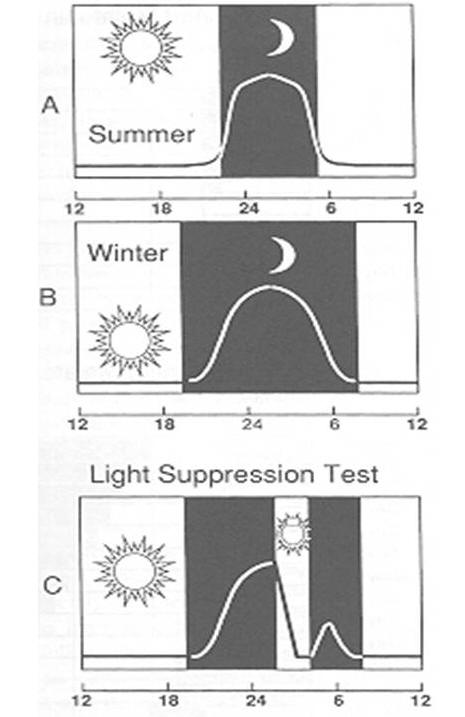
Figure 2. Exposure of light during the night, decreases melatonin production. From: Sack, R. L., Blood, M. L., Hughes, R. J., Lewy, A. J. (1998). Circadian-Rhythm Sleep Disorders in Persons Who Are Totally Blind. Journal of Visual Impairment & Blindness, 92, (3).
The more our biological rhythms are disturbed the greater the risk of illness. For example, shift workers and airline cabin attendants have significant increased risk of accidents and illnesses such as cancer. Studies have shown that lab rats’ cancer cells proliferate significantly more when lights are kept on during the night than in the control group who remain in the dark. The disturbance of biological rhythms is usually associated with increased illness and reduced longevity. This disruption acts as an allostatic load (or a stressor on the system).
To promote health, return to your evolutionary roots and support your circadian rhythms by reducing light exposure before going to sleep and by sleeping in total darkness. Promote sleep onset, reduce sleep disturbances and support your circadian rhythm by following these simple steps:
- Do not watch LED, TV or computer screens an hour before going to sleep to enhance melatonin production.
- Light proof the bedroom and eliminate all light sources –yes, even the small indicator lights on electronic equipment — to maintain melatonin production and maximize your biological rhythm.
- Install a free computer program such as f.lux™ that makes your computer screen look like the room you’re in, all the time. When the sun sets, it makes your computer look like your indoor lights with warmer colors by reducing the blue light. In the morning, it makes the screen brighter like the color of sunshine.
For additional evolutionary perspective concepts and strategies to promote health, see the book Fighting Cancer: A Nontoxic Approach to Treatment.
Nontoxic cancer treatment: Conversation between Emmett Miller, MD and Erik Peper, PhD
Posted: January 29, 2012 Filed under: Uncategorized | Tags: cancer, Emmett Miller, fever, hyperthermia Leave a commentListen to the conversation between Erik Peper, PhD and Emmett Miller, MD recorded January 7, 2012.
We will explore some of the powerful ideas from his latest book, Fighting Cancer: A Nontoxic Approach to Treatment, written with Robert Gorter, MD. The model presented here is science based, and appears to be effective, humane, nontoxic, and stunningly successful for a wide range of cancers. Supporting the immune system to fight cancer from within is critical to complete care for the patient, and Fighting Cancer encourages millions to take action and restore hope.”
If you, your patients, or any of those you love are dealing with cancer, this is an excellent opportunity for discovery, and to enjoy Dr. Peper’s always spellbinding presentation. If you haven’t yet encountered cancer in your life or community, this is an excellent way to prepare to deal wisely with its challenges. In addition, we explore some of the latest discoveries in biofeedback and tools for self-healing.
In a world where our health care system is actually a “sick-care” system that requires us to be ill in order to function Dr. Peper focuses on the inner potential we all have to respond to disease and illness.
To listen to this conversion, click on this link conversation between Erik Peper, PhD and Emmett Miller, MD
Is there a link between stress and cancer?
Posted: January 19, 2012 Filed under: Uncategorized | Tags: breast cancer, cancer, stress, stress management Leave a commentMany factors contribute to the onset and progression of cancer such as exposure to carcinogenic agents, behavioral risk factors, compromised immune functioning or stress. The stress most strongly associated with increased breast cancer occurrence is the stress caused by major life events such death of a husband, divorce/separation, personal illness or injury, death of a close relative or friend, and loss of a job. Stress also increases the risk of re-occurrence and poorer outcome.
If stress can increase cancer risk then learning stress management techniques may reduce the risk and improve clinical outcome. In a superb eleven year long follow-up study, Professor Barbara Anderson of Ohio University showed that patients with breast cancer who had participated in a 14 week stress management program had significantly higher survival rates and lower re-occurrence rates as compared to the control group.
The findings that stress increases cancer risk and stress management improves survival suggests that stress management should be part of cancer treatment and prevention. For useful stress management techniques that patients can immediately do for themselves, see Part III-Self-care in the book, Fighting Cancer.
Reduce animal protein; reduce cancer expression
Posted: December 30, 2011 Filed under: Uncategorized | Tags: cancer, diet, protein 3 CommentsCancer expression and growth depends upon the interaction between immune competence, the presence of a carcinogenic factor, the body’s ability to process the toxin and the food ingested. For example, when rats are given a low dose of aflatoxin, which is a very potent carcinogen, cancer expression depends on how much protein the rat consumes. If the rat consumption of its normal amount of protein is reduced from 20% to 5%, the cancer which should have been induced by the aflatoxin does not occur. This relationship between animal protein intake and cancer expression is not new. It has been well documented for human beings by Campbell and Campbell in their book, The China Study. The overall finding is that lower animal protein intake is associated with lower cancer rates.
Thus to reduce cancer risk, reduce animal protein intake and increase intake of plants.

This dietary perspective is superbly shown in the recent leased movie, Forks over knives (2011), which claims that most, if not all, of the degenerative diseases that afflict us can be controlled, or even reversed, by rejecting animal-based and processed foods.
For general guidelines and an evolutionary perspective of diet and health you may want to look at Part III, Self-Care, in our book, Fighting Cancer-A Nontoxic Approach to Treatment.
Inhibiting fever with acetaminophen increases risk of asthma in children
Posted: December 22, 2011 Filed under: Uncategorized | Tags: acetaminophen, asthma, cancer, fever, paracetamol 1 CommentMy child has a fever, what can I do? I do not want to give aspirin because of the rare complication of Reye’s syndrome. I give them acetaminophen to reduce the fever and inflammation. However, research by Dr. McBride, published in Pediatrics, has documented that there is a strong link between acetaminophen (also known as paracetamol) and asthma This high correlation between acetaminophen use and asthma is across all groups, ages and location. This correlation even holds up for mothers who took acetaminophen during pregnancy. Their children have increased risk for asthma by age six.
A better solution for a feverish child is watchful waiting and hold back on the medication until they are truly needed–which is very rare. Remember in almost all cases fever is not the illness; it is the body’s response to fight the illness and regain health. For more information about the relationship between acetaminophen and asthma see the New York Time‘s article, “Studies Suggest an Acetaminophen-Asthma Link,” the Pediatrics‘ article, “The Association of Acetaminophen and Asthma Prevalence and Severity,” or chapter 6, Therapeutic Fever, in the book, Fighting Cancer-A Nontoxic Approach to Treatment.
Fever can save your life
Posted: November 24, 2011 Filed under: Uncategorized | Tags: cancer, fever, ICU, paracetamol, tylenol Leave a commentMost people are terrified of fever and quickly rush to take a Tylenol. Fever is not the cause of illness; it is the body’s response to fight an infection. Fever causes the immune system to be activated so that it can fight the infection. Fever allows the body to return to health. If patients in the hospital intensive care units experience fever, aggressively fever suppression is the norm. Recent research by Dr. Schulman and colleagues at University of Miami Leonard M. Miller School of Medicine have shown that if instead the patients are carefully monitored and the fever is not suppressed the death rate in the ICU is reduce seven fold. Robert Gorter and I discuss the important role of fever and possible harm of fever suppression in our new book, Fighting Cancer.
 the peper perspective