Will the stock market bubble collapse? Will human fertility decrease to zero?
Posted: July 13, 2026 Filed under: behavior, cancer, Evolutionary perspective, healing, health, lifestyle, Nutrition/diet | Tags: books, cycles, economics, fertility, financial bubble, sperm count, stocks, technology Leave a comment
“Those who cannot remember the past are condemned to repeat it.” – George Santayana (Santayana, 1905)
These two questions may seem totally unrelated, yet they are deeply connected if one takes a long historic view and hypothesizes that present-day trends will continue.
When I drive or commute, I very much enjoy listening to podcasts. They offer an in-depth, nuanced discussions that are missing from today’s soundbite culture. These deep-dive podcasts offer a vital antidote, providing the nuanced, extended discussions necessary for true cognitive synthesis. One of my favorite podcasts is The Diary of a CEO with Steven Bartlett. I found the recent episode, “Billionaire’s WARNING: I’m SELLING. The Crash Is Already Here!”, very eye opening.
The interview was with billionaire investor Jeremy Grantham, the co-founder and long-term investment strategist of GMO. He is also the chairman of the Grantham Foundation for the Preservation of the Environment, and co-author of “The Making of a Permabear: The Perils of Long-term Investing in a Short-term World.”
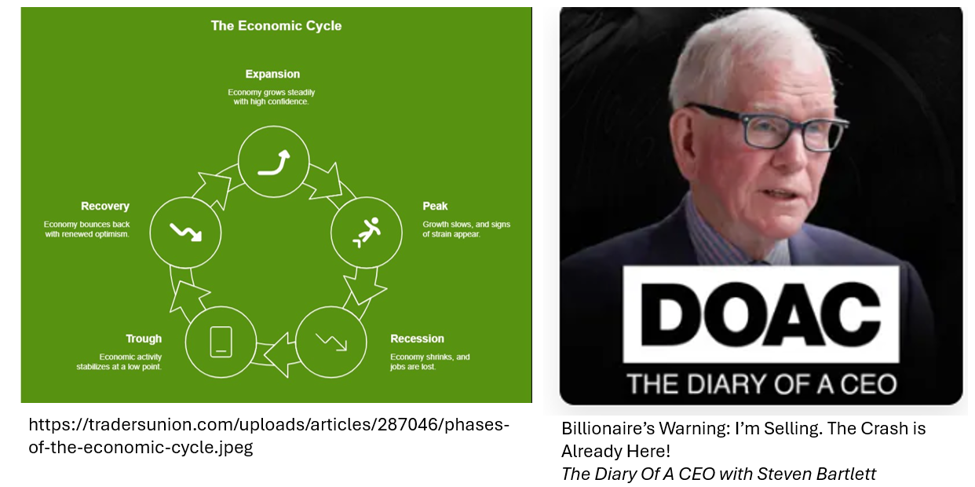
While economics and financial markets fall outside my primary line of research, I deeply appreciated his long-term perspective—an analysis I find to be entirely spot-on. The actual content offered a masterclass in pattern recognition, forcing me to sit back and critically analyze the macroeconomic shifts happening around us rather than just reacting to the daily noise of the market. He persuaded me that the present AI-driven financial bubble will burst; we simply do not know exactly when. I concur with him that it will occur sooner rather than later. Personally, I would not be surprised if it occurred within the next two years. We must simply be prepared to deal with more challenging times.
What surprised and fascinated me even more were the last 40 minutes of the podcast. Grantham shifted entirely away from the financial markets and applied that same rigorous, analytical thinking to what is truly driving the modern “baby bust” (Dilmaghani et al., 2024).
The scientific data is clear: human fertility—both male and female—has been decreasing each decade. This is starkly indicated by a 50% drop in male sperm counts and a rising number of couples struggling to conceive (Ravitsky & Kimmins, 2019; Mann et al., 2020; Inam, 2025). The culprits as for the increase in cancer rates? Ubiquitous modern disruptions like microplastics, pesticides, and pervasive environmental toxins (NIOSH, 2023; Doroftei et al., 2025; Brander et al., 2026).
Although the prognosis can look bleak, Grantham doesn’t just sound the alarm; he offers realistic strategies. He outlines how to protect yourself from the impending financial bubble collapse, as well as what you and your community can do to minimize toxic exposure and enhance fertility.
I smiled as I listened to the podcast, because his systemic analysis and practical recommendations are very similar to what we described in our just-published book, Cancer reconsidered-Why Environment, lifestyle, and immunity matter more than we thought (Peper et al., 2026).
To prepare yourself for the financial future and optimize your health and fertility, listen to Grantham’s insights on the podcast episode, “Billionaire’s WARNING: I’m SELLING. The Crash Is Already Here!”,
See the following blogs for more detailed information:
References
Brander, S.M., Swan, S.H., Mehinto, A.C., & et al. (2026). Impacts of environmental stressors on fertility and fecundity across taxa, with implications for planetary health. npj Emerging Contaminants, 2, Article 12. https://doi.org/10.1038/s44454-026-00032-6
Dilmaghani, D., Ainsworth, A. J., Nath, K. A., & Garovic, V. D. (2024). Decreasing fertility rate in the United States: Demographics, challenges, and consequences. Mayo Clinic Proceedings, 99(11), 1693–1697. https://doi.org/10.1016/j.mayocp.2024.09.004
Doroftei, B., Savuca, A., Cretu, A.-M., Maftei, R., Anton, N., Ilea, C., Doroftei, M., & Puha, B. (2025). Microplastics and human fertility: A comprehensive review of their presence in human samples and reproductive implication. Ecotoxicology and Environmental Safety, 303, Article 118939. https://doi.org/10.1016/j.ecoenv.2025.118939
Inam, Ö. (2025). Impact of microplastics on female reproductive health: Insights from animal and human experimental studies: A systematic review. Archives of Gynecology and Obstetrics, 312(1), 77–92. https://doi.org/10.1007/s00404-024-07929
Mann, U., Shiff, B., & Patel, P. (2020). Reasons for worldwide decline in male fertility. Current Opinion in Urology, 30(3), 296–301. https://doi.org/10.1097/MOU.0000000000000745
NIOSH. (2023, December 15). About pesticides and reproductive health. National Institute for Occupational Safety and Health Centers for Disease Control and Prevention. https://www.cdc.gov/niosh/reproductive-health/prevention/pesticides.html
Peper, E. Gorter, R. & Faass, N. (2026). Cancer Reconsidered: Why Environment, Lifestyle, and Immunity Matter More Than We Thought. BiofeedbackHealth/Regent Press. https://www.amazon.com/Cancer-Reconsidered-Environment-Lifestyle-Immunity/dp/1587907402/
Ravitsky, V. & Kimmins, S. (2019). The forgotten men: rising rates of male infertility urgently require new approaches for its prevention, diagnosis and treatment. Biol Reprod. 101(5), 872-874. https://doi.org/10.1093/biolre/ioz161
Santayana, G. (1905). The Life of Reason: Vol. 1. Reason in Common Sense. Charles Scribner’s Sons. p. 284. https://www.amazon.com/Reason-Phases-Progress-Introduction-Common/dp/B01DF937WU
 the peper perspective