Being safe means more than being physically and emotionally protected. It is the trust that, whatever happens, you can cope with it.
Posted: September 14, 2026 Filed under: attention, behavior, biofeedback, cognitive behavior therapy, emotions, healing, health, meditation, Pain/discomfort, relaxation, self-healing, stress management, Uncategorized, zoom fatigue | Tags: hope, resilience, safety, trust Leave a comment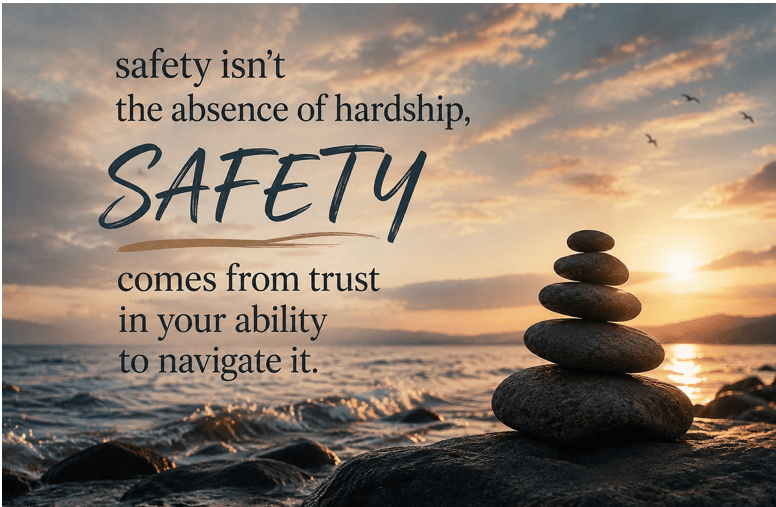
From: Pulde, A, & Lederman, M. (2026). The safest man I met had every reason not to feel safe.. https://connectiondocs.substack.com/p/the-safest-man-i-met-had-every-reason
Self-regulation is the cornerstone of biofeedback and neurofeedback and a potent tool for reducing symptoms and enhancing both health and performance. Early in my work, I hypothesized that if a participant, whether a student or client, simply mastered their self-regulation skills, they would generalize these practices into their daily lives, thereby improving their well-being. While this often leads to success, I have come to recognize that the true power of these interventions lies in the synergy between physiological techniques and psychological states.
When a person learns to master relaxation and slow, diaphragmatic breathing while intentionally adopting a state of “being in the present” that is free from the constraints of expectation and the noise of rumination, they facilitate a biological environment conducive to healing. This is because healing and regeneration are most effective when the autonomic nervous system is shifted away from the stress response (Levy et al., 2013; Budhiraja et al., 2024).
My perspective on these mechanisms was significantly expanded through the observation of a yogi and Sufi practitioners who voluntarily engaged in what would objectively be considered deliberate harm to the body, such as the insertion of skewers, without reporting pain or discomfort (Kakigi et al., 2005; Peper et al., 2005a; Peper et al., 2006–; Fuhs & Peper, 2005). Witnessing this, demonstrated that beyond breathing and relaxation, a critical ingredient is the profound “knowing” that one is safe and no harm will occur. Feeling safe is the first step in the healing process (Peper et al., 2025).
In those Sufi piercings, total trust and visceral sense of safety were anchored by the permission and blessing of their Sheikh (their spiritual guide). This dynamic illustrates that implicit and explicit trust, combined with a conviction of safety, is likely a fundamental quality underpinning the placebo effect: the embodied belief that a procedure will lead to healing .
Often, this quality is highly state-dependent, constrained to the specific setting where the safety is perceived (for the Sufis it was the permission and blessing by their Sheik). The challenge is to generalize this feeling of safety beyond the specific setting and therapeutic room. To transcend situational anxiety or future-oriented worry, one must cultivate a foundational belief that whatever unfolds is acceptable, and that the person possess the internal resources and skills to cope with it. When one truly adopts and experience this perspective, the stressors of life can be met with resilience rather than reactivity.
This process has been exquisitely described by Drs Alona Pulde and Matthew Lederman in their inspirational substack blog, The Safest Man I Met Had Every Reason Not to Feel Safe (Pulde & Ledereman, 2026). Their blog is reproduced with their permission from, https://connectiondocs.substack.com/p/the-safest-man-i-met-had-every-reason?r=4scjd0&utm_medium=ios
The Safest Man I Met Had Every Reason Not to Feel Safe
Dr. Alona Pulde and Dr. Matthew Lederman
What a chance encounter at an LAX rental car counter taught me about the difference between trying to control what happens and trusting myself to meet whatever does.
Sep 08, 2026
It was late when I pulled into the rental car return at LAX, probably 10 or 11 at night. I was tired, ready to be done with the day, and there was some kind of problem with my return. The woman helping me clicked around on her computer for a while before finally looking up and calling over to someone nearby.
“Hey, Moose. Can you help this man? I can’t figure out what’s going on with his return.”
I looked over and saw this massive man walking toward me. Not heavy, just big. Tall, broad, the kind of person who has a commanding presence without needing to do anything to command it. But what I noticed almost immediately was his smile. There was something warm about him, something easy.
As he started working on my problem, I asked, “Is your name really Moose?”
He laughed and told me his actual name, which seemed to contain about sixteen more syllables than I was prepared for.
“My friends just call me Moose,” he said.
I smiled. “I’m going to call you Moose, too.”
I asked where his name came from, and he told me he was from a country in Africa. I didn’t recognize the name of the place. I sort of laughed and said, “Maybe I should visit. I’ve always wanted to go to Africa.”
His expression changed.
“No. Never go there.”
I wasn’t expecting that.
“Why not?”
He told me it was dangerous. Then, standing there at a rental car counter at LAX, while he was trying to figure out whatever was wrong with my paperwork, this man began telling me his story.
When he was a child, he said, he was kidnapped from his family and forced into labor connected to the conflict diamond trade. Eventually he was rescued and placed in an orphanage. Then the orphanage was bombed and destroyed.
There was more, one impossible thing after another.
I remember looking at him as he told me all of this and thinking about the person standing in front of me. He wasn’t telling the story with bitterness. He wasn’t collapsed under the weight of it. He still had that enormous smile.
Finally, I asked him the question that had been forming in my mind.
“How are you still smiling?”
His answer has stayed with me.
He told me, essentially, that after everything he had lived through, he wasn’t very afraid of what life could throw at him anymore. He had already been through things most of us couldn’t imagine. And he had made it through them.
He trusted himself.
Whatever happened next, he believed he would find a way through that, too.
I stood there listening to him and realized he was describing something I have spent a lot of time trying to find in myself.
Safety.
I think about safety a lot. I notice what happens inside me when I feel safe and what happens when I don’t. When I feel safe, connection comes more easily. I listen better, I’m more present. My body feels different. When fear takes over, everything starts to narrow. I can feel myself wanting to manage, anticipate, fix, prepare.
And like a lot of people, one of the ways I have tried to create safety is through control.
If I can know what’s coming, I can prepare for it. If I can anticipate what might go wrong, maybe I can prevent it. If I make the right decisions, say the right thing, watch closely enough, think far enough ahead, maybe I can keep the people I love from getting hurt.
I feel this especially as a father.
There is a part of me that wants to make sure nothing bad happens to my kids. Of course there is. I love them. I want to protect them. I want to see the danger before they see it. I want to know that they’ll be okay.
But there is something exhausting about trying to get safety that way. Because life refuses to make that promise. There is always another thing I haven’t considered. Another possibility. Another what if. Another way something could go wrong.
I’m beginning to wonder whether some of what I’ve called my pursuit of safety has actually been a pursuit of certainty. And certainty is a brutal thing to require from life.
Because if safety depends on certainty, the conditions for relaxing are almost impossible to meet. If everything goes according to plan, I can relax. If everyone I love is okay, I can relax. If I know what is going to happen next, I can relax.
Except life never signs that contract.
And here was Moose. A man whose life had given him almost none of the certainty I keep trying to create.
Terrible things had happened to him. Things he couldn’t predict or control or prevent. Yet somehow the evidence of his survival had become stronger than his fear of what might happen next.
I don’t want to romanticize that. What happened to him was horrific. Trauma doesn’t automatically make people stronger, and suffering isn’t something we need to be grateful for. But there was something in the way he had made meaning of his own survival that I couldn’t stop thinking about.
He didn’t seem to feel safe because he believed the world was safe. He clearly knew it wasn’t.
He seemed to feel safe because he trusted himself to meet the world as it was.
That turned something upside down for me.
Maybe safety isn’t knowing that nothing bad is going to happen. Maybe safety is knowing that if something does, I won’t abandon myself in it.
I’ll hurt. I’ll grieve. I’ll get scared. I might be overwhelmed for a while. I might need help. Trusting myself doesn’t mean believing I’ll handle everything gracefully. Maybe it means trusting that even when I don’t handle something gracefully, I can still find my way back.
That feels different from control.
Control says, “I need life to go a certain way so I can be okay.”
Trust says, “I don’t know how life is going to go, but I believe I can meet it.”
As Moose and I were talking, another manager called out sick. Moose had told me earlier that he was at the end of his eight-hour shift. Now someone needed to cover another eight hours overnight.
I watched him hear the news.
There was no visible outrage. No “You’ve got to be kidding me.” No sense that the night had suddenly become something that shouldn’t be happening to him.
He smiled.
Basically: Okay. I guess I’m working tonight.
He even seemed determined to enjoy it.
And I remember thinking, He’s doing it right in front of me.
This wasn’t a philosophy he had developed for an inspirational quote. It was how he was moving through his life. Something happened that he hadn’t planned. He adjusted. Life changed. He moved with it.
And somehow, because he wasn’t spending all of his energy demanding that the moment be different, he was still there to experience the moment he actually had.
I’ve thought about that a lot since. Because when safety depends on control, we don’t only suffer when things are bad. Sometimes we have trouble fully enjoying when things are good.
Things are going well and some part of the mind starts whispering, How long is this going to last? Someone you love is happy, and you imagine what could happen to them. Life feels good, and instead of settling into the goodness, you start preparing for its disappearance.
And maybe that is one of the hidden costs of trying to protect ourselves from the future: we make the present pay for something that hasn’t happened yet.
Maybe trust gives us another option.
Maybe I don’t have to use the good times to prepare myself for the bad ones. Maybe I can actually be here. Because when the hard thing comes, I can meet it then.
I still want to protect my kids. I still want to make good decisions. I still want to anticipate real risks and take care of the people I love. Trust isn’t passivity, and it isn’t pretending bad things don’t happen.
Maybe it’s simply loosening my grip on the belief that I need to prevent every painful thing in order for us to be okay.
And maybe there is something else I want my kids to learn from me. Not only that I will try to protect them from hard things, but that I believe in their ability to meet hard things too.
Because perhaps one of the greatest forms of safety we can give the people we love isn’t the promise that nothing will happen to them. It’s helping them discover, If something does, I won’t be alone. And I can find my way through.
There is a strange kind of freedom in that.
I don’t need every person I love to be okay every second in order to experience this second. I don’t need life to promise me that nothing painful is coming.
Maybe safety isn’t a promise life makes to me at all.
Maybe it’s a relationship I’m building with myself.
Eventually, whatever problem I’d had with the rental car got resolved. I barely remember what it was now. I do remember shaking Moose’s hand. I told him there was something about him I found incredibly inspiring. I told him I felt drawn to his energy and his way of looking at life. I wished him well.
And then I laughed and told him that I don’t get inspired all that often, and I definitely hadn’t expected it to happen while returning a rental car at LAX late at night.
I walked away thinking about this man who had experienced so many reasons not to trust life, yet somehow had developed an extraordinary trust in himself.
I’m still working on that. I still catch myself reaching for certainty. I still try to think far enough ahead that I can protect myself and the people I love from whatever might be coming.
But now, sometimes, I think about Moose.
And I wonder if the question isn’t, How do I make sure nothing bad happens?
Maybe it’s, Can I trust myself even when I don’t know what happens next?
The article was reproduced with permission from the blog by Dr. Alona & Dr. Matt’s Substack which is a reader-supported publication. To receive new posts and support our work, consider becoming a free or paid subscriber. https://connectiondocs.substack.com/p/the-safest-man-i-met-had-every-reason?r=4scjd0&utm_medium=ios
References
Budhiraja, A., Mehta, A., Alhamo, M. A., Swedarsky, R., Dahle, S., & Isseroff, R. R. (2024). Vagus nerve stimulation: Potential for treating chronic wounds. Wound Repair and Regeneration, 32(1), 108–117. https://doi.org/10.1111/wrr.13151
Fuhs, M., & Peper, E. (2005). The limits of your beliefs are the limits of your reality. Psychophysiology Today, 2(1), 9–13. https://www.researchgate.net/publication/414300494_Limits_of_your_belief
Kakigi, R., Nakata, H., Inui, K., Hiroe, N., Nagata, O., Honda, M., Tanaka, S., Sadato, N., & Kawakami, M. (2005). Intracerebral pain processing in a yoga master who claims not to feel pain during meditation. European Journal of Pain, 9(5), 581–589. https://doi.org/10.1016/j.ejpain.2004.12.006
Levy, G., Fishman, J. E., Xu, D., Chandler, B. T. J., Feketova, E., Dong, W., Qin, Y., Alli, V., Ulloa, L., & Deitch, E. A. (2013). Parasympathetic stimulation via the vagus nerve prevents systemic organ dysfunction by abrogating gut injury and lymph toxicity in trauma and hemorrhagic shock. Shock, 39(1), 39–44. https://doi.org/10.1097/shk.0b013e31827b450d
Peper, E. (2015). Pain as a contextual experience. Townsend Letter, 388, 63–66.
Peper, E., Booiman, A. & Harvey, R. (2025). Pain-There is Hope. Biofeedback, 53(1), 1-9. http://doi.org/10.5298/1081-5937-53.01.16
Peper, E., Gibney, K. H., & Wilson, V. E. (2005a). Enhancing therapeutic success — Some observations from Mr. Kawakami: Yogi, teacher, mentor and healer. Somatics, 14(4), 18–21. https://biofeedbackhealth.org/wp-content/uploads/2011/01/edited-enhancing-therapeutic-success-8-23-05.pdf
Peper, E., Wilson, V. E., Gunkelman, J., Kawakami, M., Sata, M., Barton, W., & Johnston, J. (2006). Tongue piercing by a Yogi: QEEG observations. Applied Psychophysiology and Biofeedback, 31(4), 331–338. https://doi.org/10.1007/s10484-006-9025-3
Pulde, A. & Lederman, M. (2026). The safest man I met had every reason not to feel safe. Connection Docs. https://connectiondocs.substack.com/p/the-safest-man-i-met-had-every-reason