Healing Visualization: Part 1 – Experiencing the Mind-Body Connection
Posted: October 7, 2026 Filed under: attention, behavior, biofeedback, cancer, CBT, cognitive behavior therapy, education, emotions, healing, health, imagery, mindfulness, Pain/discomfort, relaxation, self-healing, stress management, Uncategorized, visualization Leave a commentAdapted in part from Cancer Reconsidered: Why Environment, Lifestyle, and Immunity Matter More Than We Thought, by Erik Peper, Robert Gorter, and Nancy Faass.
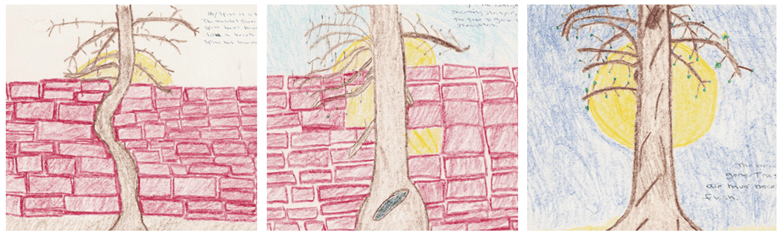
I saw my spine as crooked tree. On both sides of my spine, there were brick walls molding my spine into this bent position. I felt that all my muscles surrounding my spine to be hard and rigid like a brick wall. My spine had become inflexible. I began to imagine the bricks falling away one by one. I imagined the sun shining, with all its warmth, beyond the brick wall. As each brick fell away, the sun’s rays broke through and warmed my flesh—giving my flesh life and flexibility. The more I did this, the more vivid the images became. The sun became a stronger force allowing the tree to grow upright and straight. I was even able to generate heat in my back. This intensified my relaxed state. As bricks fell away there was less tension—allowing my spine to straighten. Over a five-week period of practdicing this regularly, my chronic back pain which I had had since the seventh grade, decreased from an average level of 7 to 2 or 3. – 22-year old college senior
In a health-care system where medication and surgery often take center stage, it may seem surprising that imagery could influence a person’s experience of a backpain, headache, fibromyalgia, or a serious illness such as cancer (Porter & Norris, 1985; Van Kuiken, 2004; Roffe et al., 2005; Menzies et al., 2006). Many people find that taking an active role in their care helps them manage symptoms, stress, or worry (Peper et al., 2002; Wang et al., 2022).

BACKGROUND
Over the years, I’ve guided thousands of students and clients in using self-healing visualization. Almost everyone can mentally picture their illness or stress, their healing process, and what it feels like to be healthy and whole. After practicing their personalized imagery, many report that their pain and symptoms have noticeably decreased. Possible mechanism include redirecting attention away from worry and discomfort, evoking a relaxation response that reduces stress-related symptoms, and triggering actual physiological changes induced by visualization. This blog post, the first of a three-part series on self-healing visualization, describes simple practices that may transform participants’ beliefs and open their minds to imagery as a powerful tool for self-healing. Future posts in this series will focus on a structured relaxation approach that to evoke hand warming, as well as detailed step-by-step instructions for practicing self-healing visualization.
For many participants, visualization is easier to accept and implement after they have experienced firsthand how thoughts and emotions affect the body and howpracticing relaxation alongside hand warming can reduce stress related symptoms. In addition, I often share case examples and drawings from previous participants whose health improved (Peper et al., 2022; Peper & Yirmiyahu, 2023). Before teaching self-healing imagery, I usually demonstrate and discuss how thoughts and emotions change the body’s physiology and how relaxation, practiced with passive attention, can increase hand warmth.
Guided Practices to Experience the Mind–Body Connection
A useful first step is to experience and know that thoughts and emotions evoked bodily changes. Depending on the person and setting, this can be demonstrated with biofeedback, guided exercises, or reflection on emotional memories. This process is is grounded in the psychophysiological principle, which states:
“Every change in the physiological state is accompanied by an appropriate change in the mental-emotional state, conscious or unconscious, and, conversely, every change in the mental-emotional state, conscious or unconscious, is accompanied by an appropriate change in the physiological state” (Green & Green, 1977). Simply put, when we purposefully change our mental-emotional state and imagery, we actively influence our underlying physiology.
BIOFEEDBACK MONITORING
Depending on the equipment available, a practitioner can monitor skin conductance, breathing, heart rate, or muscle tension. Participants might relax, recall a stressful memory, or notice their response to a brief, unexpected sound. This demonstration is usually stopped before anyone feels uncomfortable. By recording their physiology, participants can then observe and are often totally surprised by, how their body’s physiology changed of ways they were not consciously aware of as illustrated in Figure 1.
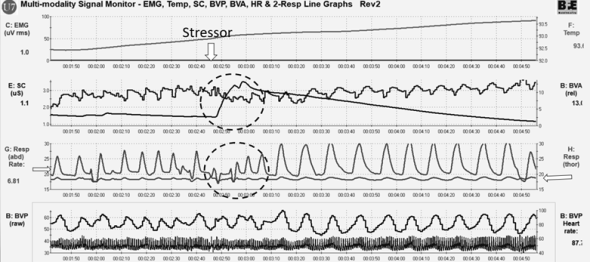
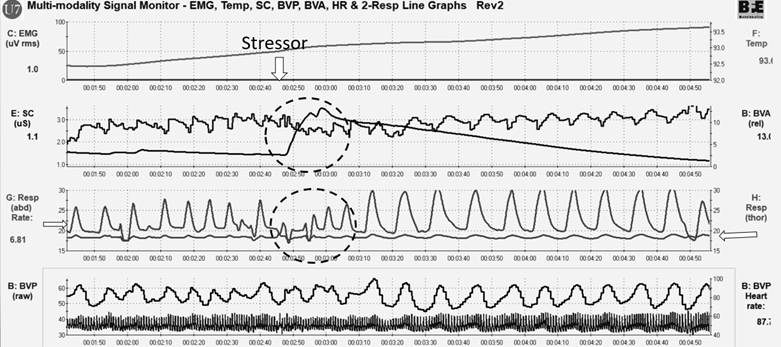
Figure 1. Example of a response to a stressor: skin conductance (SC) increased and abdominal breathing (Resp) decreased. After noticing the response, the participant practiced diaphragmatic breathing and recovered.
Seeing their own recording can prompt an “Aha” moment. It may help participants notice how internal or external events relate to their bodily responses. They can then explore strategies, such as guided breathing or calming imagery, and again observe what happens.
COMPLEMENTARY NON-BIOFEEDBACK PRACTICES
Without equipment, guided practice done, individually or in groups, can help participants experience how thoughts and imagery can change body sensations. These are explored with the following two guided practices: Lemon imagery and Muscle testing.
Guided practice: Lemon imagery
Close your eyes, get comfortable, and picture a lemon. Imagine cutting it in half and squeezing the juice into a glass. Then picture lifting the glass, tasting the juice, and swallowing. Notice any changes in your mouth or body. To experience how this visualization affects your body, try the pracdtice using the guided instructions provided in the YouTube video (Peper, July 25, 2018).
After guiding college students through this practice, more than 94% of participants report an increase in salivation and some noticed their mouths puckering. Individual responses vary in intensity.
Guided practice: Muscle testing
Pair up and stand facing each other. One person is the tester; the other is the participant. The participant extends one arm at shoulder height while the tester briefly presses down on the wrist and the participant resists. Repeat with the other arm, then use the arm that felt stronger.
Next, the participant recalls either a memory associated with feeling hopeless, helpless, or powerless, or one associated with feeling optimistic or empowered. When ready, they extend the chosen arm while the tester briefly presses down. Repeat with a memory from the other category. Afterward, take turns describing what you noticed. To experience how this recall of memories affects your body, try the practice using the guided instructions provided in the YouTube video (Peper, July 23, 2018).
After guiding college students through this practice, about 95% of participants reportedly felt weaker while recalling a hopeless or powerless memory and stronger while recalling an empowering memory. About 5% reported the opposite and those who reported the opposite pattern said they had recalled anger or resentment rather than helplessness or powerlessness.
Self-observation: How thoughts, imagery, and emotions affect the body
Many people have noticed changes in their bodies when they recall emotional charged positive or negative memories, or when they watch films or streaming videos: a thriller may make them feel frightened, erotic scenes may evoke sexual arousal, and a family drama may evoke tenderness. In a self-observation exercise, participants are asked to recall past or present emotionally experiences and observe their own body’s responses. People may notice changes in breathing, muscle tension, warmth, or sweating. Responses differ from person to person; no particular response is required.
DISCUSSION
By guiding participants through these simple awareness exercises, they may discover the intimate connections between their thoughts, emotions, mental images, and bodily responses. Experiencing this mind–body feedback loop may open the door to practical stress management and explore how our mental state shapes our health and immune function. For instance, shifting from helpless rumination to feelings of hope and empowerment doesn’t just change our mood, it boosts our vitality and resilience. When people observe how their bodies react to both internal thoughts and external triggers, they gain the objective perspective needed to interrupt negative patterns, redirect their attention, and consciously choose responses that foster healing and strength.
Without conscious awareness, our thoughts and images form the template of our future. Many of these thoughts and images were derived from the covert hypnotic suggestions give by our family, friends, and culture. Suggestions may limit our potential unless we make an effort to think otherwise. If we become aware of, accept, and change habitual thoughts that act as hypnotic suggestions, we may be able to expand our health and potential. (Peper et al., 2026, p. 292-293).
These practices form the foundation and motivation for self-healing visualization. The next two blog posts will focus on learning relaxation with hand warming and self-healing visualization.
For more on self-care strategies, lifestyle, breathing, relaxation, hope, and environmental risk factors, see Cancer Reconsidered: Why Environment, Lifestyle, and Immunity Matter More Than We Thought (2026), by Erik Peper, Robert Gorter, and Nancy Faass.

REFERENCES
Green, E., & Green, A. (1977). Beyond biofeedback. Delacorte Press. https://www.amazon.com/Beyond-biofeedback-Elmer-Green/dp/0440005833
Menzies, V., Taylor, A. G., & Bourguignon, C. (2006). Effects of guided imagery on outcomes of pain, functional status, and self-efficacy in persons diagnosed with fibromyalgia. The Journal of Alternative and Complementary Medicine, 12(1), 23–30. https://doi.org/10.1089/acm.2006.12.23
Peper, E. (July 23, 2018). Be careful what you think. Peper Perspective. (Youtube link: https://youtu.be/5JDSmB-nroA;) https://peperperspective.com/2018/07/23/be-careful-what-you-think/
Peper, E. (July 25, 2018). Experience how thoughts affectd body. Peper Perspective. You tube link: https://youtu.be/5JDSmB-nroA https://peperperspective.com/2018/07/25/experience-how-thoughts-affect-body-with-lemon-imagery/
Peper, E., Cosby, J., & Almendras, M. (2022). Healing chronic back pain. NeuroRegulation, 9(3), 164–172. https://doi.org/10.15540/nr.9.3.164
Peper, E., K. H. Gibney, and C. Holt. (2002). Make Health Happen: Training Yourself to Create Wellness. Dubuque, IA: Kendall-Hunt. https://he.kendallhunt.com/product/make-health-happen-training-yourself-create-wellness
Peper, E. Gorter, R., & Faass, N. (2026). Cancer Reconsidered: Why Environment, Lifestyle, and Immunity Matter More Than We Thought. BiofeedbackHealth/Regent Press. https://www.amazon.com/Cancer-Reconsidered-Environment-Lifestyle-Immunity/dp/1587907402/
Peper, E. & Yirmiyahu, D. (2023). Transforming a “bad eye” to an “amazing eye”: a case report and protocol. Townsend Letters. The Examiner of Alternative Medicine, Saturday, July 29, 2023. https://www.townsendletter.com/e-letter-14-changing_health_outcomes_with_self_talk/
Porter, G. & Norris, P. (1985). Why Me?: Harnessing the healing power of the human spirit. Stillpoint Publishing. https://www.amazon.com/Why-Me-Harnessing-Healing-Spirit/dp/0913299197
Roffe, L., Schmidt, K., & Ernst, E. (2005). A systematic review of guided imagery as an adjuvant cancer therapy. Psycho-Oncology, 14(8), 607–617. https://doi.org/10.1002/pon.889
Van Kuiken, D. (2004). A meta-analysis of the effect of guided imagery practice on outcomes. Journal of Holistic Nursing, 22(2), 164–179. https://doi.org/10.1177/0898010104266066
Wang, R., Zhou, C., Wu, Y., Sun, M., Yang, L., Ye, X., & Zhang, M. (2022). Patient empowerment and self-management behaviour of chronic disease patients: A moderated mediation model of self-efficacy and health locus of control. Journal of Advanced Nursing, 78(4), 1055–1065. https://doi.org/10.1111/jan.15077