Be your own health detective: Uncover and Reduce the Hidden Toxins in Your Daily Life
Posted: September 21, 2026 Filed under: behavior, cancer, education, healing, health, lifestyle, Nutrition/diet, self-healing, Uncategorized | Tags: contamination, endocrine disruptors, pesticides, pollution Leave a commentWhy are we seeing such alarming spikes in colon and breast cancer among younger generations? Why do so many now suffer from persistent allergies and a compromised immune system?
We are continually shaped by the environmental exposures and stressors that surround us and not merely victims of our genetics. Research indicates that chemical exposures in our food and environment may contribute to rising rates of cancer and immune dysregulation (National Cancer Institute, 2025; Miller, 2023). It is time to stop being passive observers and become proactive detectives of our own health. This blog empowers you to identify the environmental risk factors that may be influencing your well-being and offers practical self-care strategies to help you reduce harmful exposure, and restore health.
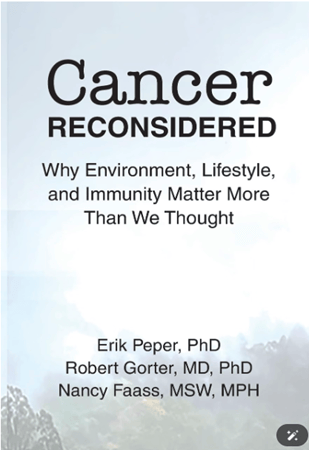
For a deeper exploration that includes and goes beyond environmental factors, read Cancer Reconsidered: Why Environment, Lifestyle, and Immunity Matter More Than We Thought (Peper et al., 2026). This essential book brings together the science of environmental exposure, immunity, lifestyle, and cancer—and translates it into practical strategies you can use to make more informed, protective choices for yourself and your family.
Where you live can shape your exposures
The idea that our environment can affect cancer risk is not new. In 1775, English surgeon Percivall Pott described an unusually high rate of scrotal cancer among young chimney sweeps. He associated the disease with soot that collected in the folds of the workers’ skin and contained carcinogenic substances (Benmoussa et al., 2019). Environmental exposure is not limited to the jobs people do. It can also depend on where people live, work, attend school, and spend time—sometimes without their knowledge or consent. For example, communities located near nuclear-weapons testing or nuclear-waste sites have reported increased rates of certain cancers and other illnesses (Gilbert et al., 2010; Lee, 2024; Brownstein, 2025; Leung et al., 2025).
Become a health detective and reduce avoidable exposures
Investigate the hidden dangers beneath your feet
History serves as a sobering reminder of the consequences of ignoring land use. Consider the Love Canal disaster in Niagara Falls, New York. A residential community and school were constructed directly atop a former industrial chemical waste dump. The subsequent, toxic migration of chemicals through the soil and groundwater led to severe health crises for residents, including increased rates of cancer, reproductive issues, and other chronic illnesses (New York State Department of Health, 1978). Research the history of land use where you live and work and where your children attend school to protect your long-term health and ask:
- Was the land previously used for industry, waste disposal, mining, or intensive agriculture?
- Are there publicly available environmental or health assessments?
- Have local agencies issued advisories about soil, air, or water contamination?
- Have many neighbors reported health issues?
What to do: If evidence indicates serious contamination, consult local environmental-health authorities and qualified professionals about testing, remediation, or relocation. Relocation may be a difficult but wise solution to avoid long term harm to you and your family.
Check your water supply
Water can be compromised by a host of contaminants, including bacteria, parasites, industrial chemicals, and lead leaching from aging infrastructure.
A stark reminder of this vulnerability was the Flint, Michigan, water crisis (2014–2015), where a failure to properly treat the water supply resulted in severe lead exposure for over 140,000 residents (Ruchart et al., 2019). This is particularly devastating for children, as lead is a potent neurotoxin capable of causing irreversible damage to developing brains and nervous systems, leading to long-term cognitive, behavioral, and developmental challenges (Naranjo et al., 2020)
Beyond lead, modern contaminants like PFAS (per- and polyfluoroalkyl substances) also known as the “forever chemicals” are detected in more than 45% of United State tap water (Smalling et al., 2023). Take proactive steps: check the latest water quality reports from your provider or local health agency.
What to do:
- Have your water tested by a certified laboratory if you rely on private wells or surface water.
- Use a filter that is certified for the specific contaminant you want to reduce. Different technologies remove different substances; no single filter removes everything. Follow the manufacturer’s replacement schedule. If appropriate, consider filtration for shower water as well as drinking and cooking water.
Prevent workplace contaminants from entering the home
Lead, asbestos, pesticides, dust, sawdust, fibers, and other substances can be transported from a worksite on clothing, shoes, tools, skin, or hair. This remains a significant public health risk. A notable example involved the Water Gremlin Company in Minnesota, where between 2018 and 2019, at least 12 children were diagnosed with lead poisoning linked to lead dust brought home on the clothing and skin of their parents, who were employed at the facility (Ceballos et al., 2022).
What to do:
- Change out of contaminated work clothing before entering common living areas.
- Keep work shoes and equipment outside the main living space when possible.
- Wash your hands and, when appropriate, shower before close contact with children or other household members.
- Never handle asbestos or other hazardous materials without appropriate training and protective controls.
Reduce unnecessary plastic contact with food
Storing or heating food in plastic containers may increase the transfer of certain plastic additives into food such as phthalates and bisphenols (like BPA) that are endocrine-disrupting chemicals. Research suggests that chronic exposure to these substances through diet interfere with hormonal systems, potentially leading developmental issues, reproductive dysfunction, and metabolic changes (National Institute of Environmental Health Sciences. 2026).
What to do:
- Store and reheat food in glass, ceramic, or stainless-steel containers when practical.
- Avoid using nonstick frying pans.
- Replace damaged, cloudy, or heavily scratched food containers.
Reduce pesticide exposure while maintaining a balanced diet
Pesticide residues are found in most conventionally grown foods, although the presence of a residue does not automatically mean that a food is dangerous; since, the risk depends on the substance and the amount of exposure. Even if the risk is very low, human beings are accumulators and over time it may reach harmful levels. The 2026 Shopper’s Guide to Pesticides in Produce indicated that nearly 75 percent of non-organic fresh produce sold in the U.S. contained detectable residues of potentially harmful pesticides (Environmental Working Group, 2026). This report provides list of twelve foods that are most contaminated with pesticides (The Dirty Dozen) and 15 foods with the lowest amount of pesticide residues (The Clean Fifteen).
Although the US government agencies like the EPA set permissible residue levels to ensure safety, these levels may be harmful over the long time. They are often much higher than allowed in European Union. For example, the U.S. allows up to 30 mg/kg (ppm) of glyphosate on certain foods, including some cereal grains, whereas the EU allows only 0.05 mg/kg, In addition, some pesticides, such as atrazine which can interfere with the endocrine system and effect fertility and fetus development, are not approved for use in the EU but are permitted in the United States (European Food Safety Authority, 2019; Donley, 2019).
What to do:
- Eat a varied diet rich in organic (if possible) vegetables, fruits, legumes, whole grains, nuts, and other minimally processed foods.
- Wash produce under running water; do not use household soap or detergent.
- Choose organic foods when affordable and practical, especially if doing so helps you eat more fruits and vegetables.
- Reduce ultraprocessed foods high in added sugars, sodium, and refined starches.
Actionable self-audit checklist
Use this checklist to observe your environment and identify realistic next steps.
| Area | Quick audit action | Potential health benefit |
| Air | Use appropriate ventilation and consider a HEPA filter in sleeping areas, particularly when indoor pollution or wildfire smoke is a concern. | May reduce exposure to fine particles and improve indoor air quality. |
| Water | Review your annual water-quality report; test private wells and use certified filtration when indicated. | May reduce exposure to identified contaminants. |
| Kitchen | Use glass, ceramic, stainless steel, or well-maintained cookware for food storage and preparation. | May reduce unnecessary contact with certain plastic additives and overheated coatings. |
| Food | Eat a varied diet centered on minimally processed foods; wash produce and choose organic options when practical. | Supports overall nutrition while potentially reducing some pesticide exposures. |
Are corporations a new disease vector?
Environmental disasters often reveal failures in corporate accountability, public oversight, and timely regulation. Tracy Woodruff, Ph.D., director of the University of California, San Francisco’s Center for Environmental and Corporate Harm, has described corporations as potential drivers of disease risk, particularly when commercial incentives conflict with public health (Lawton, 2025a).
These conflicts may contribute to the suppression or selective presentation of research, delayed regulation, aggressive lobbying, or inadequate disclosure of risks. Similar concerns have been raised in relation to the tobacco industry, hazardous chemicals, industrial waste, and the marketing of highly processed foods.
Individual choices matter, but they are not enough by themselves. Our health depends as much on government policy as on personal willpower (Lawton, 2025b). Government regulations set safety standards for the air we breathe, the food we eat, and the water we drink. They define what levels of toxins are “acceptable” and determine how corporations must act and what they must disclose .– Devi Sridhar, DPhil, Professor, University of Edinburgh
Sadly, federal government regulations are usually years behind and presently they are being dismantled and thereby putting more people at risk. Smoking illustrates this interaction. Smoking rates declined substantially after governments combined public education with restrictions on smoking in public places, limits on youth access, higher tobacco taxes, and other tobacco-control measures. These policies, mainly developed and implemented at the local state level, were important contributors to reduced smoking prevalence and, over time, declining tobacco-related disease and mortality.
An integrative perspective
For an integrative perspective on environmental exposures, lifestyle, immunity, and cancer and what you can do about it, see the book: Cancer Reconsidered: Why Environment, Lifestyle, and Immunity Matter More Than We Thought.
The book presents a framework for considering how daily behavior, environmental conditions, and mind–body processes may influence health and recovery. Its practical value is strongest when its recommendations complement—not replace—evidence-based screening, diagnosis, and medical treatment. By observing your environment, making manageable changes, and developing self-regulatory skills, you can take a more active role in your health while working with qualified healthcare professionals.
Available in paperback or economical ebook from; https://www.amazon.com/Cancer-Reconsidered-Environment-Lifestyle-Immunity/dp/1587907402/
Additional relevant blogs
References
Benmoussa, N., Rebibo, J.D., Conan, P., & Charlier, P. (2019). Chimney sweeps cancer: Early proof of environmentally driven tumorigenicity. The Lancet Oncology, 20(3), 338. https://doi.org/10.1016/S1470-2045(19)30106-8
Brownstein, M. (2025, July 23). Living near St. Louis-area Coldwater Creek during childhood linked with higher risk of cancer from radiation. Harvard T. H. Chan School of Public Health. Retrieved July 23, 2025, from https://hsph.harvard.edu/news/living-near-st-louis-area-coldwater-creek-during-childhood-linked-with-higher-risk-of-cancer-from-radiation/
Ceballos, D. M., Spierling, E., Yáñez, N. D., & Calafat, A. M. (2022). A response to take-home lead exposure in a Minnesota manufacturing facility. American Journal of Public Health, 112(12), 1779–1786. https://doi.org/10.2105/AJPH.2022.306982
Donley, N. (2019). The USA lags behind other agricultural nations in banning harmful pesticides. Environmental Health, 18(1), Article 44. https://doi.org/10.1186/s12940-019-0488-0Gilbert, E. S., Huang, L., Bouville, A., Berg, C. D., & Ron, E. (2010). Thyroid cancer rates and 131I doses from Nevada atmospheric nuclear bomb tests: An update. Radiation Research, 173(5), 659–664. https://doi.org/10.1667/RR2057.1
Environmental Working Group (2026). EWG’s Shopper’s Guide to Pesticides in Produce. Accessed September 18, 2026. https://www.ewg.org/foodnews/summary.php
European Food Safety Authority. (2019). Review of the existing maximum residue levels for glyphosate according to Article 12 of Regulation (EC) No 396/2005: Revised version to take into account omitted data. EFSA Journal, 17(10), Article e05862. https://doi.org/10.2903/j.efsa.2019.5862Lawton, G. (2025a). Corporations are the new disease vector. New Scientist, 266(3546), 36–39. https://www.newscientist.com/article/2481125-do-corporations-actually-have-more-control-over-your-health-than-you/
Gilbert, E. S., Huang, L., Bouville, A., Berg, C. D., & Ron, E. (2010). Thyroid cancer rates and 131I doses from Nevada atmospheric nuclear bomb tests: An update. Radiation Research, 173(5), 659–664. https://doi.org/10.1667/RR2057.1
Lawton, G. (2025a). Corporations are the new disease vector. New Scientist, 266(3546), 36–39. https://www.newscientist.com/article/2481125-do-corporations-actually-have-more-control-over-your-health-than-you/
Lawton, G. (2025b). The idea that individuals are fully responsible for their health doesn’t reflect the realities of people’s lives. New Scientist, 266(3550), 38–41. https://www.newscientist.com/article/2485021-youve-been-sold-agiant-myth-when-it-comes-to-improving-your-health/
Lee, S. (2024, July 20). Congresswoman Lee calls for extension and expansion of Radiation Exposure Compensation Act for suffering Nevadans. Congresswoman Susie Lee [Press release]. Retrieved July 20, 2025, from https://susielee.house.gov/media/press-eleases/congresswoman-lee-calls-extension-and-expansion-radiation-exposure
Leung, M., Tang, I. W., Lin, J. J. Y., et al. (2025). Cancer incidence and childhood residence near the Coldwater Creek radioactive waste site. JAMA Network Open, 8(7), e2521926. https://doi.org/10.1001/jamanetworkopen.2025.21926
Miller, F. W. (2023). The increasing prevalence of autoimmunity and autoimmune diseases: An urgent call to action for improved understanding, diagnosis, treatment, and prevention. Current Opinion in Immunology, 80, Article 102266. https://doi.org/10.1016/j.coi.2022.102266
Naranjo, V. I., Hendricks, M., & Jones, K. S. (2020). Lead toxicity in children: An unremitting public health problem. Pediatric Neurology, 113, 51–55. https://doi.org/10.1016/j.pediatrneurol.2020.08.005
National Cancer Institute. (2025, May 14). As rates of some cancers increase in younger people, researchers search for answers. U.S. Department of Health and Human Services, National Institutes of Health. https://www.cancer.gov/news-events/cancer-currents-blog/2025/early-onset-cancer-research-environment-genetics-support
National Institute of Environmental Health Sciences. (2026.). Endocrine disruptors. Accessed September 18, 2026. https://www.niehs.nih.gov/health/topics/agents/endocrine
New York State Department of Health. (1978, September). Love Canal—Public health time bomb: A special report to the governor and legislature. https://www.health.ny.gov/environmental/investigations/love_canal/docs/lctimbmb.pdf
Peper, E. Gorter, R. & Faass, N. (2026). Cancer Reconsidered: Why Environment, Lifestyle, and Immunity Matter More Than We Thought. BiofeedbackHealth/Regent Press. https://www.amazon.com/Cancer-Reconsidered-Environment-Lifestyle-Immunity/dp/1587907402/
Ruckart, P. Z., Ettinger, A. S., Hanna-Attisha, M., Jones, N., Davis, S. I., & Breysse, P. N. (2019). The Flint water crisis: A coordinated public health emergency response and recovery initiative. Journal of Public Health Management and Practice, 25(Suppl. 1), S84–S90. https://doi.org/10.1097/PHH.0000000000000871
Smalling, K. L., Romanok, K. M., Bradley, P. M., Morriss, M. C., Gray, J. L., Kanagy, L. K., Gordon, S. E., Williams, B. M., Breitmeyer, S. E., Jones, D. K., DeCicco, L. A., Eagles-Smith, C. A., & Wagner, T. (2023). Per- and polyfluoroalkyl substances (PFAS) in United States tap water: Comparison of underserved private-well and public-supply exposures and associated health implications. Environment International, 178, Article 108033. https://doi.org/10.1016/j.envint.2023.108033
Being safe means more than being physically and emotionally protected. It is the trust that, whatever happens, you can cope with it.
Posted: September 14, 2026 Filed under: attention, behavior, biofeedback, cognitive behavior therapy, emotions, healing, health, meditation, Pain/discomfort, relaxation, self-healing, stress management, Uncategorized, zoom fatigue | Tags: hope, resilience, safety, trust Leave a comment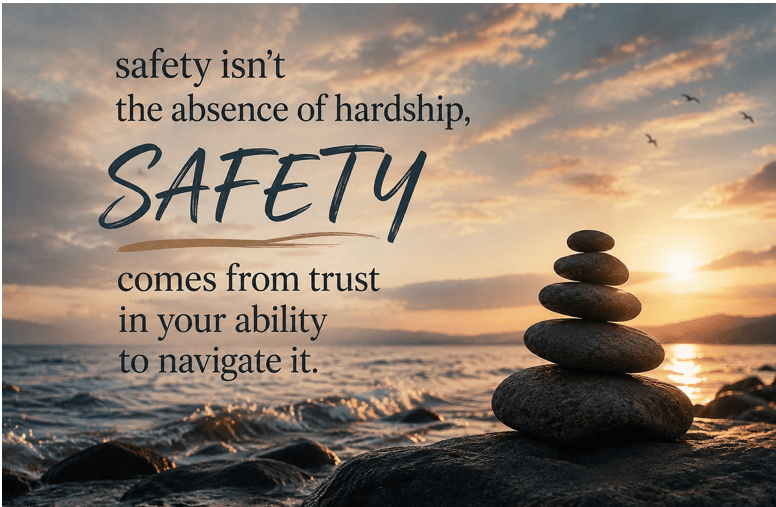
From: Pulde, A, & Lederman, M. (2026). The safest man I met had every reason not to feel safe.. https://connectiondocs.substack.com/p/the-safest-man-i-met-had-every-reason
Self-regulation is the cornerstone of biofeedback and neurofeedback and a potent tool for reducing symptoms and enhancing both health and performance. Early in my work, I hypothesized that if a participant, whether a student or client, simply mastered their self-regulation skills, they would generalize these practices into their daily lives, thereby improving their well-being. While this often leads to success, I have come to recognize that the true power of these interventions lies in the synergy between physiological techniques and psychological states.
When a person learns to master relaxation and slow, diaphragmatic breathing while intentionally adopting a state of “being in the present” that is free from the constraints of expectation and the noise of rumination, they facilitate a biological environment conducive to healing. This is because healing and regeneration are most effective when the autonomic nervous system is shifted away from the stress response (Levy et al., 2013; Budhiraja et al., 2024).
My perspective on these mechanisms was significantly expanded through the observation of a yogi and Sufi practitioners who voluntarily engaged in what would objectively be considered deliberate harm to the body, such as the insertion of skewers, without reporting pain or discomfort (Kakigi et al., 2005; Peper et al., 2005a; Peper et al., 2006–; Fuhs & Peper, 2005). Witnessing this, demonstrated that beyond breathing and relaxation, a critical ingredient is the profound “knowing” that one is safe and no harm will occur. Feeling safe is the first step in the healing process (Peper et al., 2025).
In those Sufi piercings, total trust and visceral sense of safety were anchored by the permission and blessing of their Sheikh (their spiritual guide). This dynamic illustrates that implicit and explicit trust, combined with a conviction of safety, is likely a fundamental quality underpinning the placebo effect: the embodied belief that a procedure will lead to healing .
Often, this quality is highly state-dependent, constrained to the specific setting where the safety is perceived (for the Sufis it was the permission and blessing by their Sheik). The challenge is to generalize this feeling of safety beyond the specific setting and therapeutic room. To transcend situational anxiety or future-oriented worry, one must cultivate a foundational belief that whatever unfolds is acceptable, and that the person possess the internal resources and skills to cope with it. When one truly adopts and experience this perspective, the stressors of life can be met with resilience rather than reactivity.
This process has been exquisitely described by Drs Alona Pulde and Matthew Lederman in their inspirational substack blog, The Safest Man I Met Had Every Reason Not to Feel Safe (Pulde & Ledereman, 2026). Their blog is reproduced with their permission from, https://connectiondocs.substack.com/p/the-safest-man-i-met-had-every-reason?r=4scjd0&utm_medium=ios
The Safest Man I Met Had Every Reason Not to Feel Safe
Dr. Alona Pulde and Dr. Matthew Lederman
What a chance encounter at an LAX rental car counter taught me about the difference between trying to control what happens and trusting myself to meet whatever does.
Sep 08, 2026
It was late when I pulled into the rental car return at LAX, probably 10 or 11 at night. I was tired, ready to be done with the day, and there was some kind of problem with my return. The woman helping me clicked around on her computer for a while before finally looking up and calling over to someone nearby.
“Hey, Moose. Can you help this man? I can’t figure out what’s going on with his return.”
I looked over and saw this massive man walking toward me. Not heavy, just big. Tall, broad, the kind of person who has a commanding presence without needing to do anything to command it. But what I noticed almost immediately was his smile. There was something warm about him, something easy.
As he started working on my problem, I asked, “Is your name really Moose?”
He laughed and told me his actual name, which seemed to contain about sixteen more syllables than I was prepared for.
“My friends just call me Moose,” he said.
I smiled. “I’m going to call you Moose, too.”
I asked where his name came from, and he told me he was from a country in Africa. I didn’t recognize the name of the place. I sort of laughed and said, “Maybe I should visit. I’ve always wanted to go to Africa.”
His expression changed.
“No. Never go there.”
I wasn’t expecting that.
“Why not?”
He told me it was dangerous. Then, standing there at a rental car counter at LAX, while he was trying to figure out whatever was wrong with my paperwork, this man began telling me his story.
When he was a child, he said, he was kidnapped from his family and forced into labor connected to the conflict diamond trade. Eventually he was rescued and placed in an orphanage. Then the orphanage was bombed and destroyed.
There was more, one impossible thing after another.
I remember looking at him as he told me all of this and thinking about the person standing in front of me. He wasn’t telling the story with bitterness. He wasn’t collapsed under the weight of it. He still had that enormous smile.
Finally, I asked him the question that had been forming in my mind.
“How are you still smiling?”
His answer has stayed with me.
He told me, essentially, that after everything he had lived through, he wasn’t very afraid of what life could throw at him anymore. He had already been through things most of us couldn’t imagine. And he had made it through them.
He trusted himself.
Whatever happened next, he believed he would find a way through that, too.
I stood there listening to him and realized he was describing something I have spent a lot of time trying to find in myself.
Safety.
I think about safety a lot. I notice what happens inside me when I feel safe and what happens when I don’t. When I feel safe, connection comes more easily. I listen better, I’m more present. My body feels different. When fear takes over, everything starts to narrow. I can feel myself wanting to manage, anticipate, fix, prepare.
And like a lot of people, one of the ways I have tried to create safety is through control.
If I can know what’s coming, I can prepare for it. If I can anticipate what might go wrong, maybe I can prevent it. If I make the right decisions, say the right thing, watch closely enough, think far enough ahead, maybe I can keep the people I love from getting hurt.
I feel this especially as a father.
There is a part of me that wants to make sure nothing bad happens to my kids. Of course there is. I love them. I want to protect them. I want to see the danger before they see it. I want to know that they’ll be okay.
But there is something exhausting about trying to get safety that way. Because life refuses to make that promise. There is always another thing I haven’t considered. Another possibility. Another what if. Another way something could go wrong.
I’m beginning to wonder whether some of what I’ve called my pursuit of safety has actually been a pursuit of certainty. And certainty is a brutal thing to require from life.
Because if safety depends on certainty, the conditions for relaxing are almost impossible to meet. If everything goes according to plan, I can relax. If everyone I love is okay, I can relax. If I know what is going to happen next, I can relax.
Except life never signs that contract.
And here was Moose. A man whose life had given him almost none of the certainty I keep trying to create.
Terrible things had happened to him. Things he couldn’t predict or control or prevent. Yet somehow the evidence of his survival had become stronger than his fear of what might happen next.
I don’t want to romanticize that. What happened to him was horrific. Trauma doesn’t automatically make people stronger, and suffering isn’t something we need to be grateful for. But there was something in the way he had made meaning of his own survival that I couldn’t stop thinking about.
He didn’t seem to feel safe because he believed the world was safe. He clearly knew it wasn’t.
He seemed to feel safe because he trusted himself to meet the world as it was.
That turned something upside down for me.
Maybe safety isn’t knowing that nothing bad is going to happen. Maybe safety is knowing that if something does, I won’t abandon myself in it.
I’ll hurt. I’ll grieve. I’ll get scared. I might be overwhelmed for a while. I might need help. Trusting myself doesn’t mean believing I’ll handle everything gracefully. Maybe it means trusting that even when I don’t handle something gracefully, I can still find my way back.
That feels different from control.
Control says, “I need life to go a certain way so I can be okay.”
Trust says, “I don’t know how life is going to go, but I believe I can meet it.”
As Moose and I were talking, another manager called out sick. Moose had told me earlier that he was at the end of his eight-hour shift. Now someone needed to cover another eight hours overnight.
I watched him hear the news.
There was no visible outrage. No “You’ve got to be kidding me.” No sense that the night had suddenly become something that shouldn’t be happening to him.
He smiled.
Basically: Okay. I guess I’m working tonight.
He even seemed determined to enjoy it.
And I remember thinking, He’s doing it right in front of me.
This wasn’t a philosophy he had developed for an inspirational quote. It was how he was moving through his life. Something happened that he hadn’t planned. He adjusted. Life changed. He moved with it.
And somehow, because he wasn’t spending all of his energy demanding that the moment be different, he was still there to experience the moment he actually had.
I’ve thought about that a lot since. Because when safety depends on control, we don’t only suffer when things are bad. Sometimes we have trouble fully enjoying when things are good.
Things are going well and some part of the mind starts whispering, How long is this going to last? Someone you love is happy, and you imagine what could happen to them. Life feels good, and instead of settling into the goodness, you start preparing for its disappearance.
And maybe that is one of the hidden costs of trying to protect ourselves from the future: we make the present pay for something that hasn’t happened yet.
Maybe trust gives us another option.
Maybe I don’t have to use the good times to prepare myself for the bad ones. Maybe I can actually be here. Because when the hard thing comes, I can meet it then.
I still want to protect my kids. I still want to make good decisions. I still want to anticipate real risks and take care of the people I love. Trust isn’t passivity, and it isn’t pretending bad things don’t happen.
Maybe it’s simply loosening my grip on the belief that I need to prevent every painful thing in order for us to be okay.
And maybe there is something else I want my kids to learn from me. Not only that I will try to protect them from hard things, but that I believe in their ability to meet hard things too.
Because perhaps one of the greatest forms of safety we can give the people we love isn’t the promise that nothing will happen to them. It’s helping them discover, If something does, I won’t be alone. And I can find my way through.
There is a strange kind of freedom in that.
I don’t need every person I love to be okay every second in order to experience this second. I don’t need life to promise me that nothing painful is coming.
Maybe safety isn’t a promise life makes to me at all.
Maybe it’s a relationship I’m building with myself.
Eventually, whatever problem I’d had with the rental car got resolved. I barely remember what it was now. I do remember shaking Moose’s hand. I told him there was something about him I found incredibly inspiring. I told him I felt drawn to his energy and his way of looking at life. I wished him well.
And then I laughed and told him that I don’t get inspired all that often, and I definitely hadn’t expected it to happen while returning a rental car at LAX late at night.
I walked away thinking about this man who had experienced so many reasons not to trust life, yet somehow had developed an extraordinary trust in himself.
I’m still working on that. I still catch myself reaching for certainty. I still try to think far enough ahead that I can protect myself and the people I love from whatever might be coming.
But now, sometimes, I think about Moose.
And I wonder if the question isn’t, How do I make sure nothing bad happens?
Maybe it’s, Can I trust myself even when I don’t know what happens next?
The article was reproduced with permission from the blog by Dr. Alona & Dr. Matt’s Substack which is a reader-supported publication. To receive new posts and support our work, consider becoming a free or paid subscriber. https://connectiondocs.substack.com/p/the-safest-man-i-met-had-every-reason?r=4scjd0&utm_medium=ios
References
Budhiraja, A., Mehta, A., Alhamo, M. A., Swedarsky, R., Dahle, S., & Isseroff, R. R. (2024). Vagus nerve stimulation: Potential for treating chronic wounds. Wound Repair and Regeneration, 32(1), 108–117. https://doi.org/10.1111/wrr.13151
Fuhs, M., & Peper, E. (2005). The limits of your beliefs are the limits of your reality. Psychophysiology Today, 2(1), 9–13. https://www.researchgate.net/publication/414300494_Limits_of_your_belief
Kakigi, R., Nakata, H., Inui, K., Hiroe, N., Nagata, O., Honda, M., Tanaka, S., Sadato, N., & Kawakami, M. (2005). Intracerebral pain processing in a yoga master who claims not to feel pain during meditation. European Journal of Pain, 9(5), 581–589. https://doi.org/10.1016/j.ejpain.2004.12.006
Levy, G., Fishman, J. E., Xu, D., Chandler, B. T. J., Feketova, E., Dong, W., Qin, Y., Alli, V., Ulloa, L., & Deitch, E. A. (2013). Parasympathetic stimulation via the vagus nerve prevents systemic organ dysfunction by abrogating gut injury and lymph toxicity in trauma and hemorrhagic shock. Shock, 39(1), 39–44. https://doi.org/10.1097/shk.0b013e31827b450d
Peper, E. (2015). Pain as a contextual experience. Townsend Letter, 388, 63–66.
Peper, E., Booiman, A. & Harvey, R. (2025). Pain-There is Hope. Biofeedback, 53(1), 1-9. http://doi.org/10.5298/1081-5937-53.01.16
Peper, E., Gibney, K. H., & Wilson, V. E. (2005a). Enhancing therapeutic success — Some observations from Mr. Kawakami: Yogi, teacher, mentor and healer. Somatics, 14(4), 18–21. https://biofeedbackhealth.org/wp-content/uploads/2011/01/edited-enhancing-therapeutic-success-8-23-05.pdf
Peper, E., Wilson, V. E., Gunkelman, J., Kawakami, M., Sata, M., Barton, W., & Johnston, J. (2006). Tongue piercing by a Yogi: QEEG observations. Applied Psychophysiology and Biofeedback, 31(4), 331–338. https://doi.org/10.1007/s10484-006-9025-3
Pulde, A. & Lederman, M. (2026). The safest man I met had every reason not to feel safe. Connection Docs. https://connectiondocs.substack.com/p/the-safest-man-i-met-had-every-reason