Free resources: Your Healing Journey and Information on Complementary and Alternative Medicine
Posted: October 8, 2013 Filed under: Uncategorized | Tags: CAM, complementary medicine, healing, Holistic health 7 CommentsThe old song, The hipbone is connected to the thigh bone, expresses that we are part of a system in which every part is affected and affects every other part. This system includes the physical, mental, emotional, social, environment and spiritual factors (see figure 1).

Figure 1. The healing environment–we are all interconnected. From: Optimal Healing Environment, Samueli Institute, 2013 (http://www.samueliinstitute.org/health-policy/your-healing-journey).
Not only are we an integrated system, we also need to feel SAFE in order to heal and grow. Without feeling safe, we are on guard–a state that inhibits our self-healing potential. It is no wonder that sometimes people are dissatisfied with traditional medical care and visit holistic health/complementary and alternative health care providers. These professionals often take more time to listen, touch you, and make you feel SAFE.
It can be challenging to make sense out of the overwhelming barrage of information available on the web. How do you know what is appropriate, what is healing strategy , or even what is a holistic perspective?
To put healing in context and to offer a frame work for what is useful, the recent free book and videos by the Samueli Institute and the information on National Center for Complementary and Alternative Medicine (NCCAM)’s website are very useful (http://nccam.nih.gov).
Samueli Institute publications
The free book Optimal Healing Environments: Your Healing Journey and video resources were developed by the Samueli Institute in collaboration with the Clinton Foundation’s Health Matters Initiative. It is a personal resource for understanding the role of Optimal Healing Environments in your personal and professional quest for health and well-being.. Go to their website and down load the free book and videos (http://www.samueliinstitute.org/health-policy/your-healing-journey).

National Center for Complementary and Alternative Medicine (NCCAM)
The National Center for Complementary and Alternative Medicine (NCCAM) is the Federal Government’s lead agency for scientific research on complementary and alternative medicine (CAM). The mission of NCCAM is to define, through rigorous scientific investigation, the usefulness and safety of complementary and alternative medicine interventions and their roles in improving health and health care. One of the best sources for evidence based medicine on CAM that can be used to help decision making.
The NCCAM website offers free resources and comprehensive video lectures about research in complementary health approaches that provide an in-depth perspective on the current state of science, as related to complementary medicine. Topics range from mind-body pain therapies to acupuncture. Watch these online video lectures from the National Institutes of Health (NIH) Complementary and Alternative Medicine Online Continuing Education Series (http://nccam.nih.gov/training/videolectures).

Cancer: A modern scourge or the cost of being a multi-cell organism?
Posted: September 27, 2013 Filed under: cancer, Uncategorized | Tags: cancer, evolution, Immune function 1 CommentAlthough I knew intellectually that cancer was not a new disease since it had been described in early medical texts, I always thought that it was more a scourge of recent times. The tweets, the news reports, the innumerable stories of new cancer treatments promoted on the web, the ongoing recommendations for specific foods, vitamin supplements, and lifestyle recommendations to prevent cancer, and the heart wrenching stories of celebrities telling their personal cancer saga, all suggested that cancer rates are increasing and definitely a modern disease.
It is difficult to make sense out of this maelstrom of pessimistic and optimist news about the war on cancer. Yet, if one can take a broader perspective, cancer is not the number one killer–that honor belongs to heart disease. And, although breast cancer is terrifying, many more women die of heart disease than breast cancer (Jemal, et al, 2008).
Most likely, cancer has been with us since we evolved from a single cell—it may express the fundamental life force of a cell when it becomes threatened or is no longer subservient and supportive for the maintenance of its community of cells. It is humbling to realize that cancer transcends our human history. It has even been found in dinosaur bones. If it was in the bones, then other cancers probably also occurred in the dinosaur’s soft tissue. It is equally humbling to recognize that although environmental and dietary factors can affect carcinogenesis, in most cases the data is much less clear. So often one study finds a beneficial effect and then a few years later another study reports the opposite finding. Yes, some behaviors are generally harmful-smoking increases the risk of lung cancer significantly although most smokers do not die of lung cancer. And, most likely the major significant factor in the recent decrease in breast cancer death rate is that women are smoking less and stopped using hormone replacement therapy.
One thing is clear, cancer is part of our human biology and it has occurred since multi-cellular organisms (e.g., morula) evolved to deal with cellular stress (Boaz, 2002). To grasp the biological complexity, the confusion that exists and appreciate how to perceive different perspectives, I strong recommend reading the remarkable book, The Cancer Chronicles: Unlocking Medicine’s Deepest Mystery, by the award winning science writer George Johnson. (Johnson, 2013).
References:
Boaz, N.T. (2002). Evolving Health: The origins of illness and how the modern world is making us sick. New York: John Wiley & Sons.
Jemal, A., Siegel, R., Ward, E., Hao, Y., Xu, J., Murray, T. and Thun, M. J. (2008), Cancer Statistics, 2008. CA: A Cancer Journal for Clinicians, 58: 71–96. doi: 10.3322/CA.2007.0010 http://onlinelibrary.wiley.com/doi/10.3322/CA.2007.0010/full
Johnson, G. (2013). The Cancer Chronicles: Unlocking Medicine’s Deepest Mystery. New York: Alfred A. Knopf. http://talaya.net/chronicles/
Make your voice heard! Contact your legislators how they should vote on possible Syrian Intervention.
Posted: September 2, 2013 Filed under: Uncategorized | Tags: Community Health, Politics 2 CommentsOptimum health implies living a healthy life style and being an active participant in the community. In the next week, the US will make a decision whether or not to initiate some form of military action in Syria. Whatever the US will or will not do may have significant long term unexpected consequences. Enhance your community health by participating in shaping your legislators’ decision making process. By actively participating and encouraging others to participate, we increase our social connectedness. In taking action, we become empowered and reduce helplessness which improves immune function.
The Syrian conflict is tragic and the use of chemical weapons horrible; however, how the USA and other countries can resolve this horror is not as clear. President Obama has stated that he wants to initiate some form of military action (most likely a cruise missile attack) to show that the use weapons of mass destruction is unacceptable. What is not clear are the consequence of such military intervention.
Personally, I am strongly opposed to military intervention especially when the endgame is not clear. On the other hand, I strongly support giving add to the millions of refugees.
Congress will decide around September 9th whether to support or not support President Obama’s call for military action (an act of war). Congress’ outcome will be influenced by the views expressed by the public. Be an active participant and let your voice be heard whether you are for or against military action.
Make your voice heard! Contact the President, Vice-President, your two Senators and your Representative. This decision should not be left to a few people in power. Remember NOT participating is still participating.
Below are the email contacts for the President, Vice President, California Senators and the websites to find your senators or representative.
President Barack Obama http://www.whitehouse.gov/contact/submit-questions-and-comments
Vice-President Joe Biden http://www.whitehouse.gov/contact-vp
California Senators:
Senator Barbara Boxer http://www.boxer.senate.gov/en/contact/policycomments.cfm
Senator Dianne Feinstein https://www.feinstein.senate.gov/public/index.cfm/e-mail-me
Websites find your senator or representative:
Representative: http://www.house.gov/representatives/
Senator: http://www.senate.gov/general/contact_information/senators_cfm.cfm
Keep mobile phones, tablets or laptops away from your body: Wireless devices may cause harm
Posted: April 27, 2013 Filed under: Uncategorized | Tags: brain cancer, cancer, cell phones, microwaves, wireless 75 CommentsDid you ever notice the heat of your mobile phone against your ear?
Did you ever feel the warmth of the laptop against your stomach and thighs?
While recording muscle tension, we sometimes observe a signal that is NOT the actual muscle contracting. It is an electrical signal that is recorded with sensors at the location of the body but not produced by the muscles. In some cases, this artifact is caused by the client’s mobile phone or other wireless device being activated even though the ringer function was set to off. Below is an example of an artifact signal that can be hundreds of times larger than the biological muscle (electromyography) or brainwave (electroencephalography) signal as shown in Figure 1.

Figure 1. Surface electromyography recording showing the effect of cell phone located 1 cm (0.4 inches) away from the electrodes (from: Lin, I.M. & Peper, E.,2009).
The artifact was caused by the microwaves radiating from the cell phone antenna as it communicated to the by cell phone tower. As long as the cell phone and the wireless devices are being used for talking, texting, streaming data, or audio and visual media, they are communicating with the tower. Most cell phones, as long as they can receive calls, also connect every 900 milliseconds to the tower to report its location. To prevent artifacts in electromyographic and electroencephalographic recording, request clients to turn off their mobile phone or switch it to airplane mode.
When we initially observed this artifact produced by the mobile phone antenna signal, we wondered if this could be a health risk. I was further persuaded after reading epidemiologist, Devra Davis, Ph.D superb book, Disconnect- The Truth about cell phone radiation, What the industry is doing to hide it, and How to protect your family. For more information see her website Environmental Health Trust (http://ehtrust.org/).
Although being exposed by microwave radiation at 1 watt of power output while talking is not the same as being blasted for two minutes by 1000 watts necessary to bring a cup of water to boil in a microwave, most of us experience ongoing exposure for many minutes per day. We are now connected 24/7- anywhere we go-from coffee shop to the bedroom. We tend to keep cell phones and other wireless devices on our person. Men often stash it in their pant pockets and woman sometimes in their bra. Yes, you can even buy a bra with a built in cell phone pocket.
We use smartphones and tablets as a communication device for texting, talking, updating our social networks, searching the web, and as an alarm clock next to our head while sleeping (we do not want to disturb our roommate or partner). Smart phones and tablets have become omnipresent in our world. They are used in classes, while waiting for appointments (the stack of dated magazines have become irrelevant), and are the last thing we check before going to sleep. Soon these devices will be so small that they will be inserted in our ear, under our skin, or embedded in our glasses — truly connected at all times.
In our 2012 survey, university students used mobile phones and tablets/i-Pads for at least 118 minutes a day, of which 40 minutes occurred just before going to sleep. This meant that they spent 19.7 days a year texting/talking on their smartphones (Waderick et al, 2013) as shown in figure 2. 
Figure 2. Minutes of smart phone and tablet used by students and the percentage of disturbed sleep and hours of sleep (from: Waderich, K., Peper, E., Harvey, R., & Sutter, S., 2013).
In less than 20 years, we can no longer imagine a life without these wireless devices and go into a panic when they are missing. We have accepted the new technology and assumed that it is safe. Yet, could this be similar to the early cigarette debates in the tobacco industry? Most of the published studies claimed that cigarettes did not harm people and had nothing to do with cancer. We now know better. One cigarette probably does no harm; however, smoking many cigarettes over numerous years does cause harm.
When radar was initially developed in World War II, some sailors on ships in the North Atlantic Ocean warmed themselves by momentarily standing in front of the radar beam. While they did get warmer, they also became sterile for a period of time since heating the testicles with radar reduced sperm production. Could a similar effect occur by the heat and microwaves emitted from a laptop, tablet, or cell phone against the abdomen or lap?
Research findings over the last twenty years have often been ambiguous, although indicating that there is a risk (Davis, 2010). It is unlikely that the telecommunication industry will support research into possible dangers since it would put them at financial risk. Instead, the telecommunication industry lobbies to oppose laws that would require right to know labeling of cell phones with disclosure of possible risks or antenna output power. A more neutral perspective is reported by the International Agency for Research into Cancer (IARC), which is part of the World Health Organization World Health Organization (WHO). As of 2011, the WHO has classified mobile phones (and any wireless device that uses microwaves to communicate) as a group2b risk, which means that they are “possibly carcinogenic to humans” and there is “limited evidence” that something causes cancer in people, and even the evidence from animal studies is “less than sufficient”.
Research studies report that adults who have used mobile phones intensively for at least ten years experience an increase in brain cancer (glioma and acoustic neuroma), salivary gland cancer, and even rare eye cancers on the side of the head where the cell phone was predominantly held (Davis, 2010). Some men diagnosed with testicular cancer had the cancer occur in the testicle that was closest to the pant pocket where they stashed their cell phone (Davis, 2013).
More recently, some women who have habitually stashed their cell phone in their bra have been diagnosed with a rare breast cancer located beneath the area of the breast where they stored their cell phone. Watch the heart breaking TV interview with Tiffany. She was 21 years old when she developed breast cancer which was located right beneath the breast were she had kept her cell phone against her bare skin for the last 6 years.
http://www.youtube.com/watch?v=1FA4Mhc30Ug
While these rare cases could have occurred by chance, they could also be an early indicator of risk. Most research studies were based upon older adults who have tended to use their mobile phone much less than most young people today. The average age a person acquires a mobile phone is ten years old. Now infants and toddlers are entertained by smartphones and tablets–the new technological babysitter. The possible risk may be much greater for a young people since their bodies and brains are still growing rapidly. I wonder if the antenna radiation may be one of the many initiators or promoters of later onset cancers. And, most cancer take twenty or more years to develop.
Instead of waiting for twenty or thirty years to find out definitively whether the antenna radiation is, or is not, harmful, adapt the precautionary principle and reduce your and your children’s exposure. The simplest strategy is to keep the devices away from your body. The further it is away the device is from the body the less power of the antenna signal reaches you as shown in figure 3.
 Figure 3. Decrease in amplitude of microwave emission as recorded from the skin as a function of distance (from: Lin, I.M. & Peper, E., 2009).
Why take the risk! Act now and reduce the exposure to the antenna radiation by implementing the following suggestions:
- Keep your phone, tablet or laptop in your purse, backpack or attaché case. Do not keep it on or close to your body.
- Use the speaker phone or plug in earphones with microphone while talking. Do not hold it against the side of your head, close to your breast or on your lap.
- Text while the phone is on a book or on a table away from your body.
- Put the tablet and laptop on a table and away from the genitals.
- Be old fashioned and use a cable to connect to your home router instead of relying on the WiFi connection.
- Keep your calls short and enjoy the people in person.
- Support legislation to label wireless devices with a legible statement of possible risk and the specific absorption rate (SAR) value. Generally, higher the SAR value, the higher the exposure to antenna radiation.
- Support the work by the Environmental Health Trust.
For more background, read epidemiologist Devra Davis’ book, Disconnect–The truth about cell phone radiation, What the industry is doing to hide it, and How to protect your family.
*I thank James Johnston, PhD., for his constructive feedback.
References:
Davis, D. (2010). Disconnect-The Truth about cell phone radiation, What the industry is doing to hide it, and how to protect your family.. New York: Plume.
Davis, D. (2013). Health Risks of Cell Phones & WiFi Devices. Presentation at the Holistic Health Learning Center, San Francisco State University, April 17, 2013.
Lin, I.M. & Peper, E. (2009). Keep the cell phone away from your body to prevent electromagnetic interference artifacts and cancer. Biofeedback, 37(3), 114-116.
Waderich, K., Peper, E., Harvey, R., & Sara Sutter. (2013). The psychophysiology of contemporary information technologies-Tablets and smart phones can be a pain in the neck. Presented at the 44st Annual Meeting of the Association for Applied Psychophysiology and Biofeedback. Portland, OR.
Live longer, enhance fertility and increase stress resistance: Eat organic foods
Posted: April 21, 2013 Filed under: Nutrition/diet, Uncategorized | Tags: diet, fertility, organic foods, pesticide, stress 12 CommentsHealth food advocates have long claimed that organic foods are better for your health because they have more nutrients and fewer pesticides than non organic or genetically modified grown foods. On the other hand, the USDA and agribusiness tend to claim that organically grown foods have no additional benefits. Until now, much of the published research appeared inconclusive and meta-analysis appeared to indicate that there are no health benefits from organic as compared to non organic foods although organic foods did reduce eczema in infants (Dangour et al, 2010).
Food studies that have demonstrated no benefits of organic farmed foods as compared to non-organic or genetically modified crops should be viewed with skepticism since many of these studies have been funded directly or indirectly by agribusiness. On the other hand, independently funded research studies have tended to demonstrate that organic foods are more beneficial than non-organic foods. Sadly, the United States Department of Agriculture (USDA) and agribusiness are highly interdependent as the USDA both regulates and promotes agricultural products. On the one hand the USDA’s mission is “To expand economic opportunity through innovation, helping rural America to thrive; to promote agriculture production” and on the other hand “Enhance food safety by taking steps to reduce the prevalence of food borne hazards from farm to table, improving nutrition and health by providing food assistance and nutrition education and promotion. (For more discussion on the conflict of interest between agribusiness and the USDA, see Michael Pollan’s superb books, The Omnivore’s Dilemma: A Natural History of Four Meals and In Defense of Food: An Eater’s Manifest).
Historically, most nutritional studies have investigated the nutritional difference or pesticide residue between organic and non-organically farmed. Many studies have shown that organic grown foods have significantly lower pesticide residues than non organic foods (Baker et al, 2002; Luc, 2006). Even though agribusiness and the USDA tend to state that the pesticide residues left in or on the food are safe and non-toxic and have no health consequences, I have my doubts. Human beings accumulate pesticides just like tuna fish accumulates mercury—frequent ingesting of very low levels of pesticides residue may result in long term harmful effects. One way to measure if there is an effect of organic, non organic or genetically modified grown foods or residual pesticides is to do a long term follow up and measure the impact over the lifespan of the organism. This is difficult with human beings; since, it would take 50 or more years to observe the long term effects. Nevertheless, the effects of organically grown foods versus non-organically grown foods upon lifespan, fertility and stress resistance has now been demonstrated with fruit flies.
The elegant research by Chhabra R, Kolli S, Bauer JH (2013) showed that when fruit flies were fed either organic bananas, potatoes, soy or raisins, they demonstrated a significant increase in longevity, fertility and stress resistance as compared to eating non-organic bananas, potatoes, soy and raisins. In this controlled study, the outcome data is stunning. Below are some of their results reproduced from their article, “Organically Grown Food Provides Health Benefits to Drosophila melanogaster.”

Figure 1. Longevity of D. melanogaster fed organic diets. Survivorship curves of female fruit flies fed diets made from extracts of potatoes, raisins, bananas or soybeans (grey: conventional food; black: organic food; statistically significant changes (p,0.005) are indicated by asterisks).Median survival times of flies on conventional and organics food sources, respectively, are: potatoes: 16 and 22 days (,38% longevity increase,p,0.0001); soybeans: 8 and 14 days (,75% longevity increase, p,0.0001).doi:10.1371/journal.pone.0052988.g001. Reproduced from Chhabra R, Kolli S, Bauer JH (2013).

Figure 2. Daily egg-laying of flies exposed to organic diets. Egg production of flies fed the indicated food was determined daily. Shown are the averages of biological replicates; error bars represent the standard deviation (grey: conventional food; black: organic food; statistically significant changes (p,0.005) are indicated by asterisks; p,0.0001 for all food types). doi:10.1371/journal.pone.0052988.g002. Reproduced from Chhabra R, Kolli S, Bauer JH (2013).

Figure 3. Starvation tolerance of flies raised on organic diets. Survivorship curves of female flies raised for 10 days on the indicated food sources. Flies were then transferred to starvation media and dead flies were counted twice daily (grey: conventional food; black: organic food; statistically significant changes (p,0.005) are indicated by asterisks). Median survival times of flies on conventional and organics food sources, respectively, are: potatoes: 6 and 24 hours (p,0.0001); bananas: 24 and 48 hours (p,0.0001). doi:10.1371/journal.pone.0052988.g003. Reproduced from Chhabra R, Kolli S, Bauer JH (2013)
This elegant study demonstrated the cumulative impact of organic versus non-organic food source upon survival fitness. It demonstrated that non-organic foods decreased the overall health of the organism which may be due to the lower levels of essential nutrients, presence of pesticides or genetic modified factors.
The take home message of their research is: If you are concerned about your health, want to live healthier and longer, improve fertility and resist stress, eat organically grown fruits and vegetable. Although this research was done with fruit flies and human beings are not fruit flies since we eat omnivorously, it may still be very relevant especially for children. As children grow the ingestion of non-organic foods may cause a very low level nutrient malnutrition coupled with an increased exposure to pesticides. The same concept can be extended to meats and fish. Eat only meat from free ranging animals that have been fed organic grown foods and not been given antibiotics or hormones to promote growth.
Bon appétit
.References
Baker, B.P., Benbrook, C.M., & Groth III, E., & Lutz, K. (2002). Pesticide residues in conventional, integrated pest management (IPM)-grown and organic foods: insights from three US data sets. Food Additives and Contaminants, 19(5) http://www.tandfonline.com/doi/abs/10.1080/02652030110113799
Chhabra R, Kolli S, Bauer JH (2013) Organically Grown Food Provides Health Benefits to Drosophila melanogaster. PLoS ONE 8(1): e52988. doi:10.1371/journal.pone.0052988 http://www.plosone.org/article/info:doi%2F10.1371%2Fjournal.pone.0052988
Dangour, A.D., Lock, K., Hayter, A., Aikenhead, A., Allen, E., Uauy, R. (2010). Nutrition related health effects of organic foods: a systematic review. Am J Clin Nutr, 92,203–210. http://ajcn.nutrition.org/content/92/1/203.short
Luc, C., Toepel, K., Irish, R., Fenske, R.A., Barr, D.B., & Bravo, R. (2006). Organic Diets Significantly Lower Children’s Dietary Exposure to Organophosphorus Pesticides. Environ Health Perspect, 114(2), 260–263. http://www.ncbi.nlm.nih.gov/pmc/articles/PMC1367841/
Pollan, M. (2009). In Defense of Food: An Eater’s Manifesto. New York: Penguin Press. ISBN: 978-0143114963
Pollan, M. (2006). The Omnivore’s Dilemma: A Natural History of Four Meals. New York: Penguin Press. ISBN: 1594200823
Focus On Possibilities, Not On Limitations. Youtube interviews of Erik Peper, PhD, by Larry Berkelhammer, PhD
Posted: March 18, 2013 Filed under: Uncategorized | Tags: biofeedback, mind-body, pain, relaxation, shoulder pain, yoga Leave a commentFocus On Possibilities, Not On Limitations
This interview with psychophysiologist Dr. Erik Peper reveals self-healing secrets used by yogis for thousands of years. Mind-training methods used by yogis like Jack Schwarz were explored. The underlying message throughout the discussion was that suffering and even actual tissue damage are profoundly influenced by both our negative and our positive attributions. The methods by which yogis have learned to self-heal is available to all of us who are willing to assiduously adopt a daily practice. It is very clear that when our attention goes to our pain or other symptoms, our suffering and even tissue damage worsens. When we focus all our attention on what we want rather than on what we are afraid of, we achieve a healthier, more positive, and more robust level of healing. We suffer when we have negative expectancies and we reduce suffering when we focus our attention on positive expectancies. We can train the mind to fully experience sensations without negative attributions. For the vast majority of us, we have far greater potential than we believe we have. Biofeedback, concentration practices, mindfulness practices, and other yogic practices allow us to condition ourselves to concentrate on the present moment, rather than on our negative expectancies, limitations, attributions, and fears.
Belief Becomes Biology
Dr. Larry Berkelhammer speaks with Dr. Erik Peper about the connection of our beliefs and our health.
Epilepsy: New (old) treatment without drugs
Posted: March 10, 2013 Filed under: Nutrition/diet, self-healing, Uncategorized | Tags: biofeedback, diet, ketogenic diet, neurofeedback 11 CommentsNothing is so hard as watching a child having a seizure.
–Elizabeth A. Thiele, MD, PhD, professor of neurology at Harvard Medical School
Until recently, when people asked me, “What would I suggest as a non-toxic/non-invasive biofeedback approach for the treatment of epilepsy?” I automatically replied, “A combination of neurofeedback, behavioral analysis treatment, respiration training, a low glycemic diet, and stress management and if these did not work, medications.” I have now changed my mind!
Epilepsy is diagnosed if the person has two or more seizures. About one to two percent of the population is diagnosed with epilepsy and it is the most common neurological illness in children. Medication is usually the initial treatment intervention; however, in about one third of the people, the seizures will still occur despite the medications. In some cases, people -often without the support of their neurologist/healthcare provider–will explore other treatment strategies such as diet, respiration training, neurofeedback, behavioral control, diet, or traditional Chinese medicine.
It is ironic that one of the tools to diagnose epilepsy is recording the electroencephalography (EEG)– brain waves–of the person after fasting while breathing quickly (hyperventilating). For some, the combination of low blood sugar and hyperventilation will evoke epileptic wave forms in their EEG and can trigger seizures (hyperventilation when paired with low sugar levels tends to increase slow wave EEG which would promote seizure activity).
If hyperventilation and fluctuating blood sugar levels are contributing factors in triggering seizures, why not teach breathing control and diet control as the first non-toxic clinical intervention before medications are prescribed. This breathing approach has shown very promising clinical success. (For more details see the book, Fried, R. (1987). The Hyperventilation syndrome-Research and Clinical Treatment. Baltimore: The Johns Hopkins University Press).
Self-management should be the first clinical intervention and not the last. Similarly, neurofeedback– brain wave biofeedback–is another proven approach to reduce seizures. This approach was developed by Professor Maurice B. Sterman at UCLA and was based upon animal studies. He demonstrated that cats who were trained to increase sensory motor rhythm (SMR) in their EEG could postpone seizure onset when exposed to a neurotoxin that induced seizures. He then demonstrated that human beings with epilepsy could equally learn to control their EEG patterns and inhibit seizures. This approach, just as the breathing approach, is non-toxic and reduces seizures.
Underlying both these approaches is the concept of behavioral analysis to identify and interrupt the chained behavior that leads to a seizure. Namely, a stimulus (internal or external) triggers a cascading chain of neurological processes that eventually results in a seizure. Thus, if the person learns to identify and interrupt/divert this cascading chain, the seizure does not occur. From this perspective, respiration training and neurofeedback could be interpreted to interrupt this cascading process. Behavioral analyses includes all behaviors (movement, facial expressions, emotions, etc) which can be identified and then interrupted. As professors Joanne Dahl and Tobias Lundgren from Uppsala University in Sweden state, The behavior technology of seizure control provides low-cost, drug free treatment alternative for individual already suffering from seizures and the stigmatization of epilepsy.
Until recently, I would automatically suggest that people explore these self-control strategies as the first intervention in treatment of epilepsy and only medication for the last resort. Now, I have changed my mind. I suggest the ketogenic diet as the first step for the treatment of epilepsy in conjunction with the self-regulation strategies—medication should only be used if the previous strategies were unsuccessful.
A ketogenic diet has a 90% clinical success rates in children–even in patients with refractory seizures. This diet stabilizes blood sugar levels and is very low on simple carbohydrates, high in fat, some protein, and lots of vegetables (a ratio of 4 grams of fat to 1 gram of carbohydrates and protein). In adults, the success rates drops to about 50%. The lower success rate may be the result of the challenges in implementing these self-regulatory diet approaches. As Elizabeth A. Thiele, MD, PhD, professor of neurology at Harvard Medical School points out, dietary therapy is the most effective known treatment strategy for epilepsy. Even though, ketogenic diet is the most effective therapy, it is less likely to be prescribed than medications—there are no financial incentives; there are, however, many financial incentives for prescribing pharmaceuticals.
These lifestyle changes are very challenging to implement. They need to be taught and socially supported. Just telling people what to do does not often work. It is similar to learning to play a musical instrument. The person needs step by step coaching and social support which is an intensive educational approach. To learn more about the research underlying the ketogenic diet as the first level of intervention for epilepsy, watch Professor Thiele’s presentation from the 2012 Ancentral Health Symposium, Dietary Therapy: Role in Epilepsy and Beyond.
Cut out the sugar-it is toxic!
Posted: March 3, 2013 Filed under: Nutrition/diet, Uncategorized | Tags: diabetes, diet, sugar 2 CommentsPutting it simply: Too much sugar in our diet is harmful and when we return to our paleolithic diet, health tends to improve.
Sugar intake in all different forms is the single most important ingredient that contributes to diabetes. In the last one hundred years our sugar intake has radically increased as is shown in figure 1.
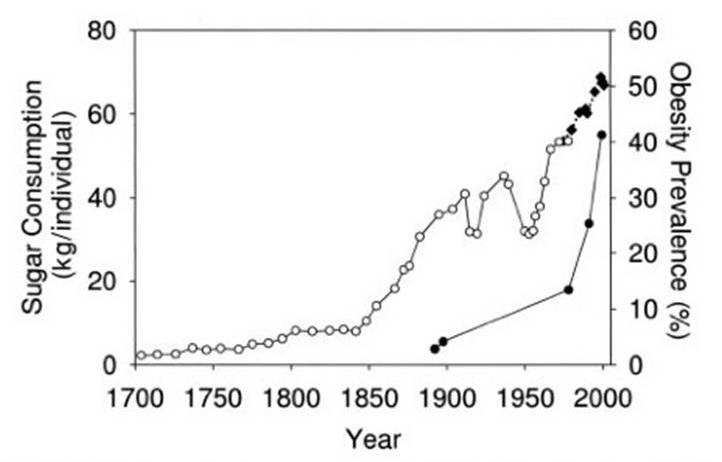
Figure 1. Sugar intake per capita in the United Kingdom from 1700 to 1978 and in the United states from 1975-2000. The line on the right with black dots is the obesity rates in the United States in non-Hispanic white men aged 60-69 y. Values for 1880-1910 are based on studies conducted in male Civil War veterans aged 50-59y. From: Johnson RJ et al, AJCN 2007; 86:899-906; Initial source: http://www.indiana.edu/~oso/Fructose/Fructose.html
Even though research and clinical findings over the last one hundred years have shown that increased sugar and processed simple carbohydrate intake are contributing factors to many illnesses ranging from diabetes, obesity, cancer and even epilepsy, the data is now undisputable. As Mark Bittman wrote in the New York Times on February 27th, “Sugar is indeed toxic. It may not be the only problem with the Standard American Diet, but it’s fast becoming clear that it’s the major one.”
When researchers accounted for poverty, aging, exercise, total food intake, and other factors, increased sugar intake increased diabetes and decreased sugar decreased diabetes. As the authors state, “for every 150 kcal/person/day increase in sugar availability (about one can of soda/day) there was associated with increased diabetes prevalence by 1.1% (p <0.001).” (Basu S, Yoffe P, Hills N, Lustig RH (2013) The Relationship of Sugar to Population-Level Diabetes Prevalence: An Econometric Analysis of Repeated Cross-Sectional Data. PLoS ONE 8(2): e57873. doi:10.1371/journal.pone.0057873)
Presently, the level of proof linking sugar to diabetes is equal to if not better than the level of proof that linked cigarette smoking to lung cancer and other illnesses. Despite the overwhelming scientific data, it will be an uphill battle to change our diet and diet recommendations from the highly processed high glycemic index diet that promotes inflammation and diabetes to a low glycemic index Paleolithic diet that supports health. The major agricultural and food processing businesses have significant influence with the USA Government (for Senate and House members lobbying pays for the election), the FDA and USDA priorities are also highly affected through direct and indirect lobbying efforts or by the financial reward to be offered a job in the agribusiness after working for the FDA or USDA. In the USA lobbying and being rewarded with a highly paid job in industry is the expression of the democratic process–for the rest of the world it is called bribery. Thus, it is likely that agricultural and food processing industries will continue to delay and obstruct any recommendations to reduce sugars and highly processed carbohydrates in our food supply. A preview of this battle has already occurred when Major Michael Bloomberg of New York City intended to restrict sales of sugary soft drinks to no more than 16 ounces a cup in city restaurants, movie theaters, stadiums and arenas. A barrage of negative comments filled the media spaces. For example, Bloomberg News, reported the comments by Kirsten Witt Webb, a Coca-Cola (KO) spokeswoman, who said in an e-mail. “They can make their own choices about the beverages they purchase. We hope New Yorkers loudly voice their disapproval about this arbitrary mandate.”
Soft drinks and soft drinks contain often eight or more table spoons of sugar per drink as shown in Figure 2.
 Figure 2. Amount of sugar cubes in soft drinks. Source: http://www.sugarstacks.com/beverages.htm
The sugar/highly processed foods battle will be similar to the battle the smoking lobby fought for the last 30 years. Just like tobacco subsidies, farmers receive subsidies to grow corn to make more low cost high fructose corn syrup. As recent as 2005 tobacco farmers were still receiving a billion and a half dollars in subsidy while farmers growing corn received more than seven billion dollars in subsidies as shown in Figure 3.

Figure 3. Farm subsidies in 2005. source: http://en.wikipedia.org/wiki/Agricultural_subsidy
At the same time pharmaceutical companies continue to reap a financial bonanza from the sugar diet induced illnesses. They will create more and more drugs to attempt to reduce the illnesses and symptoms.
We cannot expect the US government to promote our health as the lobbying power by agribusiness is overwhelming. We cannot expect published information, whether on the web or in print, to be accurate as advertising dollars significantly affect editorial decisions.
We can start eating differently ourselves and with our families and friends. Begin now. Do an experiment by eating a predominantly Paleolithic diet. For the next two weeks, eat only foods that are real foods which your great grandparents recognized as food. Thus nothing out of box or can. Nothing that has been processed or prepared! Buy only foods in their natural form. Shop at farmers’ markets or only at the periphery of the supermarket: vegetables and fruits, the meat and fish counters. After eating this diet for two weeks, check how you feel. Many people report having more energy, feeling less tired and irritability, and some experience a reduction in arthritic pains, inflammation, headaches and even anxiety. For dietary suggestions see the common sense recommendations in Michael Pollan’s book, In Defense of Food: An Eater’s Manifesto.
There is hope for neurological recovery: Redirect behaviors of habit
Posted: February 23, 2013 Filed under: self-healing, Uncategorized | Tags: behavior analysis, Cerebral palsy, epilepsy, habit, neurofeedback, rehabilitation, stroke Leave a commentAlthough many neurological disorders appear to be structural and the result of neurological dysfunctioning, recent research suggests that there is much more hope that people can learn to restore function. Even people affected by stroke, cerebral palsy, or epilepsy can regain function. The observed symptoms and dysfunctional movement patterns can be understood as the nervous system’s best strategy to solve a problem at that moment and is the best response the person could perform under the circumstances. For example in the case of stroke, a spastic movement is the best solution that becomes a conditioned habit pattern. It may occur because the person tries to achieve the previous motor behaviors which can no longer be performed because of the neurological damage. With cerebral palsy, the initial damage at birth changed the motor patterns as the child attempted to walk. While in cases of epilepsy, the spreading of the seizure across the brain is not inhibited. Despite the neurological damage, improvement is possible as demonstrated by Jill Bolte Taylor’s presentation of her experience and remarkable recovery from a left hemisphere stroke.
Application to stroke rehabilitation
A useful premise underlying neural regeneration and development is that it healing follows developmental movement sequences which cannot be skipped. Thus after a neurological injury such as a stroke, the movement sequence needs to be re-integrated. It is not relearning what was lost; it is learning the new skills as if the skills are being learned for the first time. This includes an attitude of acceptance, non judgment, fun, play and exploration concurrent with many, many, many training practices until the skills are mastered. Thus stroke patients sitting in wheelchairs may try to repeat movements which were present before the stroke but which are now beyond the biological developmental stage due to the neural damage. The person instead needs to learn anew the movement sequences that a baby mastered (lifting the head, rolling over, cross crawl moment, crawling, etc). This takes lots of practice. Compare the many hours a baby/child practices in order to be able to stand to the limited time people with strokemay spent performing their prescriptive exercises. Thus, children usually show mastery while many people with stroke demonstrate limited improvement. It is practice, practice and practice; it is not mindless practice, it is practice with awareness and intent.
Dysfunctional patterns can be understood as over learned conditioned chained behaviors which occur automatically. A superb explanation of this process is described by Charles Duhigg in his book, The power of habit-Why we do what we do in life and business. Clinical success is to identify these chains and the sequential steps and then teach the person to redirect the behavior.
Application to epilepsy
Some people with epilepsy can learn to identify the initiation of the seizure and then interrupt the cascading sequence by doing something different. In this way the seizure process is interrupted and no seizure will occur. For example, one man hyperventilated before a grand mal seizure. When the therapist taught him to become aware and change his breathing pattern each he began to hyperventilate, his epileptic seizures did not occur. Similarly, a young woman with epilepsy turned her head to the right and slightly lifted her chin upward just before an absence seizure occurred. Teaching her to interrupt her initial head movement and looking straight ahead while slowly exhaling inhibited her seizures. The efficacy of this type of behavioral analysis for the treatment of epilepsy has been described by psychologists, Joanne Dahl, PhD and Tobias Lundgren, PhD in their superb article, Behavior analysis of epilepsy: Conditioning mechanisms, behavior technology and the contribution of ACT.
Another powerful treatment approach to treat seizures was developed by M. B. Sterman, Ph.D. at UCLA who taught people with epilepsy to control their own electrical activity of their brain with neurofeedback. Many people benefited from neurofeedback training and significantly reduced their seizures.
Application to cerebral palsy
To appreciate the power of interrupting the chained behaviors and the possibility that there is hope for people with cerebral palsy. This is illustrated in the remarkable TEDx Winnepeg talk, Baby brains DO recover, but habit hides it, by Karen Pape, MD.
Improve recovery from diseases. Youtube interviews of Erik Peper, PhD by Larry Berkelhammer, PhD
Posted: February 8, 2013 Filed under: Uncategorized | Tags: cancer, healing, Immune function 1 CommentThe psychophysiology of health and recovery from cancer and other medical conditions
Discussion about remarkable recoveries from life-threatening diseases following a visit to a shaman, medicine man, faith healer, voodoo master, or other indigenous healer. Also discussed is the importance of deep trust in the doctor, healer, healthcare team, the treatment, and in the ability of the immune system to improve their health.
Shifts in consciousness improve recovery rates for cancer and other diseases
This discussion explored shifts in consciousness that are associated with improved recovery rates for cancer and other diseases. Patients with a sense of control and who are empowered tend to heal faster. Acceptance for our present circumstances, when combined with hope for the future, and a belief in possibilities contribute to speedier recoveries. An optimistic view of the future and of health have physiological correlates that are associated with healing.
 the peper perspective