Can multivitamins prevent cancer?
Posted: October 20, 2012 Filed under: Uncategorized | Tags: cancer, diet, nutrition, vitamins Leave a commentA multivitamin a day keeps the doctor away to prevent nutritional deficiency and indirectly reduce cancer risks. Although most previous research studies have not demonstrated whether vitamin supplements are useful in the prevention or the treatment of cancer, the recently published randomized control trial of 14,641 male physicians in the Journal of the American Medical Association demonstrated that a multivitamin a day significantly reduced the incidence of cancer. The participants started taking the vitamin or placebo at about age 50 and continued for eleven years. This study, Multivitamins in the Prevention of Cancer in Men- The Physicians’ Health Study II Randomized Controlled Trial, is different from most previous studies. It is one of the first randomized controlled trial in which the participants did not know whether they took a multivitamin or placebo daily. Even though the effect is small, the study finds that taking a multivitamin daily reduces cancer risk.
To promote health, take a multivitamin a day; however, the benefits gained by taking a multivitamin imply that:
- We are affluently malnutritioned as our daily western industrialized processed diet is deficient in nutrients that support our immune system and health. It would be better to eat an organic food diet with lots of vegetables and fruits. Even The President’s Cancer Panel Report, Reducing Environmental Cancer Risk: What We Can Do Now, published by the National Cancer Institute, National Institutes of Health, U.S. Department of Health and Human Services, recommends to consume to the “extent possible, food grown without pesticides or chemical fertilizers.” Eating an organic hunter and gatherer diet would include many other essential vitamins and minerals –some which we do not yet know—that are not included in a single multivitamin.
- Start eating a healthy diet from birth since it will have more impact to prevent cancer than adding a multivitamin a day at age 50. Most epidemiological studies have shown that a predominantly vegetable and fruit diet is associated with lower cancer rates.
- Implement a health promoting life style to support the immune system. Begin now by practicing stress management, incorporating exercise, performing self-healing strategies, and eating organic vegetable, fruits (no processed foods). For more suggestions see our book, Fighting Cancer-A Nontoxic Approach to Treatment.
Biofeedback and pain control. Two YouTube interviews of Erik Peper, PhD by Larry Berkelhammer, PhD
Posted: October 12, 2012 Filed under: Uncategorized | Tags: asthma, biofeedback, hope, pain, self-regulation, stress, stress management 1 CommentErik Peper, Biofeedback Builds Self-efficacy, Hope, Health, & Well-being
Interview with biofeedback pioneer Dr. Erik Peper on how biofeedback builds self-efficacy, hope, health and well-being. How to use the mind to improve physiological functioning and health. Skill-building to develop self-efficacy, self-empowerment, and hope. Evidence-based mental training to manage symptoms, self-regulate blood pressure, chronic pain & fatigue, cardiac dysrhythmias, digestion, and many other bodily processes.
Erik Peper, Pain Control Through Relaxation
This interview of Dr. Erik Peper explores the frontier of psychophysiological self-regulation. Included is conscious regulation of pain, blood pressure, and other physiological measures. We discuss how you can take control and consciously calm your sympathetic nervous system in order to attenuate pain. Autogenic Training, yogic disciplines, biofeedback, and other methods are mentioned as ways to use the mind to gain conscious control of cognitive, emotional, and physiological processes. For example, when we experience sudden pain, we automatically brace against it in the hope of resisting it. Paradoxically, this increases suffering. Autogenic Training and many other disciplines provide us with the skills to relax into any painful stimulus. Although it seems counterintuitive, learning to fully accept and relax into the pain allows us to take control over the pain, whereas trying to control it serves to increase the suffering. Another concept that is discussed in this video is that we can reduce pain and speed healing by extending loving self-care to any injury.
Adopt a power posture and change brain chemistry and probability of success
Posted: October 7, 2012 Filed under: Uncategorized | Tags: cortisol, posture, stress 3 CommentsLess than two minutes of body movement can increase or decrease energy level depending on which movement the person performs (Peper and Lin). Static posture has an even larger social impact—it affects how others see us and how we perform. Social psychologist Amy Cuddy, professor and researcher from Harvard Business School, has demonstrated that by adopting a posture of confidence for two minutes—even when you just fake it—significantly improves yourchances for success and your brain chemistry. The power position significantly increases testosterone and decreases cortisol levels in our brain. If you want to improve performance and success, watch Professor Amy Cuddy’s inspiring Ted talk (http://www.ted.com/talks/amy_cuddy_your_body_language_shapes_who_you_are.html)
Take charge of your energy level and depression with movement and posture
Posted: September 30, 2012 Filed under: Uncategorized | Tags: depression, energy level, exercise, posture 17 CommentsI felt depressed when I looked down walking slowly. I realized that I walk like that all the time. I really need to change my walking pattern. When doing opposite arm and leg skipping, I had more energy. Right away I felt happy and free. I automatically smiled. –Student
Hunched forward at the computer, collapsed in front of the TV, bent forward with an I-pad and smart phone while answering emails, updating Facebook, playing games, reading or texting—these are all habits that may affect our energy level. Students may also experience a decrease in energy level and concentration when they slouch in their seats.
The low tech solution is not caffeine or medications; it is episodic movement and upright posture. In the controlledresearch study published October 5, 2012 in the journal Biofeedback, Erik Peper, PhD of San Francisco State University and I-Mei Lin, PhD of Kaohsiung Medical University, Taiwan, showed that subjective energy level can quickly be increased.
In this study 110 participants rated their immediate subjective energy level and their general depression level. The participants either walked in a slouched position or engaged in opposite arm and leg skipping (see Figure 1).

Figure 1. Illustration of slouched walking (left) and opposite arm and leg skipping (right). Reproduced from Peper & Lin (2012).
Skipping even for even one minute significantly increased energy level and alertness for all subjects. On the other hand, walking in a slouched pattern reduced the energy level significantly for those participants who had high levels of depression as shown in Figure 2.

Figure 2. Self-rating of energy level for the top and bottom 20% of the students’ self-rating of depression. Reproduced from: Peper & Lin, (2012).
For people with a history of depression, their energy level may covertly increase or decrease depending upon posture and movements. When individuals have less energy, they feel that they can do less, and this feeling tends to increase depressive thinking. They also tend to label the lower energy state as the beginning of depression instead being tired. At the same time, the lower energy state tends to evoke depressive memories and thoughts which escalate the experience of depression. This process can be interrupted and reversed by shifting body posture and performing movement.
This study offers a strategy for people with depression to reverse conditioned cues associated with posture that evoke depressive thoughts and feelings. Wilson and Peper (2004) showed previously that ‘‘sitting collapsed’’ allowed easier access to hopeless, helpless, powerless, and negative memories than sitting upright and looking up. Posture appears to be aan overlooked aspect in the prevention of depression.
There is hope if you tend to become depressed and experience low energy. Numerous participants reported that after they performed opposite arm/leg skipping they did not want to walk in a slouched position. This suggests that this type of movement my act as a protective mechanism to avoid energy decrease and depression. Some participants with attention deficit disorders reported that after skipping they could focus their attention much better. I recommend being more aware of your body posture during the day and increasing your arm and leg skipping movements.
*Adapted from: Peper, E. & Lin, I-M. (2012). Increase or decrease depression-How body postures influence your energy level. Biofeedback, 40 (3), 126-130.
Cancer and what you can do. Youtube interviews of Erik Peper, PhD by Larry Berkelhammer, PhD
Posted: September 29, 2012 Filed under: Uncategorized | Tags: cancer, health, hyperthermia 1 CommentErik Peper, Fighting Cancer: A Nontoxic Approach to Treatment
Psychophysiologist Erik Peper, PhD, discusses the book he co-authored with cancer researcher Robert Gorter, MD. He describes a novel, promising, nontoxic treatment for cancer, the results of which, have been quite exciting. In line with the actual pathophysiological process of all disease, these authors view cancer as a failure of the immune system. This is because we all have cancer cells growing in us all the time, but a healthy immune system kills them off before they have a chance to make us sick. Dr. Peper teaches people how to live in such a way as to dramatically reduce the odds of ever getting cancer, and Dr. Gorter is the one who invented the method of curing cancer described in the book. This 3-month treatment, combining a dendritic cell treatment with artificial-induced hyperthermia has evidenced a 40 to 60 percent cure rate.
Erik Peper, Cancer, the Immune System, States of Mind, and Health
This interview points out the power of choice and intention to improve health and well-being. Terms like “have to” are deleterious to our health. According to Dr. Erik Peper: “Health is the ability to make choices.” People who are empowered to recognize choices from moment-to-moment are healthier than fatalistic people and healthier than people who use words like “should” and “have to.”
Are medications the cause of your muscle pain, dizziness, low energy, confusion, broken femur, allergy, anxiety, depression, type 2 diabetes, etc?
Posted: August 22, 2012 Filed under: Uncategorized | Tags: confusion, Medication side effects, muscle pain 1 CommentAlthough prescription and over the counter medication can be very helpful, in some cases the medications may not cure the disorder but instead trigger a cascade of symptoms and more treatments. The risk for negative side effects, rise in mortality and morbidity increases with the number and length of time medications are taken as well as the age of the person. The Institute of Medicine estimates that medications errors are the most common medical mistake and harm at least 1.5 million people each year. These numbers most likely represent only the tip of the iceberg and do not include the more experience, especially for older people, of taking multiple medications. The medication for the first symptom or disease marker causes another symptom which is not recognized as a medication side effect. Thus, a second medication is prescribed to treat the first, and then a third prescription to treat the unrecognized side effects of the second medication or the interaction of the first and second medications. Then a third medication is prescribed to treat the these symptoms…
For example in the United States about 21 million patients are prescribed statins such as Lipitor, Zocor, Crestor, Vytorin to lower to lower their LDL (low density lipoprotein) cholesterol. Most likely the statins will not reduce your risk of death from coronary heart disease especially if you are taking it for prevention. Instead, the statins often cause muscle pain and weakness, as well as cognitive confusion and forgetfulness. You would then begin to take pain medications to treat the muscle pain and the escalating cycle has begun.

Whatever the medications you are taking, be skeptical of the health claims and investigate whether the benefits outweigh the risks. In many cases the research data suggests that the harm, especially in long term use, may outweigh the benefits. If you are taking medications or are being prescribed to take medications, first read Are Your Prescriptions Killing You? by Armon Neel and Bill Hogan. You may become healthier with fewer drugs.
Improve rest and healing when hospitalized*
Posted: May 7, 2012 Filed under: Uncategorized | Tags: healing, hospitals, insomnia, sleep 1 CommentImagine being in a strange hospital room with nothing to evoke calmness and peace – just a TV going and showing horrors of the world. Staff coming in and out who often interrupt a person’s little sleep, blinking cardiac monitor lights, florescent lighting, beeping monitor noise, muffled groans of the other patient. So hard to rest and sleep and to feel safe. Sleep, please come and take me away from this horror – it’s now two in the morning, the terrors begin to crawl through me, sleep is withdrawing and I am facing my demons of thoughts and worries.
Instead of helping me with my natural progression of sleep, I am offered a sleeping pill to numb me out and disappear. Don’t they know that regularly taking of sleeping medication has been found to increase mortality risk by 25% and if used sporadically, by 10% to 15%? Being able to sleep promotes healing and sleep more likely occurs when patients feel calm and safe. When sick and in pain, we often are terrified and want to be nurtured; we tend to regress and become more baby like – desiring our loved one(s) holding us and telling us all will be well. A fearful child wants to be surrounded by loving, calm, supportive parent(s) as do most adults. This helps us to let go and know in a non-verbal way that we are now safe and can safely rest.
Benefits of feeling safe have been found to be numerous. For example, when a loving partner holds the patient’s hand, he/she experiences significantly less pain and a slowing of the heart rate.
Yet the patient placed in an unfamiliar room with clanking noise, flashing lights, fluorescent light and with another patient who makes unfamiliar noise adds to fearfulness and unrest. No wonder when elderly patients go to the hospital they often become confused and anxious and can experience major cognitive loss. Terror and fear of the new and unfamiliar can lead to cognitive disturbances and when combined with anesthesia may cause significant cognitive decline,
It can be so simple to promote a healing environment that will improve patient recovery and significantly reduce medical cost as studies have found. Patients who had gall bladder surgery and their room had a window with a view of trees compared to patients with a view of a brick wall had less pain medication and were discharged a day earlier.
To promote healing in a hospital, we need to honor ones natural evolutionary origins and reduce factors that evoke fear and at the same time increase factors that promote healing and safety. The following suggestions show an increase in long-term health benefits for the patient.
- Have the room in absolute darkness and no noise to support sleep and no interruptions for medical tests unless absolutely necessary. Findings suggest improved sleep and positive changes in patient outcomes
- Have medical staff use red lights as the only light at night when working with patients as florescent lights with its blue spectrum blocks melatonin production and interrupts sleep.
- Arrange a bed next to the patient for a loving person to be able to caringly attend to the person in their hour of need. Just being present, holding a patient’s hand, reassuring, or giving a foot massage before going to sleep is often more effective than giving sleeping medication.
- Prescribe hand holding and being with a patient without time pressures as a billable procedure as done for routine prescribed treatments such as medications, epidural, or intravenous solutions.
- Support nurses to be able to take the time to be with the patien, Make it a valued, legitimate nursing intervention.
- Offer a room with a view.
*I thank Dr. Betsy Stetson for her helpful suggestions and feedback
Food for thought- Is my “healthy diet” harming me?
Posted: March 16, 2012 Filed under: Uncategorized | Tags: ADHD, Alzheimer, diet, multiple sclerosis, Spina bivada, vitamins 3 CommentsHow can you imply that I have malnutrition! I eat a full, balanced diet including meats, vegetables, fruits, dairy, etc. I take a multiple vitamin every day and even shop for organic foods at my local farmer’s market. In fact, I shifted my diet to follow the American Heart Disease Association and USDA Food Plate and Pyramid guidelines!
Evolution optimized human genetics for a hunter-gatherer diet but in the last few centuries our diet has radically changed and is totally different from the ideal diet of our ancestors. We now eat many foods that were not part of our diet five to ten thousand years ago such as corn, wheat, milk and all packaged and processed foods. We eat on the average 160 lbs of sugar instead of less than two pounds of honey a year, and steaks instead of the organ meats such as liver which would have provided essential vitamin A, D, etc.
A healthy diet is much more than a nutritionally poor high caloric foods (e.g., cereals, hamburgers, white rice or flour) with some vitamins and minerals added. A healthy diet mirrors our evolutionary past —a hunter gatherer diet–which supports the growth and maintenance of our body and brain. This diet would consist of natural, non industrialized produced foods such as vegetables, leaves, fruits, berries, nuts, roots, tubers, wild fish and meats from animals. This type of diet significantly exceeds the FDA’s recommended Daily Intake (RDI) guidelines which are the daily intake level of a nutrient that is considered to be sufficient to meet the requirements of 97–98% of healthy individuals in the United States.
These minimum RDI for vitamins and minerals are often too low and do not include the myriad of micro and macro nutrients necessary to achieve and maintain optimum health. Nutrients do not act in alone but in concert with each other as Michael Pollan pointed out in his superb book, In Defense of Food.
Dietary guidelines from the United States Department of Agriculture (USDA) My Plate and Food Pyramid and organizations such as the American Heart Association are more the result of successful lobbying by large agribusiness than from research findings. By following USDA and FDA guidelines, we may set the stage for long term subclinical malnutrition which reduces our resilience to fight disease.
If the recommended modern Western diet was sufficient then there would be no need to take additional vitamin or mineral supplements to prevent illnesses. This is not the case! Controlled research studies have shown that numerous illnesses can be ameliorated or prevented by taking specific supplements.
- The risk of having a baby with Spina bivida (neural tube defect) can be reduced by 71% when women before becoming pregnant take 400 µg of folic acid (vitamin B9) per day. Taking the folic acid supplement may not have been necessary if the woman had eating foods naturally high in folic acid such as leafy vegetable (spinach, asparagus, turnip greens), egg yolks, sun flower seeds and liver.
- Pregnant women can reduce the risk of their babies having eczema by 42 percent and egg allergies by 40 percent when they take fish oil capsules (1000 mg of Omega 3s) daily during pregnancy as compared to the women whoonly took vegetable capsule. Taking Omega 3s may not have been necessary if the woman had eating foods naturally high in Omega 3s such as cold water oily fish, flax seed, eggs produced by free ranging hens who are not fed corn or soy, and brains from mammals.
- Teenage girls who took vitamin D supplements had significantly lower bone fractures than girls who did not take vitamin D supplements. Is it possible that chronic low levels of vitamin D (chronic malnutrition caused by our industrialized agribusiness diet) and use of sunscreen are significant co-factor in the increasing epidemic of osteoporosis in older women? Taking vitamin D may not have been necessary if the girls had eating foods naturally high in vitamin D such as alfalfa shoots, fatty fish, beef liver and whole eggs produced by free ranging hens and enough sun exposure.
Eating the industrialized produced western diet may also increase the risk developing neurological degenerative diseases. Adults with low omega-3 blood levels had significantly lower total cerebral brain volume than adults who had the highest levels of omega-3s. More importantly, adults with low levels of omega-3 levels did significantly worse on abstract memory, visual memory and executive function than the adults who had high omega-3 levels.
These research findings are worrisome; since, shrinking brains are a feature associated with neurological diseases such as multiple sclerosis, Parkinson’s disease and Alzheimer’s disease. Is it possible that our diet contributes to the expanding epidemics of Alzheimer’s disease and ADHD?
If some illness can be prevented by taking supplements, would it not be wiser to eat a diet which provides sufficiently nutrients for the brain and body?
Watch the inspirational presentation by Dr. Terry Wahls, MD, Minding Your Mitochondria, who cured her multiple sclerosis which was untreatable by western medicine. She reversed her illness by eating a hunter and gathers diet which provided the optimum nutrition for her brain. Over a period of three to a year, she got out of herwheel chair, started to ride a bicycle, and eventually rode horseback as shown in her Youtube video.
Experience the benefits of eating a hunter gatherer diet. For one month eat as a hunter and gatherer. Eat nine cups of organic vegetables, leaves, berries, roots, fruit as well as tubers, some fish, and some organ meat from free ranging animals. Do not eat corn products, sugar and processed foods. In four weeks, you may notice a difference: more energy, less inflammation and improved cognition. For dietary guidelines see chapter 9 in the book, Fighting Cancer-A Nontoxic Approach to Treatment.
Maintain energy and health at work
Posted: February 22, 2012 Filed under: Uncategorized | Tags: breath holding, Computing, neck pain, repetitive strain injury, respiration, shoulder pain 4 CommentsI never realized that I braced my shoulders and held my breath while typing. Now I know the importance of not doing this, and have tools to change.
–Secretary in training program, San Francisco State University
Most employees who work on computers experience discomfort ranging from neck, shoulder, back, and arm pain to eye irritation and exhaustion–a cluster of symptoms that we have labeled Stress Immobilization Syndrome. A major cause of this is the holding of chronic and unnecessary muscle tension of which the employee is usually unaware. This often leads to illness. Doing the following practice will help you to become aware of these patterns:
Sit on the edge of your chair and hold your mouse and then begin to draw with your mouse, the letters and numbers of your street address; however, draw the letters backward by beginning with the last letter of the street address. Draw each letter about 1 1/4 inch in height, and then click the left button after having drawn the letter. Continue to draw the next letter. Draw as quickly as possible without making any mistakes as if your boss is waiting for the results. Start now, and continue for the next 30 seconds. Now, observe what happened.
Did you hold your breath, tightened your neck, shoulders, and trunk, forgot to blink as you drew the letters with your mouse? Imagine what would happen if you worked like this hour after hour: Tension headaches, shoulder pain, exhaustion?
Research at San Francisco State University has demonstrated that with biofeedback 95% of employees automatically raised their shoulders, and maintained low-level tension in their forearms while keyboarding and mousing.They also increased their breathing rates , and decreased eye blinking rates. Almost all employees studied thought that their muscles were relaxed when they were sitting correctly at the computer, even though they were tense, as is shown in Figure 1.

Figure 1 is a representative recording of a person working at the computer. Note how 1) forearm and shoulder (deltoid/trapezius) muscle tension increased as the person rests her hands on the keyboard without typing; 2) respiration rate increased during typing and mousing; 3) shoulder muscle tension increased during typing and mousing; and 4) there were no rest periods in the shoulder muscles as long as the fingers are either resting, typing, or mousing. By permission from: Peper, E. (2007). Stay Healthy at the Computer: Lessons Learned from Research. Physical Therapy Products. April.
While working at the computer most people are captured by the computer, and are unaware of how their bodies react. Computing during the day and surfing the net at night, most people report neck and shoulder tension, back pain, eye irritation and/or fatigue otherwise labeled as Stress Immobilization Syndrome, see figure 2.

Figure 2. Distribution of reported symptoms experienced by college students (average age 26.3 years) while working on the computer near the end of their semester (reproduced with permission from Peper, E., & Gibney, K, H. (1999). Computer related symptoms: A major problem for college students. Applied Psychophysiology and Biofeedback. 24 (2), 134.
How to reverse and interrupt Stress Immobilization Syndrome
When working at the computer, remind yourself to
- Interrupt your computer work every few minutes to wiggle and move
- Breathe diaphragmatically
- Get up and do large movements (stretch or walk) for a few minutes.
- Smile and realize that the work stress it is not worth dying over
When implementing these simple changes, employees report significant reduction in symptoms. As one participant stated, “There is life after five.”
For detailed tips how to maintain health at the computer download Healthy Computing Email Tips
Do night lights cause cancer?
Posted: February 13, 2012 Filed under: Uncategorized | Tags: cancer, circadian rhythm, LED, light 11 CommentsBefore going to sleep in a 24/7 world, we watch TV, surf the web to catch the latest news, check Facebook to connect with our friends, or glance at our smart phones for the latest emails. Although it seems the normal thing to do, evening and night time light disrupts our biological rhythms and can affect our health and even increase risk for cancer.
Exposure to light in the evening or night is very recent in evolutionary terms. For hundreds of thousands of years the night was dark as we hid away in caves to avoid predators. Only in the last few thousand years did candles or oil lamps with their yellow orange light illuminate the dark. The fear of the dark is primordial– in the dark we were the prey. During those prehistoric times, our fear was reduced by huddling together for warmth and safety as we slept. Although our present life is far removed from our evolutionary past, our evolutionary past is embedded within us and controls much of our biology and psychology.
These days, while sleeping we turn on a night light to feel safe or allow us to see in case we have to get up. For many of us, darkness still feels unsafe since as babies the fear was amplified as we slept alone in a crib without feeling the tactile signals of safety provided by direct human contact. Presently, light permeates our night: the flashing status light of the standby mode of the TV, the blinking lights of our cell phone charger, the soft glow of the alarm clock, and the street lights or flashing headlights of the cars leaking around the edges of the blinds and curtains. These lights and especially the blue light produced by LED, TV and computer screens switches off the production of melatonin as shown in the figure 1.

Figure 1. The white line represents the wavelengths of light that suppress the secretion of the sleep-promoting hormone melatonin. The light spectrum of LED, TV and Computer screens has a strong peak in the blue and thus inhibits melatonin production and affecting our circadian rhythm. From: Dijk, D & Winsky-Sommerer R. (2012). Sleep, New Scientist Instant Expert 20. New Scientist, 213(2850), i-vii.
Melatonin, the hormone that makes us sleepy, contributes to regulating our circadian rhythms. When exposed to the blue component of the light before going to sleep, melatonin production is suppressed, our sleep onset is delayed, and sleep is more disturbed. Equally harmful is light exposure during the night because it suppresses the body’s melatonin production which affects and disturbs our circadian rhythm as shown in Figure 2.
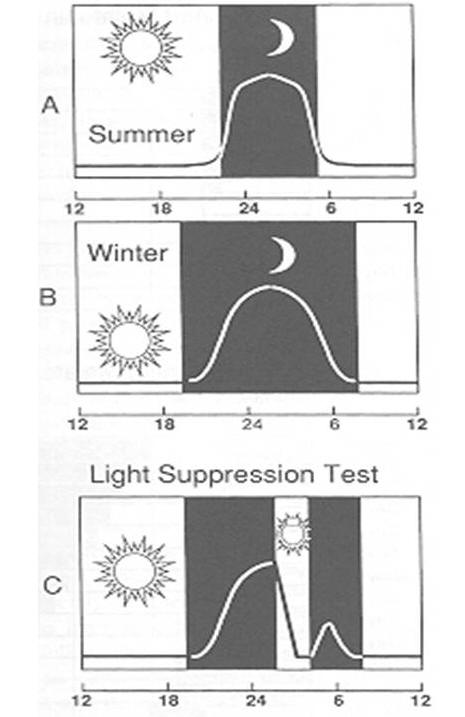
Figure 2. Exposure of light during the night, decreases melatonin production. From: Sack, R. L., Blood, M. L., Hughes, R. J., Lewy, A. J. (1998). Circadian-Rhythm Sleep Disorders in Persons Who Are Totally Blind. Journal of Visual Impairment & Blindness, 92, (3).
The more our biological rhythms are disturbed the greater the risk of illness. For example, shift workers and airline cabin attendants have significant increased risk of accidents and illnesses such as cancer. Studies have shown that lab rats’ cancer cells proliferate significantly more when lights are kept on during the night than in the control group who remain in the dark. The disturbance of biological rhythms is usually associated with increased illness and reduced longevity. This disruption acts as an allostatic load (or a stressor on the system).
To promote health, return to your evolutionary roots and support your circadian rhythms by reducing light exposure before going to sleep and by sleeping in total darkness. Promote sleep onset, reduce sleep disturbances and support your circadian rhythm by following these simple steps:
- Do not watch LED, TV or computer screens an hour before going to sleep to enhance melatonin production.
- Light proof the bedroom and eliminate all light sources –yes, even the small indicator lights on electronic equipment — to maintain melatonin production and maximize your biological rhythm.
- Install a free computer program such as f.lux™ that makes your computer screen look like the room you’re in, all the time. When the sun sets, it makes your computer look like your indoor lights with warmer colors by reducing the blue light. In the morning, it makes the screen brighter like the color of sunshine.
For additional evolutionary perspective concepts and strategies to promote health, see the book Fighting Cancer: A Nontoxic Approach to Treatment.
 the peper perspective