Can abdominal surgery cause epilepsy, panic and anxiety and be reversed with breathing biofeedback?*
Posted: March 5, 2016 Filed under: Breathing/respiration, self-healing, stress management, Uncategorized | Tags: anxiety, biofeedback, Breathing, epilepsy, iatrogenic illness, learned disuse, panic, respiration, surgery 4 Comments“I had colon surgery six months ago. Although I made no connection to my anxiety, it just started to increase and I became fearful and I could not breathe. The asthma medication did not help. Learning effortless diaphragmatic breathing and learning to expand my abdomen during inhalation allowed me to breathe comfortably without panic and anxiety—I could breathe again.” (72 year old woman)
“One year after my appendectomy, I started to have twelve seizures a day. After practicing effortless diaphragmatic breathing and changing my lifestyle, I am now seizure-free.” (24 year old male college student)
One of the hidden long term costs of surgery and injury is covert learned disuse. Learned disuse occurs when a person inhibits using a part of their body to avoid pain and compensates by using other muscle patterns to perform the movements (Taub et al, 2006). This compensation to avoid discomfort creates a new habit pattern. However, the new habit pattern often induces functional impairment and creates the stage for future problems.
Many people have experienced changing their gait while walking after severely twisting their ankle or breaking their leg. While walking, the person will automatically compensate and avoid putting weight on the foot of the injured leg or ankle. These compensations may even leads to shoulder stiffness and pain in the opposite shoulder from the injured leg. Even after the injury has healed, the person may continue to move in the newly learned compensated gait pattern. In most cases, the person is totally unaware that his/her gait has changed. These new patterns may place extra strain on the hip and back and could become a hidden factor in developing hip pain and other chronic symptoms.
Similarly, some women who have given birth develop urinary stress incontinence when older. This occurred because they unknowingly avoided tightening their pelvic floor muscles after delivery because it hurt to tighten the stretched or torn tissue. Even after the tissue was healed, the women may no longer use their pelvic floor muscles appropriately. With the use of pelvic floor muscle biofeedback, many women with stress incontinence can rapidly learn to become aware of the inhibited/forgotten muscle patterns (learned disuse) and regain functional control in nine sessions of training (Burgio et al., 1998; Dannecker et al., 2005). The process of learned disuse is the result of single trial learning to avoid pain. Many of us as children have experienced this process when we touched a hot stove—afterwards we tended to avoid touching the stove even when it was cold.
Often injury will resolve/cure the specific problem. It may not undo the covert newly learned dysfunctional patterns which could contribute to future iatrogenic problems or illnesses (treatment induced illness). These iatrogenic illnesses are treated as a new illness without recognizing that they were the result of functional adaptations to avoid pain and discomfort in the recovery phase of the initial illness.
Surgery creates instability at the incision site and neighboring areas, so our bodies look for the path of least resistance and the best place to stabilize to avoid pain. (Adapted from Evan Osar, DC).
After successful surgical recovery do not assume you are healed!
Yes, you may be cured of the specific illness or injury; however, the seeds for future illness may be sown. Be sure that after injury or surgery, especially if it includes pain, you learn to inhibit the dysfunctional patterns and re-establish the functional patterns once you have recovered from the acute illness. This process is described in the two cases studies in which abdominal surgeries appeared to contribute to the development of anxiety and uncontrolled epilepsy.
How abdominal surgery can have serious, long-term effect on changing breathing patterns and contributing to the development of chronic illness.
When recovering from surgery or injury to the abdomen, it is instinctual for people to protect themselves and reduce pain by reducing the movement around the incision. They tend to breathe more shallowly as not to create discomfort or disrupt the healing process (e.g., open a stitch or staple. Prolonged shallow breathing over the long term may result in people experiencing hyperventilation induced panic symptoms or worse. This process is described in detail in our recent article, Did You Ask about Abdominal Surgery or Injury? A Learned Disuse Risk Factor for Breathing Dysfunction (Peper et al., 2015). The article describes two cases studies in which abdominal surgeries led to breathing dysfunction and ultimately chronic, serious illnesses.
Reducing epileptic seizures from 12 per week to 0 and reducing panic and anxiety
A routine appendectomy caused a 24-year-old male to develop rapid, shallow breathing that initiated a series of up to 12 seizures per week beginning a year after surgery. After four sessions of breathing retraining and incorporating lifestyle changes over a period of three months his uncontrolled seizures decreased to zero and is now seizure free. In the second example, a 39-year-old woman developed anxiety, insomnia, and panic attacks after her second kidney transplant probably due to shallow rapid breathing only in her chest. With biofeedback, she learned to change her breathing patterns from 25 breaths per minute without any abdominal movement to 8 breathes a minute with significant abdominal movement. Through generalization of the learned breathing skills, she was able to achieve control in situations where she normally felt out of control. As she practiced this skill her symptoms were significantly reduced and stated:
“What makes biofeedback so terrific in day-to-day situations is that I can do it at any time as long as I can concentrate. When I feel I can’t concentrate, I focus on counting and working with my diaphragm muscles; then my concentration returns. Because of the repetitive nature of biofeedback, my diaphragm muscles swing into action as soon as I started counting. When I first started, I had to focus on those muscles to get them to react. Getting in the car, I find myself starting these techniques almost immediately. Biofeedback training is wonderful because you learn techniques that can make challenging situations more manageable. For me, the best approach to any situation is to be calm and have peace of mind. I now have one more way to help me achieve this.” (From: Peper et al, 2001).
The commonality between these two participants was that neither realized that they were bracing the abdomen and were breathing rapidly and shallowly in the chest. I highly recommend that anyone who has experienced abdominal insults or surgery observe their breathing patterns and relearn effortless breathing/diaphragmatically breathing instead of shallow, rapid chest breathing often punctuated with breath holding and sighs.
It is important that medical practitioners and post-operative surgery patients recognize the common covert learned disuse patters such as shifting to shallow breathing to avoid pain. The sooner these patterns are identified and unlearned, the less likely will the person develop future iatrogenic illnesses. Biofeedback is an excellent tool to help identify and retrain these patterns and teach patients how to reestablish healthy/natural body patterns.
The full text of the article see: “Did You Ask About Abdominal Surgery or Injury? A Learned Disuse Risk Factor for Breathing Dysfunction,”
*Adapted from: Biofeedback Helps to Control Breathing Dysfunction.http://www.prweb.com/releases/2016/02/prweb13211732.htm
References
Burgio, K. L., Locher, J. L., Goode, P. S., Hardin, J. M., McDowell, B. J., Dombrowski, M., & Candib, D. (1998). Behavioral vs drug treatment for urge urinary incontinence in older women: a randomized controlled trial. Jama, 280(23), 1995-2000.
Dannecker, C., Wolf, V., Raab, R., Hepp, H., & Anthuber, C. (2005). EMG-biofeedback assisted pelvic floor muscle training is an effective therapy of stress urinary or mixed incontinence: a 7-year experience with 390 patients. Archives of Gynecology and Obstetrics, 273(2), 93-97.
Osar, E. (2016). http://www.fitnesseducationseminars.com/
Peper, E., Castillo, J., & Gibney, K. H. (2001, September). Breathing biofeedback to reduce side effects after a kidney transplant. In Applied Psychophysiology and Biofeedback (Vol. 26, No. 3, pp. 241-241). 233 Spring St., New York, NY 10013 USA: Kluwer Academic/Plenum Publ.
Peper, E., Gilbert, C.D., Harvey, R. & Lin, I-M. (2015). Did you ask about abdominal surgery or injury? A learned disuse risk factor for breathing dysfunction. Biofeedback. 34(4), 173-179. DOI: 10.5298/1081-5937-43.4.06
Taub, E., Uswatte, G., Mark, V. W., Morris, D. M. (2006). The learned nonuse phenomenon: Implications for rehabilitation. Europa Medicophysica, 42(3), 241-256.
Mind-Guided Body Scans for Awareness and Healing Youtube Interview of Erik Peper, PhD by Larry Berkelhammer, PhD
Posted: February 19, 2016 Filed under: Uncategorized | Tags: autogenic training, body scan, mind-body, mindfulness, pain, passive attention, stress management Leave a commentIn this interview psychophysiology expert Dr. Erik Peper explains the ways how a body scan can facilitate awareness and healing. The discussion describes how the mind-guided body scan can be used to improve immune function and maintain passive attention (mindfulness), and become centered. It explores the process of passive attentive process that is part of Autogenic Training and self-healing mental imagery. Mind-guided body scanning involves effortlessly observing and attending to body sensations through which we can observe our own physiological processes. Body scanning can be combined with imagery to be in a nonjudgmental state that supports self-healing and improves physiological functioning.
Seeing is believing*
Posted: February 14, 2016 Filed under: Uncategorized | Tags: biofeedback, CBT, cognitive behavior therapy, Imagery, min-body, musle tension, SCL, SEMG, skin conductance, visualization 3 CommentsMy arm did not move and yet the muscle tension from my forearm increased when I mentally rehearsed playing the piano. I did not notice anything. It really made me aware how my thoughts affect my body. –25 year old woman psychologist
*This blog was adapted from: Peper, E., Nemoto, S., Lin, I-M., & Harvey, R. (2015).
Therapists and educators can demonstrate the mind/body interaction with physiological monitoring to change their clients’ illness beliefs and demonstrate how ruminating thoughts may affect mental and physical health (Peper, Shumay, Moss, & Sztembis, 2013). When clients see how their body’s physiological responses are affected by thoughts and emotions, they gain a perspective that allows them to KNOW that thoughts affect body—the objective physiological evidence is indisputable.
The concept that thoughts affect the body has been described by many researchers. For example, Whatmore and Kohli (1975) used the term “Representing efforts,” which are the efforts we bring forth within our self during thinking, remembering, anticipating, daydreaming and worrying. Similarly, Green, Green and Walters (1970, p.3) described a process of thoughts influencing human physiological reactions as the Psycho-physiological principle, where “every change in the physiological state is accompanied by an appropriate change in the mental-emotional state, conscious or unconscious, and conversely, every change in the mental-emotional state, conscious or unconscious, is accompanied by an appropriate change in the physiological state.”
The mind/body connection can be demonstrated through recording physiological signals. For example, when a volunteer had her skin conductance (SC) level monitored, and then another person was asked in the group to give the volunteer a kiss, there was an increase in skin conductance response just after the instruction was given even though the person did not actually kiss the volunteer. The volunteer was responding to the instructions that a kiss might occur, as shown in Figure 1.

Figure 1. The effect on SC level of hearing the instruction that someone will give her a kiss
For educators and psychotherapists, biofeedback can be used to demonstrate the connection between positive or negative mental rehearsal, thoughts or visualization or recalling memories and physiological responses. This process can be demonstrated with surface electromyography (SEMG) recorded from muscles that become activated when the person mentally rehearses a task as illustrated in the following case example.
The participant was a 25 year old female psychologist who had practiced playing the piano for more than 16 years. Muscle activity was recorded from her right forearm extensor muscles and displayed on a large screen so that other group participants could observe. The physiological data and video recording of the volunteer were simultaneously recorded. The volunteer was asked to relax, imagine playing a musical piece, relax, and again imagine playing a musical piece and relax.
Results. Each time she imagined playing the piano, the forearm extensor muscle tension increased, even though there was no observed finger and forearm movements, as shown in Figure 2.

Figure 2. The covert SEMG increase in forearm SEMG as the participant imagined playing the piano.
After the recording, the session was replayed so she could see herself and her movements on the screen simultaneously with the SEMG signal. She reported being totally unaware that she had activated her forearm muscles and, was totally surprised when she saw the recording of the SEMG activity while her forearm appeared to stay in a relaxed position.
Discussion.The physiological monitoring demonstrated that her body responded to here thoughts and imagtes. In the case example, the arm muscle tension increased in tension when she mentally rehearsed playing the piano. This participant like most other people was unaware that her body reacted.If the thought of piano playing increased forearm tension,what would thoughts of anger, resentment, hopelessness, kindness or love do to the body. This concrete physiological demonstration illustrated that changing your thoughts changes your physiology. .
Once the person is aware how thoughts affect their body, it may motivate the person to become aware and change their cognitions. They can now understand that interrupting negative ruminations and behavior patterns and rehearsing new behavior patterns, their health can be improved. We strongly recommend that cognitive behavioral therapists, educators, psychologists, and other therapeutic practitioners include biofeedback monitoring for demonstrating the links between cognitions and physiological reactions.
After such a demonstration, the therapist may point out that what happens in the office setting is likely the identical process that occurs when a person worries, has negative cognitions, continuously reviews personal failures, or makes judgmental statements such as “I should not have done ________.”
When individuals think a negative statement such as “I should not have…………”, they are mentally rehearsing what they should not do and are unintentionally strengthening the negative behavior even more. Instead, whenever people becomes aware of the beginning of the negative cognitions, they can learn to stop and transform their negative cognitions to positive cognitions. In this way they can rehearse what they would want to do instead of what they do not want to do (Peper, Gibney, & Holt, 2002).
The more you rehearse what you want to achieve, the more likely it is to occur. This strategy is useful to change clients’ illness beliefs and motivate them to transform their cognitions from what they do not want to what they want to do. In addition, it offers cognitive behavior therapists documented evidence—the biofeedback recording provides the data which is necessary for evidence based medicine.
Between stimulus and response there is a space. In that space is our power to choose our response. In our response lies our growth and our freedom.
–Victor E. Frankle
References
Green, E.E., Green, A.M., & Walters, E.D. (1970). Voluntary control of internal states: Psychological and physiological. Journal of Transpersonal Psychology, 11, 1-26.
Peper, E., Gibney, K.H., & Holt. C. (2002). Make health happen: Training yourself to create wellness. Dubuque, IA: Kendall-Hunt.
Peper, E., Shumay, D. M., Moss, D. & Sztembis, R. (2013). The Power of Words, Biofeedback, and Somatic Feedback to Impact Illness Beliefs. Somatics .XVII(1), 4-8.
Whatmore, G.B., & Kohli, D. R. (1975). The physiopathology and treatment of functional disorders: Including anxiety states and depression and the role of biofeedback training. New York: Grune and Stratton, Inc.
Antifragile: How to survive in an uncertain world
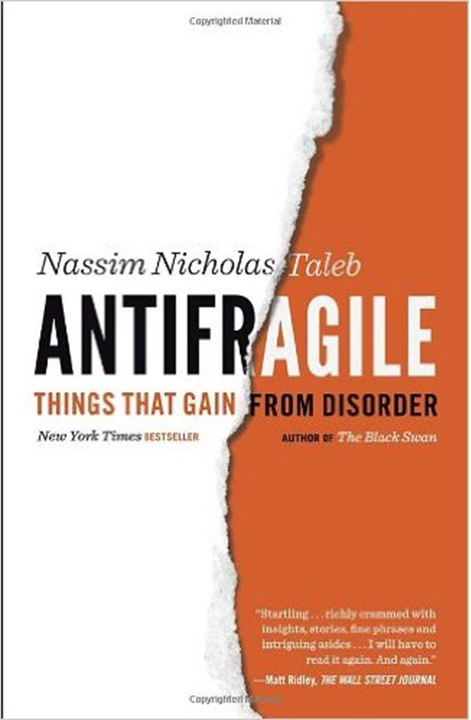
Posted: February 11, 2016 Filed under: Uncategorized | Tags: health, risk 1 CommentMany of our experiences are unpredictable and radically changed by rare events. Although our conventional thinking is useful for maintaining the status quo, it is unable to anticipate or cope with unprecedented events . Just think of the unanticipated political consequences of the 9/11 terrorist attack, the iatrogenic effects (treatment induced negative side effects) of taking statins to reduce cholesterol (15% of the patients experience serious complications such as muscle weakness and cognitive dysfunction) or the 44 percent increase risk of dementia in people age 75 or older who regularly take heartburn medications called proton pump inhibitors (PPIs) such as Prilosec, Nexium and Prevacid, the elimination of book stores by Amazon’s success, or how computer failures can shut down air travel. One of the most thoughtful and brilliant authors who cuts through the cloud of conventional thinking and teaching is Nassim Nicholas Taleb. His books offer useful guidelines how to think about risk when interfacing with medicine or how to make healthy lifestyle choices. Begin by reading The Black Swan: The Impact of the Highly Improbable and then enjoy his recent book, Antifragile-Things that Gain from Disorder.
Integrative Medicine: NATO’s Task Force Report
Posted: January 24, 2016 Filed under: Uncategorized | Tags: CAM, complementary medicine, integrative medicine 1 CommentNorth Atlantic Treaty Organization’s Task Force Human Factors and Medicine (HFM)-195 has just published the results of their deliberations on integrative medicine interventions for military personal. The findings were published as NATO Special Edition-Integrative Medicine Interventions for Military Personnel in the October 2015 issue of Medical Acupuncture, 27(5). The individual articles range from historical perspectives to analysis of clinical applications of CAM. The individual articles can be downloaded – free of charge – from http://online.liebertpub.com/toc/acu/27/5.
The articles point out that the current health care system must adapt and include the utilization of complementary and alternative medicine (CAM). It is not main stream medicine versus CAM. It is how to integrate the best of both approaches and offer the most effective integrative medicine. The objectives of the report are:
- To improve health care systems and increase available treatment options for patients.
- To identify and to evaluate the various countries’ data on the utilization (rationale, frequency, accessibility) of CAM among Military personnel.
- To learn about the acceptability of CAM by the leadership of Military organizations, and review briefly the current regulatory and legal status of CAM utilization and its implementation.
- To explore NATO-wide implementation of selected CAM modalities (e.g., acupuncture, meditation/mindfulness programs, movement/yoga, biofeedback), with ongoing analysis of efficacy, cost-effectiveness, suitability, and acceptability.
- To develop acceptable terminology, regulatory policies, and educational literature.
- To expand perspectives and understanding of cross cultural initiatives and research project.
Look at the articles in the journal. It is a great resource.

Letting go of stress and worry*
Posted: January 15, 2016 Filed under: Uncategorized | Tags: mindfulness, stress management, visualization, worry 7 Comments One evening an old Cherokee told his grandson about a battle that goes on inside people. He said, “My son, the battle is between two wolves inside us all.”
“One is Evil – It is anger, envy, jealousy, sorrow, regret, greed, arrogance, self-pity, guilt, resentment, inferiority, lies, false pride, superiority, and ego.”
“The other is Good – It is joy, peace, love, hope, serenity, humility, kindness, benevolence, empathy, generosity, truth, compassion and faith.”
The grandson thought about it for a minute and then asked his grandfather: “Which wolf wins?”
The old Cherokee simply replied, “The one you feed.”
–Author and source unknown
Are you stressed and worrying what will happen? Are you thinking of all that could go wrong? Do you feel overwhelmed and anxious?
It is very challenging to let go of negative thoughts, images, memories and anticipations. These negative worries can be useful if they mobilize you towards active planning and action; however, in most cases, the thoughts continue to go around and around in our heads. The more we worry, the worse we feel. Often our shoulders and neck tighten and our stomach churns. The worries and concerns may become a pain in the neck and we no longer can stomach the stress.
Begin to take charge and realize that even though health and healing is not our control, we can contribute and support the healing process. Regardless how overwhelmed we are, begin with the basics. Start the day by respecting your body so that it can run well. It needs:
Proper fuel. Begin by having breakfast—not the sugar coated cereals or snack bars on the run—but an egg, oatmeal, and some fruit or other non-processed foods. Even when you think you do not have the time, fuel up your body so your body engine can work well. Drink only one cup of coffee with little sugar. Drink water or tea and avoid all soft drinks and any low calorie drinks. Remember that people who drink low calorie soft drinks increase their abdominal girth by three inches as compared to people who do not drink low calorie soft drinks (Fowler et al, 2015).
Follow-up with lunch and dinner, do not skip meals! Many of my college students do not eat breakfast or lunch before coming to class, as a group they are more reactive, anxious and perform significantly poorer on exams than the ones who do eat.
If you haven’t eaten, or eaten only high sugary snack foods an hour or two before, your blood sugar will lower and you become more reactive “Hangry” (the combination of hungry and angry). As the blood sugar drops, the brain reactivity pattern changes and you become much more impulsive (Peper et al, 2009).
Dynamic movement. The moment you do some movement your urge to snack, smoke, or ruminate is significantly reduced. When you begin physical movement (especially when you do not want to), the built up tension from the personal and interpersonal stress will decrease. You are completing the biological alarm reaction. When you physically move, you dissipate the fight/flight response and are shifting your body to a state of regeneration. As the alarm reaction response decreases, it becomes easier to do problem solving and abstract thinking. As long as you are in the alarm state, you tend to react defensively to the immediate events. Thus, when you feel uptight and stressed, take a hike. Walk up the stairs instead of taking the escalator, get off Muni one stop earlier and walk rapidly to your destination.
Positive and peaceful thoughts. Remember your thoughts, memories and images affect your body and vice versa. Experience how your thoughts effect your body. Have someone read the following to you. It takes only a few minutes.
Sit comfortably, and gently close your eyes and imagine a lemon. Notice the deep yellow color, and the two stubby ends. Imagine placing the lemon on a cutting board and cutting it in half with your favorite kitchen knife. Notice the pressure of the knife in your hand as you cut the lemon. Feel the drop of lemon juice against your skin. After cutting the lemon in half, put the knife down and pick up one half of the lemon.

As you look at it, notice the drops of juice glistening in the light, the half-cut seeds, the outer yellow rind, and the pale inner rind. Now get a glass and squeeze this half of lemon so the juice goes into the glass. As you squeeze, notice the pressure in your fingers and forearm. Feel droplets of lemon juice squirting against your skin. Smell the pungent, sharp fragrance. Now take the other half of lemon and squeeze the juice into the glass. Now take the glass in your hand. Feel the coolness of the glass and bring it to your lips. Feel the juice against your lips, and then sip the lemon juice. Taste the tart juice and swallow the lemon juice. Observe the pulp and seeds as you swallow (Adapted from Gorter and Peper, 2011).
What did you notice? As you imagined the lemon, did you notice that you experienced an increase in salivation, or that your mouth puckered? Almost everyone who does this exercise experiences some of these physical changes. The increase in salivation demonstrates that these thoughts and images have a direct effect on our bodies. Similarly, when we have thoughts of anger, resentment, frustration, or anxiety, they also affect our bodies. Unknowingly we may tighten our shoulders or our abdomen. We may unconsciously hold our breath or breathe shallowly. This response interferes with our ability to relax and heal. If this kind of tension is a constant habit, it reduces the body’s ability to regenerate.
Although we may dismiss our experience when we did the imagery exercise with an imaginary lemon—it was only an imaginary lemon, after all—it is fundamentally important. Every minute, every hour, every day, our bodies are subtly affected by thoughts, emotions, and images. Just as the image of the lemon caused us to salivate, our thoughts and emotions also cause physiological change.
What to do when consumed by worry. Although it seems impossible, you have a choice to focus on the negative or positive thoughts. When you feel stressed and overwhelmed, ask yourself, do I have control over this situation?
If “No”, acknowledge that you feel frustrated and stuck. Recognize you want to let it go and have no control. Ask yourself “does this thought serve any purpose or help me in any way” If not, let go of the thought and the sensations in your body” If there is a purpose or value act upon the thought (go feed the parking meter, make that call). Then do the following thought interrupting practice.
Sit up and make yourself tall on your sitz bones with your lower spine slightly arched at the same time look up and take a breath in. While inhaling, think of someone who loves you such as your grandmother an aunt. For that moment feel their love. Exhale softly while slightly smiling while still looking upward. As you exhale think of someone for whom you care for and wish them well.
Each time your brain begins to rehash that specific event, do not argue with it, do not continue with it, instead, initiate the thought interrupting practice. Many people report when they do this many, many, times a day, their energy, mood and productivity significantly increases. Initially it seems impossible, yet, the more you practice, the more the benefits occur.
If “yes,” make a list of all the things over which you have control and that need to be done. Acknowledge that this list appears overwhelming and you do not even know where to start. Begin by doing one small project. Remember, you do not have to finish it today. It is a start. And, if possible, share your list and challenge with friends or family members and ask them for support. The most important part is to move into action. Then, each time your brain worries, “I do not have enough time”, or “there is too much to do,” practice the thought interrupting practice.
Watch your thoughts; they become words.
Watch your words; they become actions.
Watch your actions; they become habits.
Watch your habits; they become character.
Watch your character; it becomes you
– Frank Outlaw (1977)
Reference:
Fowler, S. P., Williams, K., & Hazuda, H. P. (2015). Diet Soda Intake Is Associated with Long‐Term Increases in Waist Circumference in a Biethnic Cohort of Older Adults: The San Antonio Longitudinal Study of Aging. Journal of the American Geriatrics Society, 63(4), 708-715. http://onlinelibrary.wiley.com/doi/10.1111/jgs.13376/pdf
Peper, E., Harvey, R., Takabayashi, N., & Hughes, P. (2009). How to do clinical biofeedback in psychosomatic medicine: An illustrative brief therapy example for self-regulation. Japanese Journal of Biofeedback Research..36 (2), 1-16. https://biofeedbackhealth.files.wordpress.com/2011/01/howdoyouclinicalbiofeedback19.pdf
Gorter, R. & Peper, E. (2011). Fighting Cancer-A Non Toxic Approach to Treatment. Berkeley: North Atlantic: Random House. http://www.amazon.com/Fighting-Cancer-Nontoxic-Approach-Treatment-ebook/dp/B004C43GAQ/ref=sr_1_1?s=books&ie=UTF8&qid=1452923651&sr=1-1&keywords=fighting+cancer
Outlaw, F (1977). What They’re Saying Quote Page 7-B, San Antonio Light (NArch Page 28), Column 4, 1San Antonio, Texas, May 18, 1977 (NewspaperArchive).
*Adapted from: Peper, E. (2016). Legend of two wolves is a beacon across time for healthy thinking. Western Edition. January, pp 6, 8. http://thewesternedition.com/admin/files/magazines/WE-January-2016.pdf
Do medications work as promised? Ask questions!
Posted: January 13, 2016 Filed under: Uncategorized | Tags: antidepressants, medication, opiod, pharmaceuticals, risk-benefit, side effects, stress Leave a commentMedications can be beneficial and safe lives; however, some may not work as well as promised. In some cases, they may do more harm than good as illustrated by the following examples.
- There is weak or no evidence of effectiveness for the long term use of any opiod (morphine, fentanyl, oxycodone, methadone and hydrocodone) in the treatment of chronic pain (Perlin, 2015). As the Center for Disease Control and Prevention reports, “Since 1999, the amount of prescription painkillers prescribed and sold in the U.S. has nearly quadrupled, yet there has not been an overall change in the amount of pain that Americans report. Over prescribing leads to more abuse and more overdose deaths.” More than 16,000 people a year die from prescription drug overdose (CDC, 2016). For a superb discussion of the treatment of chronic pain, see the recently published book by Cindy Perlin, The truth about chronic pain treatments.
- Selective serotonin re-uptake inhibitor such as Paxil and Prozac (SSRI) are much less effective than promised by pharmaceutical companies. When independent researchers (not funded by pharmaceutical companies) re-analyzed the data from published and unpublished the studies, they found that the medication was no more effective than the placebo for the treatment of mild and moderate depression (Ioannidis, 2008; Le Noury et al, 2015). In addition, the SSRIs (paroxetine and Imipramine) in treatment of unipolar major depression in adolescence may cause significant harm which outweigh any possible benefits (Le Le Noury et al., 2015). On the other had, exercise appears as effective as antidepressants for reducing symptoms of mild to moderate depression (Cooney et al., 2013). Despite the questionable benefits of SSRI medications, pharmaceutic industry to posted $11.9 billion dollars in 2011 global sales (Perlin, 2015).
When medications are recommended, ask your provider the following questions (Robin, 1984; Gorter & Peper, 2011).
- Why are you prescribing the medication?
- What are the risks and negative side effects?
- Do the benefits outweigh the risks?
- How do I know when the medication is working?
- What will you do if the medication does not work?
- How many patients do you need to treat before one patient benefits?
- Can you recommend non-pharmaceutical options?
The important questions to ask are:
- How many patients need to be treated with the medication before one patient benefits?
- How many will experience negative side effects?
The data can be discouraging. As Daniel Levitin, neuroscientist at McGill University in Montreal and Dean at Minerva Schools in San Francisco, points out, it takes 300 people to take statins for one year before one heart attack, stroke or other serious event is prevented. However, 5% of all the people taken statins (the of drug of choice to lower cholesterol) will experience debilitating adverse effects such as severe muscle pain and gastrointestinal disorders. This means that you are 15 times more likely to suffer serious side effect than being helped by the drug. Nevertheless, the CDC reported that during 2011–2012, more than one-quarter (27.9%) of adults aged 40 and over used a prescription cholesterol-lowering medication (statins) (Gu, 2014).
Before making any medical decision when stressed, watch the superb 2015 TED London presentation by neuroscientist Daniel Levitin, How to think about making a decision under stress.
Reference:
CDC Center for Disease Control and Prevention (2016). Injury prevention & control: Prescription drug overdose. http://www.cdc.gov/drugoverdose/
Cooney, G.M., Dwan, K., Greig, C.A., Lawlor, D.A, Rimer, J., Waugh, F.R., McMurdo, M., & Mead, G. E.(2013). Exercise for depression. Cochrane Database of Systematic Reviews 2013, Issue 9. Art. No.: CD004366. DOI: 10.1002/14651858.CD004366.pub6.The Cochrane Library. http://onlinelibrary.wiley.com/doi/10.1002/14651858.CD004366.pub6/epdf
Goter, R. & Peper, E. (2011). Fighting cancer: A nontoxic approach to treatment. Berkeley, CA: Noreth Atlantic Books.http://www.amazon.com/Fighting-Cancer-Nontoxic-Approach-Treatment/dp/1583942483/ref=sr_1_2_twi_pap_2?ie=UTF8&qid=1452715134&sr=8-2&keywords=gorter+and+peper
Gu, Q., Paulose-Ram, R., Burt, V.L., & Kit, B.K. (2014).Prescription Cholesterol-Lowering Medication Use in Adults Aged 40 and Over: United States, 2003–2012. NCHS Data Brief No. 177. U.S. Department of Health and Human Services, Centers for Disease Control and Prevention National Center for Health Statistics.http://www.cdc.gov/nchs/data/databriefs/db177.pdf
Ioannidis, J. P. (2008). Effectiveness of antidepressants: an evidence myth constructed from a thousand randomized trials?. Philosophy, Ethics, and Humanities in Medicine, 3(1), 14. http://peh-med.biomedcentral.com/articles/10.1186/1747-5341-3-14
Le Noury, J., Nardo, J. M., Healy, D., Jureidini, J., Raven, M., Tufanaru, C., & Abi-Jaoude, E. (2015). Restoring Study 329: efficacy and harms of paroxetine and imipramine in treatment of major depression in adolescence. http://www.bmj.com/content/351/bmj.h4320.full
Levitin, D. (2015). How to stay calm when you know you’ be stressed. TEDGlobal London Talk http://www.ted.com/talks/daniel_levitin_how_to_stay_calm_when_you_know_you_ll_be_stressed
Perlin, C. (2015). The truth about chronic pain treatments. Delmar, NY: Morning Light Books, LLC. http://www.amazon.com/gp/product/B0160UEQB2/ref=dp-kindle-redirect?ie=UTF8&btkr=1
Robin, E.D. (1984). Matters of life & death: Risks vs. benefits of medical care. New York: W.H. Freeman and Company. http://www.amazon.com/Matters-Life-Death-Benefits-Medical/dp/071671681X/ref=tmm_pap_swatch_0?_encoding=UTF8&qid=&sr=
 the peper perspective