Managing Blood Sugar: Lifestyle Changes for Better Health
Posted: May 25, 2026 Filed under: ADHD, attention, behavior, cancer, Evolutionary perspective, healing, health, lifestyle, Nutrition/diet, self-healing, Uncategorized | Tags: AIC, carbohydrate, continous glucose monitoring, diet, exhaustion, glucose, insulin, metabolic disease, obesity, sugar, ultra-processed foods Leave a comment
It was 4:45 p.m., and I was looking forward to swimming. I briskly walked the eight blocks from my house to the heated outdoor city pool. The pool is unusual—100 feet long instead of the standard 25 yards—and I enjoy the rhythm of swimming lap after lap.
I arrived just as the sign flipped from Closed to Open. I quickly changed into my bathing suit, locked my clothes in a metal locker, took a short shower, and jumped into the lane. The sun was still out, and only one other swimmer shared my lane. I felt energized and expected to complete my usual forty laps.
However, after about eighteen laps, my energy suddenly disappeared. There was nothing left in the tank. I swam to the side, pulled myself slowly onto the pool deck, and even slowly and unsteadily walked to the men’s locker room. I sat down on the bench feeling shaky, weak, and exhausted. This was not ordinary fatigue. After resting for several minutes, I slowly showered, dressed, and walked home with heavy, almost uncoordinated legs.
As I reflected on the experience, I remembered something similar that had happened two weeks earlier. Around 5 p.m, I had taken my son’s dog for a brisk walk. Again, I began energized, walking quickly, and then suddenly felt drained and sweaty. When I returned home, all I could do was sit down and recover.
What happened
Reflecting back, I realized that both cases I had eaten sweets—cake one time and a large chocolate chip cookie the other about two hours earlier Most likely, the rapidly absorbed sugars and refined carbohydrates caused a sharp increase in blood glucose, followed by a significant insulin response (Ludwig & Ebbeling, 2018). During exercise, my muscles then demanded additional glucose, and my blood sugar may have dropped rapidly enough to trigger symptoms of reactive hypoglycemia: shakiness, sweating, weakness, and fatigue (Morales-Brown, 2025, June 12).
The process is more complex than simply “sugar highs” and “crashes.” Carbohydrates are broken .break down into glucose during digestion, which begins in the mouth. Chewing breaks down food physically, while the enzyme amylase in saliva starts the chemical breakdown by splitting starches into sugars (Peyrot des Gachons & Breslin, 2016). This raises blood glucose levels, which stimulates insulin release from the pancreas. Insulin helps move glucose from the bloodstream into cells. In some people—especially those developing insulin resistance or prediabetes—the insulin response may overshoot, leading to a later drop in blood glucose. Exercise can amplify this effect because active muscles rapidly consume glucose for energy (American Diabetes Association, 2024).
This experience was a wake-up call for me because my hemoglobin A1C is 5.7%, the lower threshold for prediabetes. Hemoglobin A1C reflects average blood glucose levels over approximately the previous three months (American Diabetes Association, 2026).
Like many people, I enjoy and am even addicted to bread, potatoes, pastries, and sweets. Looking back, the subtle changes began during COVID. Before the pandemic, I spent much of the day teaching in person, walking across campus, moving, and interacting with students. During lockdown, I sat for hours teaching online. My physical activity during the day dramatically decreased while my eating habits did not significantly change.
When we are inactive, excess sugars and refined carbohydrates are less likely to be immediately used by muscles for fuel. Instead, repeated spikes in blood glucose and insulin can contribute over time to insulin resistance, weight gain, metabolic dysfunction, and increased inflammation (Ludwig & Ebbeling, 2018).
Although my episodes were minor, they reminded me that lifestyle patterns especially eating ultra-processed foods can increase the risk for chronic diseases such as type 2 diabetes, cardiovascular disease, obesity, and some cancers and dementia (Lane et al., 2024; Menegassi & Vinciguerra, 2025). The scientific literature strongly links obesity, insulin resistance, and type 2 diabetes with increased risk for several cancers, including colorectal and postmenopausal breast cancer (Peper et al., 2026; Scully et al., 2021: Lauby-Secretan et al., 2016). Ultra-processed foods and sugar-sweetened beverages are also associated with increased risk for obesity and metabolic disease; moreover, cancer survivors who consume higher amounts of ultra processed foods face a significantly increased risk of both all-cause and cancer-specific mortality (Hall et al., 2019; Bonaccio et al., 2026). However, cancer is multifactorial, and no single food alone “causes” cancer. Rather, long-term dietary patterns, inactivity, obesity, chronic inflammation, genetics, environmental exposures, sleep, and stress all interact together ( Marino et al., 2024; Dalamaga et al., 2026; Peper et al., 2026).
What to do
The encouraging news is that these processes are often reversible.
Weight, hunger, blood sugar fluctuations, and even A1C are not fixed. They can improve significantly through lifestyle changes. Research consistently shows that reducing ultra-processed foods, lowering intake of refined carbohydrates and sugary beverages, increasing fiber-rich vegetables, improving sleep, reducing stress, and exercising regularly can improve insulin sensitivity and metabolic health (Bird & Hawley, 2017; Vaezi et al., 2025; American Diabetes Association, 2024; Peper et al., 2026).
For many people, continuous glucose monitors (CGMs) can provide powerful real-time feedback (Ehrhardt & Zaghal, 2020). Seeing how specific foods affect your glucose levels can increase awareness and motivate healthier choices. Often, we do not realize how dramatically a muffin, fruit juice, or bowl of white rice may affect blood sugar until we see the data on the screen.
The goal is not perfection or rigid dieting. Instead, it is learning to observe how your body responds and gradually shifting toward foods that support stable energy, satiety, and long-term health.
Before making major dietary changes, watch the superb interview with Dr. David Unwin, a British physician known for his work using lower-carbohydrate dietary approaches to help patients improve type 2 diabetes and metabolic health. His clinical work demonstrates that many patients can significantly improve blood sugar control and sometimes reduce medications through lifestyle changes (Unwin et al., 2020). The video, The Sugar Doctor’s Warning: The “Healthy” Foods Quietly Destroying Your Body! – Dr. David Unwin, is from the podcast, The Diary of a CEO with Steven Bartlett.
The Link Between Diet, Lifestyle, and Cancer Risk: Steps You Can Take
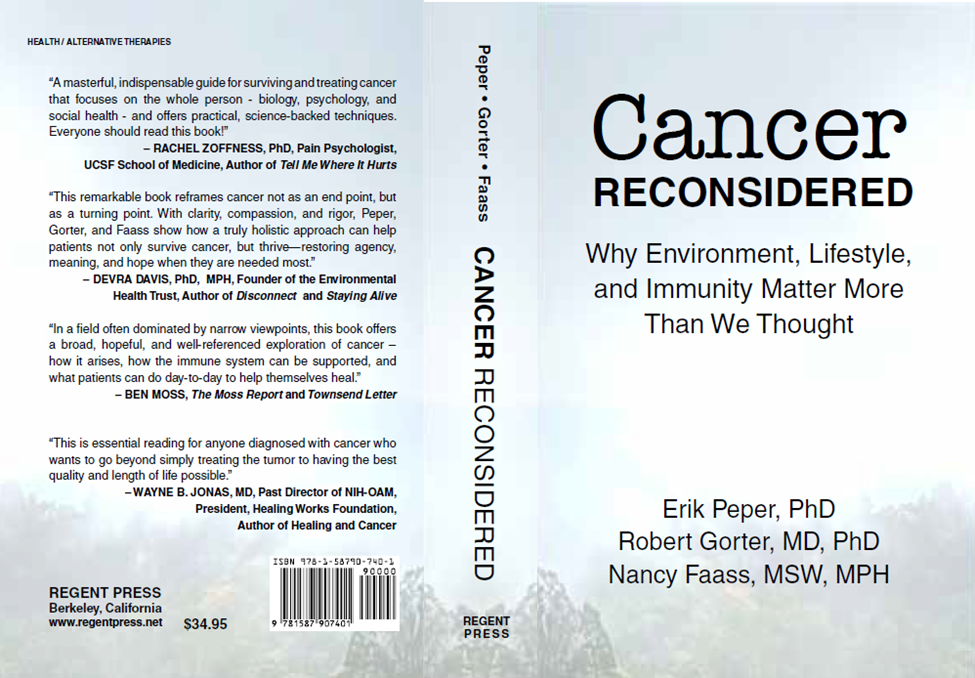
Read the new book, Cancer Reconsidered: Why Environment, Lifestyle, and Immunity Matter More than We Thought, by Erik Peper, Robert Gorter, and Nancy Faass. It explore the many of the lifestyle factors that can increase cancer risk—or help protect against it. The book brings together an extraordinary range of scientific research to illuminate how everyday habits and modern lifestyles influence cancer risk and healing. Drawing from both conventional medicine and integrative approaches, the authors thoughtfully examine the many factors involved in cancer causation while offering hopeful, evidence-based strategies for supporting recovery and restoring health.
What makes this book especially compelling is that it goes far beyond reviewing the science. It translates research into practical, everyday actions people can use to support healing and improve quality of life. At its heart is lifestyle medicine—the recognition that stress management, hope, physical activity, nourishing foods, supportive relationships, community, and resilience during times of crisis profoundly affect health and well-being. The book also offers a detailed and highly practical discussion of sugar metabolism and explains how continuous glucose monitoring sensors (CGMS) with the smartphone app can help people directly observe how specific foods and daily habits influence their blood sugar levels. Instead of relying on abstract nutrition advice, readers learn how to become active investigators of their own health.
Throughout the book, the message is empowering: our daily habits, social connections, attitudes, and environment may influence health as much as—if not more than—genetics alone. The book is available from Amazon: https://www.amazon.com/Cancer-Reconsidered-Environment-Lifestyle-Immunity/dp/1587907402
Listen to the in-depth discussion of this blog created with Google NotebookLM
Addition relevant blogs
References
American Diabetes Association. (2026). Blood glucose and exercise. American Diabetes Association. Retrieved May 24, 2026, from https://diabetes.org/health-wellness/fitness/blood-glucose-and-exercise
American Diabetes Association. (2024). Standards of care in diabetes—2024. Diabetes Care, 47(Suppl. 1). https://diabetesjournals.org/care/issue/47/Supplement_1
Bonaccio, M., Di Castelnuovo, A., Costanzo, S., Ruggiero, E., Esposito, S., Panzera, T., Di Costanzo, G., De Curtis, A., Magnacca, S., Cerletti, C., Donati, M. B., de Gaetano, G., & Iacoviello, L., for the Moli-sani Study Group. (2026). Ultra-processed food and mortality among long-term cancer survivors from the Moli-sani Study: Prospective findings and analysis of biological pathways. Cancer Epidemiology, Biomarkers & Prevention, 35(4), 664–674. https://doi.org/10.1158/1055-9965.EPI-25-0808
Dalamaga, M., Rozani, S., & Petropoulou, D. (2026). Why is colorectal cancer occurring earlier? Metabolic dysfunction, underrecognized carcinogens, and emerging controversies. Current Obesity Reports, 15(1), 24. https://doi.org/10.1007/s13679-026-00700-z
Ehrhardt, N., & Al Zaghal, E. (2020). Continuous glucose monitoring as a behavior modification tool. Clinical Diabetes, 38(2), 126–131. https://doi.org/10.2337/cd19-0037
Hall, K. D., Ayuketah, A., Brychta, R., Cai, H., Cassimatis, T., Chen, K. Y., Chung, S. T., Costa, E., Courville, A., Darcey, V., Fletcher, L. A., Forde, C. G., Gharib, A. M., Guo, J., Howard, R., Joseph, P. V., McGehee, S., Ouwerkerk, R., Raisinger, K., … Zhou, M. (2019). Ultra-processed diets cause excess calorie intake and weight gain: An inpatient randomized controlled trial. Cell Metabolism, 30(1), 67–77. https://doi.org/10.1016/j.cmet.2019.05.008
Lane, M. M., Gamage, E., Du, S., Ashtree, D. N., McGuinness, A. J., Gauci, S., Baker, P., Lawrence, M., Rebholz, C. M., Srour, B., Touvier, M., Jacka, F. N., O’Neil, A., Segasby, T., & Marx, W. (2024). Ultra-processed food exposure and adverse health outcomes: Umbrella review of epidemiological meta-analyses. BMJ, 384, e077310. https://doi.org/10.1136/bmj-2023-077310
Lauby-Secretan, B., Scoccianti, C., Loomis, D., Grosse, Y., Bianchini, F., & Straif, K. (2016). Body fatness and cancer—Viewpoint of the IARC Working Group. New England Journal of Medicine, 375(8), 794–798. https://doi.org/10.1056/NEJMsr1606602
Ludwig, D. S., & Ebbeling, C. B. (2018). The carbohydrate-insulin model of obesity: Beyond “calories in, calories out.” JAMA Internal Medicine, 178(8), 1098–1103. https://doi.org/10.1001/jamainternmed.2018.2933
Marino, P., Mininni, M., Deiana, G., Marino, G., Divella, R., Bochicchio, I., Giuliano, A., Lapadula, S., Lettini, A. R., & Sanseverino, F. (2024). Healthy lifestyle and cancer risk: Modifiable risk factors to prevent cancer. Nutrients, 16(6), 800. https://doi.org/10.3390/nu16060800
Menegassi, B., & Vinciguerra, M. (2025). Ultraprocessed food and risk of cancer: Mechanistic pathways and public health implications. Cancers, 17(13), 2064. https://doi.org/10.3390/cancers17132064
Morales-Brown, P. (2025, June 12). What is reactive hypglycemia. Medical News Today. Accessed May 24, 2026. https://www.medicalnewstoday.com/articles/reactive-hypoglycemia
Peper, E., Gorter, R., & Faass, N. (2026). Cancer reconsidered: Why environment, lifestyle, and immunity matter more than we thought. Biofeedback Health. https://www.amazon.com/Cancer-Reconsidered-Environment-Lifestyle-Immunity/dp/1587907402
Peyrot des Gachons, C., & Breslin, P. A. S. (2016). Salivary amylase: Digestion and metabolic syndrome. Current Diabetes Reports, 16, 102. https://doi.org/10.1007/s11892-016-0794-7
Scully, T., Ettela, A., LeRoith, D., & Gallagher, E. J. (2021). Obesity, type 2 diabetes, and cancer risk. Frontiers in Oncology, 10, 615375. https://doi.org/10.3389/fonc.2020.615375
Unwin, D., Khalid, A. A., Unwin, J., Crocombe, D., Delon, C., Martyn, K., Hasan, M., & Tobin, S. D. (2020). Insights from a general practice service evaluation supporting a lower carbohydrate diet in patients with type 2 diabetes mellitus and prediabetes: A secondary analysis of routine clinic data including HbA1c, weight and prescribing over 6 years. BMJ Nutrition, Prevention & Health, 3(2), 285–294. https://doi.org/10.1136/bmjnph-2020-000072
Vaezi, S., Freeling, J. L., de Vargas, B. O., Weidauer, L., Shoemaker, M. E., Sanders, W. M., & Dey, M. (2025). Impacts of minimally-processed omnivorous vs lacto-ovo-vegetarian diets on insulin sensitivity, lipid profile, and adiposity in older adults: Secondary findings from a randomized crossover feeding trial. Clinical Nutrition, 55, 90–103. https://doi.org/10.1016/j.clnu.2025.10.010
Improve your health: Lower your carbs
Posted: January 25, 2018 Filed under: Evolutionary perspective, Exercise/movement, Nutrition/diet, self-healing, Uncategorized | Tags: diet, metabolic syndrome, obesity, Type 2 diabetes 8 Comments
How come there is no disease caused by the absence of carbohydrates? This simple observation suggests that carbohydrates are not necessary for health and are not an essential food in our evolutionary history. This is different from vitamin C or other essential nutrients whose absence will cause scurvy and eventually death.
From an evolutionary perspective, simple carbohydrates, especially sugars and high-fructose corn syrup, are significant contributing factors to the increasing epidemic of obesity, type 2 diabetes, metabolic syndrome, coronary heart disease and many autoimmune disorders. The recommended nutritional guideline of the last forty years to reduce fats and increase carbohydrates were not based upon good science but on ideology influenced by agribusiness and the sugar industry (La Berge, 2008). The recommendations were WRONG AND HARMFUL (Taubes, 2016; see also: https://peperperspective.com/2017/02/18/read-the-case-against-sugar/). It may explains why the obesity epidemic is not caused by eating or drinking too many calories but the eating the wrong type of calories; namely, those found in simple carbohydrates and overly processed foods. The increase in obesity appears highly correlated with the US low-fat diet recommendations published in 1977 as shown in figure 1.
 Figure 1. Increase in U.S. obesity begins after the publication of the U.S. recommendations to eat a low-fat diet. Reproduced from National Center for Health Statistics (US). Health, United States, 2008: With Special Feature on the Health of Young Adults. Hyattsville (MD): National Center for Health Statistics (US); 2009 Mar. Chartbook
The harmful effects of the simple high carbohydrate diet amplified with a decrease in physical activity interacts with your genetics. People, with a family risk factors of metabolic syndrome (type 2 diabetes) can improve their health by eating a low carbohydrate diet with lots of vegetables, fruit and fats.
Watch the superb video lectures by Professor Timothy Noakes, an emeritus professor of exercise and sports science at the University of Cape Town and by Gary Taubes, science writer and author of The case against sugar. It may shift your perspective and improve your health.
Reference:
La Berge, A. F. (2008). How the ideology of low fat conquered America. Journal of the History of Medicine and Allied Sciences, Volume 63, Issue 2, 1 April 2008, Pages 139–177, https://doi.org/10.1093/jhmas/jrn001
National Center for Health Statistics (US). Health, United States, 2008: With Special Feature on the Health of Young Adults. Hyattsville (MD): National Center for Health Statistics (US); 2009 Mar. Chartbook
Taubes, G. (2016). The Case Against Sugar. Portobello Books. ISBN 978-0-307-70164-0
What the food companies forgot to tell you: For the sake of profits we promote metabolic syndrome, obesity and diabetes
Posted: May 23, 2015 Filed under: Nutrition/diet, Uncategorized | Tags: diabetes, diet, metabolic syndrome, obesity 5 CommentsShould a five year old be responsible for being obese?
Drinking diet sodas increases the urge to eat more!
Sugar is more addicting than cocaine!
Calories from sugar are NOT the same as calories from other types of foods.

As you are reaching for another diet soda, low fat yogurt, or low calorie dessert, you are compromising your health by increasing the risk for metabolic syndrome, diabetes and obesity. The artificial sugar substitutes increase feeling of hunger and encourage you to eat more while the low fat foods are made more appetizing by adding sugar (Lustig, 2012; Lustig et al, 2012). As sugar is more addicting than cocaine (Ahmed et al, 2013; Lenoir et al, 2013), how can you assign personal responsibility to young child who is obese with the statement, “You are responsible for being fat and for eating too much sugar laced foods!” Watch the superb documentary, Fed Up, based upon impeccable science. It explores America’s obesity epidemic and the food industry’s role in aggravating it. It systematically shows that everything we’ve been told about food and exercise especially by the food industry and federal government for the past 30 years is dead wrong. The documentary can easily be viewed from streaming video services such as Google Play, Netflix, or Amazon Prime Instant Video.
For the impact of sugar on health and the myth of self-responsibility, watch the 2013 TEDxBermuda talk, Sugar–the elephant in the kitchen, by Robert Lustig, MD, Professor of Clinical Pediatrics, University of California, San Francisco.
The movie, Fed UP, and Professor Lustig’s 2013Ted talk serve as a call to action to take control of the foods we serve and eat. Support policies to promote food health:
- Increase local taxes on every soft drink sold and use the income to support public health.
- Demand that schools and public institutions serve children real food and not sugar laced fast foods.
- Support policies that prohibit sales of soft drinks to minors just as alcohol is prohibited to minors.
- Eliminate all soft drinks from public institutions and work sites just as smoking is prohibited.
References
Ahmed, S. H., Guillem, K., & Vandaele, Y. (2013). Sugar addiction: pushing the drug-sugar analogy to the limit. Current Opinion in Clinical Nutrition & Metabolic Care, 16(4), 434-439.http://journals.lww.com/co-clinicalnutrition/Abstract/2013/07000/Sugar_addiction___pushing_the_drug_sugar_analogy.11.aspx
Fed Up.(2014). American documentary film directed, written and produced by Stephanie Soechtig.http://fedupmovie.com/#/page/home
Fowler, S. P., Williams, K., Resendez, R. G., Hunt, K. J., Hazuda, H. P., & Stern, M. P. (2008). Fueling the Obesity Epidemic?Artificially Sweetened Beverage Use and Long‐term Weight Gain. Obesity, 16(8), 1894-1900.http://onlinelibrary.wiley.com/doi/10.1038/oby.2008.284/full
Lenoir, M., Serre, F., Cantin, L., & Ahmed, S. H. (2007). Intense sweetness surpasses cocaine reward. PloS one, 2(8), e698.http://journals.plos.org/plosone/article?id=10.1371/journal.pone.0000698
Lustig, R. H. (2012). Fat chance: beating the odds against sugar, processed food, obesity, and disease. Penguin.
Lustig, R. H., Schmidt, L. A., & Brindis, C. D. (2012). Public health: The toxic truth about sugar. Nature, 482(7383), 27-29.http://www.nature.com/nature/journal/v482/n7383/full/482027a.html
 the peper perspective