Are you encouraging your child to get into accidents or even blind when growing up?
Posted: May 12, 2021 Filed under: ADHD, behavior, computer, education, ergonomics, Evolutionary perspective, Exercise/movement, laptops, Neck and shoulder discomfort, posture, screen fatigue, Uncategorized, vision | Tags: glaucoma, myopia, nearsightedness, palming 6 CommentsErik Peper and Meir Schneider
Adapted in part from: TechStress-How Technology is Hijacking our Lives, Strategies for Coping and Pragmatic Ergonomics by Erik Peper, Richard Harvey and Nancy Faass
As a young child I laid on the couch and I read one book after the other. Hours would pass as I was drawn into the stories. By the age of 12 I was so nearsighted that I had to wear glasses. When my son started to learn to read, I asked him to look away at the far distance after reading a page. Even today at age 34, he continues this habit of looking away for a moment at the distance after reading or writing a page. He is a voracious reader and a novelist of speculative fiction. His vision is perfect. –Erik Peper
How come people in preliterate, hunting and gatherer, and agricultural societies tend to have better vision and very low rates of nearsightedness (Cordain et al, 2003)? The same appear true for people today who spent much of their childhood outdoors as compared to those who predominantly stay indoors. On the other hand, how come 85% of teenagers in Singapore are myopic (neasighted) and how come in the United States myopia rate have increased for children from 25% in the 1970s to 42% in 2000s (Bressler, 2020; Min, 2019)?

Why should you worry that your child may become nearsighted since it is easy correct with contacts or glasses? Sadly, in numerous cases, children with compromised vision and who have difficulty reading the blackboard may be labeled disruptive or having learning disability. The vision problems can only be corrected if the parents are aware of the vision problem (see https://www.covd.org/page/symptoms for symptoms that may be related to vision problems). In addition, glasses may be stigmatizing and children may not want to wear glasses because of vanity or the fear of being bullied.
The recent epidemic of near sightedness is paritally a result of disrespecting our evolutionary survival patterns that allowed us to survive and thrive. Throughout human history, people continuously alternated by looking nearby and at the distance. When looking up close, the extraocular muscles contract to converge the eyes and the ciliary muscles around the lens contract to increase the curvature of the lens so that the scene is in focus on the retina — this muscle tension creates near visual stress.
The shift from alternating between far and near vision to predominantly near vision and immobility

Figure 2. The traditional culture of Hdzabe men in Tanzania returning from a hunt. Notice how upright they walk and look at the far distance as compared to young people today who slouch and look predominantly at nearby screens.
Experience the effect of near visual stress.
Bring your arm in front of you and point your thumb up. Look at your thumb on the stretched out arm. Keep focusing on the thumb and slow bring the thumb four inches from your nose. Keep focusing on the thumb for a half minute. Drop the arm to the side, and look outside at the far distance.
What did you experience? Almost everyone reports feeling tension in the eyes and a sense of pressure inside around and behind their eyes. When looking at the distance, the tension slowly dissipates. For some the tension is released immediately while for others it may take many minutes before the tension disappears especially if one is older. Many adults experience that after working at the computer, their distant vision is more fuzzy and that it takes a while to return to normal clarity.
When the eyes focus at the distance, the ciliary muscles around lens relaxes so that the lens can flatten and the extra ocular muscles relax so that the eyes can diverge and objects in the distance are in focus. Healthy vision is the alternation between near and far focus– an automatic process by which the muscles of the eyes tightening and relax/regenerate.
Use develops structure and structure limits use
If we predominantly look at nearby surfaces, we increase near visual stress and the risk of developing myopia. As children grow, the use of their eyes will change the shape of the eyeball so that the muscles will have to contract less to keep the visual object into focus. If the eyes predominantly look at near objects, books, cellphones, tablets, toys, and walls in a room where there is little opportunity to look at the far distance, the eye ball will elongate and the child will more likely become near sighted. Over the last thirty year and escalated during COVID’s reside-in-place policies, children spent more and more time indoors while looking at screens and nearby walls in their rooms. Predominantly focusing on nearby objects starts even earlier as parents provide screens to baby and toddlers to distract and entertain them. The constant near vision remodels the shape of eye and the child will likely develop near sightedness.
Health risks of sightedness and focusing predominantly upon nearby objects
- Increased risk of get into an accident as we have reduced peripheral vision. In earlier times if you were walking in jungle, you would not survive without being aware of your peripheral vision. Any small visual change could indicate the possible presence food or predator, friend or foe. Now we focus predominantly centrally and are less aware of our periphery. Observe how your peripheral awareness decreases when you bring your nose to the screen to see more clearly. When outside and focusing close up the risk of accidents (tripping, being hit by cars, bumping into people and objects) significantly increases as shown in figure 3 and illustrated in the video clip.
Pedestrian accidents (head forward with loss of peripheral vision)

Figure 3. Injuries caused by cell phone use per year since the introduction of the smartphone (graphic from Peper, Harvey and Faass,2020; data source: Povolatskly et al., 2020).
- Myopia increases the risk of eye disorder. The risk for glaucoma, one the leading causes of blindness, is doubled (Susanna, De Moraes, Cioffi, & Ritch, R. 2015). The excessive tension around the eyes and ciliary muscles around the lens can interfere with the outflow of the excess fluids of the aqueous humour through the schlemm canal and may compromise the production of the aqueous humour fluid. These canals are complex vascular structures that maintains fluid pressure balance within the anterior segment of the eye. When the normal outflow is hindered it would contribute to elevated intraocular pressure and create high tension glaucoma (Andrés-Guerrero, García-Feijoo, & Konstas, 2017). Myopia also increases the risk for retinal detachment and tears, macular degeneration and cataract. (Williams & Hammond, 2019).
By learning to relax the muscles around the lens, eye and face and sensing a feeling of soft eyes, the restriction around the schlemm canals is reduced and the fluids can drain out easier and is one possible approach to reverse glaucoma (Dada et al., 2018; Peper, Pelletier & Tandy, 1979).
- Increase in neck and upper back compression when the person cranes their head forward or looks down while reading books/articles, looking at a cellphone or a laptop screen, This often results in an increase of back, neck and shoulder pain as well as headaches (Harvey, Peper, Booiman, Heredia Cedillo, & Villagomez, 2018; Hansraj, 2014).
- Decrease in subjective energy and increase in helpless, hopeless, powerless and defeated thoughts when the person habitually looks down in a slouched position (Peper, Booiman, Lin, & Harvey, 2016; Peper, Lin, Harvey, & Perez, 2017).
WHAT CAN YOU DO?
The solutions are remarkable simple. Respect your evolutionary background and allow your eyes to spontaneously alternate between looking at near and far objects while being upright (Schneider, 2016; Peper, 2021; Peper, Harvey & Faass, 2020).
For yourself and your child
- Let children play outside so that they automatically look far and near.
- When teaching children to read have them look at the distance at the end of every paragraph or page to relax the eyes.
- Limit screen time and alternate with outdoor activities
- Every 15 to 20 minutes take a vision break when reading or watching screens. Get up, wiggle around, move your neck and shoulders, and look out the window at the far distance.
- When looking at digital screens, look away every few minutes. As you look away, close your eyes for a moment and as you are exhaling gently open your eyes.
- Practice palming and relaxing the eyes. For detailed guidance and instruction see the YouTube video by Meir Schneider.
Create healthy eye programs in schools and work
- Arrange 30 minute lesson plans and in between each lesson plan take a vision and movement breaks. Have children get up from their desks and move around. If possible have them look out the window or go outside and describe the furthest object they can see such as the shape of clouds, roof line or details of the top of trees.
- Teach young children as they are learning reading and math to look away at the distance after reading a paragraph or finishing a math problem.
- Teach palming for children.
- During recess have students play games that integrate coordination with vision such as ball games.
- Episodically, have students close their eyes, breathe diaphragmatically and then as they exhale slowly open their eyes and look for a moment at the world with sleepy/dreamy eyes.
- Whenever using screen use every opportunity to look away at the distance and for a moment close your eyes and relax your neck and shoulders.
BOOKS TO OPTIMIZE VISION AND TRANSFORM TECHSTRESS INTO TECHHEALTH
Vision for Life, Revised Edition: Ten Steps to Natural Eyesight Improvement by Meir Schneider.
YOUTUBE PRESENTATION, Transforming Tech Stress into Tech Health.
ADDITIONAL BLOGS THAT FOCUS ON RESOLVING EYES STREAN AND TECHSTRESS
REFERENCES
Bressler, N.M. (2020). Reducing the Progression of Myopia. JAMA, 324(6), 558–559.
Peper, E. (2021). Resolve eyestrain and screen fatigue. Well Being Journal, 30(1), 24-28.
Schneider, M. (2019). YouTube video Free Webinar by Meir Schneider: May 6, 2019.
Williams, K., & Hammond, C. (2019). High myopia and its risks. Community eye health, 32(105), 5–6.
Nutrition to support the Stress Response
Posted: April 17, 2021 Filed under: behavior, Evolutionary perspective, health, Nutrition/diet, stress management, Uncategorized | Tags: food 5 Comments
Let food be thy medicine and medicine be thy food
-Hippocrates, the Greek physician and father of medicine.
What should I eat? More greens, more Vitamin D, more fish, no meats, no grains, or should I become a vegetarian, go on a ketogenic diet, or evolutionary diet? There are so many options. What are the best choices?
The foods we eat provide the building blocks and energy source for our body. If you eat high quality foods, the body has the opportunity to create and maintain a healthy strong structure; on the other hand, if you eat low quality foods, it is more challenging to create and maintain a healthy body. The analogy is building a house. If the materials are high quality, the structure well engineered and well built, the house has the opportunity to age well. On the other hand, if the house is built out of inferior materials and poorly engineered, it is easily damaged by wind, rain or even earthquakes.
Although we are bombarded with recommendations for healthy eating, many of the recommendations are not based upon science but shaped by the lobbying and advertisement efforts of agribusiness. For example, the scientific recommendations to reduce sugar in our diet were not implements in the government guidelines. This demonstrates the power of lobbying which places profits over health.
Officials at the Department of Agriculture and the Department of Health and Human Services rejected explicit caps on sugar and alcohol consumption. Although “the preponderance of evidence supports limiting intakes of added sugars and alcoholic beverages to promote health and prevent disease.” (Rabin, 2020).
To make sense out of the multitude of nutritional recommendations, watch the superb presentation by Dr. Marisa Soski, ND, Nutrition to Support Stress Response.* She discusses how and what we eat has direct impact on how our bodies manage our reactions to stress.
*Presented April 16, 2021 at the Holistic Health Series on Fridays: Optimize Health and Well-Being Lecture Series. The series is sponsored by the Institute for Holistic Health Studies and Department of Recreation, Parks, Tourism, San Francisco State University.
Reference
Rabin, R.C. (2020). U.S. Diet Guidelines Sidestep Scientific Advice to Cut Sugar and Alcohol. The New York Times. https://www.nytimes.com/2020/12/29/health/dietary-guidelines-alcohol-sugar.html
Breaking the social bond: The immobilized face
Posted: October 13, 2020 Filed under: behavior, computer, digital devices, Evolutionary perspective, health, laptops, self-healing, stress management | Tags: baby, communication, non verbal communication, Tier Social Stress Test, zoom fatigue 5 CommentsAfter teaching for hours on Zoom, I feel exhausted. Zoom fatigue is real.
While talking to a close friend, all of a sudden his attention shifted from listening to me to looking his cellphone as he heard a notification. At that moment, I felt slightly left and hurt.
Students report that when they are are talking with friends and their friends look at their cellphone or responds to a notification they feel hurt and slightly dismissed. Even though most experience this break in social bonding, almost all do this with others. The looking at the phone is the conditioned stimuli to which we automatically respond when we feel it vibrate or even when we see it. We respond by shifting our attention to the phone in the same way that Pavlov’s dogs would salivate when they heard the bell that was conditioned with the food. On the average we now check our phones 96 times a day—that is once every 10 minutes and an increase of 20% as compared to two years ago (Asurion Research, 2019).
To feel SAFE is essential for growth and developing intimacy. We interpret being safe through the process of neuroception. Without conscious awareness our brain processes facial cues to identify if the interactions are safe or not safe. If safe, vigilance and sympathetic arousal is reduced and better communication is supported (Porges, 2017). On the other hand, if a person’s face is flat and non-responsive during a conversation, it may signal danger and trigger fight/flight in the person seeing the non-reactive face. This unconscious stress reaction to a non-responsive face is the basis of the Tier Social Stress Test. In this stress assessment, participants are asked to give a presentation and are also given an unexpected mental arithmetic test in front of an panel of judges who do not provide any feedback or encouragement (Allen et al, 2016)). Not receiving social feedback while communicating is one of the most stressful events –it is being stuck in social quicksand as there are no cues to know what is going on.
We wonder if the absence of confirmative facial feedback is a component of Zoom fatigue when presenting to a larger group in which you see multiple faces as small postage stamps or no face at all. In those cases, the screen does not provide enough covert facial and body feedback to know what is going on as you are communicating. The audience non-responsive faces may covertly signal DANGER, The decrease visual and auditory signals is compounded by:
- Technical issues due to signal bandwidth and microphone (freezing of the screen, pixilation of the display, breakup in sound, warbling of voice, etc.).
- Viewers sitting still and facially immobilized without reacting as they watch and listen.
- Time delay caused by participants turning on the microphone before speaking may be negatively evaluated by the listener (Roberts, Margutti, & Takano, 2011).
- Non-recognizable faces because the face and upper torso are not illuminated and blacked out by backlighting or glare.
- Lack of eye and face contact because the speaker or participant is looking at the screen and their camera is to the side, below or above their face.
- Multi-tasking by the speaker who simultaneously presents and monitors and controls the Zoom controls such as chat or screen share.
In normal communication, nonverbal components comprise a significant part of the communication (Lapakko, 2007; Kendon, 2004). We use many nonverbal cues (lip, eye, face, arm, trunk, leg and breathing movements) as well as olfactory cues to understand the message. In most group zoom meeting we only see the face and shoulders instead of an integrated somatic body response in a three-dimensional space as we look near and far. On the other hand, in front of the computer, we tend to sit immobilized and solely look at a two-dimensional screen at a fixed distance. As we look at the screen we may not process the evolutionary nonverbal communication patterns that indicate safety. Similarly, when child does not receive feedback as it reaches out, it often becomes more demanding or withdraws as the social bond is disconnected.

From: https://live.staticflickr.com/3724/11180721716_1baa040430_b.jpg
Communication is an interactive process that supports growth and development. When the child or a person reaches out and there is no response. The detrimental effect of interrupting facial responsiveness is demonstrated by the research of University of Massachusetts’s Distinguished University Professor of Psychology Edward Tronick (Goldman, 2010; Tronick et al, 1975).
How to maintain build social bonds
Recognize that being distracted by cellphone notifications and not being present are emotional bond breakers, thus implement behaviors that build social connections.
Zoom recommendations
- Arrange your camera so that your face and upper torso is very visible, there is no backlight and glare, and you are looking straight at the camera.
- Provide dynamic visual feedback by exaggerating your responses (nod your head for agreement or shake your head no for disagreement).
- When presenting, have a collaborator monitor Chat and if possible have them shift back and forth between share screen and speaker view so that the speaker can focus on the presentation.
- Use a separate microphone to improve sound.
- If the screen freezes or the sound warbles often an indication of insufficient bandwidth, turn off the video to improve the sound quality.
Social bonding recommendations
- Share with your friends that you feel dismissed when they interrupt your conversation to check their cell phone.
- When meeting friends, turn off the cell phone or put them away in another room so not to be distracted.
- Schedule digital free time with your children.
- During meal times, turn off cell phones or put them in another room.
- Attend to the baby or child instead of your cellphone screen.
For a detailed perspective how technology impacts our lives and what you can do about it, see our book, TechStress-How Technology is Hijacking our Lives, Strategies for Coping and Pragmatic Ergonomics (Peper, Harvey, & Faass, 2020). Available from: https://www.penguinrandomhouse.com/books/232119/tech-stress-by-erik-peper-phd/
References:
Asurion Research (November 19, 2019).Americans Check Their Phones 96 Times a Day.
Goldman, J.G. (2010). Ed Tronick and the “Still Face Experiment.” Scientific American, Oct 18.
Tronick, E., Adamson, L.B., Als, H., & Brazelton, T.B. (1975, April). Infant emotions in normal and pertubated interactions. Paper presented at the biennial meeting of the Society for Research in Child Development, Denver, CO.
Exploiting evolutionary traps: Netflix’s new movie, The Social Dilemma
Posted: September 20, 2020 Filed under: behavior, computer, digital devices, emotions, Evolutionary perspective, surgery, Uncategorized | Tags: addiction, anxiety, depression, evolutionary trap, Facebook, Google, Instagram, social media, suicide 1 Comment
Apple founder Steve Jobs didn’t let his kids use the iPad, or really any product their dad invented, As Steve Jobs stated, “They haven’t used it,” “We limit how much technology our kids use at home.” (Bilton, 2014).
In 2007, Bill Gates, the former CEO of Microsoft, implemented a cap on screen time when his daughter started developing an unhealthy attachment to a video game. He also didn’t let his kids get cell phones until they turned 14 (Akhtar & Ward, 2020).
What is it that these two titans of the tech revolution and the many Silicon Valley insiders know and discuss in the Netflix docudrama, The Social Dilemma?
They recognized the harm that occurs when monetary incentives are the singular driver to optimize the hardware (the look and feel of the cellphone) and much more important the software algorithms to capture the attention of the user. It is interesting that there are only two industries that label their customers as users, illegal drugs and software (Kalsim 2020).
The longer a user is captured by the screen, the more the user responds to notifications, the more the user clicks to other sites, the more money the corporation earns from its advertisers. The algorithms continuously optimize what the user sees and hears so that they stay captured. Thus, the algorithms are designed to exploit the evolutionary response patterns that allowed us to survive and thrive. Evolutionary traps occur when adaptive behaviors that were once successful become maladaptive or even harmful. When this occurs, cues that were protective or beneficial can lead to reduced health and fitness (Peper, Harvey & Faass 2020).
Companies exploit evolutionary traps for the purpose of improving profits. This potentially constitutes a major health risk for humanity. As quoted from the The Social Dilemma, “Your attention is the product that is being sold to advertisers”
Google, Facebook, Twitter, Instagram, Pinterest, and others are designed to be highly addictive and incorporate some of the following evolutionary traps (Peper, Harvey & Faass, 2020):
- We are wired to see artificial images and to hear reproduced sounds as real. The brain does not discriminate between actual and visual-auditory images that are artificial, which explains one aspect of our attraction to our phones, to binge-watching, and to gaming.
- We are wired to react to any stimuli that suggests potential danger or the presence of game animals. Whether the stimuli is auditory, visual, tactile, or kinesthetic, it triggers excessive arousal. This makes us vulnerable to screen addiction, because our biology compels us to respond.
- We are wired to attend to social information about power within our group, a major factor in social media addiction.
If you concerned about false news, political polarization, radicalization, increased anxiety, depression, suicides and mental health in people, watch Netflix, The Social Dilemma and the powerful presentation by Sacha Baron Cohen’s superb presentation, Never is Now, the 2019 Anti-Defamation League Leadership Award.
What makes this film so powerful is that it is told by the same people who were the designers, developers, and programmers for the different social media companies.

From: https://www.netflix.com/title/81254224
For an outstanding critique of social media and the power of Facebook, Twitter, and Google, watch Sacha Baron Cohen’s superb presentation at the 2019 Anti-Defamation League Leadership Award.
References:
Bilton, N. (Sept 10, 2014). Steve Jobs was a low-tech parent. New York Times.
Inna Khazan, PhD, interviews the authors of TechStress
Posted: August 18, 2020 Filed under: behavior, computer, digital devices, ergonomics, Evolutionary perspective, Exercise/movement, health, laptops, Neck and shoulder discomfort, Pain/discomfort, posture, stress management, Uncategorized, vision Leave a commentGo behind the screen and watch Inna Khazan, PhD, faculty member at Harvard Medical School and author of Biofeedback and mindfulness in everyday life: Practical solutions for improving your health and performance, interview Erik Peper, PhD and Richard Harvey, PhD. coauthors of the new book, TechStress-How Technology is Hijacking our Lives, Strategies for Coping and Pragmatic Ergonomics.
Dr. Inna Khazan interviews Dr. Erik Peper about his new book Tech Stress. We talk about some of the ways in which technology overuse affects our health and what we can do about it.
Dr. Inna Khazan interviews Dr. Rick Harvey about his new book Tech Stress, the way technology overuse can affect adults and children, and what we can do about it.
Ways to reduce TechStress
Posted: August 13, 2020 Filed under: ADHD, behavior, computer, digital devices, emotions, ergonomics, Evolutionary perspective, Exercise/movement, health, Neck and shoulder discomfort, Nutrition/diet, Pain/discomfort, posture, relaxation, self-healing, stress management, Uncategorized 5 CommentsWe are excited about our book, TechStress-How Technology is Hijacking our Lives, Strategies for Coping and Pragmatic Ergonomics, that was published August 25, 2020.
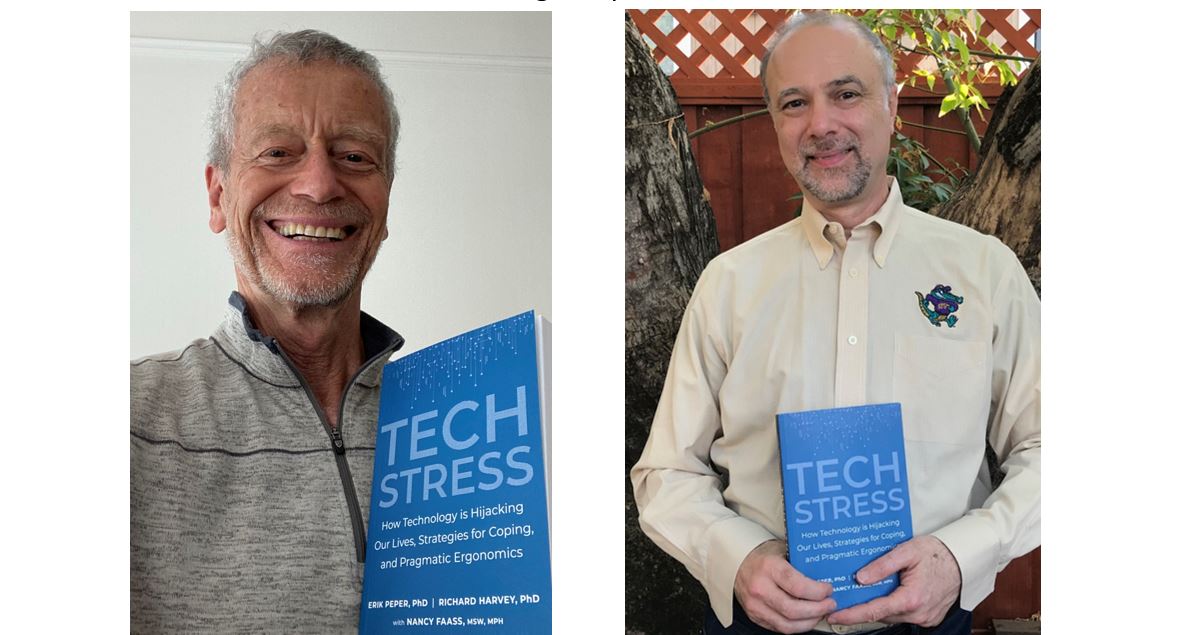
Evolution shapes behavior — and as a species, we’ve evolved to be drawn to the instant gratification, constant connectivity, and the shiny lights, beeps, and chimes of our ever-present devices. In earlier eras, these hardwired evolutionary patterns may have set us up for success, but today they confuse our instincts, leaving us vulnerable and stressed out from fractured attention, missed sleep, skipped meals, aches, pains, and exhaustion and often addicted to our digital devices.
Tech Stress offers real, practical tools to avoid evolutionary pitfalls programmed into modern technology that trip us up. You will find a range of effective strategies and best practices to individualize your workspace, reduce physical strain, prevent sore muscles, combat brain drain, and correct poor posture. The book also provides fresh insights on reducing psychological stress on the job, including ways to improve communication with coworkers and family.
Although you will have to wait to have the book delivered to your home, you can already begin to implement ways to reduce physical discomfort, zoom/screen fatigue and exhaustion. Have a look the blogs below.
How evolution shapes behavior
How to optimize ergonomics
Cartoon ergonomics for working at the computer and laptop
Hot to prevent and reduce neck and shoulder discomfort
Why do I have neck and shoulder discomfort at the computer?
Relieve and prevent neck stiffness and pain
How to prevent screen fatigue and eye discomfort
Resolve Eyestrain and Screen Fatigue
How to improve posture and prevent slouching
“Don’t slouch!” Improve health with posture feedback
How to improve breathing and reduce stress
Anxiety, lightheadedness, palpitations, prodromal migraine symptoms? Breathing to the rescue!
How to protect yourself from EMF
Cell phone radio frequency radiation increases cancer risk

Available from: https://www.penguinrandomhouse.com/books/232119/tech-stress-by-erik-peper-phd/
Evolutionary traps: How screens, digital notifications and gaming software exploits fundamental survival mechanisms
Posted: January 17, 2020 Filed under: ADHD, behavior, digital devices, emotions, Evolutionary perspective, Uncategorized | Tags: Aggression, CBT, depression, gaming, media, mental rehearsal 6 CommentsErik Peper and Richard Harvey
If athletes, psychologists, business executives, actors, students, politicians, job seekers and others use mental and actual rehearsal to improve their performances, would repeated watching of violent and aggressive streaming-videos, or playing hours and hours of first-shooter computer games be a form of rehearsal for aggressive behavior?
Arguably, mental and actual rehearsal is positively associated with improving health, such as preparing for an athletic competition or an academic exam and is negatively associated with health when playing aggressive, violent first-person shooter video games, or continuously watching aggressive or violent content on a variety of streaming platforms. Rehearsal–whether physical or in our imagination–impacts our health and performance in school, sports, therapy, politics, business and health. Choose to rehearse activities that improve health and well-being.
- Athletes use mental rehearsal to improve sports performance (Peper & Aita, 2017; Schenk & Miltenberger, 2019).
- Surgeons use mental rehearsal and actual practice to improve performance (Spiotta et al., 2018).
- Psychologists use cognitive behavioral therapy (CBT) rehearsal techniques to reduce anxiety and depression (Dobson & Dobson, 2018; Yamada et al, 2018; Cook, Mostazir, & Watkins, 2019)
- Successful business executives rehearse presentations before a staff meeting (Couch & Citrin, 2018).
- Actors and performers spend hours and days rehearsing their roles so that they portray and act it realistically during the performance .
- Students take practice exams so that they will perform better on the actual exam.
- Politicians, lawyers, and many others rehearse and practice being able to answer unexpected questions.
- Job seekers rehearse elevator pitches so that they transmit in a few words what is important
Mechanisms of rehearsal
Both mental and physical rehearsal strengthens neurochemical connections in the brain so that the rehearsed behaviors become more automated, fluid and unconscious. There is a saying in neurosciences, “Neurons that fire together wire together.” –the more you rehearse a task, the more those specific neurological pathways are strengthened, leading to automatic and efficient outcomes.
We now spend hours a day being exposed to digital displays on our phones, computers, gaming consoles and other digital devices, immersing ourselves in content reflecting life promoting, positive behavior and sometimes violent, negative behavior. Children and adults spend much of their free time looking at screens, texting, playing computer games, updating social media sites with moment by moment accounts of sometimes trivial activities, or going down the rabbit hole by following one hyperlinks after another. As we do this, we are unaware how much time has frittered away without actually doing anything productive. Below are some recent estimates of ‘daily active user’ minutes per day that uses a screen.
- Facebook about an hour per day
- Instagram just under an hour per day
- Texting about 45 minutes per day
- Internet browsing, about 45 minutes per day
- Snapchat, about 30 minutes per day
- Twitter, about 25 minutes per day
Adolescents interact with media for over 40 hours per week, or around 6 hours per day!
In spending much of our time with the screens, we rehearse a variety of physical body postures as well as a variety of cognitive and behavioral states that impact our physical, mental, emotional and social health. Many researchers have lamented the loss of some social skills that develop during physical face-to-face contact. The colloquial phrase, Use it or lose it, raises several questions about what is being lost when we spend so much of our waking time interacting with screens instead actually with other people?
It is almost impossible not to be distracted by the digital screen. The powerful audiovisual formats override our desire to do something different that some of us become enslaved to watching streaming videos, playing computer games or texting. Moreover, the ongoing visual and auditory notifications from our apps interrupts and/or capture our attention. Why is it difficult to turn away from visual or auditory stimuli? The answer has roots in our survival.
To attend to stimuli is an automatic evolutionary survival response. If we did not attend, we would not survive–Is the slight movement to the far right, just at the edge of our peripheral vision, a predator ready to attack?

Tiger in Kanha National Park, Madhya Pradesh, India
Each time a stimulus occurs, we need to check it out to see if it is friend or foe, safety or danger. The response is so automatic that we are unaware that we have reacted until after we have responded. We all have experienced this. When a computer screen or cellphone screen is held by the stranger next to us, we automatically look at their screen and we may even begin to read their emails. Although we know that peering at some else’s screen is not proper, we are still feel compelled to do it!
Similarly, screens displaying computer games and other media can capture or hijack our attention by the rapid scene changes, primarily because the content is programmed so we receive intermittent rewards for our responses. For example, the sound or visual notifications from our apps, cellphone messages, or social media trigger an impulse to scan the environment for information that may be critical to our survival. Even without receiving notifications, we may anticipate or project that there may be new information on our social media accounts, and sometimes we become disappointed when the interval between notifications is long. One student talking to another might say: “Don’t worry, they’ll respond; It’s only been 30 seconds.” Anticipating responses from the media can interrupt what we are otherwise doing. For example, rather than finish our work, we check for updates on social media, even though we probably know that there are no new important messages to which we would have to respond right away.
The mechanisms that help us survive by scanning our environment for predators may now become an evolutionary trap and is exploited to capture as many eyeballs as possible to increase market share, advertising revenue, and corporate bottom line.
We usually blame the individual for lack of self-control instead of blaming the designers of the digital apps, games and displays who have exploited this biological survival mechanism. We expect that children have voluntary control as their brains are developing–but how could they not react to the stimuli that for thousands of generations, helped them to survive. It is similar to asking children to have control and say “No” to fast foods and sweets. The foods that were previously necessary for survival represented by moderate amounts of ‘salt, fat, acid, heat and sweet’ tastes are often found in excess in our modern commercial or packaged ‘fast food nation’ making it likely that people may fall into an evolutionary trap related to what they eat.
Presently, high levels of exposure to violent and aggressive streaming videos and computer games can be harmful as they provide the practice to rehearse violence, killing and aggression mentally. It would be too strong a statement to assert that everyone who plays violent video games will become delinquent, criminal or homicidal in an extreme form of aggression. According to the American Psychological Association Task Force on Video Game Violence in 2017, it may be asserted that high frequency, long duration, high intensity interactions with violent video games or similar media content is highly associated with angry and aggressive thoughts, desensitization to violence, and decreases in empathy or helping others (Calvert et al., 2017). Some forms of social media interactions also lead to a form of social isolation, loneliness (phoneliness) (Christodoulou, G., Majmundar, A., Chou, C-P, & Pentz, M.A., 2020; Kardaras, 2017). Digital content requires the individual to respond to the digital stimuli, without being aware of the many verbal and nonverbal communication cues (facial expressions, gestures, tone of voice, eye contact, body language, posture, touch, etc) that are part of social communication (Remland, 2016). It is no wonder that more and more adolescents experience anxiety, depression, loneliness, and attention deficit disorders with a constant ‘digital diet’ that some have suggested include not only media, but junk food as well .
The negative impact of watching digital media was prescient by Jerry Mander, one of the leading visionaries of the 20th century, in his 1978 book, Four Arguments for the Elimination of Television, as well as by Joseph C. Pearce, author of books on human development and child development, in his 1993 book, Evolution’s End.
More recently, two superb books detail the harm that the digital revolution has brought, along with recommended strategies for how to use modern technologies wisely and live successfully in an e-world. We are not saying to avoid the beneficial parts of the digital age. We are saying to be aware how some material and digital platforms prey upon our evolutionary survival mechanisms. Unfortunately, most people —especially children– have not evolved skills to counter the negative impacts of some types of media exposure. It may take parental control and societal policies to mitigate the damage and enhance the benefits of the digital age. We highly recommend the following two books.
Glow Kids by Nicholas Kardaras, PhD describes the impact of excessive texting and computer gaming as well as strategies how to use digital media wisely
Deep Work by Cal Newport, PhD describes the impact of constant interruptions and offers rules for focused success in a distracted world.

References:
Kardaras, N. (2017). Glow Kids, New York: St. Martin’s Griffin
Newport, C. (2019). Deep Work. New York: Grand Central Publishing
Pearce, J. C. (1993). Evolution’s End. New York: Harper One
Reduce the risk for ADHD: Breastfeed your baby
Posted: June 30, 2018 Filed under: ADHD, Evolutionary perspective, Nutrition/diet, Uncategorized | Tags: allergic rhinitis, asthma, breastfeeding, breastmilk, exzema, infants 3 Comments
In a superb meta-analysis, Professor Ping-Tao Tseng and colleagues (2018), found that breast feeding reduces the risk of ADHD. The longer the breast feeding was the sole food source, the lower the risk of ADHD. Read the complete article, Material breastfeeding and attention-deficit/hyperactivity disorders in children: a meta-analysis.
One should not be surprised by this finding– breastmilk has been the primary food source for babies since the dawn of human evolution. To accept that formula is as good as breast milk is foolish. Breast milk provides the essential nutrients for infants’ growth, contains the appropriate fatty acids for brain development, and the bioactive factors to protect the baby against disease (Oddy, 2001). It modulates the sleep wake cycle since the evening breast milk contains nucleotides that promote baby’s sleep which are different from morning breast milk that promotes wakefulness (Sanchez et al, 2009). In addition, it reduces the risk of asthma, eczema, and allergic rhinitis (Lodge et al, 2015). Despite the commercial advertisements that formal is as good as breast milk, it contributes to neural malnutrition. That babies do develop with formula is a remarkable demonstration of human adaptability.
Food is our building blocks. When we consume low quality foods, we may increase the risk of developing illness. This is analogous to using superb building materials when constructing a house as the building is more resilient and may better survive the assault from the environment such as termites, storms, or earthquakes than if built from inferior materials.
People, businesses and government have a choice. We can pay the upfront costs to support women to breastfeed their babies for a year by providing paid leave from their jobs or pay much higher long term costs to remediate and treat the deficiencies induced by not supporting breast feeding.
If you are concerned about your child’s future health and want to reduce the risk of ADHD, asthma, eczema, or allergic rhinitis there is only one recommendation: Breast feed your baby for a long time period.
References
Timing affects health and productivity
Posted: March 10, 2018 Filed under: behavior, education, emotions, Evolutionary perspective, Uncategorized | Tags: behavioral economics, chronobiology, emotions, mood, performance, productivity Leave a commentHave you experienced that your attentions is more focused in the morning than late afternoon?
Have you wondered what is the best time in the day to have a job interview?
Is it better to have an operation in the morning or in the afternoon?
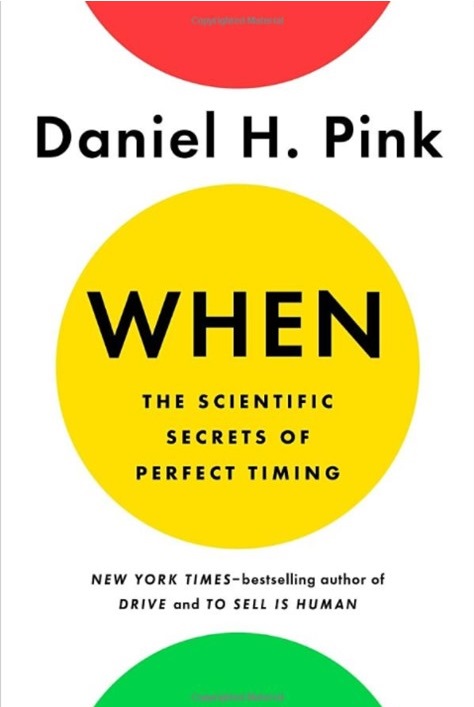
These and many other questions are explored in the superb book by Daniel Pink, When-The scientific secrets of perfect timing. This book reviews the literature of chronobiology, psychology, and behavior economics and describes the effect of time of day on human behavior. For example, students do significantly better if they take math tests in the morning than late afternoon or parolees have a much higher chance of being paroled early morning or right after the judge has taken a break than before lunch or late afternoon. Read Pink’s book or watch his JCCSF presentation and use the information to change your own timing patterns to optimize your health and performance.
 the peper perspective
