Listen to Revisionist History-A podcast series from Malcolm Gladwell
Posted: June 22, 2017 Filed under: Uncategorized | Tags: history, Interpretation, Malcolm Gladwell 3 Comments Each week I look forward to listening to a new episode by Malcom Gladwell’s podcast Revisionist History. Malcolm Gladwell is the author of five New York Times bestsellers — The Tipping Point, Blink, Outliers, and David and Goliath. In the podcasts he goes back in history and reinterpret something from the past. He offers a new perspective which illuminates the present. Take time to listen to the podcast on your cellphone or computer. His revisionist’s interpretation will shed a different perspective on present days’ events. It even gave me a new understanding why some people vote against their own self-interest. His podcast can be downloaded from: http://revisionisthistory.com/seasons
Winning the Gold in weight lifting-Using biofeedback, imagery and cognitive change*
Posted: June 12, 2017 Filed under: Uncategorized | Tags: biofeedback, electromyography, Imagery, peak performance, visualization, weight lifting 5 CommentsErik Peper [1], [2] and Jo Aita
“It was the best meet of my life.” -Jo Aita
Setting a personal best and winning the Gold medal is a remarkable feat. Jo Aita, age 46 and weighing 58 kg, set the Masters World Records and Masters Games Records in Snatch, Clean & Jerk and Total Olympic weight lifting at the World Masters Games in Auckland, New Zealand, April 26th, 2017. She lifted 71 kg in the Snatch and 86 kg in the Clean and Jerk Olympic lifts in the 45-49-year-old age group (see video in figure 1). What makes this more remarkable is that her combined lifts were 3 kilograms more than her life-time best in previous competition. She refuted the conventional wisdom that weight lifters peak in their mid to late twenties. There is hope for improvement as aging may not mean we have to decline.
Figure 1. Video of Jo Aita successful lift at the World Masters Games in Auckland, NZ., April 26, 2017.
There are many factors–and many more which we do not know–which contribute to this achievement such as genetics, diligent training and superb coaching at the Max’ Gym in Oakland as a member of Team Juggernauts. In the last three years, Jo Aita also incorporated biofeedback and visualization training to help optimize her performance. This report summarizes how breathing and electromyography feedback combined with imagery may have contributed to achieving her personal best[3]. As Jo Aita stated, “I recommend this to everyone and hope that you can work with athletes in my gym.”
Components of the 30 sessions of biofeedback, internal language and visualization training program
The training was started in September 2014 to reduce anxiety and improve performance. The components embedded in the training are listed sequentially; however, training did not occur sequentially. They were dynamically interwoven throughout the many sessions and augmented with homework practices, as well as storytelling of other people achieving success using similar approaches. The major components included:
1. Mastering effortless slow diaphragmatic breathing in which the abdomen expanded during inhalations and constricted during exhalation. The respiration feedback and training was recorded with BioGraph Infinity respiration sensors and recorded from the abdomen and upper chest. Her homework included monitoring situations where she held her breath and then anticipate breath holding by continuing to breathe. She also practiced slower breathing with heart rate variability feedback from a Stress Eraser. Practicing these allowed her to become centered and regenerate more quickly. As she stated, “It helped me during the day when I am anxious to calm down.” Throughout the training, the focus was to use breathing to rapidly regenerate after exertion especially after training.
2. Learning to relax her shoulder muscles with electromyography (EMG) feedback to regenerate and learn awareness of minimal trapezius muscle tension. She could use this awareness to identify her emotional reactivity (Peper, Booiman, Lin, & Shaffer, 2014). Often emotional reactivity increases muscle tension. She learned to relax here muscles quickly after muscle contractions to allow regeneration
3. Experiencing how cognition affect performance. This was initially demonstrated by arm resistance test. In this experiential practice, she extended her arm and attempted to resist the downward pressure applied to her wrist while she recalled either a hopeless, helpless, powerless or defeated memory or an empowered positive memory (for detailed description see, Gorter and Peper, pp 186-188, 2011). When she recalled the powerless memory she was significantly weaker than when she recalled the empowering memory. This experience demonstrated to her the power of her thoughts.
4. Rewriting failure into success. Each time she missed the lift, she would think, “I should not have done that,” or “I was doubtful or nervous during competition,” she shifted her focus to:
- Accepting what happened by acknowledging she did the best she could have done under the circumstances.
- Exploring how she could have done it differently and imagine herself doing it in the new optimum way.
- Using the trigger of the beginning thought of failure or defeat to evoke the new empowering memory thus interrupting the chained behavior.
The underlying concept was that what we mentally rehearse is what we may become and that our thoughts affect performance which she previously experienced by the arm resistance test. If you keep thinking about a defeat you are training the physiological pattern of defeat. This practice of transforming self-defeating thoughts into empowering thoughts can be applied to all phases of one’s life and was continued throughout the training sessions. The focus was to acknowledge and realize that whatever you did, it was the only thing you could have done because you did not yet have the skills to do it differently. She would then create a new strategy of mental rehearsal that lead to a positive outcome (for detailed description of this practice see Peper, Harvey, Lin, & Duvvuri, 2014).
5. Identifying whether imagery rehearsal is somatically connected. It is our bias that imagery rehearsal is useful if the body responds in a similar pattern when the person images the task as it would during an actual activity (Hall, 2001; Peper et al, 2015). The concurrent physiological activity would indicate that the person is experientially involved in the task and not just observing as a witness/second party.
Her performance is weightlifting and this would involve major muscle activity. Surface EMG was recorded from muscles that would be activated during the actual performance of the task to identify if they would be activated during mental rehearsal. The muscle activity during mental rehearsal is usually at a much smaller amplitude than that occurred during actual physical performance; however, should follow a similar timing sequence. In our experience there are three responses:
- Muscle activity in the appropriate muscles that are in the same timing as in and actual performance. This implies that mental rehearsal is actually training the motor pattern and facilitate performance. Thus continue practicing with mental rehearsal.
- Muscle activity in the appropriate muscles are not generally in the same timing sequence as the actual performance. This may mean that the person was performing too slow or was skipping sequences in the mental rehearsal and mental training may not be useful. The person needs to master and exhibit the same muscle pattern during mental rehearsal as during actual performance of the task.
- No muscle activity or inappropriate muscle activity during the during the mental rehearsal. This implies that during mental rehearsal there is no motor pattern training and the approach would not be useful unless the person learned to activate appropriate motor activity. It is possible that some people who have experienced past traumas may have coped by shutting off feelings and sensations in their bodies.
When Jo Aita initially practiced mental rehearsal while being monitored with surface EMG recorded with Myoscan Pro sensors (filter set narrow 100-200Hz) from the right and left upper trapezius muscles, there was no corresponding muscle activity as shown in Figure 2. Although she imaged, she did not feel/experience the lifting. The training focused upon reconnecting imagery and body experience.

Figure 2. Left and right upper trapezius EMG showed no increase in activity while Jo Aita mentally imaged performing her lift.
6. Integrating imagery and body experience with EMG. After identifying that imagery did not elicit concurrent muscle activity, the training focused on developing the imagery muscle connection. The training consisted of:
- Monitoring EMG activity from her right and left quadriceps and right and left upper trapezius muscle and have her simulate her actually lifting in practice and competition by going through the complete sequence which included standing and waiting till her name was called, caulking her hands, performing a ritual activity to be ready to lift the weights, lifting the weights, and releasing them. The pattern is shown in Figure 3.

Figure 3. Simulating the actual Snatch and Jerk lift (Clean is lifting the weights to the chest and punching Jerk is pushing the weigh upward is labelled).
- Practicing imagery by going through the same procedure and purposely slightly activating the movements which were necessary to lift the weight. As she stated, “I learned to do mental rehearsal in a more structured way and visualized the total sequence from chalking up to doing all six lifts”. This was monitored by the EMG to see that there occurred EMG activation of the muscles. This was repeated numerous times till, the activation occurred in imagery as shown in Figure 4.[1]

Figure 4. EMG activity during mental rehearsal.
She then reported that imagery was a real experience.
7. Training mental rehearsal and imagery for peak performance (Cumming, Hall, & Shambrook, 2004). The major components of the mental rehearsal focused upon performing perfectly, visualizing lifting more weight easily than actually lifted in the gym, performing in the gym as she would during competing, practicing performing when interruptions occurred, and punching the weight through the ceiling.
- Performing perfectly. During the day she would mentally rehearse practicing lifting perfectly. In addition, as part of her readiness routine she would image performing the lift perfectly.
- Practicing recovery and being centered when interruptions would occur. For example, she was asked to role play competition and waiting for the judge to give the signal to start, I delayed giving her the signal to begin and told her the weights had to be adjusted because they had miss-loaded the bar. This way there would be no novelty during actual competition. This concept of coping with the unexpected was illustrated by Michael Phelps swimming the 200-meter butterfly in 2012 Being Olympics when his googles filled up with water when he dove in. Michael still won his 10th gold medal even though he swam part of the race blind (Fanning, E., June 25, 2012). He could do this because numerous time in the past, his coach had purposely trained Michael to swim with leaking googles
- Imagining lifting 10 kg more while competing. The concept of feeling/imagining yourself performing more that you can do at this moment creates the possibility for improvement since the limits of imagination may limit the experience/performance. As she reported, “This was incredibly helpful last year in competition when I needed to lift more than I had done before to qualify for the American Open, so I had mentally done it so often, then I just did it and made the qualifying lift.”
- Feeling your arms extending way up into the ceiling. Extending beyond your mental boundary of the test allows more power because the body tends to stop at the boundary. For example, when running 100 meters you want to see the finish line at least ten meters beyond the actual finish line this way you continue to run at maximum speed through the finish. If you focus on the actual finish line, you often slow down before reaching it. I told her how we used this concept with young male gymnasts to be able to do the iron cross for the first time by thinking of their arms being an iron beam and extending through the rings into the wall. In the case of lifting, you want to feel yourself punching the weight through the ceiling instead of just driving it upward. This portion of the lift when punching up into the ceiling is call the Jerk. This concept was experientially demonstrated by the following Aikido exercise of the iron arm.
Two people pair up and face each other. One stretches his arm straight out and rests the wrist and back of the palm on the shoulder of his partner. The partner put both hands on the elbow and then then pulls down trying to bend the elbow while his partner is try resist the downward force and try not to bend it as shown in Figure 5. 
Figure 5. Testing the effect of imagery on resisting downward pull at the elbow with wrist facing palm up.
Then relax, and repeat the same exercise except the person imagines that his arm is like a metal bar extending from their shoulders out through his hand into the wall. Once the person is imaging this, then the partner again attempts to bend the arm.
In almost all cases, when the person imagines the arm extending like an iron bar into the wall, it is much stronger and much more difficult to bend. Jo integrated this felt imagery in her lifting during practice and she experienced increased strength while imagining/feeling the iron bar and reported that she had the “best Jerks in her life.”
Discussion
Achieving a new world and personal record at age 46 in the master’s competition is a remarkable tribute to the athlete’s dedication and coaching. Although I (EP) may think I contributed, and hopefully what I taught was beneficial, in the end it is the athlete herself who has to perform in the competition–she is alone stands on the platform to lift the weights. When I (EP) asked whether the biofeedback visualization training was useful, Jo inequitably said, “Yes, and I would recommend this approach and training to everyone!” Watch the in-depth interview with Jo Aita in which she describes her experience of integrating imagery techniques and biofeedback to enhance performance on May 26, 2017.
What is interesting to ask is, how come a 46-year-old woman could lift 3 kg more than at any other time during her competitive career of Olympic lifting? It gives hope that loss of strength that commonly occurs as we age may be due less to aging than to learned disuse, injuries and lack of recovery. Most important factors are personal motivation and hope—you want to perform your best and know/believe that it is possible (Wilson and Peper, 2011). As Jo stated, “It helped for me to focus on doing my personal best.” I love Olympic lifting, I like taking care of my body, and I like feeling strong.” Finally, Jo is a recent athlete in her sport. She started lifting when she was 33 and competed one year later. She then took time out to give birth to her son and in a couple of months came back quickly and continued to become stronger. As she stated, “I always wanted to get stronger no matter what my age was.”
From a performance perspective it is interesting that she lifted more than ever before. Would it be possible that she is similar to many performers who achieve maximum performance after about 10 to 15 years of dedicated training? As she gets older, she improves her skills, increases efficiency of here muscles and neural connections. Is a possible that loss of performance as we age less due to aging than loss of motivation after years of practice, competition and achieving your goal. At that point life may offer other challenges and new opportunities.
* This blog was adapted and expanded from: Peper, E. & Aita, J. (2017). Winning the Gold in Weightlifting Using Biofeedback, Imagery and Cognitive Change. Biofeedback, 45(4), 77–82. DOI: 10.5298/1081-5937-45.4.01 https://biofeedbackhealth.files.wordpress.com/2018/02/a-winning-the-gold-in-weightlifting-published.pdf
References
Cumming, J., Hall, C., & Shambrook, C. (2004). The influence of an imagery workshop on athletes’ use of imagery. Athletic insight, 6(1), 52-73.
Fanning, E. (June 25, 2012). 50 stunning Olympic Moments No 42: Michael Phelps goes big in Being. Downloaded May 30, 2017 from https://www.theguardian.com/sport/blog/2012/jun/25/50-stunning-olympic-moments-michael-phelps
Gorter, R. & Peper, E. (2011). Fighting Cancer-A Non Toxic Approach to Treatment. Berkeley: North Atlantic.
Hall, C. (2001). Imagery in sport and exercise. In R. Singer, H. Hausenblas, & C. Janelle (Eds.), Handbook of Sport Psychology (pp. 529 – 549). New York, NY: John Wiley & Sons, Inc.
Peper, E., Harvey, R., Lin, I-M, & Duvvuri, P. (2014). Increase productivity, decrease procrastination and increase energy. Biofeedback, 42(2), 82-87.
Peper, E., Booiman, A., Lin, I-M., & Shaffer, F. (2014). Making the Unaware Aware-Surface Electromyography to Unmask Tension and Teach Awareness. Biofeedback.42(1), 16-23.
Footnotes:
[1] Correspondence: Erik Peper, Ph.D., Institute for Holistic Health Studies, Department of Health Education, San Francisco State University, 1600 Holloway Avenue, San Francisco, CA 94132. email: epeper@sfsu.edu; web: www.biofeedbackhealth.org; blog: www.peperperspective.com
[2] We thank Dr. Sue Wilson for her helpful and constructive feedback.
[3] We purposely use the word “may” because it is a case report and not a controlled study. Coaches, sport psychologist, or anyone who has had contact with an athlete who does extremely well usually claims that their suggestions were the magic ingredient; however, it could be synchronicity and not due to the actual skills taught. It may be due to unidentified factors or covert factors embedded in the coaching or teaching such as transforming hope and belief.
[4] Be aware that when people learn to reconnect with their body or learns slow diaphragmatic breathing and allow their lower abdomen to relax and expand, it is possible that past traumatic memories could be released. This release is a healthy process and we usually adapt an Autogenic Therapy/Training perspective by which the person accepts, allows discharge and continues with the task at hand.
Enjoy laughter-It’s healing
Posted: April 21, 2017 Filed under: Uncategorized | Tags: health, humor, laughter, pain, stress management Leave a commentJoy and laughter are healing and contagious (Wang, 2006). When we laugh, our mood lightens, we feel better and our health improves (Bennett & Lengacher, 2006a; Bennett & Lengacher, 2006b; Bennett & Lengacher, 2008; Bennett & Lengacher, 2009). As Norman Cousins, who had ankylosing spondylitis (a degenerative disease causing the breakdown of collagen) which left him in severe pain that even morphine couldn’t touch, claimed that 10 minutes of belly laughter would give him two hours of pain-free sleep. He documented his remarkable recovery in his book Anatomy of an illness (Cousins, 2005). Laughter and joy has the ability to transform your health.
Despite the challenges you may face, the actual troubles that may occur during the day, or feeling frustrated or depressed, treat yourself to a moment of joy and laughter. Through laughing, we relax and support the intrinsic self-healing processes in our body. Even in suffering we have a choice of what to feed our brain. Enjoy watching the following videos.
Finally, watch Norman Cousins describe his own healing experience: https://www.youtube.com/watch?v=0LwKd68S15I
Also see the embedded videos posted on: http://www.laughteronlineuniversity.com/norman-cousins-a-laughterpain-case-study/
References:
Wang, S. (2006). Contagious behavior. American Psychological Society Observer, 19(2), 22-26.
Freeing the neck and shoulders*
Posted: April 6, 2017 Filed under: Neck and shoulder discomfort, self-healing, Uncategorized | Tags: computer, flexibility, Holistic health, neck pain, relaxation, repetitive strain injurey, shoulder pain, somatic practices, stress 5 CommentsStress, incorrect posture, poor vision and not knowing how to relax may all contribute to neck and shoulder tension. More than 30% of all adults experience neck pain and 45% of girls and 19% of boys 18 year old, report back, neck and shoulder pain (Cohen, 2015; Côté, Cassidy, & Carroll, 2003; Hakala, Rimpelä, Salminen, Virtanen, & Rimpelä, 2002). Shoulder pain affects almost a quarter of adults in the Australian community (Hill et al, 2010). Most employees working at the computer experience neck and shoulder tenderness and pain (Brandt et al, 2014), more than 33% of European workers complained of back-ache (The European Agency for Safety and Health at Work, 2004), more than 25% of Europeans experience work-related neck-shoulder pain, and 15% experience work-related arm pain (Blatter & De Kraker, 2005; Eijckelhof et al, 2013), and more than 90% of college students report some muscular discomfort at the end of the semester especially if they work on the computer (Peper & Harvey, 2008).
The stiffness in the neck and shoulders or the escalating headache at the end of the day may be the result of craning the head more and more forward or concentrating too long on the computer screen. Or, we are unaware that we unknowingly tighten muscles not necessary for the task performance—for example, hunching our shoulders or holding our breath. This misdirected effort is usually unconscious, and unfortunately, can lead to fatigue, soreness, and a buildup of additional muscle tension.
The stiffness in the neck and shoulders or the escalating headache at the end of the day may be the result of craning the head more and more forward or concentrating too long on the computer screen. Poor posture or compromised vision can contribute to discomfort; however, in many cases stress is major factor. Tightening the neck and shoulders is a protective biological response to danger. Danger that for thousands of years ago evoke a biological defense reaction so that we could run from or fight from the predator. The predator is now symbolic, a deadline to meet, having hurry up sickness with too many things to do, anticipating a conflict with your partner or co-worker, worrying how your child is doing in school, or struggling to have enough money to pay for the rent.
Mind-set also plays a role. When we’re anxious, angry, or frustrated most of us tighten the muscles at the back of the neck. We can also experience this when insecure, afraid or worrying about what will happen next. Although this is a normal pattern, anticipating the worst can make us stressed. Thus, implement self-care strategies to prevent the occurrence of discomfort.
What can you do to free up the neck and shoulder?
Become aware what factors precede the neck and shoulder tension. For a week monitor yourself, keep a log during the day and observe what situations occur that precede the neck and should discomfort. If the situation is mainly caused by:
- Immobility while sitting and being captured by the screen. Interrupt sitting every 15 to 20 minutes and move such as walking around while swinging your arms.
- Ergonomic factors such as looking down at the computer or laptop screen while working. Change your work environment to optimize the ergonomics such as using a detached keyboard and raising the laptop screen so that the top of the screen is at eyebrow level.
- Emotional factors. Learn strategies to let go of the negative emotions and do problem solving. Take a slow deep breath and as you exhale imagine the stressor to flow out and away from you. Be willing to explore and change ask yourself: “What do I have to have to lose to change?”, “Who or what is that pain in my neck?”, or “What am I protecting by being so rigid?”
Regardless of the cause, explore the following five relaxation and stretching exercises to free up the neck and shoulders. Be gentle, do not force and stop if your discomfort increases. When moving, continue to breathe.
1. WIGGLE. Wiggle and shake your body many times during the day. The movements can be done surreptitiously such as, moving your feet back and forth in circles or tapping feet to the beat of your favorite music, slightly arching or curling your spine, sifting the weight on your buttock from one to the other, dropping your hands along your side while moving and rotating your fingers and wrists, rotating your head and neck in small unpredictable circles, or gently bouncing your shoulders up and down as if you are giggling. Every ten minutes, wiggle to facilitate blood flow and muscle relaxation.
2. SHAKE AND BOUNCE. Stand up, bend your knees slightly, and let your arms hang along your trunk. Gently bounce your body up and down by bending and straightening your knees. Allow the whole body to shake and move for about one minute like a raggedy Ann doll. Then stop bouncing and alternately reach up with your hand and arm to the ceiling and then let the arm drop. Be sure to continue to breathe.
3. ROTATION MOVEMENT (Adapted from the work by Sue Wilson and reproduced by permission from: Gorter, R. & Peper, E. (2011). Fighting Cancer- A Nontoxic Approach to Treatment).
Pre-assessment: Stand up and give yourself enough space, so that when you lift your arms to shoulder level and rotate, you don’t touch anything. Continue to stand in the same spot during the exercise as shown in figures 1a and 1b.
Lift your arms and hold them out, so that they are at shoulder level, positioned like airplane wings. Gently rotate your arms to the left as far as you can without discomfort. Look along your left arm to your fingertips and beyond to a spot on the wall and remember that spot. Rotate back to center and drop your arms to your sides and relax.
 Figures 1a and 1b. Rotating the arms as far as is comfortable (photos by Jana Asenbrennerova)
Movement practice. Again, lift your arms to the side so that they are like airplane wings pointing to the left and right. Gently rotate your trunk, keeping your arms fixed at a right angle to your body. Rotate your arms to the right and turn your head to the left. Then reverse the direction and rotate your arms in a fixed position to the left and turn your head to the right. Do not try to stretch or push yourself. Repeat the sequence three times in each direction and then drop your arms to your sides and relax.
With your arms at your sides, lift your shoulders toward your ears while you keep your neck relaxed. Feel the tension in your shoulders, and hold your shoulder up for five seconds. Let your shoulders drop and relax. Then relax even more. Stay relaxed for ten seconds.
Repeat this sequence, lifting, dropping, and relaxing your shoulders two more times. Remember to keep breathing; and each time you drop your shoulders, relax even more after they have dropped.
Repeat the same sequence, but this time, very slowly lift your shoulders so that it takes five seconds to raise them to your ears while you continue to breathe. Keep relaxing your neck and feel the tension just in your shoulders. Then hold the tension for a count of three. Now relax your shoulders very slowly so that it takes five seconds to lower them. Once they are lowered, relax them even more and stay relaxed for five seconds. Repeat this sequence two more times.
Now raise your shoulders quickly toward your ears, feel the tension in your upper shoulders, and hold it for the count of five. Let the tension go and relax. Just let your shoulders drop. Relax, and then relax even more.
Post-assessment. Lift your arms up to the side so that they are at shoulder level and are positioned like airplane wings. Gently rotate without discomfort to the left as far as you can while you look along your left arm to your fingers and beyond to a spot on the wall.
Almost everyone reports that when they rotate the last time, they rotated significantly further than the first time. The increased flexibility is the result of loosening your shoulder muscles.
4. TAPPING FEET (adapted from the work of Servaas Mes)
Diagonal movements underlie human coordination and if your coordination is in sync, this will happen as a reflex without thought. There are many examples of these basic reflexes, all based on diagonal coordination such as arm and leg movement while walking. To restore this coordination, we use exercises that emphasize diagonal movements. This will help you reverse unnecessary tension and use your body more efficiently and thereby reducing “sensory motor amnesia” and dysponesis (Hanna, 2004). Remember to do the practices without straining, with a sense of freedom, while you continue relaxed breathing. If you feel pain, you have gone too far, and you’ll want to ease up a bit. This practice offers brief, simple practices to avoid and reverse dysfunctional patterns of bracing and tension and reduce discomfort. Practicing healthy patterns of movement can reestablish normal tone and reduce tension and pain. This is a light series of movements that involve tapping your feet and turning your head. You’ll be able to do the entire exercise in less than twenty seconds.
Pre-assessment. Sit erect at the edge of the chair with your hands on your lap and your feet shoulders’ width apart, with your heels beneath your knees.
First, notice your flexibility by gently rotating your head to the right as far as you can. Now look at a spot on the wall as a measure of how far you can comfortably turn your head and remember that spot. Then rotate back to the center.
Practicing rotating feet and head. Become familiar with the feet movement, lift the balls of your feet so your feet are resting on your heels. Lightly pivot the balls of your feet to the right, tap the floor, and then stop and relax your feet for just a second. Now lift the balls of your feet, pivot your feet to the left, tap, relax, and pivot back to the right.
Just let your knees follow the movement naturally. This is a series of ten light, quick, relaxed pivoting movements—each pivot and tap takes only about one or two seconds.
Add head rotation. Turn your head in the opposite direction of your feet. This series of movements provides effortless stretches that you can do in less than half a minute as shown in figures 2a and 2b.
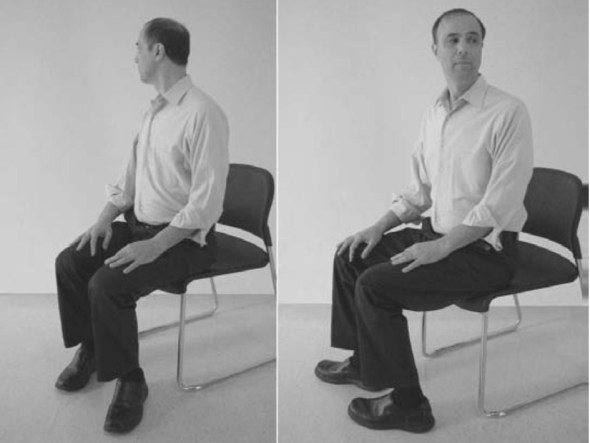 Figures 2a and 2b. Rotating the feet and head in opposite directions (photos by Gary Palmer)
When you’re facing right, move your feet to the left and lightly tap. Then face left and move your feet to the right and tap.
- Continue the tapping movement, but each time pivot your head in the opposite direction. Don’t try to stretch or force the movement.
- Do this sequence ten times. Now stop, face straight head, relax your legs, and just keep breathing.
Post assessment. Rotate your head to the right as far as you can see and look at a spot on the wall. Notice how much more flexibility/rotation you have achieved.
Almost everyone reports being able to rotate significantly farther after the exercise than before. They also report that they have less stiffness in their neck and shoulders.
5. SHOULDER AWARENESS PRACTICE. Sit comfortably with your hands on your lap. Allow your jaw to hang loose and breathe diaphragmatically. Continue to breathe slowly as you do the following:
- Shrug, raising your shoulders towards your ears to 70% of maximum effort and hold them up for about 10 seconds (note the sensations of tension).
- Let your shoulders drop and relax for 10 to 20 seconds
- Shrug, raising your shoulders towards your ears to 50% of maximum effort and hold them up for about 10 seconds (note the sensations of tension).
- Let your shoulders drop and relax for 10 to 20 seconds
- Shrug, raising your shoulders towards your ears to 25% of maximum effort and hold them up for about 10 seconds (note the sensations of tension).
- Let your shoulders drop and relax for 10 to 20 seconds
- Shrug, raising your shoulders towards ears to 5% of maximum effort and hold them up for about 10 seconds (note the sensations of tension).
- Let your shoulders drop and relax for 10 to 20 seconds
- Pull your shoulders down to 25% of maximum effort and hold them up for about 10 seconds (note the sensations of tension).
- Allow your shoulders to come back up and relax for 10 to 20 seconds
Remember to relax your shoulders completely after each incremental tightening. If you tend to hold your breath while raising your shoulders, gently exhale and continue to breathe. When you return to work, check in occasionally with your shoulders and ask yourself if you can feel any of the sensations of tension. If so, drop your shoulders and relax for a few seconds before resuming your tasks.
In summary, when employees and students change their environment and integrate many movements during the day, they report a significant decrease in neck and shoulder discomfort and an increase in energy and health. As one employee reported, after taking many short movement breaks while working at the computer, that he no longer felt tired at the end of the day, “Now, there is life after five”.
To explore how prevent and reverse the automatic somatic stress reactions, read Thomas Hanna‘s book, Somatics: Reawakening The Mind’s Control of Movement, Flexibility, and Health. For easy to do neck and shoulder guided instructions stretches, see the following ebsite: http://greatist.com/move/stretches-for-tight-shoulders
References:
Blatter, B. M., & Kraker, H. D. (2005). Prevalentiecijfers van RSI-klachten en het vóórkomen van risicofactoren in 15 Europese landen. Tijdschrift voor gezondheidswetenschappen, 1, 83, 8-15.
Côté, P., Cassidy, J. D., & Carroll, L. (2003). The epidemiology of neck pain: what we have learned from our population-based studies. The Journal of the Canadian Chiropractic Association, 47(4), 284. http://www.pain-initiative-un.org/doc-
European Agency for Safety and Health at Work (2004). http://europa.eu.int/comm/employment_social/news/2004/nov/musculoskeletaldisorders_en.html
Paoli, P., Merllié, D., & Fundação Europeia para a Melhoria das Condições de Vida e de Trabalho. (2001). Troisième enquête européenne sur les conditions de travail, 2000.
*I thank Sue Wilson and Servaas Mes for teaching me these somatic practices.
Enjoy sex: Breathe away the pain*
Posted: March 19, 2017 Filed under: Breathing/respiration, Pain/discomfort, self-healing, Uncategorized | Tags: Breathing, dyspareunia, intercourse, intimacy, pain, pelvic floor, relaxation, Sexuality, vaginismus 15 CommentsAdapted from: Peper, E. & Cohen, T. (2017). Inhale to breathe away pelvic floor pain and enjoy intercourse. Biofeedback, 45(1), 21–24. https://doi.org/10.5298/1081-5937-45.1.04
“After two and a half years of trying, ups and downs, and a long period of thinking it will never happen, it did happen. I followed your advice by only applying pressure with the cones while inhaling and at the same time relaxing the pelvic floor. We succeeded! we had “real” sex in the first time.”
Millions of women experience involuntary contraction of the musculature of the outer third of the vagina (vaginismus) interfering with intercourse, causing distress and interpersonal difficulty (ter Kuile et, 2010) or pain during intercourse (dyspareunia). It is estimated that 1 to 6% of women have vaginismus (Lewis et al, 2004) and 6.5% to 45.0% in older women and from 14% to 34% in younger women experience dyspareunia (Van Lankveld et al, 2010; Gross & Brubaker, 2022). The most common treatment for vaginismus is sequential dilation of the vaginal opening with progressively larger cones, psychotherapy and medications to reduce the pain and anxiety. At times clients and health care professionals may be unaware of the biological processes that influence the muscle contraction and relaxation of the pelvic floor. Success is more likely if the client works in harmony with the biological processes while practicing self-healing and treatment protocols. These biological processes, described at the end of the blog significantly affects the opening of vestibule and vagina are: 1) feeling safe, 2) inhale during insertion to relax the pelvic floor, 3) stretch very, very slowly to avoid triggering the stretch reflex, and 4) being sexual aroused.
Successful case report: There is hope to resolve pain and vaginismus
Yesterday my husband and I had sex in the first time, after two and a half years of “trying”. Why did it take so long? Well, the doctor said “vaginismus”, the psychologist said “fear”, the physiotherapist said “constricted muscles”, and friends said “just relax, drink some wine and it will happen”.
Sex was always a weird, scary, complicated – and above all, painful – world to me. It may have started in high school: like many other teens, I thought a lot about sex and masturbated almost every night. Masturbation was a good feeling followed by tons of bad feelings – guilt, shame, and feeling disgusting. One of the ideas I had to accept, later in my progress, is that ‘feeling good is a good thing’. It is normal, permitted and even important and healthy.
My first experience, at age 20, was short, very painful, and without any love or even affection. He was…. well, not for me. And I was…. well, naive and with very little knowledge about my body. The experiences that came after that, with other guys, were frustrating. Neither of them knew how to handle the pain that sex caused me, and I didn’t know what to do.
The first gynecologist said that everything is fine and I just need to relax. No need to say I left her clinic very angry and in pain. The second gynecologist was the first one to give it a name: “vaginismus”. He said that there are some solutions to the problem: anesthetic ointment, physiotherapy (“which is rarely helps”, according to his optimistic view..), and if these won’t work “we will start thinking of surgery, which is very painful and you don’t want to go there”. Oh, I certainly didn’t want to go there.
After talking to a friend whose sister had the same problem, I started seeing a great physiotherapist who was an expert in these problems. She used a vaginal biofeedback sensor, that measured muscles’ tonus inside the vagina. My homework were 30 constrictions every day, plus working with “dilators” – plastic cones comes in 6 sizes, starting from a size of a small finger, to a size of a penis.
At this point I was already in a relationship with my husband, who was understanding, calm and most important – very patient. To be honest, we both never thought it would take so long. Practicing was annoying and painful, and I found myself thinking a lot “is it worth it?”. After a while, I felt that the physical practice is not enough, and I need a “psychological breakthrough”. So I stopped practicing and started seeing a psychologist, for about a half a year. We processed my past experiences, examined the thoughts and beliefs I had about sex, and that way we released some of the tension that was shrinking my body.
The next step was to continue practicing with the dilators, but honestly – I had no motivation. My husband and I had great sex without the actual penetration, and I didn’t want the painful practice again. Fortunately, I participated in a short course given by Professor Erik Peper, about biofeedback therapy. In his lecture he described a young woman, who suffered from vulvodynia, a problem that is a bit similar to vaginismus (Peper et al, 2015; See: https://peperperspective.com/2015/09/25/resolving-pelvic-floor-pain-a-case-report/). She learned how to relax her body and deal with the pain, and finally she had sex – and even enjoyed it! I was inspired.
Erik Peper gave me a very important advice: breathing in. Apparently, we can relax the muscles and open the vagina better while inhaling, instead of exhaling – as I tried before. During exhalation the pelvic floor tightens and goes upward while during inhalation the pelvic floor descends and relaxes especially when sitting up (Peper et al, 2016). He advised me to give myself a few minutes with the dilator, and in every inhale – imagine the area opening and insert the dilator a few millimeters. I started practicing again, but in a sitting position, which I found more comfortable and less painful. I advanced to the biggest dilator within a few weeks, and had a just little pain – sometimes without any pain at all. The most important thing I understood was not to be afraid of the pain. The fear is what made me even more tensed, and tension brings pain. Then, my husband and I started practicing with “the real thing”, very slowly and gently, trying to find the best position and angle for us. Finally, we did it. And it was a great feeling.
The biological factors that affect the relaxation/contraction of the pelvic floor and vaginal opening are:
Feeling safe and hopeful. When threatened, scared, anticipate pain, and worry, our body triggers a defense reaction. In this flexor response, labeled by Thomas Hanna as the Red Light Reflex, the body curls up in defense to protect itself which includes the shoulders to round, the chest to be depressed, the legs pressing together, the pelvic floor to tighten and the head to jut forward (Hanna, 2004). This is the natural response of fear, anxiety, prolonged stress or negative depressive thinking.
Before beginning to work on vaginismus, feel safe. This means accepting what is, accepting that it is not your fault, and that there are no demands for performance. It also means not anticipating that it will be again painful because with each anticipation the pelvic floor tends to tightens. Read the chapter on vaginismus in Dr. Lonnie Barbach’s book, For each other: Sharing sexual intimacy (Barbach, 1983).
Inhale during insertion to relax the pelvic floor and vaginal opening. This instruction is seldom taught because in most instances, we have been taught to exhale while relaxing. Exhaling while relaxing is true for most muscles; however, it is different for the pelvic floor. When inhalation occurs, the pelvic floor descends and relaxes. During exhalation the pelvic floor tightens and ascends to support breathing and push the diaphragm upward to exhale the air. Be sure to allow the abdomen to expand during inhalation without lifting the chest and allow the abdomen to constrict during exhalation as if inhalation fills the balloon in the abdomen and exhalation deflates the balloon (for detailed instructions see Peper et al, 2016). Do not inhale by lifting and expanding your chest which often occurs during gasping and and fear. It tends to tighten and lift the pelvic floor.
Experience the connection between diaphragmatic breathing and pelvic floor movement in the following practice.
While sitting upright make a hissing noise as the air escapes with pressure between your lips. As you are exhaling feel, your abdomen and your anus tightening. During the inhalation let your abdomen expand and feel how your anus descends and pelvic floor relaxes. With practice this will become easier.
Stretch very, very slowly to avoid triggering the stretch reflex. When a muscle is rapidly stretched, it triggers an automatic stretch reflex which causes the muscle to contract. This innate response occurs to avoid damaging the muscle by over stretching. The stretch reflex is also triggered by pain and puts a brake on the stretching. Always use a lubricant when practicing by yourself or with a partner. Practice inserting larger and larger diameter dilaters into the vagina. Start with a very small diameter and progress to a larger diameter. These can be different diameter cones, your finger, or other objects. Remember to inhale and feel the pelvic floor descending as you insert the probe or finger. If you feel discomfort/pain, stop pushing, keep breathing, relax your shoulders, relax your hips, legs, and toes and do not push inward and upward again until the discomfort has faded out.
Feel sexually aroused by allowing enough foreplay. When sexually aroused the tissue is more lubricated and may stretch easier. Continue to use a good lubricant.
Putting it all together.
When you feel safe, practice slow diaphragmatic breathing and be aware of the pelvic floor relaxing and descending during inhalation and contracting and going up during exhalation. When practicing stretching the opening with cones or your finger, go very, very slow. Only apply pressure of insertion during the mid-phase of inhalation, then wait during exhalation and then again insert slight more during the next inhalation. When you experience pain, relax your shoulders, keep breathing for four or five breaths till the pain subsides, then push very little during the next inhalation. Go much slower and with more tenderness.
Be patient. Explain to your partner that your body and mind need time to adjust to new feelings. However, don’t stop having sex – you can have great sex without penetration. Practice both alone and with your partner; together find the best angle and rate. Use different lubricants to check out what is best for you. Any little progress is getting you closer to having an enjoyable sex. I recommend watching this TED video of Emily Nagoski explaining the “dual control model” and practicing as she suggests: https://www.youtube.com/watch?v=HILY0wWBlBM
Finally, practice the exercises developed by Dr. Lonnie Barbach, who as one of the first co-directors of clinical training at the University of California San Francisco, Human Sexuality Program, created the women’s pre-orgasmic group treatment program. They are superbly described in her two books, For each other: Sharing sexual intimacy, and For yourself: The fulfillment of female sexuality, and are a must read for anyone desiring to increase sexual fulfillment and joy (Barbach, 2000; 1983).
References:
Barbach, L. (1983). For each other: Sharing sexual intimacy. New York: Anchor
Barbach, L. (2000). For yourself: The fulfillment of female sexuality. New York: Berkley.
BarLewis, R. W., Fugl‐Meyer, K. S., Bosch, R., Fugl‐Meyer, A. R., Laumann, E. O., Lizza, E., & Martin‐Morales, A. (2004). Epidemiology/risk factors of sexual dysfunction. The journal of sexual medicine, 1(1), 35-39. http://www.jsm.jsexmed.org/article/S1743-6095(15)30062-X/fulltext
Gross. E. & Brubaker, L. (2022). Dyspareunia in Women. JAMA. https://doi.org/10.1001/jama.2022.4853
Hanna, T. (2004). Somatics: Reawakening the mind’s control of movement, flexibility, and health. Boston: Da Capo Press.
Martinez Aranda, P. & Peper, E. (2015). The healing of vulvodynia from a client’s perspective. https://biofeedbackhealth.files.wordpress.com/2011/01/a-healing-of-vulvodynia-from-the-client-perspective-2015-06-15.pdf
Peper, E., Booiman, A., Lin, I-M, Harvey, R., & Mitose, J. (2016). Abdominal SEMG Feedback for Diaphragmatic Breathing: A Methodological Note. Biofeedback. 44(1), 42-49. https://biofeedbackhealth.files.wordpress.com/2011/01/1-abdominal-semg-feedback-published.pdf
Peper, E., Martinez Aranda, P., & Moss, E. (2015). Vulvodynia treated successfully with breathing biofeedback and integrated stress reduction: A case report. Biofeedback. 43(2), 103-109. https://biofeedbackhealth.files.wordpress.com/2011/01/a-vulvodynia-treated-with-biofeedback-published.pdf
Ter Kuile, M. M., Both, S., & van Lankveld, J. J. (2010). Cognitive behavioral therapy for sexual dysfunctions in women. Psychiatric Clinics of North America, 33(3), 595-610. https://www.researchgate.net/publication/45090259_Cognitive_Behavioral_Therapy_for_Sexual_Dysfunctions_in_Women
Van Lankveld, J. J., Granot, M., Weijmar Schultz, W., Binik, Y. M., Wesselmann, U., Pukall, C. F., . Achtrari, C. (2010). Women’s sexual pain disorders. The Journal of Sexual Medicine, 7(1pt2), 615-631. http://www.jsm.jsexmed.org/article/S1743-6095(15)32867-8/fulltext
*We thank Dr. Lonnie Barbach for her helpful feedback and support. Written collaboratively with Tal Cohen, biofeedback therapist (Israel) and Erik Peper.
Read The case against sugar
Posted: February 18, 2017 Filed under: Nutrition/diet, Uncategorized | Tags: Alzheimer, cancer, carbohydrates, diabetes, heart disease, sugar 10 CommentsAn ounce of prevention is worth a pound of cure.
Albert Schweitzer began working in equatorial lowlands of West Africa in 1913. He was astonished to encounter no cases of cancer among the thousands of native patients he saw each year. However, as the natives [took to] living more and more after the manner of the whites, cancer in his patient population became ever more frequent (Taubes, 2016, pp 257).
Wise elders, grand parents or statesmen have been traditional roles for aging adults. Wisdom transforming into Alzheimer’s disease does not compute (Peper, 2014).
In 1960’s Surgeon Captain T. L. Cleave proposed that common western diseases (diabetes, colon cancer, ischemic heart disease, gallstones, obesity, diverticulosis, and dental carries), to which I would add Alzheimer’s disease, autoimmune diseases and allergies, could not be due primarily to genetic factors but to new factors in the environment to which man had not yet had time to adapt (Cleaves et al, 1969). As he states, “One such factor was the processing of food which resulted in the consumption of large quantities of pure sugar and starch. This led to disease because man was evolutionary adjusted to eating smaller amounts of carbohydrates intimately mixed with fiber and protein.”
Clinicians and epidemiologist have consistently reported that none western cultures, whether the Masai in Africa, the Inuit in Northern Canada, the Japanese in Japan, or the Native American, had very low incidences of these western diseases. Yet, when these people adapted a western diet of highly refined carbohydrates and sugar the prevalence of these diseases increased and approached the incidence in western cultures (Burkitt & Trowell, 1975; Taubes, 2016).
Historically these illness were initially observed in the ruling class. The affluent class was privileged and tended to eat more refined carbohydrates and sugars (white bread, cakes, pastries and sugar in coffee and tea). It is only recently that this class effect is reversed. Lower economic classes tend have a higher prevalence of these western diseases. Affluent people can afford and often eat low processed organic foods while economically disadvantaged people cannot afford low processed foods and instead eat predominantly highly processed carbohydrate and refined foods.
Highly refined processed foods and sugar–not fats–are significant risk factors for the development diabetes and cardiovascular disease and mortality (Imamura et al, 2015; Taubes, 2016; Yang et al, 2014) . What is not as well known is that some cancers and Alzheimer’s disease also correlates with the increase intake of refined carbohydrates and sugar (Das, 2015; Kandimalla et al, 2016; Peper, 2014).
It is highly likely that the increase in beta-amyloid protein plagues in the brain is not the cause of the Alzheimer’s but the brain’s defense mechanism to protect it from the fluctuating high insulin and glucose levels. A high sugar and simple carbohydrate diet are risk factors for inflammatory diseases such as diabetes, heart disease and metabolic syndrome. These inflammatory diseases are recognized as a precursor for Alzheimer’s. Alzheimer’s is sometimes described as Type 3 diabetes (Kandimalla et al, 2016; Steen et al, 2005).
Taking the perspective that foods are significant risk factors for the development of these western diseases, the focus should be on prevention and less on treatment. The research to develop drugs to treat Alzheimer’s have up till now been unsuccessful despite that the billions spent on attempting to develop new drugs. For example, the pharmaceutical company Eli Lilly has spent 3.7 billion dollars over the last decade while the National Institutes of Health spends more than half a billion dollars a year on pursuit of treatment (Coghlan, 2017).
The treatments cost of these western diseases, which at best ameliorate the disorders, is overwhelming. In the USA, we spent $147 billion to treat obesity and $116 billion to treat diabetes. While the medical costs to treat diabetes for a single patient is about $6000/year or $400,000/lifetime (Pollan, 2009).
As a refined carbohydrates and high sugar diet is a risk factor for western diseases, the focus should be on prevention. Thus, reduce sugar and refined carbohydrates intake and increase high fiber vegetable. To implement such a simple preventative measure means:
- Educate the public about the harm of sugars and refined carbohydrate foods.
- Ban advertising of foods that are high in sugar and refined carbohydrates.
- Reward companies to produce foods low in sugar and refined carbohydrates.
- Tax food products high in sugar and refined carbohydrates just as tobacco has been taxed.
I am positive that in the future when we look back at the 20th and early 21st century, we will be appalled that the government allowed people to poison themselves with sugar and highly refined carbohydrates. Just as we now warn against the harm of tobacco, limit the sales to minors, and have ongoing public health stop smoking campaigns.
For much more information, read science writer Gary Taubes superb well researched and engaging book, The case against sugar.

References:
Burkitt, D.P. & Trowell, H.C. (1975). Refined carbohydrate foods and disease: Some implications of dietary fibre. York: Academic Press.
Cleave, T.L., Campbell, G.D., & Painter, N.S. (1969). Diabetes, coronary thrombosis and the saccharine disease, 2nd ed. Bristol, UK: John Wright.
Coghlan, A. 2017). The Alzheimer’s problem. New Scientist, 233(3110), 22-23.
Das, U. N. (2015). Sucrose, fructose, glucose, and their link to metabolic syndrome and cancer. Nutrition, 31(1), 249-257.
Imamura, F., O’Connor, L., Ye, Z., Mursu, J., Hayashino, Y., Bhupathiraju, S. N., & Forouhi, N. G. (2015). Consumption of sugar sweetened beverages, artificially sweetened beverages, and fruit juice and incidence of type 2 diabetes: systematic review, meta-analysis, and estimation of population attributable fraction. Bmj, 351, h3576.
Kandimalla, R., Thirumala, V., & Reddy, P. H. (2016). Is Alzheimer’s disease a Type 3 Diabetes? A critical appraisal. Biochimica et Biophysica Acta (BBA)-Molecular Basis of Disease.
Peper, E. (2014). Affluenza: Transforming Wisdom into Alzheimer’s Disease with Affluent Malnutrition and Immobility. Neuroconnections, 9(2), 32-35.
Pollan, M. (2009). Big food vs. big insurance. New York Times, September 10, A29.
Steen, E., Terry, B.M. Rivera, E.J., Cannon, J.L., Neely, T.R., Tavares, R., Xu, X. J., Wands, J.R., & de al Monte, S. M. (2005). Impaired insulin and insulin-like growth factor expression and signaling mechanisms in Alzheimer’s disease-is this type 3 diabetes? Journal of Alzheimer’s Disease, 7(1), 53-80.
Taubes, G. (2016). The case against sugar. New York: Alfred A. Knopf.
Yang, Q., Zhang, Z., Gregg, E. W., Flanders, W. D., Merritt, R., & Hu, F. B. (2014). Added sugar intake and cardiovascular diseases mortality among US adults. JAMA internal medicine, 174(4), 516-524.
Healthy movement is the new aging
Posted: February 11, 2017 Filed under: Exercise/movement, self-healing, Uncategorized | Tags: aging, diabetes, evolution, exercise, health, interval training, sugar 2 CommentsBorn on 26 November 1911, Mr Robert Marchand and 105 years old, managed cycling 22.55 km (14 miles) at the national velodrome and set a new record for the furthest distance cycled in one hour for riders over 105. (Reynolds, 2017).
Meet 105-year-old Robert Marchand, the centenarian cyclist chasing a new record: https://www.youtube.com/watch?v=Ey48j6dDNEo
As people age there is an increase in Western Diseases such as hypertension, diabetes, gout, cancer, dementia and decreases in physical fitness (Milanović et al, 2013; Tauber, 2016). To assume that the cause of these illnesses is the natural process of aging may be too simplistic. Although aging does affect physiology, there are other factors that contribute to the increase in “Western Diseases” such as diet, lifestyle and genetics.
A significant contributing factor of Western Diseases is diet especially the increase in sugar and simple carbohydrates. Whether you are Pima, Tohono O’odham, and Navajo American Indian Tribes in Arizona, Intuits in Northern Canada, Japanese Americans, or indigenous populations of Kenya, when these people stopped eating their traditional diet and adapted the western high glucose/fructose/simple carbohydrate diet, the degenerative Western Diseases exploded (Bjerregaard et al, 2004; Burkitt & Trowell, 1975; Knowler et al, 1990; Tauber, 2016). Diabetes, hypertension, and cancer which were previously rare skyrocketed within one generation after adapting the Western life style diet. In some of these populations, 30% or more of the adults have diabetes and a significant increase in breast cancer.
The reduction of episodic high intensity physical activity and being sedentary are additional risk factors for the onset of diabetes and cardiovascular disease (Dulloo et al, 2017). As Mensing & Mekel (2015) state, “Sitting is the new smoking.” Sitting encourages more sitting which leads to nonuse of muscles and causes neural and muscle atrophy. Our physiology is efficient and will prune/eliminate what is redundant. This is reflected in the popular phrase, “Use it or lose it.” As we sit for hours in front of digital devices, use escalators, elevators, or drive cars, we are not using the muscles involved in dynamic movement. We are usually unaware of this degenerative process. Instead, we may experience difficulty walking up the stairs which encourages us to take the escalator or elevator. When we do not use the muscles or are limited in movement by discomfort and pain, we move less. As we move less, we become weaker which is often labeled as aging instead of non use.
Just, because most people loose fitness, it may not represent what is possible or optimum. Instead, we may want to emulate the diet and fitness program of Mr. Robert Marchand who at age 103 set a new world record and improved the distance bicycled in one hour from 24.25 km at the age of 101 to 26.92 km at the age of 103. A 11% improvement! As New York Times science writer Gretchen Reynolds reports, “Lifestyle may also matter. Mr. Marchand is “very optimistic and sociable,” The researcher who did the study, Dr. Billat says, “with many friends,” and numerous studies suggest that strong social ties are linked to a longer life. His diet is also simple, focusing on yogurt, soup, cheese, chicken and a glass of red wine at dinner (Reynolds, 2017).
The improvement in bicycling performance and physiological indicators such as ⩒O2max increased (31 to 35 ml.kg-1min-1; +13%), appeared to be due to a change in his training regimen (Billat et al 2016). At age 101 he changed his bicycling training program from riding at a steady speed for one hour to riding 80% at an easy pace and 20% at high intensity. This is a type of interval training and includes enough recovery allows the body the recover and strengthen. This analogous to our evolutionary movement pattern of walking interspersed with short distance high intensity running.
As a hunter and gather we often moved steadily and then had to run very fast to escape a predator or catch an animal. After extreme exertion, we would rest and regenerate (if we did not escape we would be lunch for the predator). Thus episodic high intensity activity with significant rest/regenerative periods is the movement pattern that allowed our species to survive and thrive. Research studies have confirmed that high intensity interval training offers more physiological benefits–increases cardiorespiratory fitness which is a strong determinant of morbidity and mortality– than moderate intensity continuous training (Weston et al, 2014).
Thus when Mr. Marchard changed his exercise pattern from moderate intensity continuous training to high intensity interval training with enough recovery time he set a new world record at age 103. Two years later he set a new world record at age 105.
Exercise improves brain function and interval training appears to improve brain function most. When rats had prolonged exercise, the brain’s stores of energy is significantly lowered in the frontal cortex and hippocampus all areas which area involved in thinking and memory. If on the other hand, the animals had a single intense bout of exercise and were allowed to rest and feed than the brain levels of glycogen was 60% high in the frontal and hippocampus areas. This suggest that the brain can then function better (Matsui et al, 2012).
This perspective is supported by the evolutionary hypothesis discussed by Neuroscientist Daniel Wolpert who points out that brains evolved, not to think or feel, but to direct movement. When movement is no longer needed the brain shrinks and gets reabsorbed which is illustrated by the sea squirt. This animal swims as a juvenile and then anchors on a rock and is passively moved by the currents. Once anchored, it no longer needed to coordinate movement and reabsorb its own nervous system. See Daniel Wolpert’s remarkable TED talk, The real reasons for brains.
The remarkable feat of Mr. Marchand offers suggestions for our own health. Enjoy healthy movement and exercise and incorporate our evolutionary movement patterns: episodic high intensity followed by regeneration. At the same time include a healthy diet by reducing sugars and simple carbohydrates. Finally, it helps to have the right genes.
References:
Billat, V. L., Dhonneur, G., Mille-Hamard, L., Le Moyec, L., Momken, I., Launay, T., & Besse, S. (2016). Case Studies in Physiology: Maximal Oxygen Consumption and Performance in a Centenarian Cyclist. Journal of Applied Physiology, jap-00569. http://jap.physiology.org/content/jap/early/2016/12/29/japplphysiol.00569.2016.full.pdf
Bjerregaard, P., Kue Young, T., Dewailly, E., & Ebbesson, S. O. (2004). Review Article: Indigenous health in the Arctic: an overview of the circumpolar Inuit population. Scandinavian Journal of Social Medicine, 32(5), 390-395. https://www.researchgate.net/publication/51366099_Indigenous_Health_in_the_Arctic_An_Overview_of_the_Circumpolar_Inuit_Population
Burkitt, D.P. & Trowell, H.C. eds. (1975). Refined carbohydrate foods and disease: Some implications of dietary fibre. New York: Academic Press.
Dulloo, A. G., Miles‐Chan, J. L., & Montani, J. P. (2017). Nutrition, movement and sleep behaviours: their interactions in pathways to obesity and cardiometabolic diseases. Obesity Reviews, 18(S1), 3-6.
Knowler, W. C., Pettitt, D. J., Saad, M. F., & Bennett, P. H. (1990). Diabetes mellitus in the Pima Indians: incidence, risk factors and pathogenesis. Diabetes/metabolism reviews, 6(1), 1-27.
Matsui, T., Ishikawa, T., Ito, H., Okamoto, M., Inoue, K., Lee, M. C., … & Soya, H. (2012). Brain glycogen supercompensation following exhaustive exercise. The Journal of physiology, 590(3), 607-616.
Mensing, M., & Mekel, O. C. L. (2015). Sitting is the new smoking-Modelling physical activity interventions in North Rhine-Westphalia. The European Journal of Public Health, 25(suppl 3), ckv171-037.
Milanović, Z., Pantelić, S., Trajković, N., Sporiš, G., Kostić, R., & James, N. (2013). Age-related decrease in physical activity and functional fitness among elderly men and women. Clinical interventions in aging, 8, 549-556.
Reynolds, G. (2017, February 8). Lessons on Aging Well, From a 105-Year-Old Cyclist. Retrieved from: https://www.nytimes.com/2017/02/08/well/move/lessons-on-aging-well-from-a-105-year-old-cyclist.html?rref=collection%2Fsectioncollection%2Fhealth&action=click&contentCollection=health®ion=rank&module=package&version=highlights&contentPlacement=5&pgtype=sectionfront
Taubes, G. (2016). The Case Against Sugar. New York: Alfred A. Knopf.
Weston, K. S., Wisløff, U., & Coombes, J. S. (2014). High-intensity interval training in patients with lifestyle-induced cardiometabolic disease: a systematic review and meta-analysis. British journal of sports medicine, 48(16), 1227-1234. http://www.rcsi.ie/files/facultyofsportsexercise/20141201122758_High-intensity%20interval%20traini.pdf
Wolpert, D. (2011) The Real Reason for Brains. http://www..com/tatedlks/daniel_wolpert_the_real_reason_for_brains.html
Youtube video: Meet 105-year-old Robert Marchand, the centenarian cyclist chasing a new record: https://www.youtube.com/watch?v=Ey48j6dDNEo
We are more alike than we sometime would like to think
Posted: February 1, 2017 Filed under: Uncategorized | Tags: Acceptance, community, health, love Leave a commentThe short three minute video Three Beautiful Human Minutes by Asger Leth is a reminder that we are more alike than we sometimes would like to think. Enjoy.
Happy New Year: Make each moment count
Posted: January 1, 2017 Filed under: Uncategorized | Tags: happiness, health, meaning, purpose 1 CommentAs the New Year begins, I wish you the courage to follow your dreams. May the New Year bring health, happiness and joy. Enjoy the video and make each moment count.
Best wishes for the New Year.
https://www.youtube.com/watch?v=g_g1hqMfv2A
Was it really your choice or were you covertly nudged, anchored, incentivized and manipulated?
Posted: December 27, 2016 Filed under: Uncategorized | Tags: advertising, fake news, manipulation, persuation, Politics 1 CommentWas taking sleeping medication really your choice or the outcome of subtle over the counter advertising even though the research evidence suggests that it will cause long term harm?
Was the evidence presented at the congressional hearing that contributed to Congress to authorize the first Gulf war based upon actual data or manufactured fake news orchestrated by the Kuwait Government?
How come so many people claim that Trump won the election overwhelmingly even though he actually lost the popular vote by 2.8 million?
How come we make impulsive choices which upon reflection did not work out?
Do we really make well informed choices or are they the result of being covertly nudged or manipulated? Before you vote, before you buy a product, before you undergo a medical procedure or take medication, before you share a Facebook post, or before you talk to your boss, be aware that your choices may not really be yours but instead the result of being influenced and manipulated. From voting to the sales of pharmaceuticals and cars, we act because we feel it is correct; however, in many cases our choices were not achieved through reason and deliberation. They were the result of being nudged, anchored, incentivized, manipulated and influenced by fake/false news-a process that significantly affects how we interact with each other
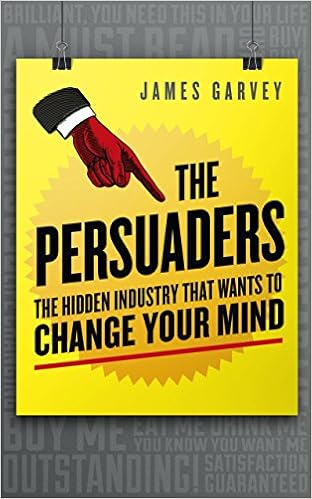
Before acting on information, read the superb book, The persuaders: The hidden industry that wants to change your mind, by philosopher James Garvey. This book describes in detail the strategies that persuaders use to have you act as they would like you to act which impacts all facets of your life As the cover of the book states: “You are no longer reasoned with–Instead your opinions and behaviors are manipulated by covert means.”
 the peper perspective