Simple acts of kindness
Posted: December 29, 2020 Filed under: behavior, emotions, health, mindfulness, self-healing, stress management | Tags: kindness 1 CommentAs we emerge from the COVID pandemic and look forward to the New Year, we can bring joy and happiness though through simple acts of kindness.
There is hope in these crazy times—three inspirational TED talks
Posted: December 16, 2020 Filed under: behavior, emotions, health, mindfulness, self-healing, Uncategorized | Tags: hope, racial bias, resilience 2 CommentsI just received an email from the Rick Hansen Foundation that inspired me to share its recommendations. In 1957 at the age of 15, Rick Hansen injured his spinal cord and was paralyzed from the waist down. He is an inspiration for all of us. In these crazy times of sheltering in place, experiencing social isolation, anxiety, depression, racial bias, and also happiness and joy, he recommends the following TED talks to increase resilience, overcome racial bias, and achieve self-acceptance. Enjoy watching the talks as they suggest strategies to deal with adversity and offer hope for the New Year.
3 Secrets of resilient people by Dr. Lucy Hone, Co-director of the New Zealand Institute of Wellbeing & Resilience and adjunct fellow at the University of Canterbury in Christchurch, New Zealand.
How racial bias works-and how to disrupt it by Stanford University social psychologist, Jennifer L. Eberhardt
To overcome challenges, stop comparing yourself to other by wheelchair athlete Dean Furnes
Beyond Zoom Fatigue: Re-energize Yourself and Improve Learning
Posted: November 24, 2020 Filed under: behavior, computer, digital devices, educationj, health, posture, stress management | Tags: boredom, learning, mind-body, zoom fatigue 7 CommentsErik Peper and Amber Yang
“Instead of zoning out and being on my phone half the time. I felt more engaged in the class and like I was actually learning something.” -21 year old college student
Before the pandemic, roughly, two-thirds of all social interactions were face-to-face—and when the shelter-in-place order hit our communities, we were all faced with the task of learning how to engage virtually. The majority of students reported that taking online classes instead of in person classes is significantly more challenging. It is easier to be distracted and multitask online—for example, looking at Instagram, Facebook, Twitter, TikTok, texting, surfing the internet, responding to notifications, listening to music, or drifting to sleep. Hours of watching TV and/or streaming videos have conditioned many people to sit and take in information passively, which discourages them from actively responding or initiating. The information is rapidly forgotten when the next screen image or advertisement appears. Effectively engaging on Zoom requires a shift from passively watching and listening to being an active, creative participant.
Another barrier to virtual engagement is that communicating online does not engage all senses. A considerable amount of our communication is nonverbal—sounds, movement, visuals, physical structures, touch, and body language. Without these sensory cues, it can be difficult to feel socially connected on Zoom, Microsoft Teams, or Google Meet to sustain attention and to focus especially if there are many people in the class or meeting. Another challenge to virtual learning is that without the normal environment of a classroom, many students across the country are forced to learn in emotionally and/or physically challenging environments, which gets in the way of maintaining attention and focus. The Center for Disease Prevention (CDC) reported that anxiety disorder and depressive disorder have increased considerably in the United States during the COVID-19 pandemic (Leeb et al, 2020; McGinty et al, 2020). Social isolation, stay-at-home orders, and coping with COVID-19 are contributing factors affecting mental health especially for minority and ethnic youth. Stress, anxiety and depression can greatly affect students’ ability to learn and focus.
The task of teaching has also become more stressful since many students are not visible or appear still-faced and non-responsive. Teaching to non-responsive faces is significantly more stressful since the presenter receives no social feedback. The absence of social feedback during communication is extremely stressful. It is the basis of Trier Social stress test in which a person presents for five minutes to a group of judges who provide no facial or verbal feedback (Allen et al, 2016; Peper, 2020).
The Zoom experience especially in a large class can be a no win situation for the presenter and the viewer. To help resolve this challenge, we explored a strategy to increase student engagement and reduce social stress of the teacher. In this exploration, we asked students to rate their subjective energy level, attention and involvement during a Zoom conducted class. For the next Zoom class, they were asked to respond frequently with facial and body expressions to the presentation. For example, students would expressively shake their head no or yes and/or use facial expressions to signal to the teacher that they were engaged and listening. Other strategies included giving thumbs up or thumbs down, making sounds, and changing your body posture as a response to the presentation. Watch the superb non-judgmental instructions adapted for high school students by Amber Yang.
When college students purposely implement and increase their animated facial and body responses by 123% during Zoom classes, they report a significant increase in frequency of animation (ANOVA (F(1,70) = 30.66, p < .0001), energy level (ANOVA (F(1,70) = 28.96, p < .0001), attention (ANOVA (F(1,70) = 16.87, p = .0001) and involvement (ANOVA (F(1,69) = 10.70, p = .002) as compared just attending normally in class (see Figure 1).

Figure 1. Change in subjective energy, attention and involvement when the students significantly increase their facial and body animation by 123 % as compared to their normal non-expressive class behavior (Peper & Yang, in press).
“I never realized how my expressions affected my attention. Class was much more fun” -22 year old college student
“I can see how paying attention and participation play a large role in learning material. After trying to give positive facial and body feedback I felt more focused and I was taking better notes and felt I was understanding the material a bit better.” –28 year old medical student
These quotes are a few of the representative reports by more than 80% of the students who observed that being animated and responsive helped them to stay present and learn much more easily and improve retention of the materials. For a few students, it was challenging to be animated as they felt shy, self-conscious and silly and kept wondering what other students would think of them.
Having students compare two different ways of being in Zoom class is a useful assignment since it allows students to discover that being animated and responsive with facial/body expression improves learning. So often we forget how our body impacts our thoughts and emotions. For example, when students were asked to sit in a slouched position, they reported that it was much easier to recall hopeless, helpless, powerless and defeated memories and more difficult to perform mental math in the slouched position. While in the upright position it was easier to access positive empowering memories and easier to perform mental math (Peper et al, 2017; Peper et al, 2018).
Experience how body posture affects emotional recall and feeling (adapted from Alda, 2018).
1) Stand up and configure your body in a position that signals defeat, hopelessness and depression (slouching with the head down). While holding this position, recall a memory of hopelessness and defeat. Notice any negative emotions that arise from this.
2) Shift and configure your body into a position that signals joy, happiness and success (standing tall, looking up with a smile). While holding this position, recall a memory of joy and happiness. Notice any positive emotions that arise from this.
3) Configure your body in a position that signals defeat, hopelessness and depression (slouching with the head down). While holding this position, recall a joy, happiness and success. Do not change your body position. End this configuration after holding it for a little while.
4) Shift and your body in a position that signals joy, happiness and success (standing tall, looking up with a smile). While holding this position, recall a memory of hopelessness and defeat. Do not change your body position. End this configuration after holding it for a little while.
When body posture and expression are congruent with the evoked emotion, it is almost always easier to experience the emotions. On the other hand, when the body posture expression is the opposite of the evoked emotion (e.g., the body in a positive empowered stance while recalling hopeless defeated memories) it is much more difficult to evoke and experience the emotion. This same concept applies to learning. When slouching and lying on the bed while in a Zoom class, it is much more difficult to stay present and not drift off. On the other hand, when sitting erect and upright and actively responding to the presentation, the body presence/posture invites the brain to focus for optimized learning.
Conclusion
In a Zoom environment, it is easy to slouch, drift away, and become non-responsive—which can exacerbate zoom fatigue symptoms and also decrease our capacity to learn, focus, and feel connected with the people around us. Take charge and actively participate in class by sitting up, maintaining an empowered posture, and using nonverbal facial and body expressions to communicate. The important concept is not how you show your animation, but that you actively participate within the constraints of your own limitations. For example, if a person is paralyzed the person will benefit if they do the experience internally even though their body may not show any expression. By engaging our soma we optimize our learning experience as we face the day-to-day challenges of the pandemic and beyond.
I noticed I was able to retain information better as well as enjoy the class more when I used facial-body responses. At times, where I would try to wonder off into bliss, I would catch myself and try to actively engage in the class with body movements even if there is no discussion. Animated face/body was a better learning experience. –21-year old college student.
References
Peper, E. (October 13, 2020). Breaking the social bond: The immobilized face. The Peper Perspective.
Peper, E., Wilson, V.E., Martin, M., Rosengard, E., & Harvey, R. (unpublished). Avoid Zoom fa
Tips to Reduce Zoom Fatigue
Posted: November 15, 2020 Filed under: behavior, computer, digital devices, ergonomics, Exercise/movement, health, laptops, Neck and shoulder discomfort, Pain/discomfort, self-healing, stress management, Uncategorized, vision 1 CommentAdapted from the book, TechStress: How Technology
is Hijacking our Lives, Strategies for Coping and Pragmatic Ergonomics, by Erik Peper, Richard Harvey and Nancy Faass.



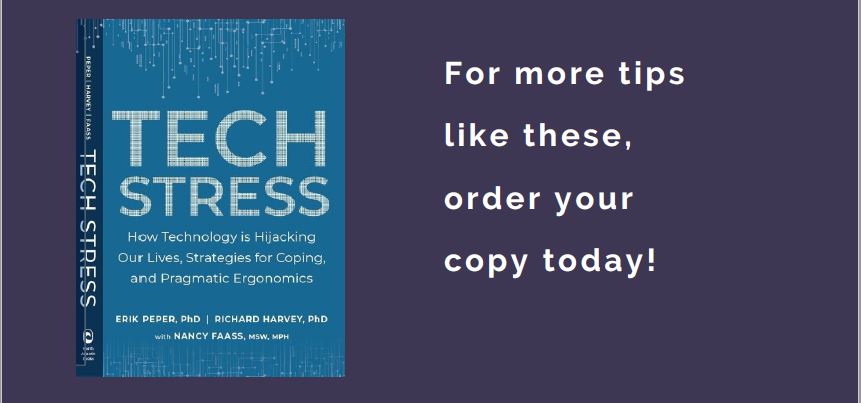
Peper, E., Harvey, R., & Faass, N. (2020), TechStress-How Technology is Hijacking our Lives, Strategies for Coping and Pragmatic Ergonomics. Berkeley, CA: North Atlantic Books.
Breaking the social bond: The immobilized face
Posted: October 13, 2020 Filed under: behavior, computer, digital devices, Evolutionary perspective, health, laptops, self-healing, stress management | Tags: baby, communication, non verbal communication, Tier Social Stress Test, zoom fatigue 5 CommentsAfter teaching for hours on Zoom, I feel exhausted. Zoom fatigue is real.
While talking to a close friend, all of a sudden his attention shifted from listening to me to looking his cellphone as he heard a notification. At that moment, I felt slightly left and hurt.
Students report that when they are are talking with friends and their friends look at their cellphone or responds to a notification they feel hurt and slightly dismissed. Even though most experience this break in social bonding, almost all do this with others. The looking at the phone is the conditioned stimuli to which we automatically respond when we feel it vibrate or even when we see it. We respond by shifting our attention to the phone in the same way that Pavlov’s dogs would salivate when they heard the bell that was conditioned with the food. On the average we now check our phones 96 times a day—that is once every 10 minutes and an increase of 20% as compared to two years ago (Asurion Research, 2019).
To feel SAFE is essential for growth and developing intimacy. We interpret being safe through the process of neuroception. Without conscious awareness our brain processes facial cues to identify if the interactions are safe or not safe. If safe, vigilance and sympathetic arousal is reduced and better communication is supported (Porges, 2017). On the other hand, if a person’s face is flat and non-responsive during a conversation, it may signal danger and trigger fight/flight in the person seeing the non-reactive face. This unconscious stress reaction to a non-responsive face is the basis of the Tier Social Stress Test. In this stress assessment, participants are asked to give a presentation and are also given an unexpected mental arithmetic test in front of an panel of judges who do not provide any feedback or encouragement (Allen et al, 2016)). Not receiving social feedback while communicating is one of the most stressful events –it is being stuck in social quicksand as there are no cues to know what is going on.
We wonder if the absence of confirmative facial feedback is a component of Zoom fatigue when presenting to a larger group in which you see multiple faces as small postage stamps or no face at all. In those cases, the screen does not provide enough covert facial and body feedback to know what is going on as you are communicating. The audience non-responsive faces may covertly signal DANGER, The decrease visual and auditory signals is compounded by:
- Technical issues due to signal bandwidth and microphone (freezing of the screen, pixilation of the display, breakup in sound, warbling of voice, etc.).
- Viewers sitting still and facially immobilized without reacting as they watch and listen.
- Time delay caused by participants turning on the microphone before speaking may be negatively evaluated by the listener (Roberts, Margutti, & Takano, 2011).
- Non-recognizable faces because the face and upper torso are not illuminated and blacked out by backlighting or glare.
- Lack of eye and face contact because the speaker or participant is looking at the screen and their camera is to the side, below or above their face.
- Multi-tasking by the speaker who simultaneously presents and monitors and controls the Zoom controls such as chat or screen share.
In normal communication, nonverbal components comprise a significant part of the communication (Lapakko, 2007; Kendon, 2004). We use many nonverbal cues (lip, eye, face, arm, trunk, leg and breathing movements) as well as olfactory cues to understand the message. In most group zoom meeting we only see the face and shoulders instead of an integrated somatic body response in a three-dimensional space as we look near and far. On the other hand, in front of the computer, we tend to sit immobilized and solely look at a two-dimensional screen at a fixed distance. As we look at the screen we may not process the evolutionary nonverbal communication patterns that indicate safety. Similarly, when child does not receive feedback as it reaches out, it often becomes more demanding or withdraws as the social bond is disconnected.

From: https://live.staticflickr.com/3724/11180721716_1baa040430_b.jpg
Communication is an interactive process that supports growth and development. When the child or a person reaches out and there is no response. The detrimental effect of interrupting facial responsiveness is demonstrated by the research of University of Massachusetts’s Distinguished University Professor of Psychology Edward Tronick (Goldman, 2010; Tronick et al, 1975).
How to maintain build social bonds
Recognize that being distracted by cellphone notifications and not being present are emotional bond breakers, thus implement behaviors that build social connections.
Zoom recommendations
- Arrange your camera so that your face and upper torso is very visible, there is no backlight and glare, and you are looking straight at the camera.
- Provide dynamic visual feedback by exaggerating your responses (nod your head for agreement or shake your head no for disagreement).
- When presenting, have a collaborator monitor Chat and if possible have them shift back and forth between share screen and speaker view so that the speaker can focus on the presentation.
- Use a separate microphone to improve sound.
- If the screen freezes or the sound warbles often an indication of insufficient bandwidth, turn off the video to improve the sound quality.
Social bonding recommendations
- Share with your friends that you feel dismissed when they interrupt your conversation to check their cell phone.
- When meeting friends, turn off the cell phone or put them away in another room so not to be distracted.
- Schedule digital free time with your children.
- During meal times, turn off cell phones or put them in another room.
- Attend to the baby or child instead of your cellphone screen.
For a detailed perspective how technology impacts our lives and what you can do about it, see our book, TechStress-How Technology is Hijacking our Lives, Strategies for Coping and Pragmatic Ergonomics (Peper, Harvey, & Faass, 2020). Available from: https://www.penguinrandomhouse.com/books/232119/tech-stress-by-erik-peper-phd/
References:
Asurion Research (November 19, 2019).Americans Check Their Phones 96 Times a Day.
Goldman, J.G. (2010). Ed Tronick and the “Still Face Experiment.” Scientific American, Oct 18.
Tronick, E., Adamson, L.B., Als, H., & Brazelton, T.B. (1975, April). Infant emotions in normal and pertubated interactions. Paper presented at the biennial meeting of the Society for Research in Child Development, Denver, CO.
Exploiting evolutionary traps: Netflix’s new movie, The Social Dilemma
Posted: September 20, 2020 Filed under: behavior, computer, digital devices, emotions, Evolutionary perspective, surgery, Uncategorized | Tags: addiction, anxiety, depression, evolutionary trap, Facebook, Google, Instagram, social media, suicide 1 Comment
Apple founder Steve Jobs didn’t let his kids use the iPad, or really any product their dad invented, As Steve Jobs stated, “They haven’t used it,” “We limit how much technology our kids use at home.” (Bilton, 2014).
In 2007, Bill Gates, the former CEO of Microsoft, implemented a cap on screen time when his daughter started developing an unhealthy attachment to a video game. He also didn’t let his kids get cell phones until they turned 14 (Akhtar & Ward, 2020).
What is it that these two titans of the tech revolution and the many Silicon Valley insiders know and discuss in the Netflix docudrama, The Social Dilemma?
They recognized the harm that occurs when monetary incentives are the singular driver to optimize the hardware (the look and feel of the cellphone) and much more important the software algorithms to capture the attention of the user. It is interesting that there are only two industries that label their customers as users, illegal drugs and software (Kalsim 2020).
The longer a user is captured by the screen, the more the user responds to notifications, the more the user clicks to other sites, the more money the corporation earns from its advertisers. The algorithms continuously optimize what the user sees and hears so that they stay captured. Thus, the algorithms are designed to exploit the evolutionary response patterns that allowed us to survive and thrive. Evolutionary traps occur when adaptive behaviors that were once successful become maladaptive or even harmful. When this occurs, cues that were protective or beneficial can lead to reduced health and fitness (Peper, Harvey & Faass 2020).
Companies exploit evolutionary traps for the purpose of improving profits. This potentially constitutes a major health risk for humanity. As quoted from the The Social Dilemma, “Your attention is the product that is being sold to advertisers”
Google, Facebook, Twitter, Instagram, Pinterest, and others are designed to be highly addictive and incorporate some of the following evolutionary traps (Peper, Harvey & Faass, 2020):
- We are wired to see artificial images and to hear reproduced sounds as real. The brain does not discriminate between actual and visual-auditory images that are artificial, which explains one aspect of our attraction to our phones, to binge-watching, and to gaming.
- We are wired to react to any stimuli that suggests potential danger or the presence of game animals. Whether the stimuli is auditory, visual, tactile, or kinesthetic, it triggers excessive arousal. This makes us vulnerable to screen addiction, because our biology compels us to respond.
- We are wired to attend to social information about power within our group, a major factor in social media addiction.
If you concerned about false news, political polarization, radicalization, increased anxiety, depression, suicides and mental health in people, watch Netflix, The Social Dilemma and the powerful presentation by Sacha Baron Cohen’s superb presentation, Never is Now, the 2019 Anti-Defamation League Leadership Award.
What makes this film so powerful is that it is told by the same people who were the designers, developers, and programmers for the different social media companies.

From: https://www.netflix.com/title/81254224
For an outstanding critique of social media and the power of Facebook, Twitter, and Google, watch Sacha Baron Cohen’s superb presentation at the 2019 Anti-Defamation League Leadership Award.
References:
Bilton, N. (Sept 10, 2014). Steve Jobs was a low-tech parent. New York Times.
Inna Khazan, PhD, interviews the authors of TechStress
Posted: August 18, 2020 Filed under: behavior, computer, digital devices, ergonomics, Evolutionary perspective, Exercise/movement, health, laptops, Neck and shoulder discomfort, Pain/discomfort, posture, stress management, Uncategorized, vision Leave a commentGo behind the screen and watch Inna Khazan, PhD, faculty member at Harvard Medical School and author of Biofeedback and mindfulness in everyday life: Practical solutions for improving your health and performance, interview Erik Peper, PhD and Richard Harvey, PhD. coauthors of the new book, TechStress-How Technology is Hijacking our Lives, Strategies for Coping and Pragmatic Ergonomics.
Dr. Inna Khazan interviews Dr. Erik Peper about his new book Tech Stress. We talk about some of the ways in which technology overuse affects our health and what we can do about it.
Dr. Inna Khazan interviews Dr. Rick Harvey about his new book Tech Stress, the way technology overuse can affect adults and children, and what we can do about it.
Ways to reduce TechStress
Posted: August 13, 2020 Filed under: ADHD, behavior, computer, digital devices, emotions, ergonomics, Evolutionary perspective, Exercise/movement, health, Neck and shoulder discomfort, Nutrition/diet, Pain/discomfort, posture, relaxation, self-healing, stress management, Uncategorized 5 CommentsWe are excited about our book, TechStress-How Technology is Hijacking our Lives, Strategies for Coping and Pragmatic Ergonomics, that was published August 25, 2020.
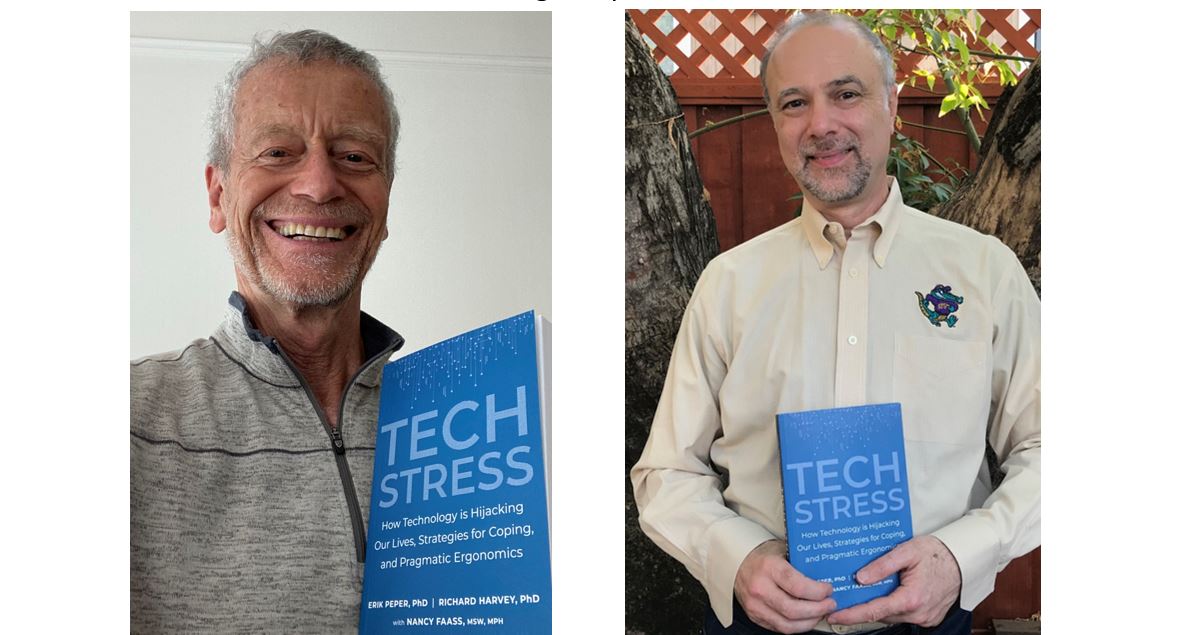
Evolution shapes behavior — and as a species, we’ve evolved to be drawn to the instant gratification, constant connectivity, and the shiny lights, beeps, and chimes of our ever-present devices. In earlier eras, these hardwired evolutionary patterns may have set us up for success, but today they confuse our instincts, leaving us vulnerable and stressed out from fractured attention, missed sleep, skipped meals, aches, pains, and exhaustion and often addicted to our digital devices.
Tech Stress offers real, practical tools to avoid evolutionary pitfalls programmed into modern technology that trip us up. You will find a range of effective strategies and best practices to individualize your workspace, reduce physical strain, prevent sore muscles, combat brain drain, and correct poor posture. The book also provides fresh insights on reducing psychological stress on the job, including ways to improve communication with coworkers and family.
Although you will have to wait to have the book delivered to your home, you can already begin to implement ways to reduce physical discomfort, zoom/screen fatigue and exhaustion. Have a look the blogs below.
How evolution shapes behavior
How to optimize ergonomics
Cartoon ergonomics for working at the computer and laptop
Hot to prevent and reduce neck and shoulder discomfort
Why do I have neck and shoulder discomfort at the computer?
Relieve and prevent neck stiffness and pain
How to prevent screen fatigue and eye discomfort
Resolve Eyestrain and Screen Fatigue
How to improve posture and prevent slouching
“Don’t slouch!” Improve health with posture feedback
How to improve breathing and reduce stress
Anxiety, lightheadedness, palpitations, prodromal migraine symptoms? Breathing to the rescue!
How to protect yourself from EMF
Cell phone radio frequency radiation increases cancer risk

Available from: https://www.penguinrandomhouse.com/books/232119/tech-stress-by-erik-peper-phd/
Why do I have neck and shoulder discomfort at the computer?
Posted: July 23, 2020 Filed under: behavior, computer, digital devices, ergonomics, Exercise/movement, laptops, Neck and shoulder discomfort, Pain/discomfort, posture, Uncategorized 8 CommentsAdapted from the upcoming book, TechStress: How Technology is Hijacking Our Lives, Strategies for Coping, and Pragmatic Ergonomics, by Erik Peper, Richard Harvey and Nancy Faass.
While working in front of screens, many of us suffer from Zoom/screen fatigue, iNeck, shoulder and back discomfort, tired eyes, exhaustion and screen addiction (Peper, 2020; Fosslien & Duffy, 2020; So, Cheng & Szeto, 2017; Peper & Harvey, 2018). As we work, our shoulders and forearms tense and we are often not aware of this until someone mentions it. Many accept the discomfort and pain as the cost of doing work–not realizing that it may be possible to work without pain.
Observe how you and coworkers work at the computer, laptop or cellphone. Often we bring our noses close to the screen in order to the text more clearly and raise our shoulders when we perform data entry and use the mouse. This unaware muscle tension can be identified with physiological recording of the muscles electrical activity when they contract (electromyography) (Peper & Gibney, 2006; Peper, Harvey & Tylova, 2006). In most cases, when we rest our hands on our laps the muscle tension is low but the moment we even rest our hands on the keyboard or when we begin to type or mouse, our muscles may tighten, as shown in Figure 1. The muscle activity will also depend on the person’s stress level, ergonomic arrangement and posture.
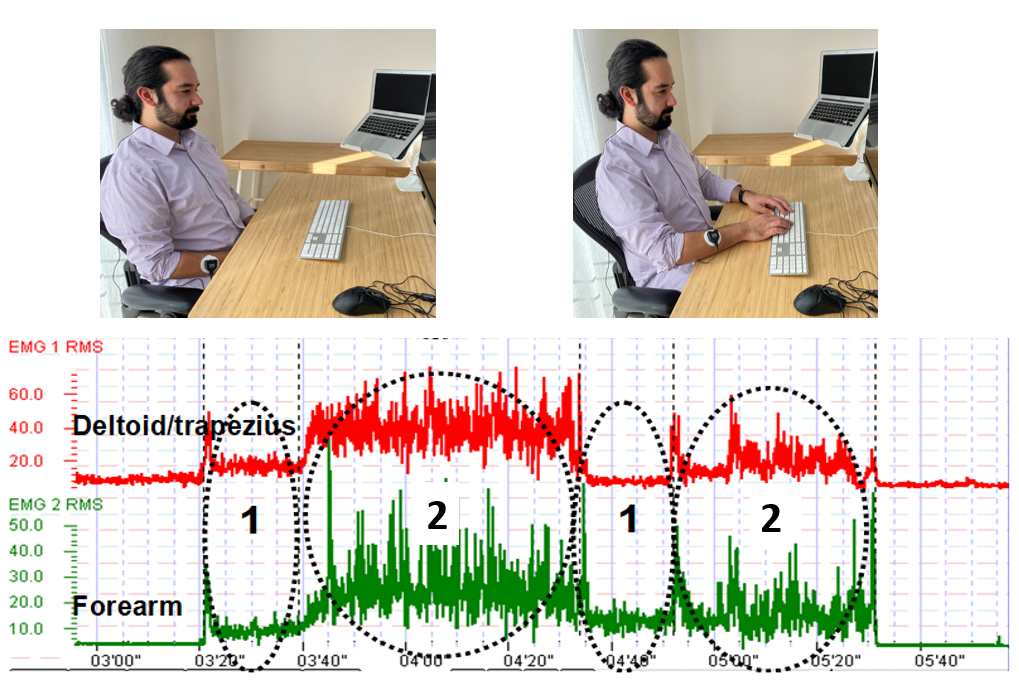 Figure 1. Muscle tension from the shoulder and forearm increased without any awareness when the person rested their hands on the keyboard (Rest Keyboard) and during typing and mousing. The muscles only relaxed when the hands were resting on their lap (Rest Lap) (reproduced by permission from Peper, Harvey, and Faass, 2020).
Stop reading from your screen and relax your shoulders. Did you feel them slightly drop and relax?
If you experienced this release of tension and relaxation in the shoulders, then you were tightening your shoulders muscles without awareness. It is usually by the end of the day that we experience stiffness and discomfort. Do the following exercise as guided by the video or described in the text below to experience how discomfort and pain develop by maintaining low-level muscle tension.
While sitting, lift your right knee two inches up so that the foot is about two inches away from the floor. Keep holding the knee up in this position. Did you notice your breathing stopped when you lifted your knee? Are you noticing increasing tension and discomfort or even pain? How much longer can you lift the knee up?
Let go, relax and observe how the discomfort dissipates.
Reasons for the discomfort
The discomfort occurred because your muscles were contracted, which inhibited the blood and lymph flow through the tissue. When your muscles contracted to lift your knee, the blood flow in those muscles was reduced. Only when your muscles relaxed could enough blood flow occur to deliver nutrients and oxygen as well as remove the waste products of metabolism (Wan et al, 2017). From a physiological perspective, muscles work most efficiently when they alternately contract and relax. For example, most people can walk without discomfort since their muscles contract and relax with each step. However, you could hold your knee up for a few minutes before experiencing discomfort in those same muscles.
How to prevent discomfort.
To prevent discomfort and optimize health, apply the same concept of alternating tensing and relaxing to your neck, shoulder, back and arm muscles while working. Every few minutes move your arms and shoulders and let them relax. Interrupt the static sitting position with movement. If you need reminders to get up and move your body during the workday or long periods sitting in front of a device, you can download and install the free app, StretchBreak.
For more information, read and apply the concepts described in our upcoming book, TechStress: How Technology is Hijacking Our Lives, Strategies for Coping, and Pragmatic Ergonomics. The book explains why TechStress develops, why digital addiction occurs, and what you can do to prevent discomfort, improve health and enhance performance. Order the book from Amazon and receive it August 25th. Alternatively, sign up with the publisher and receive a 30% discount when the book is published August 25th. https://www.northatlanticbooks.com/shop/tech-stress/
References
Peper, E. & Gibney, K. H. (2006). Muscle Biofeedback at the Computer: A Manual to Prevent Repetitive Strain Injury (RSI) by Taking the Guesswork out of Assessment, Monitoring and Training. Amersfoort: The Netherlands: Biofeedback Foundation of Europe. ISBN 0-9781927-0-2. Free download of the the book: http://bfe.org/helping-clients-who-are-working-from-home/
Wan, J. J., Qin, Z., Wang, P. Y., Sun, Y., & Liu, X. (2017). Muscle fatigue: general understanding and treatment. Experimental & molecular medicine, 49(10), e384. https://doi.org/10.1038/emm.2017.194
Reduce initial dose of the virus and optimize your immune system
Posted: April 4, 2020 Filed under: behavior, health, stress management, Uncategorized | Tags: coronavirus, COVID-19, immune system, public health, technology 9 CommentsErik Peper and Richard Harvey
Adapted from:Peper, E. & Harvey, R. (September 13, 2020). Reduce Initial Dose of the Virus and Optimize Your Immune System. Townsend Letters-The Examiner of Alternative Medicine, 44. https://www.townsendletter.com/article/reduce-initial-dose-of-the-virus-and-optimize-your-immune-system/
COVID-19 can sometimes overwhelm young and old immune systems and in some cases can result in ‘Severe Acute Respiratory Syndrome’ pneumonia and death (CDC, 2020). The risk is greater for older people, and people with serious heart conditions (e.g., heart failure, coronary artery disease, or cardiomyopathies), cancers, obesity, Type 2 diabetes, COPD, chronic kidney disease, hypertension, smoking, immune suppression or other health issues (CDC, 2020a) as well as young people who vape or smoke and those with immunological defects in type I and II interferon production (Gaiha, Cheng, & Halpern-Felsher, 2020; van der Made, 2020). As we age the immune system deteriorates (immunosenescence) that reduces the response of the adaptive immune system that needs to respond to the virus infection (Aw, Silva & Palmer, 2007; Osttan, Monti, Gueresi, et al., 2016). On the other hand, for young people and children the risk is very low and similar for Covid-19 as for seasonal influenza A and B in rates for hospitalization, admission to the intensive care unit, and mechanical ventilator ( Song et al, 2020).
Severity of disease may depend upon initial dose of the virus
In a brilliant article, How does the coronavirus behave inside a patient? We’ve counted the viral spread across peoples; now we need to count it within people, assistant professor of medicine at Columbia University and cancer physician Siddhartha Mukherjee points out that severity of the disease may be related to the initial dose of the virus. Namely, if you receive a very small dose (not too many virus particles), they will infect you; however, the body can activate its immune response to cope with the infection. The low dose exposure act similar to vaccination. If on the other hand you are exposed to a very high dose then your body is overwhelmed with the infection and is unable to respond effectively. Think of a forest fire. A small fire can easily be suppressed since there is enough time to upgrade the fire-fighting resources; however, during a fire-storm with multiple fires occurring at the same time, the fire-fighting resources are overwhelmed and there is not enough time to recruit outside fire-fighting resources.
As Mukherjee points out this dose exposure relationship with illness severity has a long history. For example, before vaccinations for childhood illnesses were available, a child who became infected at the playground usually experienced a mild form of the disease. However, the child’s siblings who were infected at home develop a much more severe form of the disease.
The child infected in the playground most likely received a relatively small dose of the virus over a short time period (viral concentration in the air is low). On the other hand, the siblings who were infected at home by their infected brother or sister received a high concentration of the virus over an extended period which initially overwhelmed their immune system. Higher virus concentration is more likely during the winter and in well insulated/sealed houses where the air is recirculated without going through HEPA or UV filters to sterilize the air. When there is no fresh air to decrease or remove the virus concentration, the risk of severity of illness may be higher (Heid, 2020).
The risk of becoming sick with COVID-19 can only occur if you are exposed to the coronavirus and the competency of your immune system. This can be expressed in the following equation. This equation suggests two strategies to reduce risk: reduce coronavirus load/exposure and strengthen the immune system.
How to reduce the coronavirus load/dose of virus exposure
Assume that everyone is contagious even though they may appear healthy. Research suggests that people are already contagious before developing symptoms or are asymptomatic carriers who do not get sick and thereby unknowingly spread the virus (Furukawa, Brooks, Sobel, 2020). Dutch researchers have reported that, “The proportion of pre-symptomatic transmission was 48% for Singapore and 62% for Tianjin, China (Ganyani et al, 2020). Thus, the intervention to isolate people who have symptoms of COVID-19 (fever, dry cough, etc.) most likely will miss the asymptomatic carriers who may infect the community without awareness. Only if you have been tested, do you know if you been exposed or recovered from the virus. To reduce exposure to the virus, avoid the “Three C’s” — closed spaces with poor ventilation, crowded places and close contact—and do the following:
- Follow the public health guidelines:
-
- Social distance (physical distancing while continuing to offer social support)
- Wear a mask and gloves to reduce spreading the virus to others.
- Wash your hands with soap for at least 20 seconds.
- Avoid touching your face to prevent microorganisms and viruses to enter the body through mucosal surfaces of the nose mouth and eyes.
- Clean surfaces which could have been touched by other such as door bell, door knobs, packages.
- Avoid the person’s slipstream that may contain the droplets in the exhaled air. The purpose of social distancing is to have enough distance between you and another person so that the exhaled air of the other person would not reach you. The distance between people depends upon their activities and the direction of airflow.
In a simulation study, Professor Bert Blocken and his colleagues at KU Leuven and Eindhoven University of Technology reported that the plume of the exhaled air that potentially could contain the virus droplets could extend much more than 5 feet. It would depends upon the direction of the wind and whether the person is walking or jogging as show in Figure 1 (Blocken, 2020).

Figure 1. The plume of exhaled droplets that could contain the virus extends behind the person in their slipstream (photo from KU Leuven en TU Eindhoven).
The plume of exhaled droplets in the person’s slipstream may extend more than 15 feet while walking and more than 60 feet while jogging or bicycling. Thus. social distancing under these conditions is much more than 6 feet and it means avoiding their slipstream and staying much further away from the person.
- Increase fresh air to reduce virus concentration. The CDC recommends ventilation with 6 to 12 room air changes per hour for effective air disinfection (Nardell & Nathavitharana, 2020). By increasing the fresh outside air circulation, you dilute the virus concentration that may be shed by an infected asymptomatic or sick person (Qian & Zheng, 2018). Thus, if you are exposed to the virus, you may receive a lower dose and increase the probability that you experience a milder version of the disease. Almost all people who contract COVID-19 are exposed indoors to the virus. In the contact tracing study of 1245 confirmed cases in China, only a single outbreak of two people occurred in an outdoor environment (Qian et al, 2020). To increase fresh air (this assumes that outside air is not polluted), explore the following:
-
- Open the windows to allow cross ventilation through your house or work setting. One of the major reasons that the flu season spikes in the winter is that people congregate indoors to escape weather extremes. People keep their windows closed to conserve heat and reduce heating bill costs. Lack of fresh air circulation increases the viral density and risk of illness severity (Foster, 2014). See the superb graphic illustration by Bartzokas et al (Feb 26, 2021).in the New York Times of virus concentration in schools when the windows are opened. https://www.nytimes.com/interactive/2021/02/26/science/reopen-schools-safety-ventilation.html?smid=em-share
- Use an exhaust fans to ventilate a building. By continuously replacing the inside “stale” air with fresh outside air, the concentration of the virus in the air is reduced.
- Use High-efficiency particulate air (HEPA) air purifiers to filter the air within a room. These devices will filter out particles whose diameter is equal to 0.3 µ m. They will not totally filter out the virus; however, they will reduce it.
- Avoid buildings with recycled air unless the heating and air conditioning system (HAC) uses HEPA filters.
- Wear masks to protect other people and your community. The mask will reduce the shedding of the virus to others by people with COVID-19 or those who are asymptomatic carriers. This is superbly illustrated by Prather, Wang, & Schooley (2020) that not masking maximizes exposure, whereas universal masking results in the least exposure.

- Avoid long-term exposure to air pollution. People exposed to high levels of air pollution and fine particulate matter (PM2.5) are more at risk to develop chronic respiratory conditions and COVID-19 death rates. In the 2003 study of SARS, ecologic analysis conducted among 5 regions in China with 100 or more SARS cases showed that case fatality rate increased with the increment of air pollution index (Cui, Zhang, Froines, et al. , 2003). The higher the concentration of fine particulate matter (PM2.5), the higher the death rate (Conticini, Frediani, & Caro, 2020). As researchers, Xiao Wu, Rachel C. Nethery and colleagues (2020) from the Harvard T.H. Chan School of Public Health point out, “A small increase in long-term exposure to PM2.5 leads to a large increase in COVID-19 death rate, with the magnitude of increase 20 times that observed for PM2.5 and all cause mortality. The study results underscore the importance of continuing to enforce existing air pollution regulations to protect human health both during and after the COVID-19 crisis.“
- Breathe only through your nose. The nose filters, warms, moisturizes and slows the airflow so that airway irritation is reduced. Nasal breathing increases nitric oxide production that significantly increases oxygen absorption in the body. During inspiration through the nose the nitric oxide helps dilate the airways in your lungs and blood vessels (McKeown, 2016). More importantly for dealing with COVID-19, Nitric Oxide, produced and released inside the nasal cavities and the lining of the blood vessels, acts as an antiviral and a secondary strategy to protect against viral infections (Mehta, Ashkar & Mossman, 2012).
How to strengthen your immune system to fight the virus
The immune system is dynamic and many factors as well as individual differences affect its ability to fight the virus. It is possible that a 40 year-old person may have an immune systems that functions as a 70 year old, while some 70 year-olds have an immune system that function as a 40 year-old. Factors that contribute to immune competence include genetics, aging, previous virus exposure, and lifestyle (Lawton, 2020).
It is estimated that 70-80% mortality caused by Covid-19 occurred in people with comorbidity who are: over 65, male, lower socioeconomic status (SES), non white, overweight/obesity, cardiovascular heart disease, and immunocompromised. Although children comprised only a small percentage of the seriously ill patients, 83% of those children in the intensive care units had comorbidities and 60% were obese. The majority of contributing factors to comorbidities and obesity are the result of economic inequality and life style patterns such as the Western inflammatory diet (Shekerdemian et al, 2020; Zachariah, 2020; Pollan, 2020).
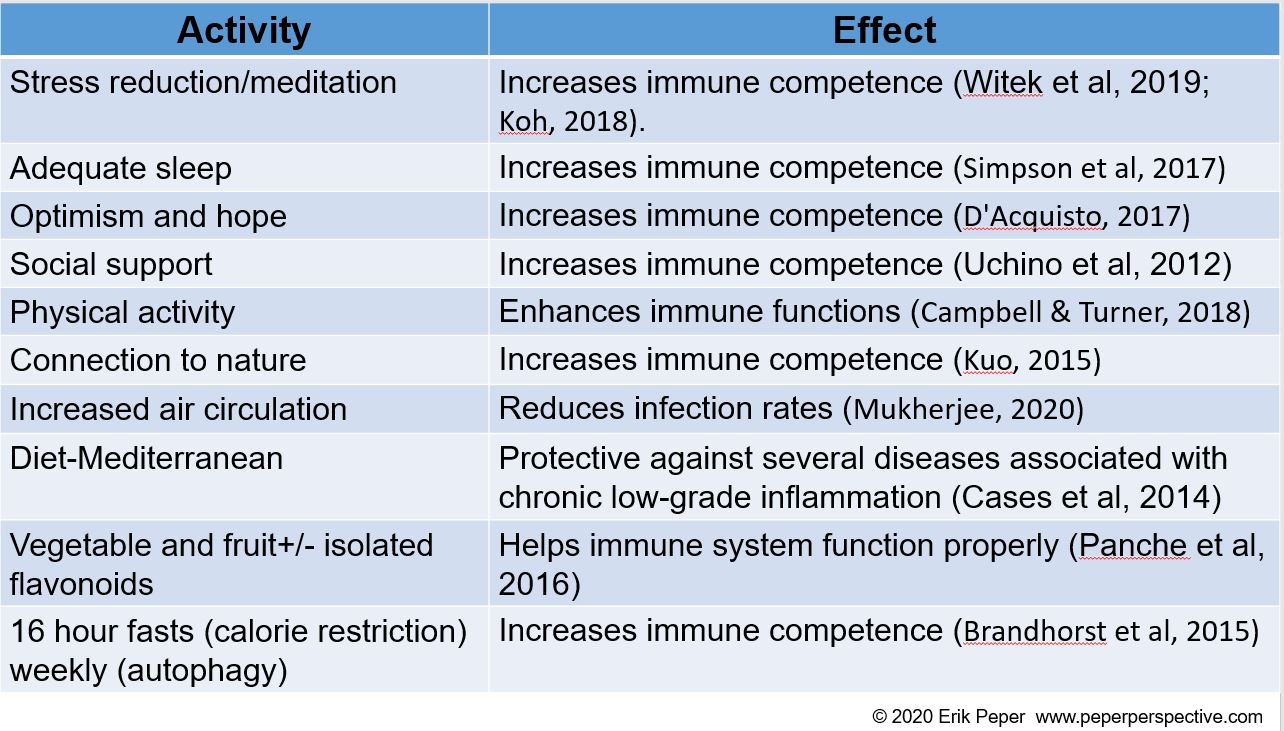
By taking charge of your lifestyle habits through an integrated approach, you may be able to strengthen your immune system (Alschuler et al, 2020; Lawton, 2020). The following tables, adapted from the published articles by Lawton (2020), Alschuler et al, (2020) and Jaffe (2020), list factors that support or decrease the immune system.
Factors that decrease immune competence

Factors that support immune competence
Phytochemicals and vitamins that support immune competence

REFERENCES
Abhanon, T. (2020 March 26). Practical tips how to keep yourself safe.
Foster, H. (2014 December 1). The reason for the season: why flu strikes in winter. SITN Science in the News.
Furukawa, N.W., Brooks, J.T., & Sobel, J. (2020, July). Evidence supporting transmission of severe acute respiratory syndrome coronavirus 2 while presymptomatic or asymptomatic. Emerg Infect Dis. [June3, 2020]. https://doi.org/10.3201/eid2607.201595
Ganyani, T., Kremer, C., Chen, D., Torneri, A, Faes, C., Wallinga, J., & Hensm N. (2020). Estimating the generation interval for COVID-19 based on symptom onset data doi:https://doi.org/10.1101/2020.03.05.20031815
Gaiha, S.M., Cheng, J. & Halpern-Felsher, B. (2020). Association between youth smoking, electronic cigarette use, and coronavirus disease 2019. Journal of Adolescent Health. Published online August 11, 2020. doi: https://doi.org/10.1016/j.jadohealth.2020.07.002
Heid, M. (2020-04-09). The Germ-Cleaning Power of an Open Window. Elemental by Medium.
BMJ Open, 11:e047474. http://dx.doi.org/10.1136/bmjopen-2020-047474
Jaffe, R. (2020). Reduce risk, boost immunity defense and repair abilities, and stay resilient. PERQUE Integrative Health.
Lawton, G. (2020). You’re only as young as your immune system. New Scientist, 245(3275), 44-48.
Lee, G. Y., & Han, S. N. (2018). The Role of Vitamin E in Immunity. Nutrients, 10(11), 1614.
Malaguarnera L. (2019). Influence of Resveratrol on the Immune Response. Nutrients, 11(5), 946.
Mukherjee, S. (2020). How does the coronavirus behave inside a patient? We’ve counted the viral spread across peoples; now we need to count it within people. The New Yorker, April 6, 2020.
 the peper perspective
