When you have pain-Listen to this first!
Posted: February 20, 2022 Filed under: behavior, CBT, cognitive behavior therapy, emotions, healing, health, Pain/discomfort, self-healing 3 Comments
Pain is so different for each person. It can range from mildly distracting to totally debilitating. It can be the result from a medical procedure (post- surgical pain), a traumatic injury, disease, trauma or unknown causes. It is challenging to know what to do to reduce suffering and improve health and functioning. Should I take narcotics, have surgery, see a pain psychologist, have acupuncture, receive physical therapy, use biofeedback, change my diet, or get a massage? Should I exercise or rest? Should I follow my doctor’s recommendations?
Before you do anything, first listen to this podcast by pain psychologist, Rachel Zoffness, PhD. In this podcast she will explain what pain is; how it works; and how thoughts, emotions, and sensations are always interconnected. You will also learn the fundamentals of treating chronic pain and helping patients living with it. As one of my close friends stated, “I only wished I could have listened to this before, it would have saved years of suffering.” The podcast is Ologies with Alie Ward and the episode is Dolorology. The link for the episode is:
https://www.alieward.com/ologies/dolorology
Rachel Zoffness, PhD, a pain psychologist, Visiting Professor at Stanford, and Assistant Clinical Professor at the UCSF School of Medicine. She serves on the Board of Directors of the U.S. Association for the Study of Pain, and the Society of Pediatric Pain Medicine. She is the author of The Pain Management Workbook and The Chronic Pain and Illness Workbook for Teens. She is a 2021 Mayday Fellow and consults on the development of integrative pain programs around the world.

Make your New Year Resolution come true
Posted: December 28, 2021 Filed under: behavior, emotions, healing, health, self-healing | Tags: habits 5 Comments
It is the time of year when we once again make New Year resolutions, “I plan to exercise every day,” “I will stop drinking,” “I will eat less processed foods and more fruits and vegetables.” We use our will power and positive thoughts to begin these new activities; however, our will power often fades out and we quickly fall of the wagon. The reason vary such as, I had planned to jog today; however it is raining, I was planning to eat more vegies; however, I had dinner with a friend and ate a juicy hamburger, I had planned to meditate; however, I needed to help my son. So many other things took priority and the motivation disappeared..
Yet it is possible to be successful with starting and then maintaining new health promoting habits. The key is to increase the friction for the behaviors that you want to reduce and decrease the friction for behaviors that you want to increase. Friction is the extra work you need to do in order to do the task. For example, to eat fewer cookies, increase the friction by not having them in the house (you now have to go to the store to buy them) or by placing them somewhere where it takes greater effort to get them such as the top shelf for which that you need a small ladder to reach them. The extra effort (increased friction) brings awareness to the automatic behavior. At that point, you can interrupt your unconscious eating pattern and choose to do something else. On the other hand, to increase eating fruits, decrease the friction by having the fruit right in front of you on the table so that you can take one without thinking.
The key is to interrupt the habit chain of behavior you want to reduce and automate the habit chains of behaviors you want to increase. The more you do a behavior and the more pleasurable it is, the more likely will the new behaviore become an automatic habit. To learn how to change friction and how to be successful in creating new habits, listen to Shankar Vedantam Hidden Brain’s Podcast, Creatures of Habit.
Healing from paralysis-Music (toning) to activate health
Posted: November 22, 2021 Filed under: behavior, Breathing/respiration, emotions, healing, health, mindfulness, stress management, Uncategorized | Tags: chakra, chanting, music therapy, paralysis, quadriplegia, singing, Toning 8 CommentsMadhu Anziani and Erik Peper

In April 2009, Madhu Anziani, just one month prior to graduation from San Francisco State University with a degree in Jazz/World music performance, fell two stories and broke C5 and C7 vertebras. He became a quadriplegic (tretraplegia) and could not breathe, talk, move his arms and legs and was incontinent. He also could not remember anything about the accident because of retrograde amnesia. Even though he was paralyzed and the medical staff suggested that he focussed on how to live well as a quadriplegic, he transcended his paralysis and the prognosis and is now a well-known vocal looping arts and ceremonial song leader/composer.
His recovery against all odds provides hope that growth and healing is possible when the mind and spirit focus on possibilities and not on limitations. Alongside physical thereapy he utilized energy healing and toning/sound vibrations to recover mobility. Toning, the vocalization of an elonggated monotonous vowel sound susteained for a number of minutes tends to vibrate specific areas in the body where the chakras are located (Crowe & Scovel, 1996; Goldman, 2017). Toning compared to mindfulness meditation reduces intrusive thoughts and mind wandering. It also increases body vibration sensations and heart rate variability much more than mindfulness practice (Peper et al, 2019). The body vibrations induced by toning and music could be one of the mechanisms by which recovery can occur at an accelerated rate as it allows the person’s passive awareness and sustained attention to feel the paralyzed body and yet be relaxed in the present without judgement.
Watch Madhu’s inspirational presentation as part of the Holistic Health Lecture Series by the Institute for Holistic Health Studies, San Francisco State University. In this presentation, he describes the process of recovery and guides the viewer through toning practices to evoke quieting of mind, bliss within the heart, and a healing state of being.
For an additional discussion and guided practice in toning, see the blog, Toning quiets the mind and increases HRV more quickly than mindfulness practice.
Madu Anziani is a sound healer who endured being a tetraplegic (paralysis affecting all four
limbs) and used sound and energy healing to recover mobility. He is a SFSU graduate and most
well-known as a vocal looping artist and ceremonial song leader/composer.
http://www.firstwasthesound.com
http://madhu.bandcamp.co
REFERENCES:
Goldman, J. (2017). The 7 Secrets of Sound Healing. Carlsbad, CA: Hay House Inc.
Simple acts of kindness
Posted: December 29, 2020 Filed under: behavior, emotions, health, mindfulness, self-healing, stress management | Tags: kindness 1 CommentAs we emerge from the COVID pandemic and look forward to the New Year, we can bring joy and happiness though through simple acts of kindness.
There is hope in these crazy times—three inspirational TED talks
Posted: December 16, 2020 Filed under: behavior, emotions, health, mindfulness, self-healing, Uncategorized | Tags: hope, racial bias, resilience 2 CommentsI just received an email from the Rick Hansen Foundation that inspired me to share its recommendations. In 1957 at the age of 15, Rick Hansen injured his spinal cord and was paralyzed from the waist down. He is an inspiration for all of us. In these crazy times of sheltering in place, experiencing social isolation, anxiety, depression, racial bias, and also happiness and joy, he recommends the following TED talks to increase resilience, overcome racial bias, and achieve self-acceptance. Enjoy watching the talks as they suggest strategies to deal with adversity and offer hope for the New Year.
3 Secrets of resilient people by Dr. Lucy Hone, Co-director of the New Zealand Institute of Wellbeing & Resilience and adjunct fellow at the University of Canterbury in Christchurch, New Zealand.
How racial bias works-and how to disrupt it by Stanford University social psychologist, Jennifer L. Eberhardt
To overcome challenges, stop comparing yourself to other by wheelchair athlete Dean Furnes
Exploiting evolutionary traps: Netflix’s new movie, The Social Dilemma
Posted: September 20, 2020 Filed under: behavior, computer, digital devices, emotions, Evolutionary perspective, surgery, Uncategorized | Tags: addiction, anxiety, depression, evolutionary trap, Facebook, Google, Instagram, social media, suicide 1 Comment
Apple founder Steve Jobs didn’t let his kids use the iPad, or really any product their dad invented, As Steve Jobs stated, “They haven’t used it,” “We limit how much technology our kids use at home.” (Bilton, 2014).
In 2007, Bill Gates, the former CEO of Microsoft, implemented a cap on screen time when his daughter started developing an unhealthy attachment to a video game. He also didn’t let his kids get cell phones until they turned 14 (Akhtar & Ward, 2020).
What is it that these two titans of the tech revolution and the many Silicon Valley insiders know and discuss in the Netflix docudrama, The Social Dilemma?
They recognized the harm that occurs when monetary incentives are the singular driver to optimize the hardware (the look and feel of the cellphone) and much more important the software algorithms to capture the attention of the user. It is interesting that there are only two industries that label their customers as users, illegal drugs and software (Kalsim 2020).
The longer a user is captured by the screen, the more the user responds to notifications, the more the user clicks to other sites, the more money the corporation earns from its advertisers. The algorithms continuously optimize what the user sees and hears so that they stay captured. Thus, the algorithms are designed to exploit the evolutionary response patterns that allowed us to survive and thrive. Evolutionary traps occur when adaptive behaviors that were once successful become maladaptive or even harmful. When this occurs, cues that were protective or beneficial can lead to reduced health and fitness (Peper, Harvey & Faass 2020).
Companies exploit evolutionary traps for the purpose of improving profits. This potentially constitutes a major health risk for humanity. As quoted from the The Social Dilemma, “Your attention is the product that is being sold to advertisers”
Google, Facebook, Twitter, Instagram, Pinterest, and others are designed to be highly addictive and incorporate some of the following evolutionary traps (Peper, Harvey & Faass, 2020):
- We are wired to see artificial images and to hear reproduced sounds as real. The brain does not discriminate between actual and visual-auditory images that are artificial, which explains one aspect of our attraction to our phones, to binge-watching, and to gaming.
- We are wired to react to any stimuli that suggests potential danger or the presence of game animals. Whether the stimuli is auditory, visual, tactile, or kinesthetic, it triggers excessive arousal. This makes us vulnerable to screen addiction, because our biology compels us to respond.
- We are wired to attend to social information about power within our group, a major factor in social media addiction.
If you concerned about false news, political polarization, radicalization, increased anxiety, depression, suicides and mental health in people, watch Netflix, The Social Dilemma and the powerful presentation by Sacha Baron Cohen’s superb presentation, Never is Now, the 2019 Anti-Defamation League Leadership Award.
What makes this film so powerful is that it is told by the same people who were the designers, developers, and programmers for the different social media companies.

From: https://www.netflix.com/title/81254224
For an outstanding critique of social media and the power of Facebook, Twitter, and Google, watch Sacha Baron Cohen’s superb presentation at the 2019 Anti-Defamation League Leadership Award.
References:
Bilton, N. (Sept 10, 2014). Steve Jobs was a low-tech parent. New York Times.
Ways to reduce TechStress
Posted: August 13, 2020 Filed under: ADHD, behavior, computer, digital devices, emotions, ergonomics, Evolutionary perspective, Exercise/movement, health, Neck and shoulder discomfort, Nutrition/diet, Pain/discomfort, posture, relaxation, self-healing, stress management, Uncategorized 5 CommentsWe are excited about our book, TechStress-How Technology is Hijacking our Lives, Strategies for Coping and Pragmatic Ergonomics, that was published August 25, 2020.
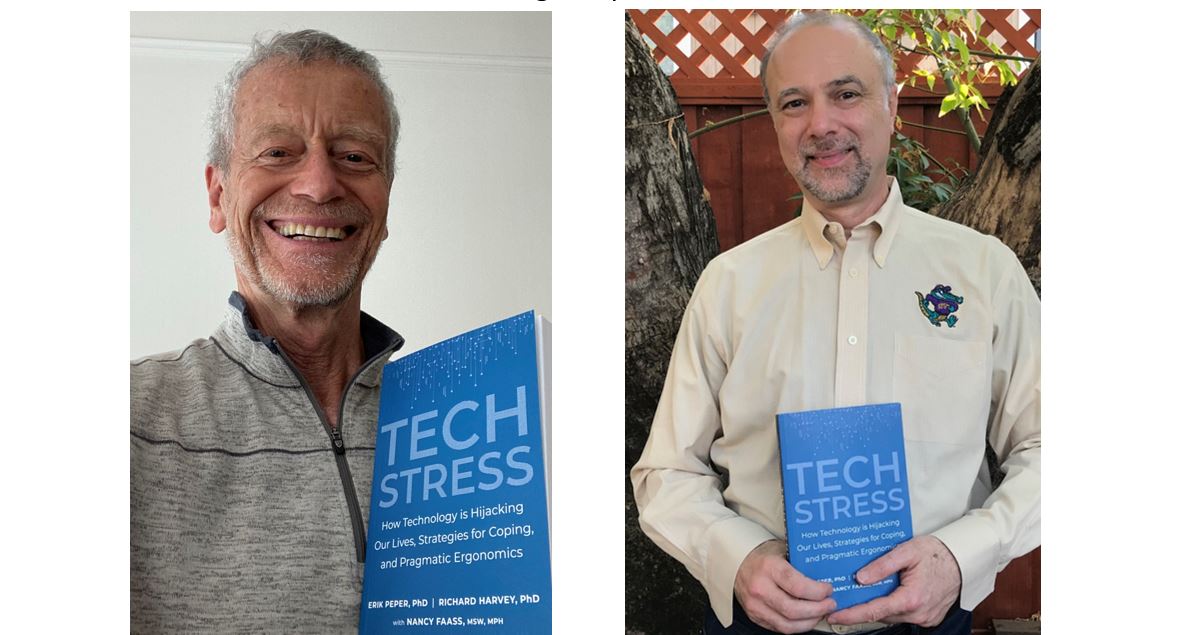
Evolution shapes behavior — and as a species, we’ve evolved to be drawn to the instant gratification, constant connectivity, and the shiny lights, beeps, and chimes of our ever-present devices. In earlier eras, these hardwired evolutionary patterns may have set us up for success, but today they confuse our instincts, leaving us vulnerable and stressed out from fractured attention, missed sleep, skipped meals, aches, pains, and exhaustion and often addicted to our digital devices.
Tech Stress offers real, practical tools to avoid evolutionary pitfalls programmed into modern technology that trip us up. You will find a range of effective strategies and best practices to individualize your workspace, reduce physical strain, prevent sore muscles, combat brain drain, and correct poor posture. The book also provides fresh insights on reducing psychological stress on the job, including ways to improve communication with coworkers and family.
Although you will have to wait to have the book delivered to your home, you can already begin to implement ways to reduce physical discomfort, zoom/screen fatigue and exhaustion. Have a look the blogs below.
How evolution shapes behavior
How to optimize ergonomics
Cartoon ergonomics for working at the computer and laptop
Hot to prevent and reduce neck and shoulder discomfort
Why do I have neck and shoulder discomfort at the computer?
Relieve and prevent neck stiffness and pain
How to prevent screen fatigue and eye discomfort
Resolve Eyestrain and Screen Fatigue
How to improve posture and prevent slouching
“Don’t slouch!” Improve health with posture feedback
How to improve breathing and reduce stress
Anxiety, lightheadedness, palpitations, prodromal migraine symptoms? Breathing to the rescue!
How to protect yourself from EMF
Cell phone radio frequency radiation increases cancer risk

Available from: https://www.penguinrandomhouse.com/books/232119/tech-stress-by-erik-peper-phd/
Evolutionary traps: How screens, digital notifications and gaming software exploits fundamental survival mechanisms
Posted: January 17, 2020 Filed under: ADHD, behavior, digital devices, emotions, Evolutionary perspective, Uncategorized | Tags: Aggression, CBT, depression, gaming, media, mental rehearsal 6 CommentsErik Peper and Richard Harvey
If athletes, psychologists, business executives, actors, students, politicians, job seekers and others use mental and actual rehearsal to improve their performances, would repeated watching of violent and aggressive streaming-videos, or playing hours and hours of first-shooter computer games be a form of rehearsal for aggressive behavior?
Arguably, mental and actual rehearsal is positively associated with improving health, such as preparing for an athletic competition or an academic exam and is negatively associated with health when playing aggressive, violent first-person shooter video games, or continuously watching aggressive or violent content on a variety of streaming platforms. Rehearsal–whether physical or in our imagination–impacts our health and performance in school, sports, therapy, politics, business and health. Choose to rehearse activities that improve health and well-being.
- Athletes use mental rehearsal to improve sports performance (Peper & Aita, 2017; Schenk & Miltenberger, 2019).
- Surgeons use mental rehearsal and actual practice to improve performance (Spiotta et al., 2018).
- Psychologists use cognitive behavioral therapy (CBT) rehearsal techniques to reduce anxiety and depression (Dobson & Dobson, 2018; Yamada et al, 2018; Cook, Mostazir, & Watkins, 2019)
- Successful business executives rehearse presentations before a staff meeting (Couch & Citrin, 2018).
- Actors and performers spend hours and days rehearsing their roles so that they portray and act it realistically during the performance .
- Students take practice exams so that they will perform better on the actual exam.
- Politicians, lawyers, and many others rehearse and practice being able to answer unexpected questions.
- Job seekers rehearse elevator pitches so that they transmit in a few words what is important
Mechanisms of rehearsal
Both mental and physical rehearsal strengthens neurochemical connections in the brain so that the rehearsed behaviors become more automated, fluid and unconscious. There is a saying in neurosciences, “Neurons that fire together wire together.” –the more you rehearse a task, the more those specific neurological pathways are strengthened, leading to automatic and efficient outcomes.
We now spend hours a day being exposed to digital displays on our phones, computers, gaming consoles and other digital devices, immersing ourselves in content reflecting life promoting, positive behavior and sometimes violent, negative behavior. Children and adults spend much of their free time looking at screens, texting, playing computer games, updating social media sites with moment by moment accounts of sometimes trivial activities, or going down the rabbit hole by following one hyperlinks after another. As we do this, we are unaware how much time has frittered away without actually doing anything productive. Below are some recent estimates of ‘daily active user’ minutes per day that uses a screen.
- Facebook about an hour per day
- Instagram just under an hour per day
- Texting about 45 minutes per day
- Internet browsing, about 45 minutes per day
- Snapchat, about 30 minutes per day
- Twitter, about 25 minutes per day
Adolescents interact with media for over 40 hours per week, or around 6 hours per day!
In spending much of our time with the screens, we rehearse a variety of physical body postures as well as a variety of cognitive and behavioral states that impact our physical, mental, emotional and social health. Many researchers have lamented the loss of some social skills that develop during physical face-to-face contact. The colloquial phrase, Use it or lose it, raises several questions about what is being lost when we spend so much of our waking time interacting with screens instead actually with other people?
It is almost impossible not to be distracted by the digital screen. The powerful audiovisual formats override our desire to do something different that some of us become enslaved to watching streaming videos, playing computer games or texting. Moreover, the ongoing visual and auditory notifications from our apps interrupts and/or capture our attention. Why is it difficult to turn away from visual or auditory stimuli? The answer has roots in our survival.
To attend to stimuli is an automatic evolutionary survival response. If we did not attend, we would not survive–Is the slight movement to the far right, just at the edge of our peripheral vision, a predator ready to attack?

Tiger in Kanha National Park, Madhya Pradesh, India
Each time a stimulus occurs, we need to check it out to see if it is friend or foe, safety or danger. The response is so automatic that we are unaware that we have reacted until after we have responded. We all have experienced this. When a computer screen or cellphone screen is held by the stranger next to us, we automatically look at their screen and we may even begin to read their emails. Although we know that peering at some else’s screen is not proper, we are still feel compelled to do it!
Similarly, screens displaying computer games and other media can capture or hijack our attention by the rapid scene changes, primarily because the content is programmed so we receive intermittent rewards for our responses. For example, the sound or visual notifications from our apps, cellphone messages, or social media trigger an impulse to scan the environment for information that may be critical to our survival. Even without receiving notifications, we may anticipate or project that there may be new information on our social media accounts, and sometimes we become disappointed when the interval between notifications is long. One student talking to another might say: “Don’t worry, they’ll respond; It’s only been 30 seconds.” Anticipating responses from the media can interrupt what we are otherwise doing. For example, rather than finish our work, we check for updates on social media, even though we probably know that there are no new important messages to which we would have to respond right away.
The mechanisms that help us survive by scanning our environment for predators may now become an evolutionary trap and is exploited to capture as many eyeballs as possible to increase market share, advertising revenue, and corporate bottom line.
We usually blame the individual for lack of self-control instead of blaming the designers of the digital apps, games and displays who have exploited this biological survival mechanism. We expect that children have voluntary control as their brains are developing–but how could they not react to the stimuli that for thousands of generations, helped them to survive. It is similar to asking children to have control and say “No” to fast foods and sweets. The foods that were previously necessary for survival represented by moderate amounts of ‘salt, fat, acid, heat and sweet’ tastes are often found in excess in our modern commercial or packaged ‘fast food nation’ making it likely that people may fall into an evolutionary trap related to what they eat.
Presently, high levels of exposure to violent and aggressive streaming videos and computer games can be harmful as they provide the practice to rehearse violence, killing and aggression mentally. It would be too strong a statement to assert that everyone who plays violent video games will become delinquent, criminal or homicidal in an extreme form of aggression. According to the American Psychological Association Task Force on Video Game Violence in 2017, it may be asserted that high frequency, long duration, high intensity interactions with violent video games or similar media content is highly associated with angry and aggressive thoughts, desensitization to violence, and decreases in empathy or helping others (Calvert et al., 2017). Some forms of social media interactions also lead to a form of social isolation, loneliness (phoneliness) (Christodoulou, G., Majmundar, A., Chou, C-P, & Pentz, M.A., 2020; Kardaras, 2017). Digital content requires the individual to respond to the digital stimuli, without being aware of the many verbal and nonverbal communication cues (facial expressions, gestures, tone of voice, eye contact, body language, posture, touch, etc) that are part of social communication (Remland, 2016). It is no wonder that more and more adolescents experience anxiety, depression, loneliness, and attention deficit disorders with a constant ‘digital diet’ that some have suggested include not only media, but junk food as well .
The negative impact of watching digital media was prescient by Jerry Mander, one of the leading visionaries of the 20th century, in his 1978 book, Four Arguments for the Elimination of Television, as well as by Joseph C. Pearce, author of books on human development and child development, in his 1993 book, Evolution’s End.
More recently, two superb books detail the harm that the digital revolution has brought, along with recommended strategies for how to use modern technologies wisely and live successfully in an e-world. We are not saying to avoid the beneficial parts of the digital age. We are saying to be aware how some material and digital platforms prey upon our evolutionary survival mechanisms. Unfortunately, most people —especially children– have not evolved skills to counter the negative impacts of some types of media exposure. It may take parental control and societal policies to mitigate the damage and enhance the benefits of the digital age. We highly recommend the following two books.
Glow Kids by Nicholas Kardaras, PhD describes the impact of excessive texting and computer gaming as well as strategies how to use digital media wisely
Deep Work by Cal Newport, PhD describes the impact of constant interruptions and offers rules for focused success in a distracted world.

References:
Kardaras, N. (2017). Glow Kids, New York: St. Martin’s Griffin
Newport, C. (2019). Deep Work. New York: Grand Central Publishing
Pearce, J. C. (1993). Evolution’s End. New York: Harper One
Life has choices
Posted: December 29, 2019 Filed under: emotions, health, self-healing, Uncategorized | Tags: hospice 4 CommentsWhen you woke up this morning, how did you feel? Were you looking forward to the day anticipating with joy what would occur or were you dreading the day as if once again you had to step on the treadmill of life?
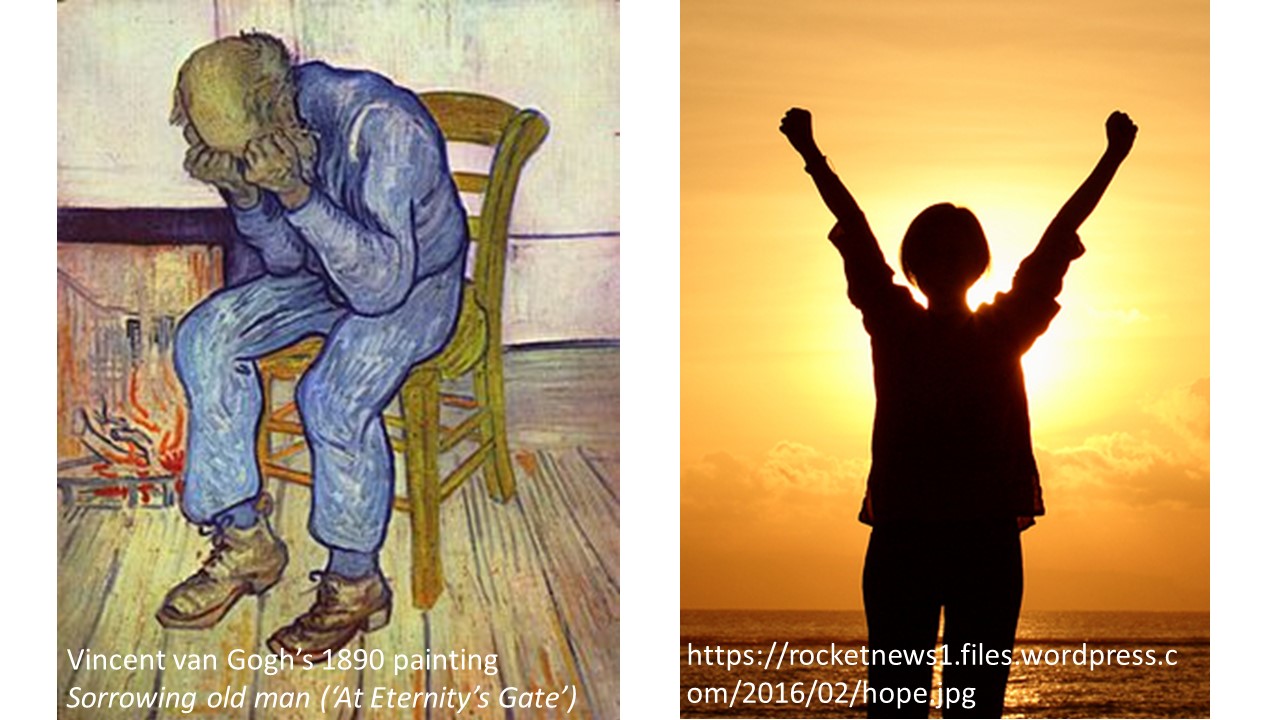
Whenever I ask this question of college students in their junior or senior year at an urban university about 20% will answer that they are looking forward to the day. The majority answer, “Well not really”, or even “Oh shit, another day”. For many students the burden of working 40 plus hours a week to pay for rent and tuition, worrying about financial debt, the challenge of commuting, and finding time to do the homework is overwhelming. Focusing on quality of life is not only a challenge for students, but for all of us.
Each day ask yourself, “Am I looking forward to my day and my activities?” If the answer is “No,” begin to explore new options. Ask yourself, “What would I like to do? Start to explore and imagine new options and then begin to plan how to implement them so that you are on the path to where you want to be.
Creating a worthwhile life is an ongoing challenge. An inspiring essay by Steven James articulates this by exploring factors that contribute to sickness and health during the height of the AIDs epidemic. He outline rules that contribute to 1) how to get sick, 2) how to get sicker (if you are already sick), and 3) how to stay well (or get better, if you are not so well to begin with).
| Steven James’s Totally Subjective, Nonscientific Guide to Illness and Health: Ten-Step Programs
How to Get Sick · Don’t pay attention to your body. Eat plenty of junk food, drink too much, take drugs, have lots of unsafe sex with lots of different partners—and, above all, feel guilty about it. If you are overstressed and tired, ignore it and keep pushing yourself. · Cultivate the experience of your life as meaningless and of little value. · Do the things you don’t like, and avoid doing what you really want. Follow everyone else’s opinions and advice, while seeing yourself as miserable and “stuck.” · Be resentful and hypercritical, especially toward yourself. · Fill your mind with dreadful pictures, and then obsess over them. Worry most, if not all, of the time. · Avoid deep, lasting, intimate relationships. · Blame other people for all your problems. · Do not express your feelings and views openly and honestly. Other people wouldn’t appreciate it. If at all possible, do not even know what your feelings are. · Shun anything that resembles a sense of humor. Life is no laughing matter! · Avoid making any changes that would bring you greater satisfaction and joy. How to Get Sicker (If You’re Already Sick) · Think about all the awful things that could happen to you. Dwell upon negative, fearful images. · Be depressed, self-pitying, envious, and angry. Blame everyone and everything for your illness. · Read articles, books, and newspapers, watch TV programs, surf the net, and listen to people who reinforce the viewpoint that there is NO HOPE. You are powerless to influence your fate. · Cut yourself off from other people. Regard yourself as a pariah. Lock yourself up in your room and contemplate death. · Hate yourself for having destroyed your life. Blame yourself mercilessly and incessantly. · Go to see lots of different doctors. Run from one to another, spend half your time in waiting rooms, get lots of conflicting opinions and lots of experimental drugs, starting one program after another without sticking to any. · Quit your job, stop work on any projects, give up all activities that bring you a sense of purpose and fun. See your life as essentially pointless, and at an end. · Complain about your symptoms, and if you associate with anyone, do so exclusively with other people who are unhappy and embittered. Reinforce each other’s feelings of hopelessness. · Don’t take care of yourself. What’s the use? Try to get other people to do it for you, and then resent them for not doing a good job. · Think how awful life is, and how you might as well be dead. But make sure you are absolutely terrified of death, just to increase the pain.
|
| How to Stay Well (Or Get Better, If You’re Not So Well to Begin With)
· Do things that bring you a sense of fulfillment, joy, and purpose, that validate your worth. See your life as your own creation and strive to make it a positive one. · Pay close and loving attention to yourself, tuning in to your needs on all levels. Take care of yourself, nourishing, supporting, and encouraging yourself. · Release all negative emotions—resentment, envy, fear, sadness, anger. Express your feelings appropriately; don’t hold onto them. Forgive yourself. · Hold positive images and goals in your mind, pictures of what you truly want in your life. When fearful images arise, refocus on images that evoke feelings of peace and joy. · Love yourself, and love everyone else. Make loving the purpose and primary expression of your life. · Create fun, loving, honest relationships, allowing for the expression and fulfillment of needs for intimacy and security. Try to heal any wounds in past relationships, as with old lovers, and with your mother and father. · Make a positive contribution to your community, through some form of work or service that you value and enjoy. · Make a commitment to health and well-being, and develop a belief in the possibility of wholeness. Develop your own healing program, drawing on the support and advice of experts without becoming enslaved to them. · Accept yourself and everything in your life as an opportunity for growth and learning. Be grateful. When you fuck up, forgive yourself, learn what you can from the experience, and then move on. · Keep a sense of humor. |
As you go into the New Year, remind yourself that life has choices.
Reduce stress, anxiety and negative thoughts with posture, breathing and reframing
Posted: October 19, 2019 Filed under: behavior, Breathing/respiration, emotions, Exercise/movement, posture, stress management, Uncategorized | Tags: Acceptance and comitment therapy, ACT, CBT, cognitive behavior therapy, empowerment, Reframing 11 CommentsWhen locked into a position, options appear less available. By unlocking our body, we allow our brain to unlock and become open to new options.
Changing positions may dissolve the rigidity associated with a fixed position. When we step away from the conflict, take a walk, look up at the treetops, roof lines and clouds, or do something different, we loosen up and new ideas may occur. We may then be able see the conflict from a different point of view that allows resolution.
When stressed, anxious or depressed, it is challenging to change. The negative feelings, thoughts and worries continue to undermine the practice of reframing the experience more positively. Our recent study found that a simple technique, that integrates posture with breathing and reframing, rapidly reduces anxiety, stress, and negative self-talk (Peper, Harvey, Hamiel, 2019).
Thoughts and emotions affect posture and posture affects thoughts and emotions. When stressed or worried (e.g., school performance, job security, family conflict, undefined symptoms, or financial insecurity), our bodies respond to the negative thoughts and emotions by slightly collapsing and shifting into a protective position. When we collapse/slouch, we are much more at risk to:
- Feel helpless (Riskind & Gotay, 1982).
- Feel powerless (Westfeld & Beresford, 1982; Cuddy, 2012).
- Recall and being more captured by negative memories (Peper, Lin, Harvey, & Perez, 2017; Tsai, Peper, & Lin, 2016),
- Experience cognitive difficulty (Peper, Harvey, Mason, & Lin, 2018).
When we are upright and look up, we are more likely to:
- Have more energy (Peper & Lin, 2012).
- Feel stronger (Peper, Booiman, Lin, & Harvey, 2016).
- Find it easier to do cognitive activity (Peper, Harvey, Mason, & Lin, 2018).
- Feel more confident and empowered (Cuddy, 2012).
- Recall more positive autobiographical memories (Michalak, Mischnat,& Teismann, 2014).
Experience how posture affects memory and the feelings (adapted from Alan Alda, 2018)
Stand up and do the following:
- Think of a memory/event when you felt defeated, hurt or powerless and put your body in the posture that you associate with this feeling. Make it as real as possible . Stay with the feeling and associated body posture for 30 seconds. Let go of the memory and posture. Observe what you experienced.
- Think of a memory/event when you felt empowered, positive and happy put your body in the posture that you associate with those feelings. Make it as real as possible. Stay with the feeling and associated body posture for 30 seconds. Let go of the memory and posture. Observe what you experienced.
- Adapt the defeated posture and now recall the positive empowering memory while staying in the defeated posture. Observe what you experience.
- Adapt the empowering posture and now recall the defeated hopeless memory while staying in the empowered posture. Observe what you experience.
Almost all people report that when they adapt the body posture congruent with the emotion that it was much easier to access the memory and feel the emotion. On the other hand when they adapt the body posture that was the opposite to the emotions, then it was almost impossible to experience the emotions. For many people, when they adapted the empowering posture, they could not access the defeated hopeless memory. If they did access that memory, they were more likely be an observer and not be involved or emotionally captured by the negative memory.
Comparison of Posture with breathing and reframing to Reframing
The study investigated whether changing internal dialogue (reframing) or combining posture change and breathing with changing internal dialogue would reduce stress and negative self-talk more effectively.
The participants were 145 college students (90 women and 55 men) average age 25.0 who participated as part of a curricular practice in four different classes.
After the students completed an anonymous informational questionnaire (history of depression, anxiety, blanking out on exams, worrying, slouching), the classes were divided into two groups. They were then asked to do the following:
- Think of a stressful conflict or problem and make it as real as possible for one minute. Then let go of the stressful memory and do one of the two following practices.
- Practice A: Reframe the experience positively for 20 seconds.
- Practice B: Sit upright, look up, take a breath and reframe the experience positively for 20 seconds.
- After doing practice A or practice B, rate the extent to which your negative thoughts and anxiety/tension were reduced, from 0 (not at all) to 10 (totally).
- Now repeat this exercise except switch and do the other practice. (Namely, if you did A now you do B; if you did B now you do A).
RESULTS
Overwhelmingly students reported that sitting erect, breathing and reframing positively was much more effective than only reframing as shown in Figure 1 and 2.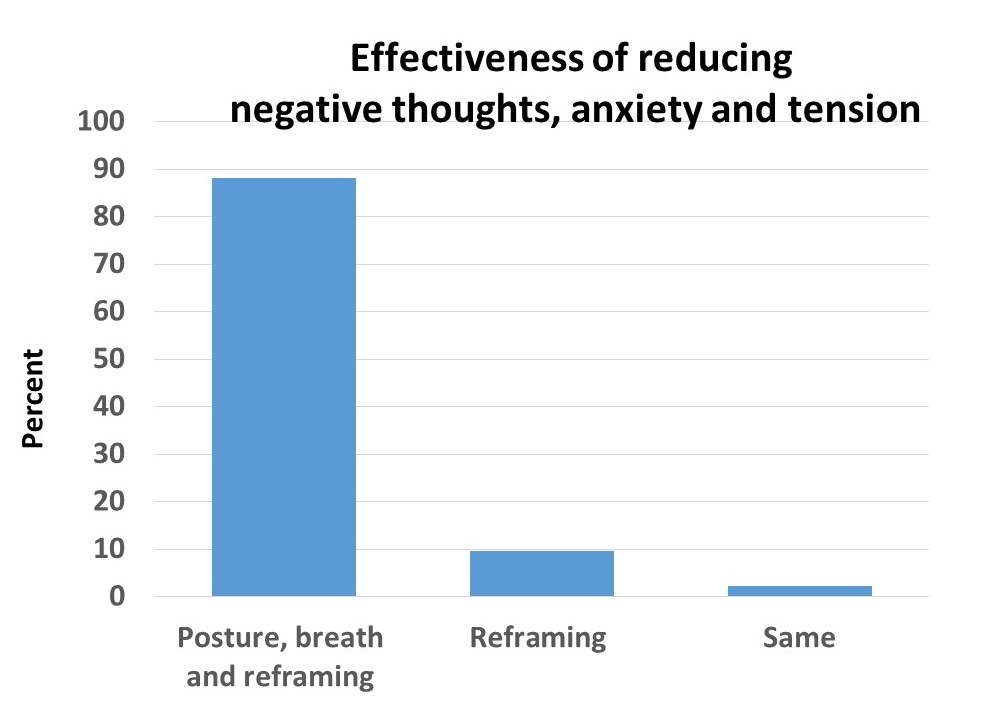
Figure 1. Percentage of students rating posture, breath and reframing practice (PBRP) as more effective than reframing practice (RP) in reducing negative thoughts, anxiety and stress.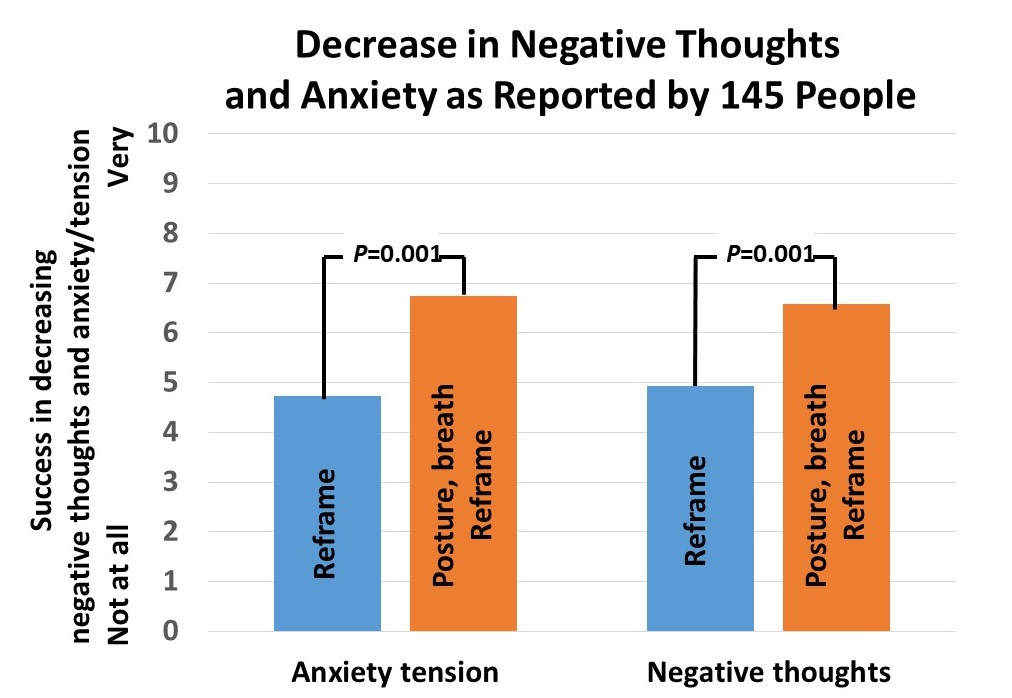 Figure 2. Self-rating of reduction of negative thoughts and anxiety/tension
Stop reading. Do the practice yourself. It is only through experience that you know whether posture with breathing and reframing is a more beneficial than simply reframing the language.
Implications for education, counseling, psychotherapy.
Our findings have implications for education, counseling and psychotherapy because students and clients usually sit in a slouched position in classrooms and therapeutic settings. By shifting the body position to an erect upright position, taking a breath and then reframing, people are much more successful in reducing their negative thoughts and anxiety/stress. They report feeling much more optimistic and better able to cope with felt stress as shown by representative comments in table 1.
| Reframing | Posture, breath and reframing |
| After changing my internal language, I still strongly felt the same thoughts. | I instantly felt better about my situation after adjusting my posture. |
| I felt a slight boost in positivity and optimism. The negative feelings (anxiety) from the negative thoughts also diminished slightly. | The effects were much stronger and it was not isolated mentally. I felt more relief in my body as well. |
| Even after changing my language, I still felt more anxious. | Before changing my posture and breathing, I felt tense and worried. After I felt more relaxed. |
| I began to lift my mood up; however, it didn’t really improve my mood. I still felt a bit bad afterwards and the thoughts still stayed. | I began to look from the floor and up towards the board. I felt more open, understanding and loving. I did not allow myself to get let down. |
| During the practice, it helped calm me down a bit, but it wasn’t enough to make me feel satisfied or content, it felt temporary. | My body felt relaxed overall, which then made me feel a lot better about the situation. |
| Difficult time changing language. | My posture and breathing helped, making it easier to change my language. |
| I felt anger and stayed in my position. My body stayed tensed and I kept thinking about the situation. | I felt anger but once I sat up straight and thought about breathing, my body felt relaxed. |
| Felt like a tug of war with my thoughts. I was able to think more positively but it took a lot more brain power to do so. | Relaxed, extended spine, clarity, blank state of mind. |
Table 1. Some representative comments of practicing reframing or posture, breath and reframing.
The results of our study in the classroom setting are not surprising. Many us know to take three breaths before answering questions, pause and reflect before responding, take time to cool down before replying in anger, or wait till the next day before you hit return on your impulsive email response.
Currently, counseling, psychotherapy, psychiatry and education tend not to incorporate body posture as a potential therapeutic or educational intervention for teaching participants to control their mood or reduce feelings of powerlessness. Instead, clients and students often sit slightly collapsed in a chair during therapy or in class. On the other hand, if individuals were encouraged to adopt an upright posture especially in the face of stressful circumstances it would help them maintain their self-esteem, reduce negative mood, and use fewer sadness words as compared to the individual in a slumped and seated posture (Nair, Sagar, Sollers, Consedine, & Broadbent, 2015).
THE VALUE OF SELF-EXPERIENCE
What makes this study valuable is that participants compare for themselves the effects of the two different interventions techniques to reduce anxiety, stress and negative thoughts. Thus, the participants have an opportunity to discover which strategy is more effective instead of being told what to do. The demonstration is even more impressive when done in groups because nearly all participants will report that changing posture with breathing and reframing is more beneficial.
This simple and quick technique can be integrated in counseling and psychotherapy by teaching clients this behavioral technique to reduce stress. In Cognitive Behavioral Therapy (CBT), sitting upright can help the individual replace a thought with a more reasonable one. In third wave CBT, it can help bypass the negative content of the original language and create a metacognitive change, such as, “I will not let this thought control me.”
It can also help in Acceptance and Commitment Therapy (ACT) since changing one’s body posture may facilitate the process of “acceptance” (Hayes, Pistorello, & Levin, 2012). Adopting an upright sitting position and taking a breath is like saying “I am here, I am present, I am not escaping or avoiding.” This change in body position represents movement from inside to outside, movement from accepting the unpleasant emotion related to the negative thoughts toward a “commitment” to moving ahead, contrary to the automatic tendency to follow the negative thought. The positive reframing during body position or posture change is not an attempt to color reality in pretty colors, but rather a change of awareness, perspective, and focus that helps the individual identify and see some new options for moving ahead toward commitment according to one’s values. This intentional change in direction is central in ACT and also in positive psychology (Stichter, 2018).
CONCLUSION AND RECOMMENDATIONS
We suggest that therapists, educators, clients and students get up out of their chairs and incorporate body movements when they feels overwhelmed and stuck. Finally, this study points out that mind and body are affected by each other. It provides another example of the psychophysiological principle enunciated by Elmer Green (1999, p 368):
“Every change in the physiological state is accompanied by an appropriate change in the mental-emotional state, conscious or unconscious; and conversely, every change in the mental-emotional state, conscious or unconscious is accompanied by an appropriate change in the physiological state.”
The findings of this study echo the ancient spiritual wisdom that is is central to the teaching of the Zen Master, Thich Nhat Hanh. He recommends that his students recite the following at any time:
Breathing in I calm my body,
Breathing out I smile,
Dwelling in the present moment,
I know it is a wonderful moment.
References
Cuddy, A. (2012). Your body language shapes who you are. Technology, Entertainment, and Design (TED) Talk, available at: www.ted.com/talks/amy_cuddy_your_body_language_shapes_who_you_are
Green, E. (1999). Beyond psychophysics, Subtle Energies & Energy Medicine, 10(4), page 368.
Peper, E., Booiman, A., Lin, I.M., & Harvey, R. (2016). Increase strength and mood with posture. Biofeedback. 44(2), 66–72.
 the peper perspective