Clean the air with plants*
Posted: March 22, 2021 Filed under: Breathing/respiration, ergonomics, health, Uncategorized | Tags: air pollution, plants Leave a comment
Fresh clean air is essential for health while polluted air is an environmental health hazard. For more than fifty years the harm of air pollution has been documented. As the National Institute of Environmental Health Sciences (NIH NIEHS) points out, initially air pollution was primarily regarded as threat to respiratory health and contributed to an increases in asthma, emphysema, chronic obstructive pulmonary disease, and chronic bronchitis. More recently, air pollution has been identified as a significant risk factor for cardiovascular disease, diabetes mellitus, obesity, reproductive, neurological, and immune system disorders and ADHD (Keller et al., 2018; Perera et al, 2014; NIH NIEHS ).
Yet many of us are unaware that often the air we breathe indoors is even more polluted than the outside air. The indoor air is the sum of outdoor air plus the indoor air pollution produced from cooking and outgassing of the volatile organic compounds (VOCs) from the many materials (Wolkoff, 2028). Materials and equipment in home and office also shed micro dust particles and outgas a chemical brew of volatile organic compounds (e.g., formaldehyde, benzene and tricholorethylene). These VOCs come from paper, inks, furniture, carpet, paints, wall coverings, cleaning materials, floor tiles and the fumes produced from gas heaters and cooking stoves. In addition, copiers and laser printers often add microscopic dust particles and sometimes ozone. These gasses stay in the room where there is limited air circulation due to sealed buildings or closed windows. Reduced air circulation is also a significant risk factor for COVID-19; since, the virus keeps recirculating in unventilated rooms. See the superb graphic illustration by Bartzokas et al (Feb 26, 2021).in the New York Times of virus concentration in schools when the windows are opened. https://www.nytimes.com/interactive/2021/02/26/science/reopen-schools-safety-ventilation.html?smid=em-share).
Be proactive to reduce pollution and enhance your health by placing plants in your office and home. When the plants are placed in the office, they also enhances subjective perceptions of air quality, concentration, and workplace satisfaction as well as objective measures of productivity (Nieuwenhuis et al., 2014). Certain plants help remove carbon dioxide and convert it to oxygen, clear the indoor smog, and remove the volatile organic compounds. Warning: Be sure that your pets do not chew or eat the leaves of these plants because they could be poisonous (e.g., azaleas are poisonous for dogs and cats),
The following plants help remove carbon dioxide and by converting it into oxygen.
- Areca Palm. You will need four shoulder height plants per person to convert all the exhaled carbon dioxide into oxygen (Meattle, 20009; Meattle, 2018).
- Mother-in-law’s Tongue is a bedroom plant because it converts carbon dioxide into oxygen at night. You will need six to eight shoulder height plants per person (Meattle, 20009).
Watch Kamal Meattle short TED talk presentation, How to grow fresh air (for an updated longer presentation watch, https://www.youtube.com/watch?v=KXgWxRUGLwM). https://www.ted.com/talks/kamal_meattle_how_to_grow_fresh_air?language=en#t-100683
The following plants remove VOCs from the air (Wolverton, 2020).
- Azaleas, rubber plants, tulips, poinsettia, philodendron, money plant, and bamboo palms (formaldehyde)
- Areca palm (toluene)
- Lady palm (ammonia)
- Peace lily and chrysanthemum (acetone, methanol, trichlorethylene, benzene, ethylacetate)
To remove particulates, install an air purifier with a HEPA filter.
After renovation or installation of furniture or carpets, be sure to allow for air circulation by opening windows and doors. Explore some of the following strategies to clean the air:
- Turn the exhaust fan on when cooking and using the oven.
- Ventilate your work area (open a window or door, if possible).
- Move copier/laser printers to a well-ventilated space and/or place an exhaust fan near the printer.
- Turn off copier or laser printers when not in use (purchase new equipment that is energy efficient and shuts down when not in use).
Take a many walks outside in nature
If possible take a walk at lunch or ask coworkers to have a walking meeting so that you can get out in the fresh air. Being in nature and forest bathing (Shinrin-Yoku) is associated with a decrease in stress, regeneration and improvement in immune function (Park et al., 2010; Hansen et a., 2017; Lyu et al., 2019). Watch the presentation by Dr. Aiko Yoshino, Soaking Up the Benefits of Nature During the PandemicForum.
* Adapted from Peper, E. (2023). Clean air with plants. Townsend Letters. The Examiner of Alternative Medicine, Sunday, June 4, 2023. https://www.townsendletter.com/e-letter-11-using-plants-to-improve-indoor-air-quality/
Republished: Peper, E. (2024). Townsend e-Letter, Townsend Letters. The Examiner of Alternative Medicine, June 3, 2024. https://www.townsendletter.com/e-letter-11-using-plants-to-improve-indoor-air-quality/
References:
Meattle, K. (2018). How to grow fresh air inside your house amidst pollution. Quint Fit. https://www.youtube.com/watch?v=KXgWxRUGLwM
Nieuwenhuis, M., Knight, C., Postmes, T., & Haslam, S. A. (2014). The relative benefits of green versus lean office space: Three field experiments. Journal of Experimental Psychology: Applied, 20(3), 199–214. https://doi.org/10.1037/xap0000024
NIH NIEHS, Air Pollution and Your Health, National Institute of Health, National Institute of Environmental Health Sciences https://www.niehs.nih.gov/health/topics/agents/air-pollution/index.cfm#:~:text=Air%20pollution%20can%20affect%20lung,are%20linked%20to%20chronic%20bronchitis
You heard it before. Now do it! Three tips to reduce screen fatigue
Posted: February 27, 2021 Filed under: behavior, ergonomics, Exercise/movement, health, Pain/discomfort, posture, relaxation, screen fatigue, Uncategorized, vision, zoom fatigue 4 CommentsMonica Almendras and Erik Peper

For almost a year, we have managed to survive this pandemic. As we work in front of screen many people experience screen fatigue (Bailenson, 2021). The tiredness, achiness and depressive feelings have many causes such as sitting disease, reduced social contact, constantly looking at the screen for work, education, socializing, and entertaining, and the increased stress from family illness and economic insecurity. The result is that many people experience low energy, depression, loneliness, anxiety, neck, shoulder, back pain at the end of the day (Son, Hegde, Smith, Wang, & Sasangohar, 2020; Peper & Harvey, 2018).
Yet there is hope to reduce discomfort and increase by implementing simple tips.
Take breaks and take more breaks by getting up from your chair and moving. Taking breaks helps us to clear our minds and it interrupts any ongoing rumination we may have going on. Doing this helps a person be more productive at work or when studying, and at the same time it helps retain more information (Peper, Harvey, & Faass, 2020; Kim, Park, & Headrick, 2018). How many of you reading this actually take a short break at least once during work? We stay in the same sitting position for long periods of time, even holding off to go to the restroom. We tell ourselves ‘one more minute’ or ‘I’ll just finish this and then I’ll go”. Sounds familiar? We know it is not healthy and yet, we continue doing it.
Solution: Set a reminder every twenty minutes to take a short break. Download a program on your computer that will remind you to take a break such as Stretch Break (www.stretchbreak.com). Every twenty minutes a window will pop up on your computer reminding you to stretch. It gives you simple exercises for you to move around and wiggle as shown in figure 1. You can say it breaks the spell from staying frozen in one position in front of your screen. The best part is that yet is free to download on your computer. What more can you ask for?

Figure 1. Stretch break window that pops up on your computer to remind you to stretch.
Stop slouching in front of the screen. We tend to gaze downwards to our device and slouch, which creates tension on our neck and shoulders ((Peper, Lin, Harvey, & Perez, 2017). And yet, we still wonder why people suffer from neck-shoulder pain and headaches. It is time to make a transformation from slouching and feeling aches and pains, to an upright posture to be free of pain.
Solution: Use an UpRight Go 2 device on your upper back or neck is a great way to remind you that you are slouching (Harvey, Peper, Mason, & Joy, 2020). The UpRight is linked via Bluetooth to the App on the mobile phone, and once you calibrate it to an upright posture, you will see and feel a vibrate when you slouch. For people who are on the computer for long hours, this will help you to be aware of your posture.
If wearing a small device on your back is not your cup of tea, or perhaps it is not in your budget at the moment. There is a solution for this, and that means you can download the UpRight Desktop App on your computer or laptop (Chetwynd, Mason, Almendras, Peper, & Harvey, 2020). The desktop version uses the camera from your computer or laptop to monitor your posture; however, at the camera cannot simultaneous be in use with another program such as ZOOM. This version provides immediate feedback through the graphic on the screen as well as, an adjustable auditory signal when you slouch as shown in Figure 2. It is also free to download, and it is available for PC and Mac (https://www.uprightpose.com/desktop-app/).

Figure 2. Posture feedback app. When slouching, the app provides immediate feedback through the graphic on the screen (the posture of figure turns red) and/or an adjustable auditory sound (from: Chetwynd, Mason, Almendras, Peper, & Harvey, 2020)
Relax your eyes and look away from the screen. Many people struggle with dry eyes and eyestrain from looking at the screen for extended time periods. We log out from work, meetings, and class; to staring at the television, tablets, and mobile phones on our free time. It is a nonstop cycle of looking at the screen, while our poor eyes never have a single break. To look at the screen, we tightened our extraocular muscles and ciliary muscles; and the result is near-vision stress (Peper, 2021).
SOLUTION: The solution to relax the eyes and reduce eyestrain will not be to buy new eyeballs online. Instead, here are three easy and free things to reestablish good eyeball health. These were adapted from the superb book, Vision for life: Ten steps for natural eyesight improvement, by Meir Schneider, PhD.
- Look out through a window at a distance tree for a moment after reading an email or clicking a link
- Look up at a distant tree and focus at the details of the branches and leaves each time you have finished a page from a book or eBook.
- Rest and regenerate your eyes with palming (Peper, 2021). To do palming, all you need to do is sit upright, place an object under your elbows (pillow or books) to avoid tensing the neck and shoulders, and cover the eyes with your hands (see figure 3). Cup your hands to avoid pressure on your eyes and with your eyes closed, imagine seeing blackness while breathing slowing from your diaphragm. For five minutes, feel how your shoulders, head, and eyes are relaxing, while doing six breaths per minutes through your nose. Once your five minutes are up, stretch or wiggle around before returning to your work. For detailed instructions, see the YouTube video, Free Webinar by Meir Schneider: May 6, 2019.

Figure 3. Position for palming.
Implement these tips as an experiment for a week and note how it affects you. Many people report that after three weeks, they experience less pain and more energy. By taking charge of your own computer work patterns, you have taken a first e first step into transforming your health.
REFERENCES
Bailenson, J. N. (2021). Nonverbal Overload: A Theoretical Argument for the Causes of Zoom Fatigue. Technology, Mind, and Behavior, 2(1). https://doi.org/10.1037/tmb0000030
Chetwynd, J., Mason, L., Almendras, M., Peper, E., & Harvey, R. (2020). “Posture awareness training.” Poster presented at the 51st Annual meeting of the Association for Applied Psychophysiology and Biofeedback. https://doi.org/10.13140/RG.2.2.20194.76485
Harvey, R., Peper, E., Mason, L., & Joy, M. (2020). “Effect of posture feedback training on health”. Applied Psychophysiology and Biofeedback. 45(3). https://DOI.org/10.1007/s10484-020-09457-0
Kim, S., Park, Y., & Headrick, L. (2018). Daily micro-breaks and job performance: General work engagement as a cross-level moderator. Journal of Applied Psychology, 103(7), 772–786. https://doi.org/10.1037/apl0000308
Peper, E. & Harvey, R. (2018). Digital addiction: increased loneliness, depression, and anxiety. NeuroRegulation. 5(1),3–8. doi:10.15540/nr.5.1.3 https://www.neuroregulation.org/article/view/18189/11842
Peper, E., Lin, I-M., Harvey, R., & Perez, J. (2017). How posture affects memory recall and mood. Biofeedback.45 (2), 36-41. https://doi.org/10.5298/1081-5937-45.2.01
Peper, E. (2021). “Resolve eyestrain and screen fatigue.” Well Being Journal,.30, Winter 2021 https://www.researchgate.net/publication/345123096_Resolve_Eyestrain_and_Screen_Fatigue
Schneider, M. (2019. YouTube video Free Webinar by Meir Schneidere: May 6, 2019.
Son. C., Hegde, S., Smith, A., Wang, X., & Sasangohar, F. (2020). Effects of COVID-19 on College Students’ Mental Health in the United States: Interview Survey Study. J Med Internet Res, 22(9):e21279 https://doi.org/10.2196/21279
CDC should make COVID-19 vaccine V-safe side effects self-reporting “Opt out” instead of “Opt in”
Posted: February 15, 2021 Filed under: health | Tags: COVID-19, Moderna, Pfizer-BioNTech, side effects, vaccine 14 Comments
At the moment the United States and the rest of the world are participating in an unprecedented experiment of being vaccinated for COVID-19 to end the pandemic without completely knowing long-term risks. The Federal Drug Administration (FDA) has authorized the emergency use for the vaccine based upon clinical trials that showing that the vaccine is highly effective in reducing or preventing COVID-19 disease and morbidity (FDA, 2021). Because it is an experimental procedure, it is necessary to monitor and follow-up everyone who is vaccinated in order to identify possible rare complications that could occur in the future. What has been reported is a very rare complication of anaphylaxis that may occur immediately after administration of the vaccine by Pfizer-BioNTech (4.7 cases per million) and Moderna (2.4 cases per million) (Shimabukuro, Cole, & Su, 2021); however, this data may under report the actual negative side effects. In the recently published prospectively study by Blumenthal et al. (2021) of 64,000 employees associated with Mass General Brigham (MGB) were actively followed through a multipronged approach including email, text message, phone, and smartphone application links. The complication rate of acute allergic reaction rate was 2.1% and the severe anaphylaxis reaction was 247 cases per million. This is 50 times higher than the previously reported results which depended on voluntary reporting instate of active all participants follow-up. Nevertheless, the benefits of vaccination far outweigh the risk of anaphylaxis, which was experienced within the first 15-30 minutes after the vaccination and treatable. What is disturbing is that at this moment, the USA does not have a systematic long-term follow up strategy for all the people who vaccinated to identify possible delayed long-term side effects since it depends upon voluntary reporting, however, rare. Thus, we are all part of an uncontrolled experiment in which I am also participating.
At the age of 76, I choose to be vaccinated after having assessed the risk-benefits reported in the published clinical studies (the possible harm caused by Covid-19 would be significantly worse than the possible harm caused by the short and long term side effects from the vaccine). It was confusing and challenging to figure out where the vaccinations were being offered. Luckily, I searched online to find a location where I could sign up to make an appointment for the first vaccination. After having successfully navigated signing up and getting an appointment for Thursday, I contacted the older couple who live nearby and asked if they already had a vaccination appointment. When they told me that they were unable to find a location, I shared with them the information for signing up on the website.
After having received the vaccination, I installed the V-safe app in my cellphone and answered the questions on the App survey; however, to participate, I had to opt in instead of having to opt out. Later on Thursday, I received the first text message from V-safe to which I responded by answering the short symptom questions. I reported that the site of the vaccination felt sore and tight and whenever I lifted up my left arm, I felt a dull ache and stiffness. It was slightly more uncomfortable than I had experienced two years earlier from a tetanus and diphtheria (Td) vaccine injection. That night I could not sleep on my left side since the deltoid area continued to feel sore and painful to pressure. The next day, I worked and did not look at my text messages. On Saturday morning, I realized that I had not responded to Friday’s check-in text message from V-safe. When I tried to response, the survey link embedded in the text message no longer worked. Thus, my discomfort that continued through Thursday night and Friday was not reported to the CDC.
As I still felt some slight tenderness, I also wondered how the older couple were doing since they had received the vaccine on the same day as I did. I called them to check on how they were doing and see if they had signed up with V-safe. They responded that they were doing well except for some soreness in the upper arm; however, they had not signed up for V-safe.
This experience brought to mind studies finding that when follow-up information depends voluntarily opting in, most people do not opt in. Thus, the follow-up data and reporting of possible negative side effects will be less reliable since it would reflect only a small subset of all the people who received the vaccine and are tech savvy. The CDC needs to revise their tracking strategy so that it is able to survey accurately the occurrence of side effects from everyone who gets vaccinated by enrolling them, unless they choose to opt out.
- Enroll people automatically unless they personally decide to opt-out. The enrollment process should be organized so that when an individual receives the vaccine, they automatically are enrolled. Automatic enrollment leads to much higher participation than a voluntary opt-in approach. The difference in participation has been demonstrated in many settings ranging from organ donations to signing up for 401K retirement plans. For example, in Austria, organ donation is the default option at the time of death, and people must explicitly ‘opt out’ of organ donation. “In these so-called opt-out countries, more than 90% of people register to donate their organs. Yet in countries such as U.S. and Germany, people must explicitly ‘opt in’ if they want to donate their organs when they die. In these opt-in countries, fewer than 15% of people register” (Davidai, Gilovich & Ross, 2012). Similar results have been observed in employees’ enrollment in 401K saving plans (Nash, 2007). For example, in analyses of recent hires by Fortune 500 firms, 85.9% of new hires will participate in a 401 K retirement plan when they are automatically enrolled versus 32.4% if they have to voluntarily enroll (opt –in).
- The V-safe app needs to allow symptom data to be reported after the deadline. There needs to be an option to allow a delayed response. In addition, if the person did not respond to the automatic survey, the person needs to be contacted to identify the cause of the non-response.
- Longterm follow-up to monitor for possible adverse effects needs to be implemented. The minimum follow-up period needs to be two years to be able to monitor possible adverse effects that may be triggered by the vaccines. In theory, this could include “antibody-dependent enhancement” to another virus. This occurs when the immune response that has been previously activated makes the clinical symptoms worse when the person is infected a subsequent time with a different type of virus and that trigger an over-reaction, creating a cytokine storm. For example, when a person gets dengue fever and is infected a second time by a different strain of dengue, the person becomes much sicker the second time (Murphy & Whitehead, 2011). Some researchers are concerned that the vaccine in the future could cause an excessive immune reaction when exposed to another virus.
Without automatic enrollment and follow-up, the short and long-term general public safety data may be unreliable and will not accurately capture the actual frequency of side effects. The reported data may under report the actual risk. When independent researchers investigated medical procedures they often find find the complication rate three-fold higher than the medical staff reported. For example, for endoscopic procedures such as colonoscopies, doctors reported only 31 complications from 6,383 outpatient upper endoscopies and 11,632 outpatient colonoscopies. The actual rate was 134 trips to the emergency room and 76 hospitalizations. This discrepancy occurred because the only incidents reported involved patients who went back to their own doctors. The research did not capture those patients who sought help at other locations or hospitals (Leffler et al., 2010).
The data reported by the cellphone web-based app V-safe may represent possibly only 20% of the people vaccinate, biased to those who are healthier, more affluent, younger, and technologically adept. In order to be able to sign-up for V-safe and respond to the text messages, the person needs to be tech savvy, have a cellphone, and be able to respond to the text message during the same day the message is send.
References
Blumenthal, K.G., Robinson, L.B., Camargo, C.A., et al. (2021). Acute Allergic Reactions to mRNA COVID-19 Vaccines. JAMA. Published online March 08, 2021. https://doi.org/10.1001/jama.2021.3976
CDC (2021). V-safe After Vaccination Health Checker. Centers for Disease Control and Prevention (CDC). Accessed January 30, 2021. https://www.cdc.gov/coronavirus/2019-ncov/vaccines/safety/vsafe.html
Davidai, S., Gilovich, T., & Ross, L. (2012). The meaning of default options for potential organ donors. Proceedings of the National Academy of Sciences, 15201-15205. https://doi.org/10.1073/pnas.1211695109
FDA (2021). COVID-19 Vaccines. Accessed January 30, 2021. https://www.fda.gov/emergency-preparedness-and-response/coronavirus-disease-2019-covid-19/covid-19-vaccines
Leffler, D.A, Kheraj, R., Garud, S., Neeman, N., Nathanson, L.A., Kelly, C.P., Sawhney, M., Landon, B., Doyle, R., Rosenberg, S., & Aronson, M. (2010). The incidence and cost of unexpected hospital use after scheduled outpatient endoscopy. Arch Intern Medicine, 170(19), 1752-1757. http://archinte.jamanetwork.com/article.aspx?articleid=226125
Madrian, B. & Shea, D. (2001). The Power of Suggestion: Inertia in 401(k) Participation and Savings Behavior. ”Quarterly Journal of Economics, 116(4), 1149-87. http://www.jstor.org/stable/2696456
Murphy, B.R. & Whitehead, S.S. (2011). Immune response to dengue virus and prospects for a vaccine. Annu Rev Immunol., 29, 587-619. https://doi.org/10.1146/annurev-immunol-031210-101315
Nash, B. J. (2007). Opt in or opt out? Automatic enrollment increases 401(k) participation. Region focus, 28-31. https://core.ac.uk/download/pdf/6670505.pdf
Shimabukuro, T.T., Cole, M., & Su, J.R. (2021) Reports of Anaphylaxis after Receipt of mRNA COVID-19 Vaccines in the US—December 14, 2020-January 18, 2021. JAMA. Published online February 12, 2021. https://doi.org/10.1001/jama.2021.1967
Simple acts of kindness
Posted: December 29, 2020 Filed under: behavior, emotions, health, mindfulness, self-healing, stress management | Tags: kindness 1 CommentAs we emerge from the COVID pandemic and look forward to the New Year, we can bring joy and happiness though through simple acts of kindness.
There is hope in these crazy times—three inspirational TED talks
Posted: December 16, 2020 Filed under: behavior, emotions, health, mindfulness, self-healing, Uncategorized | Tags: hope, racial bias, resilience 2 CommentsI just received an email from the Rick Hansen Foundation that inspired me to share its recommendations. In 1957 at the age of 15, Rick Hansen injured his spinal cord and was paralyzed from the waist down. He is an inspiration for all of us. In these crazy times of sheltering in place, experiencing social isolation, anxiety, depression, racial bias, and also happiness and joy, he recommends the following TED talks to increase resilience, overcome racial bias, and achieve self-acceptance. Enjoy watching the talks as they suggest strategies to deal with adversity and offer hope for the New Year.
3 Secrets of resilient people by Dr. Lucy Hone, Co-director of the New Zealand Institute of Wellbeing & Resilience and adjunct fellow at the University of Canterbury in Christchurch, New Zealand.
How racial bias works-and how to disrupt it by Stanford University social psychologist, Jennifer L. Eberhardt
To overcome challenges, stop comparing yourself to other by wheelchair athlete Dean Furnes
Beyond Zoom Fatigue: Re-energize Yourself and Improve Learning
Posted: November 24, 2020 Filed under: behavior, computer, digital devices, educationj, health, posture, stress management | Tags: boredom, learning, mind-body, zoom fatigue 7 CommentsErik Peper and Amber Yang
“Instead of zoning out and being on my phone half the time. I felt more engaged in the class and like I was actually learning something.” -21 year old college student
Before the pandemic, roughly, two-thirds of all social interactions were face-to-face—and when the shelter-in-place order hit our communities, we were all faced with the task of learning how to engage virtually. The majority of students reported that taking online classes instead of in person classes is significantly more challenging. It is easier to be distracted and multitask online—for example, looking at Instagram, Facebook, Twitter, TikTok, texting, surfing the internet, responding to notifications, listening to music, or drifting to sleep. Hours of watching TV and/or streaming videos have conditioned many people to sit and take in information passively, which discourages them from actively responding or initiating. The information is rapidly forgotten when the next screen image or advertisement appears. Effectively engaging on Zoom requires a shift from passively watching and listening to being an active, creative participant.
Another barrier to virtual engagement is that communicating online does not engage all senses. A considerable amount of our communication is nonverbal—sounds, movement, visuals, physical structures, touch, and body language. Without these sensory cues, it can be difficult to feel socially connected on Zoom, Microsoft Teams, or Google Meet to sustain attention and to focus especially if there are many people in the class or meeting. Another challenge to virtual learning is that without the normal environment of a classroom, many students across the country are forced to learn in emotionally and/or physically challenging environments, which gets in the way of maintaining attention and focus. The Center for Disease Prevention (CDC) reported that anxiety disorder and depressive disorder have increased considerably in the United States during the COVID-19 pandemic (Leeb et al, 2020; McGinty et al, 2020). Social isolation, stay-at-home orders, and coping with COVID-19 are contributing factors affecting mental health especially for minority and ethnic youth. Stress, anxiety and depression can greatly affect students’ ability to learn and focus.
The task of teaching has also become more stressful since many students are not visible or appear still-faced and non-responsive. Teaching to non-responsive faces is significantly more stressful since the presenter receives no social feedback. The absence of social feedback during communication is extremely stressful. It is the basis of Trier Social stress test in which a person presents for five minutes to a group of judges who provide no facial or verbal feedback (Allen et al, 2016; Peper, 2020).
The Zoom experience especially in a large class can be a no win situation for the presenter and the viewer. To help resolve this challenge, we explored a strategy to increase student engagement and reduce social stress of the teacher. In this exploration, we asked students to rate their subjective energy level, attention and involvement during a Zoom conducted class. For the next Zoom class, they were asked to respond frequently with facial and body expressions to the presentation. For example, students would expressively shake their head no or yes and/or use facial expressions to signal to the teacher that they were engaged and listening. Other strategies included giving thumbs up or thumbs down, making sounds, and changing your body posture as a response to the presentation. Watch the superb non-judgmental instructions adapted for high school students by Amber Yang.
When college students purposely implement and increase their animated facial and body responses by 123% during Zoom classes, they report a significant increase in frequency of animation (ANOVA (F(1,70) = 30.66, p < .0001), energy level (ANOVA (F(1,70) = 28.96, p < .0001), attention (ANOVA (F(1,70) = 16.87, p = .0001) and involvement (ANOVA (F(1,69) = 10.70, p = .002) as compared just attending normally in class (see Figure 1).

Figure 1. Change in subjective energy, attention and involvement when the students significantly increase their facial and body animation by 123 % as compared to their normal non-expressive class behavior (Peper & Yang, in press).
“I never realized how my expressions affected my attention. Class was much more fun” -22 year old college student
“I can see how paying attention and participation play a large role in learning material. After trying to give positive facial and body feedback I felt more focused and I was taking better notes and felt I was understanding the material a bit better.” –28 year old medical student
These quotes are a few of the representative reports by more than 80% of the students who observed that being animated and responsive helped them to stay present and learn much more easily and improve retention of the materials. For a few students, it was challenging to be animated as they felt shy, self-conscious and silly and kept wondering what other students would think of them.
Having students compare two different ways of being in Zoom class is a useful assignment since it allows students to discover that being animated and responsive with facial/body expression improves learning. So often we forget how our body impacts our thoughts and emotions. For example, when students were asked to sit in a slouched position, they reported that it was much easier to recall hopeless, helpless, powerless and defeated memories and more difficult to perform mental math in the slouched position. While in the upright position it was easier to access positive empowering memories and easier to perform mental math (Peper et al, 2017; Peper et al, 2018).
Experience how body posture affects emotional recall and feeling (adapted from Alda, 2018).
1) Stand up and configure your body in a position that signals defeat, hopelessness and depression (slouching with the head down). While holding this position, recall a memory of hopelessness and defeat. Notice any negative emotions that arise from this.
2) Shift and configure your body into a position that signals joy, happiness and success (standing tall, looking up with a smile). While holding this position, recall a memory of joy and happiness. Notice any positive emotions that arise from this.
3) Configure your body in a position that signals defeat, hopelessness and depression (slouching with the head down). While holding this position, recall a joy, happiness and success. Do not change your body position. End this configuration after holding it for a little while.
4) Shift and your body in a position that signals joy, happiness and success (standing tall, looking up with a smile). While holding this position, recall a memory of hopelessness and defeat. Do not change your body position. End this configuration after holding it for a little while.
When body posture and expression are congruent with the evoked emotion, it is almost always easier to experience the emotions. On the other hand, when the body posture expression is the opposite of the evoked emotion (e.g., the body in a positive empowered stance while recalling hopeless defeated memories) it is much more difficult to evoke and experience the emotion. This same concept applies to learning. When slouching and lying on the bed while in a Zoom class, it is much more difficult to stay present and not drift off. On the other hand, when sitting erect and upright and actively responding to the presentation, the body presence/posture invites the brain to focus for optimized learning.
Conclusion
In a Zoom environment, it is easy to slouch, drift away, and become non-responsive—which can exacerbate zoom fatigue symptoms and also decrease our capacity to learn, focus, and feel connected with the people around us. Take charge and actively participate in class by sitting up, maintaining an empowered posture, and using nonverbal facial and body expressions to communicate. The important concept is not how you show your animation, but that you actively participate within the constraints of your own limitations. For example, if a person is paralyzed the person will benefit if they do the experience internally even though their body may not show any expression. By engaging our soma we optimize our learning experience as we face the day-to-day challenges of the pandemic and beyond.
I noticed I was able to retain information better as well as enjoy the class more when I used facial-body responses. At times, where I would try to wonder off into bliss, I would catch myself and try to actively engage in the class with body movements even if there is no discussion. Animated face/body was a better learning experience. –21-year old college student.
References
Peper, E. (October 13, 2020). Breaking the social bond: The immobilized face. The Peper Perspective.
Peper, E., Wilson, V.E., Martin, M., Rosengard, E., & Harvey, R. (unpublished). Avoid Zoom fa
Tips to Reduce Zoom Fatigue
Posted: November 15, 2020 Filed under: behavior, computer, digital devices, ergonomics, Exercise/movement, health, laptops, Neck and shoulder discomfort, Pain/discomfort, self-healing, stress management, Uncategorized, vision 1 CommentAdapted from the book, TechStress: How Technology
is Hijacking our Lives, Strategies for Coping and Pragmatic Ergonomics, by Erik Peper, Richard Harvey and Nancy Faass.



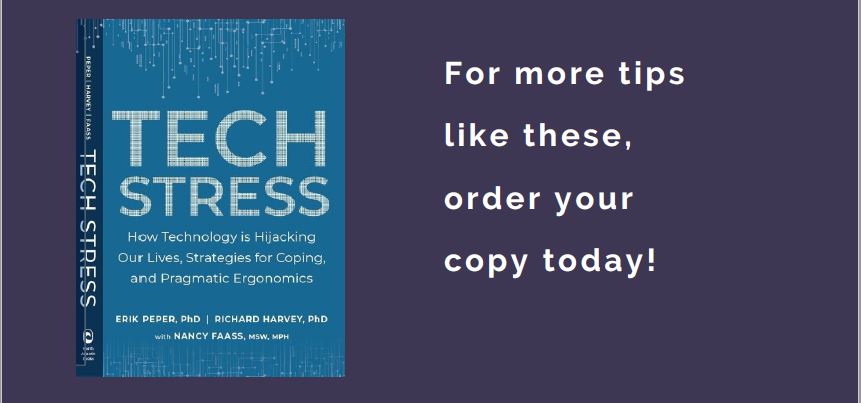
Peper, E., Harvey, R., & Faass, N. (2020), TechStress-How Technology is Hijacking our Lives, Strategies for Coping and Pragmatic Ergonomics. Berkeley, CA: North Atlantic Books.
Breaking the social bond: The immobilized face
Posted: October 13, 2020 Filed under: behavior, computer, digital devices, Evolutionary perspective, health, laptops, self-healing, stress management | Tags: baby, communication, non verbal communication, Tier Social Stress Test, zoom fatigue 5 CommentsAfter teaching for hours on Zoom, I feel exhausted. Zoom fatigue is real.
While talking to a close friend, all of a sudden his attention shifted from listening to me to looking his cellphone as he heard a notification. At that moment, I felt slightly left and hurt.
Students report that when they are are talking with friends and their friends look at their cellphone or responds to a notification they feel hurt and slightly dismissed. Even though most experience this break in social bonding, almost all do this with others. The looking at the phone is the conditioned stimuli to which we automatically respond when we feel it vibrate or even when we see it. We respond by shifting our attention to the phone in the same way that Pavlov’s dogs would salivate when they heard the bell that was conditioned with the food. On the average we now check our phones 96 times a day—that is once every 10 minutes and an increase of 20% as compared to two years ago (Asurion Research, 2019).
To feel SAFE is essential for growth and developing intimacy. We interpret being safe through the process of neuroception. Without conscious awareness our brain processes facial cues to identify if the interactions are safe or not safe. If safe, vigilance and sympathetic arousal is reduced and better communication is supported (Porges, 2017). On the other hand, if a person’s face is flat and non-responsive during a conversation, it may signal danger and trigger fight/flight in the person seeing the non-reactive face. This unconscious stress reaction to a non-responsive face is the basis of the Tier Social Stress Test. In this stress assessment, participants are asked to give a presentation and are also given an unexpected mental arithmetic test in front of an panel of judges who do not provide any feedback or encouragement (Allen et al, 2016)). Not receiving social feedback while communicating is one of the most stressful events –it is being stuck in social quicksand as there are no cues to know what is going on.
We wonder if the absence of confirmative facial feedback is a component of Zoom fatigue when presenting to a larger group in which you see multiple faces as small postage stamps or no face at all. In those cases, the screen does not provide enough covert facial and body feedback to know what is going on as you are communicating. The audience non-responsive faces may covertly signal DANGER, The decrease visual and auditory signals is compounded by:
- Technical issues due to signal bandwidth and microphone (freezing of the screen, pixilation of the display, breakup in sound, warbling of voice, etc.).
- Viewers sitting still and facially immobilized without reacting as they watch and listen.
- Time delay caused by participants turning on the microphone before speaking may be negatively evaluated by the listener (Roberts, Margutti, & Takano, 2011).
- Non-recognizable faces because the face and upper torso are not illuminated and blacked out by backlighting or glare.
- Lack of eye and face contact because the speaker or participant is looking at the screen and their camera is to the side, below or above their face.
- Multi-tasking by the speaker who simultaneously presents and monitors and controls the Zoom controls such as chat or screen share.
In normal communication, nonverbal components comprise a significant part of the communication (Lapakko, 2007; Kendon, 2004). We use many nonverbal cues (lip, eye, face, arm, trunk, leg and breathing movements) as well as olfactory cues to understand the message. In most group zoom meeting we only see the face and shoulders instead of an integrated somatic body response in a three-dimensional space as we look near and far. On the other hand, in front of the computer, we tend to sit immobilized and solely look at a two-dimensional screen at a fixed distance. As we look at the screen we may not process the evolutionary nonverbal communication patterns that indicate safety. Similarly, when child does not receive feedback as it reaches out, it often becomes more demanding or withdraws as the social bond is disconnected.

From: https://live.staticflickr.com/3724/11180721716_1baa040430_b.jpg
Communication is an interactive process that supports growth and development. When the child or a person reaches out and there is no response. The detrimental effect of interrupting facial responsiveness is demonstrated by the research of University of Massachusetts’s Distinguished University Professor of Psychology Edward Tronick (Goldman, 2010; Tronick et al, 1975).
How to maintain build social bonds
Recognize that being distracted by cellphone notifications and not being present are emotional bond breakers, thus implement behaviors that build social connections.
Zoom recommendations
- Arrange your camera so that your face and upper torso is very visible, there is no backlight and glare, and you are looking straight at the camera.
- Provide dynamic visual feedback by exaggerating your responses (nod your head for agreement or shake your head no for disagreement).
- When presenting, have a collaborator monitor Chat and if possible have them shift back and forth between share screen and speaker view so that the speaker can focus on the presentation.
- Use a separate microphone to improve sound.
- If the screen freezes or the sound warbles often an indication of insufficient bandwidth, turn off the video to improve the sound quality.
Social bonding recommendations
- Share with your friends that you feel dismissed when they interrupt your conversation to check their cell phone.
- When meeting friends, turn off the cell phone or put them away in another room so not to be distracted.
- Schedule digital free time with your children.
- During meal times, turn off cell phones or put them in another room.
- Attend to the baby or child instead of your cellphone screen.
For a detailed perspective how technology impacts our lives and what you can do about it, see our book, TechStress-How Technology is Hijacking our Lives, Strategies for Coping and Pragmatic Ergonomics (Peper, Harvey, & Faass, 2020). Available from: https://www.penguinrandomhouse.com/books/232119/tech-stress-by-erik-peper-phd/
References:
Asurion Research (November 19, 2019).Americans Check Their Phones 96 Times a Day.
Goldman, J.G. (2010). Ed Tronick and the “Still Face Experiment.” Scientific American, Oct 18.
Tronick, E., Adamson, L.B., Als, H., & Brazelton, T.B. (1975, April). Infant emotions in normal and pertubated interactions. Paper presented at the biennial meeting of the Society for Research in Child Development, Denver, CO.
Inna Khazan, PhD, interviews the authors of TechStress
Posted: August 18, 2020 Filed under: behavior, computer, digital devices, ergonomics, Evolutionary perspective, Exercise/movement, health, laptops, Neck and shoulder discomfort, Pain/discomfort, posture, stress management, Uncategorized, vision Leave a commentGo behind the screen and watch Inna Khazan, PhD, faculty member at Harvard Medical School and author of Biofeedback and mindfulness in everyday life: Practical solutions for improving your health and performance, interview Erik Peper, PhD and Richard Harvey, PhD. coauthors of the new book, TechStress-How Technology is Hijacking our Lives, Strategies for Coping and Pragmatic Ergonomics.
Dr. Inna Khazan interviews Dr. Erik Peper about his new book Tech Stress. We talk about some of the ways in which technology overuse affects our health and what we can do about it.
Dr. Inna Khazan interviews Dr. Rick Harvey about his new book Tech Stress, the way technology overuse can affect adults and children, and what we can do about it.
Ways to reduce TechStress
Posted: August 13, 2020 Filed under: ADHD, behavior, computer, digital devices, emotions, ergonomics, Evolutionary perspective, Exercise/movement, health, Neck and shoulder discomfort, Nutrition/diet, Pain/discomfort, posture, relaxation, self-healing, stress management, Uncategorized 5 CommentsWe are excited about our book, TechStress-How Technology is Hijacking our Lives, Strategies for Coping and Pragmatic Ergonomics, that was published August 25, 2020.
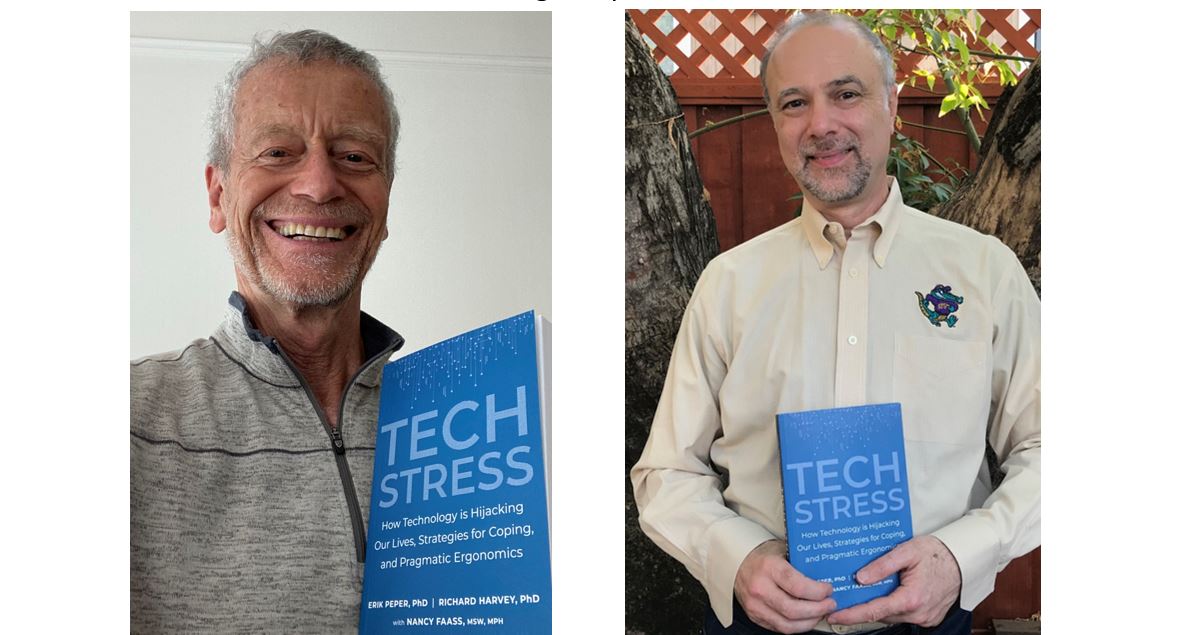
Evolution shapes behavior — and as a species, we’ve evolved to be drawn to the instant gratification, constant connectivity, and the shiny lights, beeps, and chimes of our ever-present devices. In earlier eras, these hardwired evolutionary patterns may have set us up for success, but today they confuse our instincts, leaving us vulnerable and stressed out from fractured attention, missed sleep, skipped meals, aches, pains, and exhaustion and often addicted to our digital devices.
Tech Stress offers real, practical tools to avoid evolutionary pitfalls programmed into modern technology that trip us up. You will find a range of effective strategies and best practices to individualize your workspace, reduce physical strain, prevent sore muscles, combat brain drain, and correct poor posture. The book also provides fresh insights on reducing psychological stress on the job, including ways to improve communication with coworkers and family.
Although you will have to wait to have the book delivered to your home, you can already begin to implement ways to reduce physical discomfort, zoom/screen fatigue and exhaustion. Have a look the blogs below.
How evolution shapes behavior
How to optimize ergonomics
Cartoon ergonomics for working at the computer and laptop
Hot to prevent and reduce neck and shoulder discomfort
Why do I have neck and shoulder discomfort at the computer?
Relieve and prevent neck stiffness and pain
How to prevent screen fatigue and eye discomfort
Resolve Eyestrain and Screen Fatigue
How to improve posture and prevent slouching
“Don’t slouch!” Improve health with posture feedback
How to improve breathing and reduce stress
Anxiety, lightheadedness, palpitations, prodromal migraine symptoms? Breathing to the rescue!
How to protect yourself from EMF
Cell phone radio frequency radiation increases cancer risk

Available from: https://www.penguinrandomhouse.com/books/232119/tech-stress-by-erik-peper-phd/
 the peper perspective
