TechStress: Building Healthier Computer Habits
Posted: August 30, 2023 Filed under: ADHD, behavior, biofeedback, Breathing/respiration, cognitive behavior therapy, computer, digital devices, education, emotions, ergonomics, Evolutionary perspective, Exercise/movement, health, laptops, Neck and shoulder discomfort, Pain/discomfort, posture, screen fatigue, stress management, Uncategorized, vision, zoom fatigue | Tags: cellphone, fatigue, gaming, mobile devices, screens 5 CommentsBy Erik Peper, PhD, BCB, Richard Harvey, PhD, and Nancy Faass, MSW, MPH
Adapted by the Well Being Journal, 32(4), 30-35. from the book, TechStress: How Technology is Hijacking Our Lives, Strategies for Coping, and Pragmatic Ergonomics by Erik Peper, Richard Harvey, and Nancy Faass.

Every year, millions of office workers in the United States develop occupational injuries from poor computer habits—from carpal tunnel syndrome and tension headaches to repetitive strain injury, such as “mouse shoulder.” You’d think that an office job would be safer than factory work, but the truth is that many of these conditions are associated with a deskbound workstyle.
Back problems are not simply an issue for workers doing physical labor. Currently, the people at greatest risk of injury are those with a desk job earning over $70,000 annually. Globally, computer-related disorders continue to be on the rise. These conditions can affect people of all ages who spend long hours at a computer and digital devices.
In a large survey of high school students, eighty-five percent experienced tension or pain in their neck, shoulders, back, or wrists after working at the computer. We’re just not designed to sit at a computer all day.
Field of Ergonomics
For the past twenty years, teams of researchers all over the world have been evaluating workplace stress and computer injuries—and how to prevent them. As researchers in the fields of holistic health and ergonomics, we observe how people interact with technology. What makes our work unique is that we assess employees not only by interviewing them and observing behaviors, but also by monitoring physical responses.
Specifically, we measure muscle tension and breathing, in the moment, in real-time, while they work. To record shoulder pain, for example, we place small sensors over different muscles and painlessly measure the muscle tension using an EMG (electromyograph)—a device that is employed by physicians, physical therapists, and researchers. Using this device, we can also keep a record of their responses and compare their reactions over time to determine progress.
What we’ve learned is that people get into trouble if their muscles are held in tension for too long. Working at a computer, especially at a stationary desk, most people maintain low-level chronic tension for much of the day. Shallow, rapid breathing is also typical of fine motor tasks that require concentration, like data entry.
Muscle tension and breathing rate usually increase during data entry or typing without our awareness.
When these patterns are paired with psychological pressure due to office politics or job insecurity, the level of tension and the risk of fatigue, inflammation, pain, or injury increase. In most cases, people are totally unaware of the role that tension plays in injury. Of note, the absolute level of tension does not predict injury—rather, it is the absence of periodic rest breaks throughout the day that seems to correlate with future injuries.
Restbreaks
All of life is the alternation between movement and rest, inhaling and exhaling, sleeping and waking. Performing alternating tasks or different types of activities and movement is one way to interrupt the couch potato syndrome—honoring our evolutionary background.
Our research has confirmed what others have observed: that it’s important to be physically active, at least periodically, throughout the day. Alternating activity and rest recreate the pattern of our ancestors’ daily lives. When we alternate sedentary tasks with physical activity, and follow work with relaxation, we function much more efficiently. In short, move your body more.
Better Computer Habits: Alternate Periods of Rest and Activity
As mentioned earlier, our workstyle puts us out of sync with our genetic heritage. Whether hunting and gathering or building and harvesting, our ancestors alternated periods of inactivity with physical tasks that required walking, running, jumping, climbing, digging, lifting, and carrying, to name a few activities. In contrast, today many of us have a workstyle that is so immobile we may not even leave our desk for lunch.
As health researchers, we have had the chance to study workstyles all over the world. Back pain and strain injuries now affect a large proportion of office workers in the US and in high-tech firms worldwide. The vast majority of these jobs are sedentary, so one focus of the research is on how to achieve a more balanced way of working.
A recent study on exercise looked at blood flow to the brain. Researchers Carter and colleagues found that if people sit for four hours on the job, there’s a significant decrease in blood flow to the brain. However, if every thirty or forty minutes they get up and move around for just two minutes, then brain blood flow remains steady. The more often you interrupt sitting with movement, the better.
It may seem obvious that to stay healthy, it’s important to take breaks and be physically active from time to time throughout the day. Alternating activity and rest recreate the pattern of our ancestors’ daily lives. The goal is to alternate sedentary tasks with physical activity and follow work with relaxation. When we keep this type of balance going, most people find that they have more energy, are more productive, and can be more effective.
Genetics: We’re Hardwired Like Ancient Hunters

Despite a modern appearance, we carry the genes of our forebearers—for better and for worse. (Art courtesy of Peter Sis). Reproduced from Peper, E., Harvey, R., & Faass (2020). TechStress: How Technology is Hijacking Our Lives, Strategies for Coping, and Pragmatic Ergonomics. Berkeley: North Atlantic Books.
In the modern workplace, most of us find ourselves working indoors, in small office spaces, often sitting at a computer for hours at a time. In fact, the average Westerner spends more than nine hours per day sitting indoors, yet we’re still genetically programmed to be physically active and spend time outside in the sunlight most of the day, like the nomadic hunters and gatherers of forty thousand years ago.
Undeniably, we inherently conserve energy in order to heal and regenerate. This aspect of our genetic makeup also helps burn fewer calories when food is scarce. Hence the propensity for lack of movement and sedentary lifestyle (sitting disease).
In times of famine, the habit of sitting was essential because it reduced calorie expenditure, so it enabled our ancestors to survive. In a prehistoric world with a limited food supply, less movement meant fewer calories burned. Early humans became active when they needed to search for food or shelter. Today, in a world where food and shelter are abundant for most Westerners, there is no intrinsic drive to initiate movement.
It is also true that we have survived as a species by staying active. Chronic sitting is the opposite of our evolutionary pattern in which our ancestors alternated frequent movement while hunting or gathering food with periods of rest. Whether they were hunters or farmers, movement has always been an integral aspect of daily life. In contrast, working at the computer—maintaining static posture for hours on end—can increase fatigue, muscle tension, back strain, and poor circulation, putting us at risk of injury.
Quit a Sedentary Workstyle
Almost everyone is surprised by how quickly tension can build up in a muscle, and how painful it can become. For example, we tend to hover our hands over the keyboard without providing a chance for them to relax. Similarly, we may tighten some of the big muscles of our body, such as bracing or crossing our legs.
What’s needed is a chance to move a little every few minutes—we can achieve this right where we sit by developing the habit of microbreaks. Without regular movement, our muscles can become stiff and uncomfortable. When we don’t take breaks from static muscle tension, our muscles don’t have a chance to regenerate and circulate oxygen and necessary nutrients.
Build a variety of breaks into your workday:
- Vary work tasks
- Take microbreaks (brief breaks of less than thirty seconds)
- Take one-minute stretch breaks
- Fit in a moving break
Varying Work Tasks
You can boost physical activity at work by intentionally leaving your phone on the other side of the desk, situating the printer across the room, or using a sit-stand desk for part of the day. Even a few minutes away from the desk makes a difference, whether you are hand delivering documents, taking the long way to the bathroom, or pacing the room while on a call.
When you alternate the types of tasks and movement you do, using a different set of muscles, this interrupts the contractions of muscle fibers and allows them to relax and regenerate. Try any of these strategies:
- Alternate computer work with other activities, such as offering to do a coffee run
- Schedule walking meetings with coworkers
- Vary keyboarding and hand movements
Ultimately, vary your activities and movements as much as possible. By changing your posture and making sure you move, you’ll find that your circulation and your energy improve, and you’ll experience fewer aches and pains. In a short time, it usually becomes second nature to vary your activities throughout the day.
Experience It: “Mouse Shoulder” Test
You can test this simple mousing exercise at the computer or as a simulation. If you’re at the computer, sit erect with your hand on the mouse next to the keyboard. To simulate the exercise, sit with erect posture as if you were in front of your computer and hold a small object you can use to imitate mousing.
With the mouse (or a sham mouse), simulate drawing the letters of your name and your street address, right to left. Be sure each letter is very small (less than half an inch in height). After drawing each letter, click the mouse.
As part of the exercise, draw the letters and numbers as quickly as possible for ten to fifteen seconds. What did you observe? In almost all cases, you may note that you tightened your mousing shoulder and your neck, stiffened your trunk, and held your breath. All this occurred without awareness while performing the task. Over time, this type of muscle tension can contribute to discomfort, soreness, pain, or eventual injury.
Microbreaks
If you’ve developed an injury—or have chronic aches and pains—you’ll probably find split-second microbreaks invaluable. A microbreak means taking brief periods of time that last just a few seconds to relax the tension in your wrists, shoulders, and neck.
For example, when typing, simply letting your wrists drop to your lap for a few seconds will allow the circulation to return fully to help regenerate the muscles. The goal is to develop a habit that is part of your routine and becomes automatic, like driving a car. To make the habit of microbreaks practical, think about how you can build the breaks into your workstyle. That could mean a brief pause after you’ve completed a task, entered a column of data, or before starting typing out an assignment.
For frequent microbreaks, you don’t even need to get up—just drop your hands in your lap or shake them out, move your shoulders, and then resume work. Any type of shaking or wiggling movement is good for your circulation and kind of fun.
In general, a microbreak may be defined as lasting one to thirty seconds. A minibreak may last roughly thirty seconds to a few minutes, and longer large-movement breaks are usually greater than a few minutes. Popular microbreaks:
- Take a few deep breaths
- Pause to take a sip of water
- Rest your hands in your lap
- Stretch
- Let your arms drop to your sides
- Shake out your hands (wrists and fingers)
- Perform a quick shoulder or neck roll
Often, we don’t realize how much tension we’ve been carrying until we become more mindful of it. We can raise our awareness of excess tension—this is a learned skill—and train ourselves to let go of excess muscle tension. As we increase our awareness, we’re able to develop a new, more dynamic workstyle that better fits our goals and schedule.
One-Minute Stretch Breaks

We all benefit from a brief break, even with the best of posture (left). One approach is to totally release your muscles (middle). That release can be paired with a series of brief stretches (right). Reproduced from Peper, E., Harvey, R., & Faass (2020). TechStress: How Technology is Hijacking Our Lives, Strategies for Coping, and Pragmatic Ergonomics. Berkeley: North Atlantic Books.
The typical mini-stretch break lasts from thirty seconds to a few minutes, and ideally you want to take them several times per hour. Similar to microbreaks, mini-stretch breaks are especially important for people with an injury or those at risk of injury. Taking breaks is vital, especially if you have symptoms related to computer stress or whenever you’re working long hours at a sedentary job. To take a stretch break:
Begin with a big stretch, for example, by reaching high over your head then drop your hands in your lap or to your sides.
Look away from the monitor, staring at near and far objects, and blink several times. Straighten your back and stretch your entire backbone by lifting your head and neck gently, as if there were an invisible string attached to the crown of your head.
Stretch your mind and body. Sitting with your back straight and both feet flat on the floor, close your eyes and listen to the sounds around you, including the fan on the computer, footsteps in the hallway, or the sounds in the street.
Breathe in and out over ten seconds (breathe in for four or five seconds and breathe out for five or six seconds), making the exhale slightly longer than the inhale. Feel your jaw, mouth, and tongue muscles relax. Feel the back and bottom of the chair as your body breathes all around you. Envision someone in your mind’s eye who is kind and reassuring, who makes you feel safe and loved, and who can bring a smile to your face inwardly or outwardly.
Do a wiggling movement. When you take a one-minute break, wiggling exercises are fast and easy, and especially good for muscle tension or wrist pain. Wiggle all over—it feels good, and it’s also a great way to improve circulation.
Building Exercise and Movement into Every Day
Studies show that you get more benefit from exercising ten to twenty minutes, three times a day, than from exercising for thirty to sixty minutes once a day. The implication is that doing physical activities for even a few minutes can make a big difference.
Dunstan and colleagues have found that standing up three times an hour and then walking for just two minutes reduced blood sugar and insulin spikes by twenty-five percent.Fit in a Moving Break
Fit in a Moving Break
Once we become conscious of muscle tension, we may be able to reverse it simply by stepping away from the desk for a few minutes, and also by taking brief breaks more often. Explore ways to walk in the morning, during lunch break, or right after work. Ideally, you also want to get up and move around for about five minutes every hour.
Ultimately, research makes it clear that intermittent movement, such as brief, frequent stretching throughout the day or using the stairs rather than elevator, is more beneficial than cramming in a couple of hours at the gym on the weekend. This explains why small changes can have a big impact—it’s simply a matter of reminding yourself that it’s worth the effort.
Workstation Tips
Your ability to see the display and read the screen is key to reducing neck and eye strain. Here are a few strategic factors to remember:
Monitor height: Adjust the height of your monitor so the top is at eyebrow level, so you can look straight ahead at the screen.
Keyboard height: The keyboard height should be set so that your upper arms hang straight down while your elbows are bent at a 90-degree angle (like the letter L) with your forearms and wrists held horizontally.
Typeface and font size: For email, word processing, or web content, consider using a sans serif typeface. Fonts that have fewer curved lines and flourishes (serifs) tend to be more readable on screen.
Checking your vision: Many adults benefit from computer glasses to see the screen more clearly. Generally, we do not recommend reading glasses, bifocals, trifocals, and progressive lenses as they tend to allow clear vision at only one focal length. To see through the near-distance correction of the lens requires you to tilt your head back. Although progressive lenses allow you to see both close up and at a distance, the segment of the lens for each focal length is usually too narrow for working at the computer.
Wearing progressive lenses requires you to hold your head in a fixed position to be in focus. Yet you may be totally unaware that you are adapting your eye and head movements to sustain your focus. When that is the case, most people find that special computer glasses are a good solution.
Consider computer glasses if you must either bring your nose to the screen to read the text, wear reading glasses and find that their focal length is inappropriate for the monitor distance, wear bi- or trifocal glasses, or are older than forty.
Computer glasses correct for the appropriate focal distance to the computer. Typically, monitor distance is about twenty-three to twenty-eight inches, whereas reading glasses correct for a focal length of about fifteen inches. To determine your individual, specific focal length, ask a coworker to measure the distance from the monitor to your eyes. Provide this personal focal distance at the eye exam with your optometrist or ophthalmologist and request that your computer glasses be optimized for that distance.
Remembering to blink: As we focus on the screen, our blinking rate is significantly reduced. Develop the habit of blinking periodically: at the end of a paragraph, for example, or when sending an email.
Resting your eyes: Throughout the day, pause and focus on the far distance to relax your eyes. When looking at the screen, your eyes converge, which can cause eyestrain. Each time you look away and refocus, that allows your eyes to relax. It’s especially soothing to look at green objects such as a tree that can be seen through a window.
Minimizing glare: If the room is lit with artificial light, there may be glare from your light source if the light is right in front of you or right behind you, causing reflection on your screen. Reflection problems are minimized when light sources are at a 90-degree angle to the monitor (with the light coming from the side). The worst situations occur when the light source is either behind or in front of you.
An easy test is to turn off your monitor and look for reflections on the screen. Everything that you see on the monitor when it’s turned off is there when you’re working at the monitor. If there are bright reflections, they will interfere with your vision. Once you’ve identified the source of the glare, change the location of the reflected objects or light sources, or change the location of the monitor.
Contrast: Adjust the light contrast in the room so that it is neither too bright nor too dark. If the room is dark, turn on the lights. If it is too bright, close the blinds or turn off the lights. It is exhausting for your eyes to have to adapt from bright outdoor light to the lighting of your computer screen. You want the light intensity of the screen to be somewhat similar to that in the room where you’re working. You also do not want to look from your screen to a window lit by intense sunlight.
Don’t look down at phone: According to Kenneth Hansraj, MD, chief of spine surgery at New York Spine Surgery and Rehabilitation Medicine, pressure on the spine increases from about ten pounds when you are holding your head erect, to sixty pounds of pressure when you are looking down. Bending forward to look at your phone, your head moves out of the line of gravity and is no longer balanced above your neck and spine. As the angle of the face-forward position increases, this intensifies strain on the neck muscles, nerves, and bones (the vertebrae).
The more you bend your neck, the greater the stress since the muscles must stretch farther and work harder to hold your head up against gravity. This same collapsed head-forward position when you are seated and using the phone repeats the neck and shoulder strain. Muscle strain, tension headaches, or neck pain can result from awkward posture with texting, craning over a tablet (sometimes referred to as the iPad neck), or spending long hours on a laptop.
A face-forward position puts as much as sixty pounds of pressure on the neck muscles and spine.
Repetitive strain of neck vertebrae (the cervical spine), in combination with poor posture, can trigger a neuromuscular syndrome sometimes diagnosed as thoracic outlet syndrome. According to researchers Sharan and colleagues, this syndrome can also result in chronic neck pain, depression, and anxiety.
When you notice negative changes in your mood or energy, or tension in your neck and shoulders, use that as a cue to arch your back and look upward. Think of a positive memory, take a mindful breath, wiggle, or shake out your shoulders if you’d like, and return to the task at hand.
Strengthen your core: If you find it difficult to maintain good posture, you may need to strengthen your core muscles. Fitness and sports that are beneficial for core strength include walking, sprinting, yoga, plank, swimming, and rowing. The most effective way to strengthen your core is through activities that you enjoy.
Final Thoughts
If these ideas resonate with you, consider lifestyle as the first step. We need to build dynamic physical activity into our lives, as well as the lives of our children. Being outside is usually an uplift, so choose to move your body in natural settings whenever possible, whatever form that takes. Being outside is the factor that adds an energetic dimension. Finally, share what you learn, and help others learn and grow from your experiences.
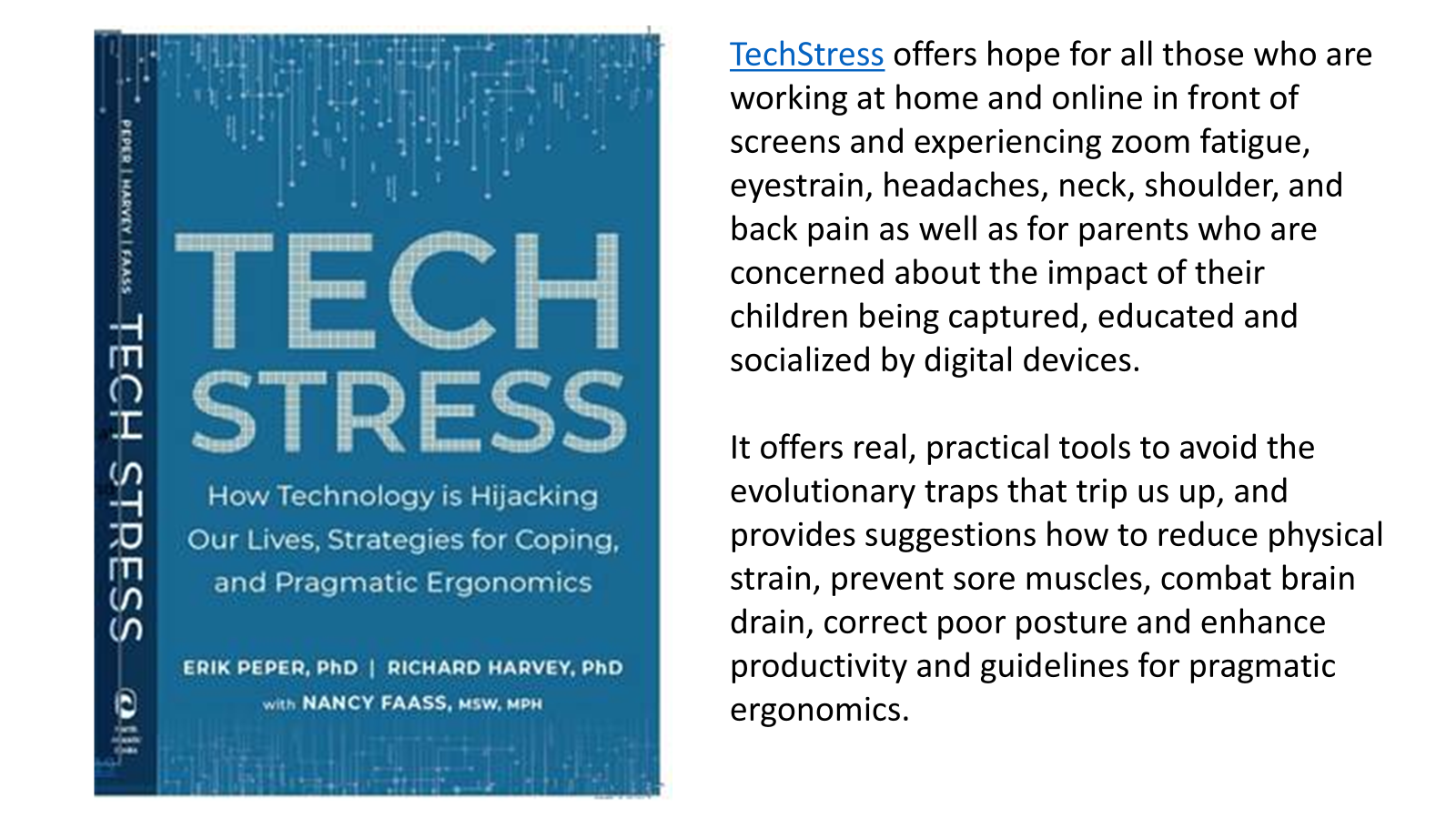
If you spend time in front of a computeror using a mobile device, read the book, TechStress: How Technology is Hijacking Our Lives, Strategies for Coping, and Pragmatic Ergonomics. It provides practical, easy-to-use solutions for combating the stress and pain many of us experience due to technology use and overuse. The book offers extremely helpful tips for ergonomic use of technology, it
goes way beyond that, offering simple suggestions for improving muscle health that seem obvious once you read them, but would not have thought of yourself: “Why didn’t I think of that?” You will learn about the connection between posture and mood, reasons for and importance of movement breaks, specific movements you can easily perform at your desk, as well as healthier ways to utilize technology in your everyday life.
See the book, TechStress-How Technology is Hijacking our Lives, Strategies for Coping and Pragmatic Ergonomics by Erik Peper, Richard Harvey and Nancy Faass. Available from: https://www.amazon.com/Beyond-Ergonomics-Prevent-Fatigue-Burnout/dp/158394768X/
Additional resources
Mouth breathing and tongue position: a risk factor for health
Posted: June 8, 2023 Filed under: ADHD, behavior, Breathing/respiration, cognitive behavior therapy, Evolutionary perspective, healing, health, Nutrition/diet, self-healing, Uncategorized | Tags: babies, breastfeedging, development, infants, jaw, mouth breathing, neurocognitive develoment, nose breathing, sleep, tongue-tie Leave a commentErik Peper, PhD, BCB and Ron Swatzyna, PhD, LCSW, BCB, BCN
Adapted from: Peper, E., Swatzyna, R., & Ong, K. (2023). Mouth breathing and tongue position: a risk factor for health. Biofeedback. 51(3), 74–78 https://doi.org/10.5298/912512

Breathing usually occurs without awareness unless there are problems such as asthma, emphysema, allergies, or viral infections. Infant and child development may affect how we breathe as adults. This blog discusses the benefits of nasal breathing, factors that contribute to mouth breathing, how babies’ breastfeeding and chewing decreases the risk of mouth breathing, recommendations that parents may implement to support healthy development of a wider palate, and the embedded video presentation, How the Tongue Informs Healthy (or Unhealthy) Neurocognitive Development, by Karindy Ong, MA, CCC-SLP, CFT, .
Benefits of nasal breathing
Breathing through the nose filters, humidifies, warms, or cools the inhaled air as well as reduces the air turbulence in the upper airways. In addition, the epithelial cells of the nasal cavities produce nitric oxide that are carried into the lungs when inhaling during nasal breathing (Lundberg & Weitzberg, 1999). The nitric oxide contributes to healthy respiratory function by promoting vasodilation, aiding in airway clearance, exerting antimicrobial effects, and regulating inflammation. Breathing through the nose is associated with deeper and slower breathing rate than mouth breathing. This slower breathing also facilitates sympathetic parasympathetic balance and reduces airway irritation.
Mouth breathing
Some people breathe predominantly through their mouth although nose breathing is preferred and health promoting. Mouth breathing negatively impacts the ability to perform during the day as well as affect our cognitions and mood (Nestor, 2020). It contributes to disturbed sleep, snoring, sleep apnea, dry mouth upon waking, fatigue, allergies, ear infections, attention deficit disorders, crowded mis-aligned teeth, and poorer quality of life (Kahn & Ehrlich, 2018). Even the risk of ear infections in children is 2.4 time higher for mouth breathers than nasal breathers (van Bon et al, 1989) and nine and ten year old children who mouth breath have significantly poorer quality of life and have higher use of medications (Leal et al, 2016).
One recommendation to reduce mouth breathing is to tape the mouths closed with mouth tape (McKeown, 2021). Using mouth tape while sleeping bolsters nose breathing and may help people improve sleep, reduce snoring, and improves alertness when awake (Lee et al, 2022).
Experience how mouth breathing affects the throat and upper airway
Inhale quickly, like a gasp, as much air as possible through your open mouth. Exhale letting the air flow out through your mouth. Repeat once more.
Inhale quickly as much air through the nose, then exhale by allow the airflow out through the nose. Repeat once more.
What did you observe? Many people report that rapidly inhaling through the mouth causes the back of the throat and even upper airways to feel drier and irritated. This does not occur when inhaling through the nose. This simple experiment illustrates how habitual mouth breathing may irritate the airways.
Developmental behavior that contributes to mouth breathing
The development of mouth breathing may begin right at birth when the mouth, tongue, jaw and nasal area are still developing. The arch of the upper palate forms the roof of the oral cavity that separates the oral and nasal cavities. When the palate and jaw narrows, the arch of the palate increases and pushes upwards into the nasal area. This reduces space in the nasal cavity for the air to flow and obstructs nasal breathing. The highly vaulted palate is not only genetically predetermined but also by how we use our tongue and jaw from birth. The highly arched palate is only a recent anatomical phenomena since the physical structure of the upper palate and jaw from the pre- industrial era was wider (less arched upper palate) than many of our current skulls (Kahn & Ehrlich, 2018).
The role of the tongue in palate development
After babies are born, they breastfeed by sucking with the appropriate tongue movements that help widen the upper palate and jaw. On the other hand, when babies are bottle fed, the tongue tends to move differently which causes the cheek to pull in and the upper palate to arch which may create a high narrow upper palate and making the jaw narrower. There are many other possible factors that could cause mouth breathing such as tongue-tie (ankyloglossia), septal deviation, congenital malformation, enlarged adenoids and tonsils (Aden tonsillar hyperplasia), inflammatory diseases such as allergic rhinitis (Trabalon et al, 2012). Whatever the reasons, the result of the impoverished tongue movement and jaw increases the risk for having a higher arched upper palate that impedes nasal breathing and contributes to habitual mouth breathing.
The forces that operate on the mouth, jaw and palate during bottle feeding may be similar to when you suck on straw and the cheeks coming in with the face narrowing. The way the infants are fed will change the development of the physical structure that may result in lifelong problems and may contribute to developing a highly arched palate with a narrow jaw and facial abnormalities such as long face syndrome (Tourne, 1990).
To widen the upper palate and jaw, the infant needs to chew, chew and tear the food with their gums and teeth. Before the industrialization of foods, children had to tear food with their teeth, chew fibrous foods or gnaw at the meat on bones. The chewing forces allows the jaw to widen and develop so that when the permanent teeth are erupting, they would more likely be aligned since there would be enough space–eliminating the need for orthodontics. On the other hand, when young children eat puréed and highly processed soft foods (e.g., cereals soaked in milk, soft breads), the chewing forces are not powerful enough to encourage the widening of the palate and jaw.
Although the solution in adults can be the use of mouth tape to keep the mouth closed at night to retrain the breathing pattern, we should not wait until we have symptoms. The focus needs to be on prevention. The first step is an assessment whether the children’s tongue can do its job effectively or limited by tongue-tie and the arch of the palate. These structures are not totally fixed and can change depending on our oral habits. The field of orthodontics is based upon the premise that the physical structure of the jaw and palate can be changed, and teeth can be realigned by applying constant forces with braces.
Support healthy development of the palate and jaw
Breastfeed babies (if possible) for the first year of life and do NOT use bottle feeding. When weaning, provide chewable foods (fruits, vegetable, roots, berries, meats on bone) that was traditionally part of our pre-industrial diet. These foods support in infants’ healthy tongue and jaw development, which helps to support the normal widening of the palate to provide space for nasal breathing.
Provide fresh organic foods that children must tear and chew. Avoid any processed foods which are soft and do not demand chewing. This will have many other beneficial health effects since processed foods are high in simple carbohydrates and usually contain color additives as well as traces of pesticides and herbicides. The highly processed foods increase the risk of developing depression, type 2 diabetes, inflammatory disease, and colon cancer (Srour et al., 2019).
Sadly, the USA allows much higher residues of pesticide and herbicides that act as neurotoxins than are allowed in by the European Union. For example, the acceptable level of the herbicide glyphosate (Round-Up) is 0.7 parts per million in the USA while in the acceptable level is 0.01 parts per million in European countries (Tano, 2016; EPA, 2023; European Commission, 2023). The USA allows this higher exposure even though about half of the human gut microbiota are vulnerable to glyphosate exposure (Puigbò et al., 2022).
The negative effects of herbicides and pesticides are harmful for growing infants. Even fetal exposure from the mother (gestational exposure) is associated with an increase in behaviors related to attention-deficit/hyperactivity disorders and executive function in the child when they are 7 to 12 years old (Sagiv et al., 2021) and organophosphate exposure is correlated with ADHD prevalence in children (Bouchard et al., 2010).
To implement these basic recommendations are very challenging. It means the mother has to breastfeed her infant during the first year of life. This is often not possible because of socioeconomic inequalities; work demands and medical complications. It also goes against the recent cultural norm that fathers should participate in caring for the baby by giving the baby a bottle of stored breast milk or formula.
From our perspective, women who give birth must have a year paid maternity leave to provide their infants with the best opportunity for health (e.g., breast-feeding, emotional bonding, and reduced financial stress). As a society, we have the option to pay the upfront cost now by providing a year- long maternity leave to mothers or later pay much more costs for treating chronic conditions that may have developed because we did not support the natural developmental process of babies.
Relevance to the field of neurofeedback and biofeedback
Clinicians often see clients, especially children with diagnostic labels such as ADHD who have failed to respond to numerous psychotherapies and pharmacotherapies. In the recent umbrella review and meta-analytic evaluation of recent meta-analyses, Leichsenring et al. (2022) found only small benefits overall for both types of intervention. They suggest that a paradigm shift in research seems to be required to achieve further progress in resolving mental health issues. As the past director of National Institute of Health, Dr. Thomas Insel pointed out that the Diagnostic and Statistical Manual of Mental Disorders (DSM) is not a valid instrument and should be a big wake up call for all of us to think outside the box (Insel, 2009). One factor that starts right at birth is the oral cavity development by dysfunctional tongue movements.
We want to make all of you aware of a serious issue in children that you may come across. For those of us who work with children children, we need to ask their parents about the following: tongue-tie, mouth breathing, bedwetting, high-vaulted palate, thumb sucking, abnormal eating issues, apraxia, dysarthria, and hypotonia. Research suggests that the palates of these children are so arched that the tongue cannot do its job effectively, causing multiple issues which may be related.
Please view the webinar from May 17, 2023. Presented by Karindy Ong, MA, CCC-SLP, CFT, How the Tongue Informs Healthy (or Unhealthy) Neurocognitive Development. The presentation explains the developmental process of the role the tongue plays and how it contributes to nasal breathing. Please pass it on to others who may have interest.
References
Bouchard, M.F., Bellinger, D.C., Wright, R.O., & Weisskopf, M.G. (2010). Attention-deficit/hyperactivity disorder and urinary metabolites of organophosphate pesticides. Pediatrics, 125(6), e1270-7. https://doi.org/10.1542/peds.2009-3058
EPA. (2023). Glyphosate. United States Environmental Protection Agency. Accessed April 1, 2023. https://www.epa.gov/ingredients-used-pesticide-products/glyphosate
European Commission. (2023). EU legislation on MRLs.Food Safety. Assessed April 1, 2023. https://food.ec.europa.eu/plants/pesticides/maximum-residue-levels/eu-legislation-mrls_en#:~:text=A%20general%20default%20MRL%20of,e.g.%20babies%2C%20children%20and%20vegetarians.
Insel, T.R. (2009). Translating scientific opportunity into public health impact: a strategic plan for research on mental illness. Arch Gen Psychiatry, 66(2), 128-133. https://doi.org/10.1001/archgenpsychiatry.2008.540
Kahn, S. & Ehrlich, P.R. (2018). Jaws. Stanford, CA: Stanford University Press. https://www.amazon.com/Jaws-Hidden-Epidemic-Sandra-Kahn/dp/1503604136/ref=tmm_hrd_swatch_0?_encoding=UTF8&qid=1685135054&sr=1-1
Leal, R.B., Gomes, M.C., Granville-Garcia, A.F., Goes, P.S.A., & de Menezes, V.A. (2016). Impact of Breathing Patterns on the Quality of Life of 9- to 10-year-old Schoolchildren. American Journal of Rhinology & Allergy, 30(5):e147-e152. https://doi.org/10.2500/ajra.2016.30.4363
Lee, Y.C., Lu, C.T., Cheng, W.N., & Li, H.Y. (2022).The Impact of Mouth-Taping in Mouth-Breathers with Mild Obstructive Sleep Apnea: A Preliminary Study. Healthcare (Basel), 10(9), 1755. https://doi.org/10.3390/healthcare10091755
Leichsenring, F., Steinert, C., Rabung, S. and Ioannidis, J.P.A. (2022), The efficacy of psychotherapies and pharmacotherapies for mental disorders in adults: an umbrella review and meta-analytic evaluation of recent meta-analyses. World Psychiatry, 21: 133-145. https://doi.org/10.1002/wps.20941
Lundberg, J.O. & Weitzberg, E. (1999). Nasal nitric oxide in man. Thorax. (10):947-52. https://doi.org/10.1136/thx.54.10.947
McKeown, P. (2021). The Breathing Cure: Develop New Habits for a Healthier, Happier, and Longer Life. Boca Raton, Fl “Humanix Books. https://www.amazon.com/BREATHING-CURE-Develop-Healthier-Happier/dp/1630061972/
Nestor, J. (2020). Breath: The New Science of a Lost Art. New York: Riverhead Books. https://www.amazon.com/Breath/dp/0593191358/ref=tmm_pap_swatch_0?_encoding=UTF8&qid=1686191995&sr=8-1
Puigbò, P., Leino, L. I., Rainio, M. J., Saikkonen, K., Saloniemi, I., & Helander, M. (2022). Does Glyphosate Affect the Human Microbiota?. Life, 12(5), 707. https://doi.org/10.3390/life12050707
Sagiv, S.K., Kogut, K., Harley, K., Bradman, A., Morga, N., & Eskenazi, B. (2021). Gestational Exposure to Organophosphate Pesticides and Longitudinally Assessed Behaviors Related to Attention-Deficit/Hyperactivity Disorder and Executive Function, American Journal of Epidemiology, 190(11), 2420–2431. https://doi.org/10.1093/aje/kwab173
Srour, B. et al. (2019). Ultra-processed food intake and risk of cardiovascular disease: prospective cohort study (NutriNet-Santé).BMJ, 365. https://doi.org/10.1136/bmj.l1451
Tano, B. (2016). The Layman’s Guide to Integrative Immunity. Integrative Medical Press. https://www.amazon.com/Laymans-Guide-Integrative-Immunity-Discover/dp/0983419299/_
Tourne, L.P. (1990). The long face syndrome and impairment of the nasopharyngeal airway. Angle Orthod, 60(3):167-76. https://doi.org/10.1043/0003
Trabalon, M. & Schaal, B. (2012). It takes a mouth to eat and a nose to breathe: abnormal oral respiration affects neonates’ oral competence and systemic adaptation. Int J Pediatr, 207605. https://doi.org/10.1155/2012/207605
van Bon, M.J., Zielhuis, G.A., Rach, G.H., & van den Broek, P. (1989). Otitis media with effusion and habitual mouth breathing in Dutch preschool children. Int J Pediatr Otorhinolaryngol, (2), 119-25. https://doi.org/10.1016/0165-5876(89)90087-6
Compassion supports healing: Case report how a “bad eye” became an “amazing eye”*
Posted: April 11, 2023 Filed under: behavior, cognitive behavior therapy, healing, health, mindfulness, Pain/discomfort, self-healing, stress management, Uncategorized, vision | Tags: compassion, self-image 3 CommentsErik Peper, PhD and Dana Yirmiyahu

“I completely changed my perception of having a bad eye, to having an amazing eye. After two months, my eye is totally normal and healthy”
When experiencing chronic discomfort or reduced function, we commonly describe that part of our body that causes problems as broken or bad. Sometimes we even wish that it did not exist. In other cases, especially if there is pain or disfigurement, the person may attempt to dissociate from that body part. The language the person uses creates a graphic imagery that may impact the healing process; since, language can also be seen as a self-hypnotic suggestion.
The negative labeling, plus being disgusted or frustrated with that part of the body that is the cause of discomfort, often increases stress, tension and sympathetic activity. This reduces our self-healing potential. In many cases, the language is both the description and the prognosis-a self-fulfilling prophecy. If the description is negative and judgmental, it may interfere with the healing/treatment process. The negative language may activate the nocebo process that inhibits regeneration. On the other hand, positive affirming language may implicitly activate the placebo process that enhances healing.
By reframing the experience as positive and appreciating what the problem area of the body had done for you in the past as well as incorporating a healing compassionate process, healing is supported. Our limiting beliefs limit our possibilities. See the TED talk, A broken body isn’t a broken person, by Janine Shepherd (2014) who, after a horrendous accident and being paralyzed, became an acrobatic pilot instructor. Another example of a remarkable recovery is that of Madhu Anziani. After falling from a second floor window, he was a quadriplegic and used Reiki, toning, self-compassion and hope to improve his health. He reframed the problem as an opportunity for growth. He can now walk, talk and play the most remarkable music (Anziani and Peper, 2021).
When a person can focus on what they can do instead of focusing on what they cannot do or on their suffering, pain may be reduced. For example, Jill Cosby describes undergoing two surgeries to replace her shattered L3 with a metal “cage” and fused this cage to the L4 and L2 vertebrae with bars. She used imagery to eliminate the pains in her back and stopped her pain medications (Peper et al., 2022). The healing process is similar to how children develop, growth, and learn–a process that is promoted through playfulness and support with an openness to possibilities.
Healing only goes forwards in time
After an injury, most people want to be the same as they were before the injury, and they keep comparing themselves to how they were. The person can never be what they were in the past, butthey can be different and even better.. Time flows only in a forward direction, and the person already has been changed by the experience. Instead, the person explores ways to accept where they are, appreciate how much the problem area has done for them in the past, and continue to work to improve. This is a dynamic process in which the person appreciates the very small positive changes that are occurring without setting limits on how much change can occur.
A useful tool while working with clients is to explore ways by which they can genuinely transform their negative beliefs and self-talk about the problem to appreciation and growth. This process is illustrated in the following report about the rapid healing of a 15-year problem with an eye that had become smaller following severe corneal abrasion.
Case report
On January 18th, 2023, I attended a workshop/ lecture by Professor Erik Peper.
During the break, I spoke to him and expressed my concern regarding my right eye. 15 years ago, the cornea of my eye was accidently scratched by my 3-year-old daughter. The eye suffered a trauma and was treated at the hospital. In addition, I had a patch over my eye for 3 weeks and suffered extrusion pain during the first 2 weeks. A scar remained on my eye, and doctors were not able to say if it would be permanent or whether the eye would heal itself eventually. An invasive operation was also suggested, which I refused. The trauma affected my eyesight for a few months, but after a year, the scar was gone and physically no permanent damage has remained.
Although it was certainly determined that my eye had healed completely, it didn’t feel that way at all. I always considered it ‘my bad eye’ and suffered irritation and pain every time I experienced tiredness, anxiety, or any other emotional discomfort. My eye was the first and only organ to reflect pain/itchiness/irritation. Over time, my eye ‘shrank’ as well. It became visibly smaller and it felt tense at all times.
For 15 years, that was my reality! I coped with it and haven’t thought of it much, until January 18, when I attended the workshop.
Professor Peper asked me to the front of the stage when we returned from break and conducted an exercise with me, where I used my imagination and words to comfort my eye and embrace it rather than call it ‘the defective/bad eye’. He pointed out that if you only describe your children as bad or evil, how can you expect them to grow? Then, he explored with me a few exercises such as evoking self-healing imagery. The self-healing imagery did not totally resonate; however, I felt I just needed to hug my eye. I thanked my eye for its being and stroked it gently in my mind. On stage and during the rest of the lecture I felt a sense of comfort. I felt if the muscles around my eye had finally loosened–a feeling I haven’t experienced for years. I continued to follow the instructions I got at the workshop for a couple of days, but unfortunately, I did not persist, and the negative sensations returned.
On a follow-up zoom meeting 10 days after the lecture with Prof. Peper, I received additional tools to practice ‘eye physiotherapy’ as well as mindfulness regarding the eye. This practice consisted of closing my eyes and covering the non-problem eye and then as I exhaled gently and softly opening my eyes, opening them more and more while looking all around. I completely changed my perception of having a bad eye, to having ‘an amazing eye’. At first talking to it didn’t come naturally to me but as I persisted it became easier and easier. I did it in the car, before going to sleep and when waking up in the morning. In addition, I practiced the exercises I got over zoom, where I covered my left eye (the undamaged one) and had my right eye look up and down to both sides.
It has been about three months since this zoom meeting and I am awed by the results. My eye has opened more, and no longer feels shrunk and small, I rarely feel negative sensations in it and when I do, I immediately know how to handle it.
I can say that attending this workshop has definitely been a life-changing event for my amazing right eye and for me.
Why did the healing occur?
The “bad eye” symptoms were most likely caused by “learned disuse”; namely, the chronic eye tension was the result of the protective response to reduce the discomfort after the injury to the cornea (Uswatte & Taub, 2005). After the injury and medical treatment, she would have unknowingly tensed her muscles around the eye to protect it. This process occurs automatically without conscious awareness. This protective response became her “new normal” and once her eye had healed, the bracing continued. The bracing pattern was amplified by the ongoing self-labeling of having a “bad eye.” By accepting the eye as it was, giving it compassionate caring and support, and following up with simple eye movement exercises to allow the eye to rediscover and experience the complete range of motion, the symptoms disappeared.
What can we take home from this case example?
Listen to the language a client uses to describe their problem. Does the language implicitly limit recovery, growth and hope (e.g., I will always have the problem)? Does the language inhibit caring and compassion for the problem area (e.g., I’m frustrated, angry, disgusted)? If that is the case, explore ways to reframe the language and emotional tone. A useful strategy is to incorporate self-healing imagery: the person first inspects the problem area, next imagines how it would look when it is healthy, and finally creates self-healing imagery that transforms what was observed to become well and whole. Then, each moment the client’s attention is drawn to the problem, he or she evokes the self-healing imagery (Peper, Gibney, & Holt, 2002). In many cases, combining this imagery with slower breathing to reduce stress promotes healing.
References
Anziani, M. & Peper, E. (2021). Healing from paralysis-Music (toning) to activate health. the peper perspective-ideas on illness, health and well-being from Erik Peper. Accessed March 22, 2023. https://peperperspective.com/2021/11/22/healing-from-paralysis-music-toning-to-activate-health/
Mullins, A. (2009). The opportunity of adversity. TEDMED. Accessed March 22, 2023. https://www.ted.com/talks/aimee_mullins_the_opportunity_of_adversity?language=en
Peper, E. Cosby, J. & Amendras, M. (2022). Healing chronic back pain. NeuroRegulation, 9(3), 165-172. https://doi.org/10.15540/nr.9.3.164
Peper, E., Gibney, H. K. & Holt, C. (2002). Make Health Happen. Dubuque, Iowa: Kendall-Hunt. pp. 193-236. https://he.kendallhunt.com/make-health-happen
Shepherd, J. (2014). A broken body isn’t a broken person. TEDxKC. Accessed March 20, 2023 https://www.ted.com/talks/janine_shepherd_a_broken_body_isn_t_a_broken_person?language=en
Uswatte, G. & Taub, E. (2005). Implications of the Learned Nonuse Formulation for Measuring Rehabilitation Outcomes: Lessons From Constraint-Induced Movement Therapy. Rehabilitation Psychology, 50(1), 34-42. https://doi.org/10.1037/0090-5550.50.1.34
*I thank Cathy Holt, MPH, for her supportive feedback.
Thoughts Have the Power to Create or Eliminate Body Tension
Posted: January 31, 2023 Filed under: Breathing/respiration, CBT, cognitive behavior therapy, computer, emotions, ergonomics, healing, health, Neck and shoulder discomfort, Pain/discomfort, posture, stress management, Uncategorized | Tags: Alexander Technique, mind-body connection 3 CommentsBy Tami Bulmash republished from: Medium-Body Wisdom
Photo by Jonathan Borba on Unsplash
The mind and body have long been regarded and treated as separate entities, yet this distinction does little to promote holistic health. Understanding the direct relationship between thoughts and body tension can illustrate how the mind and body either work dysfunctionally through separation, or optimally as a unit.
Mental and physical aren’t separate entities
Stress and pain existed long before the coronavirus, though it was highlighted during this isolating era. In the height of the pandemic nearly eight in 10 American adults cited COVID-19 as a significant stressor. Though it may no longer be front page news, the aftermath of COVID still lingers. Its toll on mental health continues to impact children and adults alike. The shift to remote work was appealing at first, but later created a more pervasive sedentary lifestyle. Now the concern has shifted to an emerging pandemic of back pain.
Yet, there is nothing novel about body tension brought forth by stressful thinking. In 2014, the American Institute of Stress reported 77 percent of people regularly experience physical symptoms caused by stress. Moreover, the findings of a 2018 Gallup poll suggest 55 percent of Americans report feeling stressed for a large part of their day. This is compounded by the American Academy of Orthopaedic Surgeons finding one in two Americans have a musculoskeletal condition. Discerning between mental and physical stress is becoming increasingly obscure.
While the mind and body have long been regarded and treated as separate entities, this distinction does little to promote holistic health. Understanding the direct relationship between thoughts and tension can illustrate how the mind and body either work dysfunctionally through separation, or optimally as a unit. What’s more, viewing the body as a whole being — in thought and activity — can promote better habits which eliminate tension.
The link between stress and pain
Dividing the self into parts is common practice in the Western world. Expressions such as “I’m mentally exhausted” vs. “I’m physically exhausted” provoke differing self-reflections. However, the psycho-physical relationship is evident in the tension stimulated by either thought. For example, sitting in front of a computer necessitates both thought and action. Viewing content on a screen lends itself to a reaction from behind the screen. This response can be minimal and inconsequential, or it can be subtle, yet critical.
Repeatedly engaging in certain thinking habits like, “I have to get this done and fast” are often reflected in forms of body tension such as stiff fingers at the keyboard, a clenched jaw after a meeting, or tense neck at the end of the day. These unconscious responses are common and have a pervasive effect.
The prevalence of technology has led to a plethora of occupational ailments, now referred to as technology diseases. These include carpal tunnel syndrome, mouse shoulder, and cervical pain syndrome and occur because of excessive work at the computer — especially keyboard and mouse usage. According to the book, TechStress-How Technology is Hijacking our Lives, Strategies for Coping and Pragmatic Ergonomics, by Drs. Erik Peper, Richard Harvey and Nancy Faass, 45 million people suffer from tension headaches, carpal tunnel, and back injuries linked to computer use and more than 30 percent of North Americans who work at a computer develop a muscle strain injury every year.
Pushing through mental tasks is reflected in the physical
Dr. Peper, a biofeedback expert and Professor of Holistic Health at San Francisco State University, gives an illustration of the mind-body connection in relation to pain. His example requires the use of a computer mouse while trying to complete difficult mental tasks. He asks me to hold the mouse in my dominant hand and draw with it the last letter of an address. Then continue to go backward with each letter of the street name, making sure the letter height is only one-half of an inch. He tells me to perform the task as quickly as possible. As I’m drawing the address backwards trying to recall the letters and their order, Dr. Peper commands, “Do it quicker, quicker, quicker! Don’t make a mistake! Quicker, quicker, quicker!”
These commands reflect the endless to-do lists that pile up throughout the day and the stress associated with their efficacy and timely completion. While enacting this task, Dr. Peper asks me, “Are you tightening your shoulders? Are you tightening your trunk? Are you raising your shoulders possibly holding all this tension? If you are like most people who do this task, you did all of that and you were totally unaware. We are usually really unaware of our body posture.”
I have spent the past 20 years practicing the Alexander Technique, a method used to improve postural health. At its core the technique is about observation and utilizing psycho-physical awareness to stop repeating harmful habits. Dr. Peper’s words resonate because becoming aware of unconscious responses isn’t easy. Most people are completely unaware of the relationship between mind-body habits and how they contribute to stress-related pain.
Posture affects mood and energy levels
Posture is often thought of as a pose — most notably being associated with “sitting up straight”. Yet the health implications of good posture extend far beyond any held position. The agility and movement which are evident in good posture exemplify the mind-body connection.
It is well-known that feeling depressed has been linked to having less subjective energy. The American Psychiatric Association listed a variety of symptoms connected to depression including feeling sad or having a depressed mood, loss of interest in activities once enjoyed, and loss of energy or increased fatigue. While the treatment of depression hasn’t traditionally considered the role of posture in informing mood, researchers have started exploring this relationship.
A study by Dr. Peper and Dr. I-Mei Lin examined the subjective energy levels of university students and their corresponding expression of depression. Participants who walked in a slouched position reported lower energy levels and higher self-rated depression scores. In contrast, when those participants walked in a pattern of opposite arm and leg skipping, they experienced an increase in energy, allowing a positive mindset to ensue.
As mentioned in the study, the mind-body relationship is a two-way street: mind to body and body to mind. If thoughts are manifested in the way one holds their body, the inverse would also be true. Namely, changing the way one carries their body would also influence their thinking and subsequent mood. If stopping certain habits — such as walking in a slumped posture — could have a positive impact on mood and well-being, perhaps it’s worth exploring the mind-body relationship even further.
Supporting the mind-body connection
One of the best ways to improve the mind-body connection is through awareness. The more present you are in your activities, the more unified the relation becomes. Give yourself a couple of minutes to connect your thoughts with what you are doing at the moment.
Begin With Grounding
If you are sitting down, imagine coloring in the space of your whole body with an imaginary marker. Begin with your feet planted on the floor. Start to outline the footprints of your feet and then color in the bottom and top of each foot. Take your time. Fill in all the space. See if you discover new parts of your feet — like the spaces between your toes. Continue up through your ankles and toward your calves. Pay attention to the entire limb (front and back). Work your way upward through the knee and then the upper leg. See if you can find your sit bones along the way to the torso. Explore new joints — such as the hip joint.
Lengthen Your Body Through Thought
Continue up while circling the front and back of the torso. Extend the awareness of your thoughts through your shoulders. Allow for an exploration of the arms — noting the joints such as the elbows, wrists and fingers. Pay attention to their length and mobility. Come back up through the arms. Extend up through the shoulders again, this time noting the passage through the chest and neck. Observe the length and space within your entire being. Journey up to the head and travel around its circumference. Imagine filling your head space with air. Picture the wholeness of your head from top to bottom and side to side.
This two-minute mind-body meditation allows you to feel the full extent of the space your body takes up. It is a way to awaken the senses and include them in conscious thinking. This helps generate awareness in how to engage the mind-body relationship optimally. The next time you try it, use a visual aid like an anatomy diagram of the whole body. This can also introduce new parts and spaces of the body you may not have thought of before. However, don’t rely on the diagram each time, as it can pull away your attention from the mind-body meditation. Instead, use it as a reference or guide every once in a while.
Learn from other cultures
In Western cultures, it is common practice to divvy up musculoskeletal ailments into an array of categories such as tension headaches, tension neck syndrome, or mechanical back syndrome. For instance, in countries like the U.S., it is normal to seek a specialist for each area of concern — like a neurologist for a migraine, an orthopedist for neck strain, or chiropractors for back pain. In contrast, Eastern lifestyles have historically taken a more holistic approach to treating (and healing) their patients.
An article by Dr. Cecilia Chan, Professor of Social Sciences at the University of Hong Kong, explains how the Eastern philosophies of Buddhism, Taoism and traditional Chinese medicine adopt a holistic approach to the healing of an individual. Rather than diagnose and treat with medication, Chan and her colleagues explore health through the harmony and balance of the body-mind-spirit as a whole.
Because basic biology clearly delineates how the human head is attached to the body, it seems fitting that the entire being be regarded as a unit. By recognizing the relationship between thought stressors and their manifestation in the physical body, awareness is elevated. This, in turn, can prevent mindlessly engaging in harmful patterns that lead to stress and pain. Combating tension is possible through the realization of how thoughts — whether they are emotional or task oriented — directly impact the body as a whole.
This excerpt from Taro Gold’s book, Open Your Mind, Open Your Life: A Book of Eastern Wisdom, cites Mahatma Gandhi’s famous quote which beautifully elucidates the mind-body connection:
Keep your thoughts positive, because your thoughts become your words.
Keep your words positive, because your words become your behavior.
Keep your behavior positive, because your behavior becomes your habits.
Keep your habits positive, because your habits become your values.
Keep your values positive, because your values become your destiny.
Referring to the mind and body as separate entities perpetuates a disconnect in the being as a whole. This is why distinguishing the mental from the physical further exacerbates the notion that the two don’t work together as an indivisible unit. Understanding the relationship between stress and tension begins through the awareness of habits.
There are recurrent thinking habits like “I’ve got to get this done now” and their unconscious counterparts that become visible through posture. The unknown habits are the ones which accrue over time and often appear seemingly out of nowhere — in the form of tension or pain. Modern culture is quick to treat symptoms, such as those related to excessive technology use. However, a holistic approach to addressing the underlying issue would examine how stress and pain work hand in hand. Once the thoughts change, so will the tension.
Biofeedback, posture and breath: Tools for health
Posted: December 1, 2022 Filed under: ADHD, behavior, biofeedback, Breathing/respiration, CBT, cognitive behavior therapy, computer, digital devices, education, emotions, ergonomics, Evolutionary perspective, Exercise/movement, healing, health, laptops, mindfulness, Neck and shoulder discomfort, Pain/discomfort, posture, relaxation, screen fatigue, self-healing, stress management, Uncategorized, vision, zoom fatigue 3 CommentsTwo recent presentations that that provide concepts and pragmatic skills to improve health and well being.
How changing your breathing and posture can change your life.
In-depth podcast in which Dr. Abby Metcalf, producer of Relationships made easy, interviews Dr. Erik Peper. He discusses how changing your posture and how you breathe may result in major improvement with issues such as anxiety, depression, ADHD, chronic pain, and even insomnia! In the presentation he explain how this works and shares practical tools to make the changes you want in your life.
How to cope with TechStress
A wide ranging discussing between Dr. Russel Jaffe and Dr Erik that explores the power of biofeedback, self-healing strategies and how to cope with tech-stress.
These concepts are also explored in the book, TechStress-How Technology is Hijacking our Lives, Strategies for Coping and Pragmatic Ergonomics. You may find this book useful as we spend so much time working online. The book describes the impacts personal technology on our physical and emotional well-being. More importantly, “Tech Stress” provides all of the basic tools to be able not only to survive in this new world but also thrive in it.
Additiona resources:
Gonzalez, D. (2022). Ways to improve your posture at home.
Healing chronic back pain
Posted: July 31, 2022 Filed under: behavior, Breathing/respiration, CBT, cognitive behavior therapy, education, healing, health, meditation, relaxation, self-healing, stress management, surgery | Tags: back pain, Imagery, self-care, visualization 4 CommentsErik Peper, PhD, BCB, Jillian Cosby, and Monica Almendras
Adapted from Peper, E. Cosby, J. & Amendras, M. (2022).Healing chronic back pain. NeuroRegulation, 9(3), 165-172. https://doi.org/10.15540/nr.9.3.164

In at the beginning of 2021, I broke my L3 vertebra during a motor cycle accident and underwent two surgeries in which surgeons replaced my shattered L3 with a metal “cage” (looks like a spring) and fused this cage to the L4 and L2 vertebrae with bars. I also broke both sides of my jaw and fractured my left shoulder. I felt so overwhelmed and totally discouraged by the ongoing pain. A year later, after doing the self-healing project as part of the university class assignment, I feel so much better all the time, stopped taking all prescription pain medications and eliminated the sharp pains in my back. This project has taught me that I have the skill set needed to be whole and healthy. –J.C., 28-year-old college student
Chronic pain is defined as a pain that persist or recurs for more than 3 months (Treede et al., 2019). It is exhausting and often associated with reduced quality of life and increased medical costs (Yong, Mullins, & Bhattacharyya, 2022). Pain and depression co-exacerbate physical and psychological symptoms and can lead to hopelessness (IsHak, 2018; Von Korff & Simon, 1996). To go to bed with pain and anticipate that pain is waiting for you as you wake up is often debilitating. One in five American adults experience chronic pain most frequently in back, hip, knee or foot (Yong, Mullins, & Bhattacharyya, 2022). Patients are often prescribed analgesic medications (“pain killers”) to reduce pain. Although, the analgesic medications can be effective in the short term to reduce pain, the efficacy is marginal for relieving chronic pain (Eriksen et al., 2006; Tan, & Jensen, 2007). Recent research by Parisien and colleagues (2022) reported that anti-inflammatory drugs were associated with increased risk of persistent pain. This suggest that anti-inflammatory treatments might have negative effects on pain duration. In addition, the long-term medication use is a major contributor to opioid epidemic and increased pain sensitivity (NIH– NIDA, 2022; Higgins, Smith, & Matthews, 2019; Koop, 2020). Pain can often be successfully treated with a multidisciplinary approach that incorporates non-pharmacologic approaches. These include exercise, acceptance and commitment therapy, as well as hypnosis (Warraich, 2022). This paper reports how self-healing strategies as taught as part of an undergraduate university class can be an effective approach to reduce the experience of chronic pain and improve health.
Each semester, about 100 to 150 junior and senior college students at San Francisco State University enroll in a holistic health class that focused on ‘whole-person’ Holistic Health curriculum. The class includes an assessment of complementary medicine and holistic health. It is based upon the premise that mind/emotions affect body and body affect mind/emotions that Green, Green & Walters (1970) called the psychophysiological principle.
“Every change in the physiological state is accompanied by an appropriate change in the mental emotional state, conscious or unconscious, and conversely, every change in the mental emotional state, conscious or unconscious, is accompanied by an appropriate change in the physiological state.”
The didactic components of the class includes the psychobiology of stress, the role of posture, psychophysiology of respiration, lifestyle and other health factors, reframing internal language, guided and self-healing imagery. Students in the class are assigned self-healing projects using techniques that focus on awareness of stress, dynamic regeneration, stress reduction imagery for healing, and other behavioral change techniques adapted from the book, Make Health Happen (Peper, Gibney, & Holt, 2002).
The self-practices during the last six weeks of the class focus on identifying, developing and implementing a self-healing project to optimize their personal health. The self-healing project can range from simple life style changes to reducing chronic pain. Each student identifies their project such as increasing physical activity, eating a healthy diet and reducing sugar and junk food, stopping vaping/smoking, reducing anxiety or depression, stopping hair pulling, reducing headaches, decreasing ezema, or back pain, etc. At the end of the semester, 80% or more of the students report significant reduction in symptoms (Peper, Sato-Perry, & Gibney, 2003; Peper, Lin, Harvey, Gilbert, Gubbala, Ratkovich, & Fletcher, 2014; Peper, Miceli, & Harvey, 2016; Peper, Harvey, Cuellar, & Membrila, 2022). During the last five semesters, 13 percent of the students focused reducing pain (e.g., migraines, neck and shoulder pain, upper or lower back pain, knee pain, wrist pain, and abdominal pain). The students successfully improved their symptoms an average of 8.8 on a scale from 0 (No benefit) to 10 (total benefit/improvement). The success for improving their symptoms correlates 0.63 with their commitment and persistence to the project (Peper, Amendras, Heinz, & Harvey, in prep).
The purposes of this paper is to describe a case example how a student with severe back pain reduced her symptoms and eliminated medication by implementing an integrated self-healing process as part of a class assignment and offer recommendations how this could be useful for others.
Participant: A 28-year-old female student (J.C.) who on January 28, 2021 broke her L3 vertebra in a motor cycle accident. She underwent two surgeries in which surgeons replaced her shattered L3 with a metal “cage” (which she describes as looking like a spring) and fused this cage to the L2 and L4 vertebrae with bars. She also broke both sides of her jaw and fractured her left shoulder. More than a year later, at the beginning of the self-healing project, she continue to take 5-10 mgs of Baclofen and 300 mgs of Gabapentin three times a day to reduce pain.
Goal of the self-healing project: To decrease the sharp pain/discomfort in her lower back that resulted from the motor cycle accident and, although not explicitly listed, to decrease the pain medications.
Self-healing process
During the last six weeks of the 2022 Spring semester, the student implemented her self-healing practices for her personal project which consisted of the following steps.
1. Create a self-healing plan that included exploring the advantage and disadvantage of her illness.
2. Develop a step-by-step plan with specific goals to relief her tension and pain in her lower back. This practice allowed her to quantify her problem and the solutions. Like so many people with chronic pain, she focused on the problem and feelings (physical and emotional) associated with the pain. As a result, she often feel hopeless and worried that it would not change.
3. Observe and evaluate when pain sensations changed. She recognized that she automatically anticipated and focused on the pain and anxiety whenever she needed to bend down into a squat. She realized that she had been anticipating pain even before she began to squat. This showed that she needed to focus on healing the movement of this area of her body.
Through her detailed observations, she realized that her previous general rating of back pain could be separated into muscle tightness/stiffness and pain. With this realization, she changed the way she was recording her pain level. She changed it from “pain level” into into two categories: tightness and sharp pains.
4. Ask questions of her unconscious through a guided practice of accessing an inner guide through imagery (For detailed instructions, see Peper, Gibney, & Holt, 2002, pages 197-206). In this self-guided imagery the person relaxes and imagines being in a special healing place where you felt calm, safe and secure. Then as you relaxed, you become aware of another being (wise one or guide) approaching you (the being can be a person, animal, light, spirit, etc.). The being is wise and knows you well. In your mind, you ask this being or guide questions such as, “What do I need to do to assist in my own healing?” Then you wait and listen for an answer. The answer may take many forms such as in words, a pictures, a sense of knowing, or it may come later in dreams or in other forms. When students are assigned this practice for a week, almost all report experiencing some form of guide and many find the answers meaningful for their self-healing project.
Through this imagery of the inner guide script, she connected with her higher self and the wise one told her to “Wait.” This connecting with the wise one was key in accepting that the project was not as daunting as she initially thought. She realized that pain was not going to be forever in her future. She also interpreted that as reminder to have patience with herself. Change takes practice, time and practice such as she previously experienced while correcting her posture to manage her emotions and edit her negative thoughts into positive ones (Peper, Harvey, Cuellar, & Membrila, 2022). Whenever she would have pain or feel discouraged because of external circumstances, she would remind herself of three things:
A. I need to have patience with myself.
B. I have all the healing tools inside me and I am learning to use them.
C. If I do not make time for my wellness, I’ll be forced to make time for my illness.
5. Practice self-healing imagery as described by Peper, Gibney, & Holt (2002) and adapted from the work by Dr. Martin Rossman (Rossman, 2000). Imagery can be the communication channel between the conscious/voluntary and the unconscious/autonomic/involuntary nervous system (Bressler, 2005; Hadjibalassi et al, 2018; Rossman, 2019). It appears to act as the template and post-hypnotic suggestion to implement behavior change and may offer insight and ways to mobilize the self-healing potential (Battino, 2020). Imagery is dynamic and changeable.
The process of self-healing imagery consists of three parts.
- Inspection the problem and drawing a graphic illustration of the problem as it is experienced at that moment of time.
- Drawing of how that area/problem would look when being completely well/whole or disappeared.
- Creation of a self-healing process by which the problem would become transformed into health (Peper, Gibney & Holt, 2002, pp. 217-236). The process focused on what the person could do for themselves; namely, each time they became aware of, anticipated, or felt the problem, they would focus on the self-healing process. It provideshope; since, the person now focuses on the healing of the problem and becoming well.
The drawings of inspection of the pain and problem she experienced at that moment of time are shown in Figure 1.

Figure 1. Illustration of the problem of the pain. Thorns dug deep, muscles tight, and frozen vertebrates grinding.
The resolution of the problem and being well/whole are illustrated in Figure 2.

Figure 2. Resolution of the problem in which her muscles are warm, full of blood, free of thorns, relaxed and flexible and being whole happy and healthy in which her spine is warm, her muscles are warm, her back is flexible and full of movement.
Although she utilized the first image of the muscles warm, full of blood, free of thorns and the muscles relaxed and flexible, her second image of her fully being healed was inspired through a religious statue of Yemaya that she had in her room (Yemaya is a major water spirit from the Yoruba religion Santeria and Orisha of the seas and protector of women). Each time she saw the statue, she thought of the image of herself fully healed and embodying the spirit Orisha. Therefore, this image remained important to her all the time.
Her healing imagery process by which she transforms the image of inspecting of the problem to being totally well are illustrated in Figure 3.

Figure 3. The healing process: The sun’s warm fingers thaw my muscles, lubricate my vertebra, thorns fall out, and blood returns.
For five weeks as she implemented her self-healing project by creating a self-healing plan, asking questions of her unconscious, drawing her self-healing imagery. She also incorporated previously learned skills from the first part of the semester such diaphragmatic breathing, hand warming, shifting slouching to upright posture, and changing language. Initially she paired hand warming with the self-healing imagery and she could feel an increase in body warmth each time she practiced the imagery. She practiced the self-healing imagery as an in-depth daily practice and throughout the day when she became aware of her back as described in one of her log entries.
I repeated the same steps as the day prior today. I did my practice in the early morning but focused on the details of the slowed down movements of the sun’s hands. I saw them as they stretched out to my back, passed through my skin, wrapped around my muscles, and began to warm them. I focused on this image and tried to see, in realistic detail, my muscles with a little ice still on them, feeling hard through and through, the sun’s glowing yellow-orange fingers wrapped around my muscles. I imaged the thorns still in my muscles, though far fewer than when I started, and then I imaged the yellow-orange glow start to seep out from the sun’s palms and fingers and spread over my muscles. I imaged the tendons developing as the muscle tissue thawed and relaxed, the red of the muscle brightened, the ice on and within my muscles started to melt, and the condensation formed as it ran down into collected droplets at the bottom of my muscles. I imaged the thorns lose their grip and fall out, one at a time, in tandem with the droplets falling. I continued this process and imaged my muscles expanding with warmth and relaxation as they stayed engulfed in the warmth of the sun.
At the end of my practice, I did a small stretch session. I felt extremely refreshed and ready for yet another extremely busy day between internship, graduation, and school. I would say I felt warm and relaxed all the way into the afternoon, about 6 hours after my practice. This was by far the most detailed and impactful imagery practice I have had.
The self-healing imagery practice provided me with the ability to conceptualize more than my problem as it showed me the tools to (and the importance of) conceptualizing my solution, both the tool and end result.
Results
Pain and tightness decreased and she stopped her medication by the third week as shown in Figure 4.

Figure 4. Self-rating of sharp pains and tightness during the self-healing project.
At the 14-week follow-up, she has continued to improve, experiences minimal discomfort, and no longer takes medication. As she stated, I was so incredibly shocked how early on [in the project] I was able to stop taking pain medications that I had already taken every day for over a year.
Discussion
This individual case example provides hope that health can be improved when shifting the focus from pain and discomfort to focusing on actively participating in the self-healing process. As she wrote, The lesson was self- empowerment in regard to my health. I brought comfort to my back. There is metal in my back for the rest of my life and this is something I have accepted. I used to look at that as a horrible thing to have to handle forever. I now look at it as a beautiful contraption that has allowed me to walk across a graduation stage despite having literally shattered a vertebra. I am reintegrating these traumatized parts of my body back into a whole health state of mind and body. Doctors did not do this, surgeries did not, PT didn’t and neither did pain medications. MY body and MY mind did it. I did this.
Besides the self-healing imagery and acting upon the information she received from the asking questions from the unconscious there were many other factors contributed to her healing. These included the semester long self-practices and mastery of different stress management techniques, learning how stress impacts health and what can the person can do to self-regulate, as well as being introduced to the many case examples and research studies that suggested healing could be possible even in cases where it seemed impossible.
The other foundational components that was part of the class teachings included attending the weekly classes session and completing the assign homework practices. These covered discussion about placebo/nocebo, possibilities and examples of self-healing with visualization, the role of nutrition, psychophysiology of stress and factors are associated with healthy aging across cultures. The asynchronous assignments investigated factors that promoted or inhibited health and the role of hope. The discussions pointed out that not everyone may return to health; however, they can always be whole. For example, if a person loses a limb, the limb will not regrow. The healing process includes acceptance and creating new goals to achieve and live a meaningful life.
The possibility that students could benefit by implementing the different skills and concepts taught in the class were illustrated by sharing previous students’ successes in reversing disorders such as hair pulling, anxiety, psoriasis, and pain. In addition, students were assigned to watch and comment on videos of people who had overcome serious illness. These included Janine Shepherd’s 2012 TED talk, A broken body isn’t a broken person, and Dr. Terry Wahl’s 2011 TEDxIowaCity talk, Minding your mitochondria. Janine Shepard shared how she recovered from a very serious accident in which she became paralyzed to becoming an aecrobatic pilot instructor while Dr. Terry Wahl shares how she he used diet to cure her MS and get out of her wheelchair (Shepherd, 2012; Wahl, 2011). Other assignments included watching Madhu Anziani’s presentation, Healing from paralysis-Music (toning) to activate health, in which he discussed his recovery from being a quadriplegic to becoming an inspirational musician (Anziani, & Peper, 2021). The students as read and commented on student case examples of reversing acid reflux, irritable bowel and chronic headaches (Peper, Mason, & Huey, 2017a; Peper, Mason, & Huey, 2017b; Peper, 2018; Peper et al., 2020; Peper, Covell, & Matzembacker, 2021; Peper, 2022).
Although self-healing imagery appears to be the major component that facilitated the healing, it cannot be separated from the many other concepts and practices that may have contributed. For example, the previous practices of learning slow diaphragmatic breathing and hand warming may have allowed the imagery to become a real kinesthetic experience. In addition, by seeing how other students overcame chronic disorders, the class provided a framework to mobilize one’s health.
Lessons extracted from this case example that others may be able use to mobilize health.
- Take action to shifts from being hopeless and powerless to becoming empowered and active agent in the healing process.
- Change personal beliefs through experiential practices and storytelling that provides a framework that healing and improvement are possible.
- Teach the person self-regulation skills such as slower breathing, muscle relaxation, cognitive internal language changes, hand warming by which the person experiences changes.
- Provide believable role models who shared their struggle in overcoming traumatic injury, watch inspirational talks, and share previous clients or students’ self-reports who had previously improved.
- Transform the problem from global description into behavioral specific parts. For example, being depressed is a global statement and too big to work on. Breaking the global concept into specific behaviors such as, my energy is too low to do exercise or I have negative thoughts, would provide specific interventions to work on such as, increasing exercise or changing thoughts. In JC’s case, she changed the general rating of pain into ratings of muscle tightness and sharp pains. This provided the bases for strategies to relax and warm her muscles.
- Focus on what you can do at that moment versus focusing on the past, what happened, who caused it, or blaming yourself and others. Explore and ask what you now can do now to support your healing process and reframe the problem as a new opportunity for growth and development.
- Practice, practice, and practice with a childlike exploratory attitude. Focus on the small positive benefits that occur as a result of the practices. It is not mindless practice; it is practice while being present and being gentle with yourself. Do not discard very small changes. The benefits accrue as you practice more and more, just many people have experienced when learning to play a musical instrument or mastering a sport. Even though many participants think that practicing 15 minutes a day is enough, it usually takes much more time. Reflect on how a baby learns to walk or climb. The toddler practices day-long and takes naps to regenerate and grow. When the toddler is not yet successful in walking or climbing, it does not give up or interpret it as failure or blaming himself that he cannot do it, it just means more practice.
- Have external reminders to evoke the self-healing practices. In JC’s case, the small statue of Yemaya in her room was the reminder. It reminded her to thinks of the image of herself fully healed each time she saw it.
- Guide yourself through the wise one imagery, ask yourself a question and listen and act on the intuitional answers.
- Develop a self-healing imagery process that transforms the dysfunction to health or wholeness. Often the person only perceives the limitations and focusses on describing the problem. Instead, acknowledge, accept what was and is, and focus on developing a process to promote healing. What many people do not realize that if they think/imagine how their injury/illness was caused, it may reactivate and recreate the initial trauma. This can be illustrated through imagery. When we think or imagine something, it changes our physiology. For example, when one imagines eating a lemon, many people will salivate. The image affects physiology. Thus, focus on processes that support healing.
- While practicing the imagery, experience it as if it is real and feel it happening inside yourself. Many people initially find this challenging as they see it outside themselves. One way to increase the “felt sense” is to incorporate more body involvement such as acting out the imagery with hand and body movements.
- When having a relapse, remind yourself to keep going. Every morning is the beginning of a new day, do each practices anew. In addition, reflect of something that was challenging in the past but that you successfully overcame. Focus on that success. As JC wrote, I was also successful in that I gave myself slack and reminded myself that relapses will happen and what matters more is the steps I take to move forward.
- Make your healing a priority that means doing it often during the day. Allow the self-healing imagery and process to run in the back of the head all the time just as a worry can be present in the background. So often people practice for a few minutes (which is great and better than not practicing at all); however, at other times during the day they are captured by their worry, negative thoughts or focus on the limitations of the disorder. When a person focuses on the limitations, it may interrupt the self-healing process. The analogy we often use is that the healing process is similar to healing from a small cut in the skin. Initially a scab forms and eventually the scab falls off and the skin is healed. On the other hand, if you keep moving the skin or pick on the scab, healing is much slower. By focusing on the limitations and past visualization of the injury, self-healing is reduced. This is similar to removing the scab before the skin has healed. As JC stated, “If you don’t make time for your wellness, you’ll be forced to make time for your illness” was 100% a motivating factor in my success.
- Explore resources for providers and people living with pain. See Dr. Rachel Zoffness website which provides a trove of high quality articles, books, videos, apps, and podcasts. https://www.zoffness.com/resources
In summary, we do not know the limits of self-healing; however, this case example illustrates that by implementing self-healing strategies health and recovery occurred. As JC wrote:
To have broken a vertebra in my back and experience all the injuries that came with the accident when I already did not have the strongest mind-body connection was incredibly intense and really heartbreaking and discouraging in my life. And, that made things difficult because I was not able to 100% focus on my healing because I felt so overwhelmed by the feeling of discouragement that I felt. Experiencing this self-healing project, seeing the imagery that helped me not just feel so much better all the time but be able to stop taking all prescription pain medications and eliminate the sharp pains in my back has taught me that I have the skill set needed to be whole and healthy.
Watch the interview will Jillian Cosby inwhich she describes her self-healing process.
References
Anziani, M. & Peper, E. (2021). Healing from paralysis-Music (toning) to activate health. The peperperspective. https://peperperspective.com/2021/11/22/healing-from-paralysis-music-toning-to-activate-health/
Battino, R. (2020). Using Guided Imagery and Hypnosis in Brief Therapy and Palliative Care. New York: Routledge.
Bresler, D. (2005).Physiological Consequences of Guided Imagery. Pract Pain Manag, 5(6). https://www.practicalpainmanagement.com/treatments/complementary/biobehavioral/physiological-consequences-guided-imagery
Eriksen, J., Sjøgren, P., Bruera, E., et al. (2006). Critical issues on opioids in chronic non-cancer pain: An epidemiologic study. Pain, 125,172–179. https://doi.org/10.1016/j.pain.2006.06.009
Green, E. E., Green, A. M., & Walters, E. D. (1970). Voluntary control of internal states: Psychological and physiological. The Journal of Transpersonal Psychology, 2(1), 1. https://atpweb.org/jtparchive/trps-02-70-01-001.pdf
Hadjibalassi, M., Lambrinou, E.., Papastavrou,E., & Papathanassoglou, E. (2018). The effect of guided imagery on physiological and psychological outcomes of adult ICU patients: A systematic literature review and methodological implications, Australian Critical Care, 31(2), 73-86. https://doi.org/10.1016/j.aucc.2017.03.001
Higgins, C, Smith, B.H., & Matthews, K. (2019). Evidence of opioid-induced hyperalgesia in clinical populations after chronic opioid exposure: a systematic review and meta-analysis, British Journal of Anaesthesia, 122(6), e114-e126. https://doi.org/10.1016/j.bja.2018.09.019
IsHak, W.W., Wen, R.Y., Naghdechi, L., Vanle, B., Dang, J., Knosp, M., Dascal, J., Lobsang, Gohar, Y.,; Eskander, L., Yadegar, J., Hanna, S., Sadek, A., Aguilar-Hernandez, L., Danovitch, I., Louy, C. (2018). Pain and Depression: A Systematic Review, Harvard Review of Psychiatry, 11/12, 26(6), 352-363. https://doi.org/10.1097/HRP.0000000000000198
Koob, G.F. (2020). Neurobiology of Opioid Addiction: Opponent Process, Hyperkatifeia, and Negative Reinforcement, Biological Psychiatry, 87(1), 44-53. https://doi.org/10.1016/j.biopsych.2019.05.023
Mullins, P.M., & Bhattacharyya, N. (2022). Prevalence of chronic pain among adults in the United States, Pain, 163(2), e328-e332. https://doi.org/10.1097/j.pain.0000000000002291NIH–
NIDA (2022). Opioid Overdose Crisis. Downloaded June 30, 2022. https://nida.nih.gov/research-topics/opioids/opioid-overdose-crisis
Parisien, M., Lima, L.V., Dagostino, C., El-Hachem, N., Drury, G.L., Grant, A.V., Huising, J., Verma, V…. .(2022). Acute inflammatory response via neutrophil activation protects against the development of chronic pain. Science Translational Medicine, 14(644). https://doi.org/10.1126/scitranslmed.abj99
Peper, E. (2018). Breathing reduces acid reflux and dysmenorrhea discomfort. the peperperspective. https://peperperspective.com/2018/10/04/breathing-reduces-acid-reflux-and-dysmenorrhea-discomfort/
Peper, E. (2022). Resolving a chronic headache with posture feedback and breathing. the peperperspective. https://peperperspective.com/2022/01/04/resolving-a-chronic-headache-with-posture-feedback-and-breathing/
Peper, E., Almedras, M., Heinz, N. & Harvey, R. (in prep). How attending a Holistic Health class reduced symptoms.
Peper, E. Cosby, J. & Amendras, M. Healing chronic back pain. NeuroRegulation, 9I(3), 165-172. https://doi.org/10.15540/nr.9.3.164
Peper, E., Covell, A., & Matzembacker, N. (2021). How a chronic headache condition became resolved with one session of breathing and posture coaching. NeuroRegulation, 8(4), 194–197. https://doi.org/10.15540/nr.8.4.194
Peper, E., Gibney, K.H. & Holt. C. (2002). Make Health Happen: Training Yourself to Create Wellness. Dubuque, IA: Kendall-Hunt.ISBN: 978-0787293314 https://he.kendallhunt.com/make-health-happen
Peper, E., Harvey, R., Cuellar, Y., & Membrila, C. (2022). Reduce anxiety. NeuroRegulation, 9(2), 91–97. https://doi.org/10.15540/nr.9.2.91 https://www.neuroregulation.org/article/view/22815/14575
Peper, E., Lin, I-M., Harvey, r., Gilbert, M. Gubbala, P, Ratkovich, A., & Fletcher, L. (2014). Transforming Chained Behaviors: Case Studies of Overcoming Smoking, Eczema, and Hair Pulling (Trichotillomania), Biofeedback, 42 (4), 154–160. https://doi.org/10.5298/1081-5937-42.4.06
Peper, E., Mason, L, & Huey, C. (2017a). Healing irritable bowel syndrome with diaphragmatic breathing. the peperperspective. https://peperperspective.com/2017/06/23/healing-irritable-bowel-syndrome-with-diaphragmatic-breathing/
Peper, E., Mason, L., Huey, C. (2017b). Healing irritable bowel syndrome with diaphragmatic breathing. Biofeedback. (45-4). https://doi.org/10.5298/1081-5937-45.4.04
Peper, E., Mason, L., Harvey, R., Wolski, L, & Torres, J. (2020). Can acid reflux be reduced by breathing? Townsend Letters-The Examiner of Alternative Medicine, 445/446, 44-47. https://www.townsendletter.com/article/445-6-acid-reflux-reduced-by-breathing/
Peper, E., Miceli, B., & Harvey, R. (2016). Educational Model for Self-healing: Eliminating a Chronic Migraine with Electromyography, Autogenic Training, Posture, and Mindfulness. Biofeedback, 44(3), 130–137. https://doi.org/10.5298/1081-5937-44.3.03
Peper, E., Sato-Perry, K & Gibney, K. H. (2003). Achieving Health: A 14-Session Structured Stress Management Program—Eczema as a Case Illustration. 34rd Annual Meeting of the Association for Applied Psychophysiology and Biofeedback. Abstract in: Applied Psychophysiology and Biofeedback, 28(4), 308. https://biofeedbackhealth.files.wordpress.com/2013/12/2003-aapb-poster-peper-keiko-long1.pdf
Peper, E., Lin, I-M, Harvey, R., Gilbert, M., Gubbala, P., Ratkovich, A., & Fletcher, F. (2014). Transforming chained behaviors: Case studies of overcoming smoking, eczema and hair pulling (trichotillomania). Biofeedback, 42(4), 154-160. https://doi.org/10.5298/1081-5937-42.4.06
Rossman, M. L.(2000). Guided imagery for self-healing. New York: New World Library. https://www.amazon.com/Guided-Imagery-Self-Healing-Martin-Rossman/dp/091581188X/ref=sr_1_3?crid=3M8I1Y1NV3A5N&keywords=martin+rossman&qid=1657649675&s=books&sprefix=rossman%2C+M%2Cstripbooks%2C131&sr=1-3
Rossman, M. L. (2019). Imagine health! Imagery in medical self-care. InSheikh, A.A. (ed). Imagination and healing (pp. 231-258). Routledge. https://www.amazon.com/Imagination-Healing-Imagery-Human-Development-ebook/dp/B07QB4RGSW/ref=sr_1_9?crid=3C7V3E5ZN92R&keywords=Imagination+and+healing&qid=1657818303&s=books&sprefix=imagination+and+healing+%2Cstripbooks%2C105&sr=1-9
Sheng, J., Liu, S., Wang, Y., Cui, R., & Zhang, X. (2017). The link between depression and chronic pain: Neural mechanisms in the brain. Neural Plasticity, 2017, Article 9724371. https://doi.org/10.1155/2017/9724371
Shepherd, Janine. (2012). A broken body isn’t a broken person. TEDxKC. https://www.ted.com/talks/janine_shepherd_a_broken_body_isn_t_a_broken_person
Tan, G., & Jensen, M. P. (2007). Integrating complementary and alternative medicine into multidisciplinary chronic pain treatment. In Chronic Pain Management (pp. 75-99). CRC Press. https://www.taylorfrancis.com/chapters/edit/10.3109/9781420045130-6/integrating-complementary-alternative-medicine-multidisciplinary-chronic-pain-treatment-gabriel-tan-mark-jensen
Treede, R-D., Rief, W., Barke, A., Aziz, Q., Bennett, M.I., Benoliel, R., Cohen, M., Evers, S., Finnerup, N.B., First, M.B., Giamberardino, M.A., Kaasa, S., Korwisi, B., Kosek, E., Lavand’homme, P., ; Nicholas, M., Perrot, S., Scholz, J., Schug, S., Smith, B.H., ; Svensson, P., Vlaeyen, J.S., & Wang, S-J. (2019). Chronic pain as a symptom or a disease: the IASP Classification of Chronic Pain for the International Classification of Diseases (ICD-11), Pain, 160(1), 19-27. https://do.org/10.1097/j.pain.0000000000001384
Von Korff, M. & Simon, G. (1996). The relationship between pain and depression. British Journal of Psychiatry, 168(S30), 101-108. https://doi.org/10.1192/S0007125000298474
Wahl, T. (2011). Minding your mitochondria. TEDzIowaCity. https://www.youtube.com/watch?v=KLjgBLwH3Wc
Warraich, H. (2022). Medicine has failed chronic pain patients. Here’s what they need. Pscyhe, Aeon, https://psyche.co/ideas/medicine-has-failed-chronic-pain-patients-heres-what-they-need
Yong, R. J., Mullins, P. M., & Bhattacharyya, N. (2022). Prevalence of chronic pain among adults in the United States. Pain, 163(2), e328-e332. https://doi.org/10.1097/j.pain.0000000000002291
Meditation Myths and Tips for Practice
Posted: May 19, 2022 Filed under: behavior, Breathing/respiration, cognitive behavior therapy, emotions, healing, health, meditation, mindfulness, self-healing | Tags: Mindfulness-based cognitive therapy, mindfulness-based stress reduction, TM, transcendental meditation Leave a commentMindfulness-based strategies are drawn from ancient Buddhist practices and have found acceptance as one of the major behavioral medicine techniques of today (Hilton et al, 2016; Khazan, 2013). Throughout this blog the term mindfulness will refer broadly to a mental state of paying total attention to the present moment, with a non-judgmental awareness of inner and outer experiences (Baer, Smith, & Allen, 2004; Kabat-Zinn, 1994). This approach is the common core for many stress management approaches (Peper, Harvey, & Lin, 2019).
Background
Transcendental meditation (TM), a form of concentrative meditation involving repetition of a sacred word or phrase known as a mantra, was a popular meditation technique introduced in the United States from India and participants reported improvement of mental and physical health (Wallace, 1970; Paul-Labrador et al, 2006; Rainforth et al, 2007; Hawkins, 2003). To make TM more acceptable for the western audience, Herbert Benson, MD, adapted and simplified the TM process and then labelled a core element, the ‘relaxation response’ (Benson, Beary, & Carol, 1974; Benson & Clipper, 1992). Instead of giving people a secret mantra and part of a spiritual tradition, he recommend using the word “one” as the mantra. Since that time numerous studies have demonstrated that when patients practice the relaxation response, many clinical symptoms were reduced.
In 1979, Jon Kabat-Zinn introduced a manual for a standardized Mindfulness-Based Stress Reduction (MBSR) program at the University of Massachusetts Medical Center (Kabat-Zinn, 1994; Kabat-Zin, 2003). The eight-week program combined mindfulness as a form of insight meditation with mindful yogic movement exercises designed to focus awareness on body sensations, thoughts, feelings, and behaviors. Mindfulness based programs have become a predominant approach used in behavioral medicine.
Mindfulness-based cognitive therapy (MBCT) and mindfulness-based stress reduction (MBSR) combine mindfulness meditation training with cognitive therapy and is a useful approach to reduce a variety of mental and physical conditions such as stress, anxiety, depression, addiction, disordered eating, chronic pain, sleep disturbances, and high blood pressure (Andersen et al., 2013; Carlson, Speca, Patel, & Goodey, 2003; Fjorback, Arendt, Ørnbøl, Fink, & Walach, 2011; Greeson, & Eisenlohr-Moul, 2014; Hoffman et al., 2012; Marchand, 2012; Baer, 2015; Demarzo et al, 2015; Khoury et al, 2013; Khoury et al, 2015; Teasdale, Segal, & Williams, 1995; Kabat-Zinn, 1994; Kabat-Zin, 2003; Zimmermann, Burrell, , & Jordan, 2018). Although in most cases, MBSR is helpful, in some cases meditation can evoke negative physical and/or psychological outcomes and inhibit prosocial behavior (Kreplin et al, 2018; Lindahl et al, 2017). Based on this encouraging research, many people are learning to meditate on their own using meditation apps. However, there are many questions that can arise for people new to meditation – such as what is meditation, how do I do it, what are the challenges, and how is it helpful? Some people also develop misconceptions about what meditation is and can become discouraged.
Watch the outstanding presentation by Professor Jennifer Daubenmier presented for the Holistic Health Lecture Series, in which she discusses meditation myths and pragmatic tips for practice.
References
Andersen, S. R., Würtzen, H., Steding-Jessen, M., Christensen, J., Andersen, K. K., Flyger, H., … & Dalton, S. O. (2013). Effect of mindfulness-based stress reduction on sleep quality: Results of a randomized trial among Danish breast cancer patients. Acta Oncologica, 52(2), 336-344. https://doi.org/10.3109/0284186X.2012.745948
Baer, R., Smith, G., & Allen, K. (2004). Assessment of mindfulness by self-report: The Kentucky Inventory of Mindfulness Skills. Assessment, 11, 191–206. https://doi.org/10.1177/1073191104268029
Benson, H., Beary, J. F., & Carol, M. P. (1974).The Relaxation Response. Psychiatry, 37(1), 37-46. https://www.tandfonline.com/loi/upsy20
Benson, H. & Clipper, M.Z. (1992). The Relaxation Response. Wings Books.
Carlson, L. E., Speca, M., Patel, K. D., & Goodey, E. (2003). Mindfulness‐based stress reduction in relation to quality of life, mood, symptoms of stress, and immune parameters in breast and prostate cancer outpatients. Psychosomatic Medicine, 65(4), 571-581. https://doi.org/10.1097/01.psy.0000074003.35911.41
Demarzo, M. M., Montero-Marin, J., Cuijpers, P., Zabaleta-del-Olmo, E., Mahtani, K. R., Vellinga, A., Vicens, C., López-del-Hoyo, Y., & García-Campayo, J. (2015). The Efficacy of Mindfulness-Based Interventions in Primary Care: A Meta-Analytic Review. Annals of family medicine, 13(6), 573–582. https://doi.org/10.1370/afm.1863
Fjorback, L. O., Arendt, M., Ørnbøl, E., Fink, P., & Walach, H. (2011). Mindfulness‐Based Stress Reduction and Mindfulness‐Based Cognitive Therapy–A systematic review of randomized controlled trials. Acta Psychiatrica Scandinavica, 124(2), 102-119. https://doi.org/10.1111/j.1600-0447.2011.01704.x
Greeson, J., & Eisenlohr-Moul, T. (2014). Mindfulness-based stress reduction for chronic pain. In R. A. Baer (Ed.), Mindfulness-Based Treatment Approaches: Clinician’s Guide to Evidence Base and Applications, 269-292. San Diego, CA: Academic Press. https://www.academia.edu/8092878/Mindfulness_Based_Stress_Reduction_for_Chronic_Pain
Hawkins, M. A. (2003). Effectiveness of the Transcendental Meditation program in criminal rehabilitation and substance abuse recovery, Journal of Offender Rehabilitation, 36(1-4), 47-65. https://doi.org/10.1300/J076v36n01_03
Hilton, L., Hempel, S., Ewing, B. A., Apaydin, E., Xenakis, L., Newberry, S., …Maglione, M. A. (2016). Mindfulness meditation for chronic pain: Systematic review and meta-analysis. Annals of Behavioral Medicine, 51(2), 199-213. https://doi.org/10.1007/s12160-016-9844-2
Hoffman, C. J., Ersser, S. J., Hopkinson, J. B., Nicholls, P. G., Harrington, J. E., & Thomas, P. W. (2012). Effectiveness of mindfulness-based stress reduction in mood, breast-and endocrine-related quality of life, and well-being in stage 0 to III breast cancer: A randomized, controlled trial. Journal of Clinical Oncology, 30(12), 1335-1342. https://doi.org/10.1200/JCO.2010.34.0331
Kabat-Zinn, J. (1994). Wherever you go, there you are: Mindfulness meditation in everyday life. New York: Hyperion.
Kabat-Zinn, J. (2003). Mindfulness-based stress reduction (MBSR). Constructivism in the Human Sciences, 8, 73–107. https://www.proquest.com/openview/fef538e3ed2210c1201ef2a946faed43/1?pq-origsite=gscholar&cbl=29080
Khazan, I. Z. (2013). The clinical handbook of biofeedback: A step-by-step guide for training and practice with mindfulness. John Wiley & Sons.
Khoury, B., Lecomte, T., Fortin, G., Masse, M., Therien, P., Bouchard, V., Chapleau, M., Paquin, K., & Hofmann, S. G. (2013). Mindfulness-based therapy: A comprehensive meta-analysis. Clinical Psychology Review, 33(6), 763-771. https://doi.org/10.1016/j.cpr.2013.05.005
Khoury, B., Sharma, M., Rush, S. E., & Fournier, C. (2015). Mindfulness-based stress reduction for healthy individuals: A meta-analysis. Journal of Psychosomatic Research, 78(6), 519-528. https://doi.org/10.1016/j.jpsychores.2015.03.009
Kreplin, U., Farias, M., & Brazil, I. A. (2018). The limited prosocial effects of meditation: A systematic review and meta-analysis. Sci Rep, 8, 2403. https://doi.org/10.1038/s41598-018-20299-z
Lindahl, J. R., Fisher, N. E., Cooper, D. J., Rosen, R. K, & Britton, W. B. (2017) The varieties of contemplative experience: A mixed-methods study of meditation-related challenges in Western Buddhists. PLoSONE, 12(5): e0176239. https://doi.org/10.1371/journal.pone.0176239
Marchand, W. R. (2012). Mindfulness-based stress reduction, mindfulness-based cognitive therapy, and Zen meditation for depression, anxiety, pain, and psychological distress. Journal of Psychiatric Practice, 18(4), 233-252. https://doi.org/10.1097/01.pra.0000416014.53215.86
Paul-Labrador, M., Polk, D., Dwyer, J.H. et al. (2006). Effects of a randomized controlled trial of Transcendental Meditation on components of the metabolic syndrome in subjects with coronary heart disease. Archive of Internal Medicine, 166(11), 1218-1224. https://doi.org/10.1001/archinte.166.11.1218
Peper, E., Harvey, R., & Lin, I-M. (2019). Mindfulness training has themes common to other technique. Biofeedback. 47(3), 50-57. https://doi.org/10.5298/1081-5937-47.3.02
Rainforth, M.V., Schneider, R.H., Nidich, S.I., Gaylord-King, C., Salerno, J.W., & Anderson, J.W. (2007). Stress reduction programs in patients with elevated blood pressure: A systematic review and meta-analysis. Current Hypertension Reports, 9(6), 520–528. https://doi.org/10.1007/s11906-007-0094-3
Teasdale, J. D., Segal, Z., & Williams, J. M. (1995). How does cognitive therapy prevent depressive relapse and why should attentional control (mindfulness) training help? Behaviour Research and Therapy, 33, 25–39. https://doi.org/10.1016/0005-7967(94)e0011-7
Wallace, K.W. (1970). Physiological Effects of Transcendental Meditation. Science, 167 (3926), 1751-1754. https://doi.org/10.1126/science.167.3926.1
A breath of fresh air: Breathing and posture to optimize health
Posted: April 3, 2022 Filed under: behavior, Breathing/respiration, CBT, cognitive behavior therapy, emotions, ergonomics, Exercise/movement, health, mindfulness, Neck and shoulder discomfort, Pain/discomfort, posture, self-healing, stress management, Uncategorized | Tags: respiration 2 CommentsMost people breathe 22,000 breaths per day. We tend to breathe more rapidly when stressed, anxious or in pain. While a slower diaphragmatic breathing supports recovery and regeneration. We usually become aware of our dysfunctional breathing when there are problems such as nasal congestion, allergies, asthma, emphysema, or breathlessness during exertion. Optimal breathing is much more than the absence of symptoms and is influenced by posture. Dysfunctional posture and breathing are cofactors in illness. We often do not realize that posture and breathing affect our thoughts and emotions and that our thoughts and emotions affect our posture and breathing. Watch the video, A breath of fresh air: Breathing and posture to optimize health, that was recorded for the 2022 Virtual Ergonomics Summit.
Reduce anxiety
Posted: March 23, 2022 Filed under: behavior, Breathing/respiration, CBT, cognitive behavior therapy, digital devices, education, emotions, health, mindfulness, posture, relaxation, self-healing, stress management | Tags: anxiety, concentration, insomnia, menstrual cramps, pain 3 Comments
The purpose of this blog is to describe how a university class that incorporated structured self-experience practices reduced self-reported anxiety symptoms (Peper, Harvey, Cuellar, & Membrila, 2022). This approach is different from a clinical treatment approach as it focused on empowerment and mastery learning (Peper, Miceli, & Harvey, 2016).
As a result of my practice, I felt my anxiety and my menstrual cramps decrease. — College senior
When I changed back to slower diaphragmatic breathin, I was more aware of my negative emotions and I was able to reduce the stress and anxiety I was feeling with the deep diaphragmatic breathing.– College junior
Background
More than half of college students now report anxiety (Coakley et al., 2021). In our recent survey during the first day of the spring semester class, 59% of the students reported feeling tired, dreading their day, being distracted, lacking mental clarity and had difficulty concentrating.
Before the COVID pandemic nearly one-third of students had or developed moderate or severe anxiety or depression while being at college (Adams et al., 2021. The pandemic accelerated a trend of increasing anxiety that was already occurring. “The prevalence of major depressive disorder among graduate and professional students is two times higher in 2020 compared to 2019 and the prevalence of generalized anxiety disorder is 1.5 times higher than in 2019” As reported by Chirikov et al (2020) from the UC Berkeley SERU Consortium Reports.
This increase in anxiety has both short and long term performance and health consequences. Severe anxiety reduces cognitive functioning and is a risk factor for early dementia (Bierman et al., 2005; Richmond-Rakerd et al, 2022). It also increases the risk for asthma, arthritis, back/neck problems, chronic headache, diabetes, heart disease, hypertension, pain, obesity and ulcer (Bhattacharya et al., 2014; Kang et al, 2017).
The most commonly used treatment for anxiety are pharmaceutical and cognitive behavior therapy (CBT) (Kaczkurkin & Foa, 2015). The anti-anxiety drugs are usually benzodiazepines (e.g., alprazolam (Xanax), clonazepam (Klonopin), chlordiazepoxide (Librium), diazepam (Valium) and lorazepam (Ativan). Although these drugs they may reduce anxiety, they have numerous side effects such as drowsiness, irritability, dizziness, memory and attention problems, and physical dependence (Shri, 2012; Crane, 2013).
Cognitive behavior therapy techniques based upon the assumption that anxiety is primarily a disorder in thinking which then causes the symptoms and behaviors associated with anxiety. Thus, the primary treatment intervention focuses on changing thoughts.
Given the significant increase in anxiety and the potential long term negative health risks, there is need to provide educational strategies to empower students to prevent and reduce their anxiety. A holistic approach is one that assumes that body and mind are one and that soma/body, emotions and thoughts interchangeably affect the development of anxiety. Initially in our research, Peper, Lin, Harvey & Perez (2017) reported that it was easier to access hopeless, helpless, powerless and defeated memories in a slouched position than an upright position and it was easier to access empowering positive memories in an upright position than a slouched position. Our research on transforming hopeless, helpless, depressive thought to empowering thoughts, Peper, Harvey & Hamiel (2019) found that it was much more effective if the person first shifts to an upright posture, then begins slow diaphragmatic breathing and finally reframes their negative to empowering/positive thoughts. Participants were able to reframe stressful memories much more easily when in an upright posture compared to a slouched posture and reported a significant reduction in negative thoughts, anxiety (they also reported a significant decrease in negative thoughts, anxiety and tension as compared to those attempting to just change their thoughts).
The strategies to reduce anxiety focus on breathing and posture change. At the same time there are many other factors that may contribute the onset or maintenance of anxiety such as social isolation, economic insecurity, etc. In addition, low glucose levels can increase irritability and may lower the threshold of experiencing anxiety or impulsive behavior (Barr, Peper, & Swatzyna, 2019; Brad et al, 2014). This is often labeled as being “hangry” (MacCormack & Lindquist, 2019). Thus, by changing a high glycemic diet to a low glycemic diet may reduce the somatic discomfort (which can be interpreted as anxiety) triggered by low glucose levels. In addition, people are also sitting more and more in front of screens. In this position, they tend to breathe quicker and more shallowly in their chest.
Shallow rapid breathing tends to reduce pCO2 and contributes to subclinical hyperventilation which could be experienced as anxiety (Lum, 1981; Wilhelm et al., 2001; Du Pasquier et al, 2020). Experimentally, the feeling of anxiety can rapidly be evoked by instructing a person to sequentially exhale about 70 % of the inhaled air continuously for 30 seconds. After 30 seconds, most participants reported a significant increase in anxiety (Peper & MacHose, 1993). Thus, the combination of sitting, shallow breathing and increased stress from the pandemic are all cofactors that may contribute to the self-reported increase in anxiety.
To reduce anxiety and discomfort, McGrady and Moss (2013) suggested that self-regulation and stress management approaches be offered as the initial treatment/teaching strategy in health care instead of medication. One of the useful approaches to reduce sympathetic arousal and optimize health is breathing awareness and retraining (Gilbert, 2003).
Stress management as part of a university holistic health class
Every semester since 1976, up to 180 undergraduates have enrolled in a three-unit Holistic Health class on stress management and self-healing (Klein & Peper, 2013). Students in the class are assigned self-healing projects using techniques that focus on awareness of stress, dynamic regeneration, stress reduction imagery for healing, and other behavioral change techniques adapted from the book, Make Health Happen (Peper, Gibney & Holt, 2002).
82% of students self-reported that they were ‘mostly successful’ in achieving their self-healing goals. Students have consistently reported achieving positive benefits such as increasing physical fitness, changing diets, reducing depression, anxiety, and pain, eliminating eczema, and even reducing substance abuse (Peper et al., 2003; Bier et al., 2005; Peper et al., 2014).
This assessment reports how students’ anxiety decreased after five weeks of daily practice. The students filled out an anonymous survey in which they rated the change in their discomfort after practicing effortless diaphragmatic breathing. More than 70% of the students reported a decrease in anxiety. In addition, they reported decreases in symptoms of stress, neck and shoulder pain as shown in Figure 1.

Figure 1. Self-report of decrease in symptoms after practice diaphragmatic breathing for a week.
In comparing the self-reported responses of the students in the holistic health class to those of the control group (N=12), the students in the holistic health class reported a significant decrease in symptoms since the beginning of the semester as compared to the control group as shown in Figure 2.

Figure 2. Change in self-reported symptoms after 6 weeks of practice the integrated holistic health skills as compared to the control group who did not practice these skills.
Changes in symptoms Most students also reported an increase in mental clarity and concentration that improved their study habits. As one student noted: Now that I breathe properly, I have less mental fog and feel less overwhelmed and more relaxed. My shoulders don’t feel tense, and my muscles are not as achy at the end of the day.
The teaching components for the first five weeks included a focus on the psychobiology of stress, the role of posture, and psychophysiology of respiration. The class included didactic presentations and daily self-practice
Lecture content
- Diadactic presentation on the physiology of stress and how posture impacts health.
- Self-observation of stress reactions; energy drain/energy gain and learning dynamic relaxation.
- Short experiential practices so that the student can experience how slouched posture allows easier access to helpless, hopeless, powerless and defeated memories.
- Short experiential breathing practices to show how breathing holding occurs and how 70% exhalation within 30 seconds increases anxiety.
- Didactic presentation on the physiology of breathing and how a constricted waist tends to have the person breathe high in their chest (the cause of neurasthemia) and how the fight/flight response triggers chest breathing, breath holding and/or shallow breathing.
- Explanation and practice of diaphragmatic breathing.
Daily self-practice
Students were assigned weekly daily self-practices which included both skill mastery by practicing for 20 minutes as well and implementing the skill during their daily life. They then recorded their experiences after the practice. At the end of the week, they reviewed their own log of week and summarized their observations (benefits, difficulties) and then met in small groups to discuss their experiences and extract common themes. These daily practices consisted of:
- Awareness of stress. Monitoring how they reacted to daily stressor
- Practicing dynamic relaxation. Students practiced for 20 minutes a modified progressive relaxation exercise and observed and inhibit bracing pattern
- Changing energy drain and energy gains. Students observed what events reduced or increased their subjective energy and implemented changes in their behavior to decrease events that reduced their energy and increased behaviors that increase their enery
- Creating a memory of wholeness practice
- Practicing effortless breathing. Students practiced slowly diaphragmatic abdominal breathing for 20 minutes per day and each time they become aware of dysfunctional breathing (breath holding, shallow chest breathing, gasping) during the day, they would shift to slower diaphragmatic breathing.
Discussion
Almost all students were surprised how beneficial these practices were to reduce their anxiety and symptoms. Generally, the more the students would interrupt their personal stress responses during the day by shifting to diaphragmatic breathing the more did they experience success. We hypothesize that some of the following factors contributed to the students’ improvement.
- Learning through self-mastery as an education approach versus clinical treatment.
- Generalizing the skills into daily life and activities. Practicing the skills during the day in which the cue of a stress reaction triggered the person to breathe slowly. The breathing would reduce the sympathetic activation.
- Interrupting escalating sympathetic arousal. Responding with an intervention reduced the sense of being overwhelmed and unable to cope by the participant by taking charge and performing an active task.
- Redirecting attention and thoughts away from the anxiety triggers to a positive task.
- Increasing heart rate variability. Through slow breathing heart rate variability increased which enhanced sympathetic parasympathetic balance.
- Reducing subclinical hyperventilation by breathing slower and thereby increasing pC02.
- Increasing social support by meeting in small groups. The class discussion group normalized the anxiety experiences.
- Providing hope. The class lectures, assigned readings and videos provide hope; since, it included reports how other students had reversed their chronic disorders such as irritable bowel disease, acid reflux, psoriasis with behavioral interventions.
Although the study lacked a control group and is only based upon self-report, it offers an economical non-pharmaceutical approach to reduce anxiety. These stress management strategies may not resolve anxiety for everyone. Nevertheless, we recommend that schools implement this approach as the first education intervention to improve health in which students are taught about stress management, learn and practice relaxation and diaphragmatic breathing and then practice these skills during the day whenever they experience stress or dysfunctional breathing.
I noticed that breathing helped tremendously with my anxiety. I was able to feel okay without having that dreadful feeling stay in my chest and I felt it escape in my exhales. I also felt that I was able to breathe deeper and relax better altogether. It was therapeutic, I felt more present, aware, and energized.
See the following blogs for detailed breathing instructions
References
Adams. K.L., Saunders KE, Keown-Stoneman CDG, et al. (2021). Mental health trajectories in undergraduate students over the first year of university: a longitudinal cohort study. BMJ Open 2021; 11:e047393. https://doi.org/10.1136/bmjopen-2020-047393
Barr, E. A., Peper, E. & Swatzyna, R.J. (2019). Slouched Posture, Sleep Deprivation, and Mood Disorders: Interconnection and Modulation by Theta Brain Waves. Neuroregulation, 6(4), 181–189 https://doi.org/10.15540/nr.6.41.181
Bhattacharya, R., Shen, C. & Sambamoorthi, U. (2014). Excess risk of chronic physical conditions associated with depression and anxiety. BMC Psychiatry 14, 10 (2014). https://doi.org/10.1186/1471-244X-14-10
Bier, M., Peper, E., & Burke, A. (2005). Integrated stress management with ‘Make Health Happen: Measuring the impact through a 5-month follow-up. Poster presentation at the 36th Annual Meeting of the Association for Applied Psychophysiology and Biofeedback. Abstract published in: Applied Psychophysiology and Biofeedback, 30(4), 400. https://biofeedbackhealth.files.wordpress.com/2013/12/2005-aapb-make-health-happen-bier-peper-burke-gibney3-12-05-rev.pdf
Bierman, E.J.M., Comijs, H.C. , Jonker, C. & Beekman, A.T.F. (2005). Effects of Anxiety Versus Depression on Cognition in Later Life. The American Journal of Geriatric Psychiatry,13(8), 686-693, https://doi.org/10.1097/00019442-200508000-00007.
Brad, J., Bushman, C., DeWall, N., Pond, R.S., &. Hanus, M.D. (2014).. Low glucose relates to greater aggression in married couples. PNAS, April 14, 2014. https://doi.org/10.1073/pnas.1400619111
Chirikov, I., Soria, K. M, Horgos, B., & Jones-White, D. (2020). Undergraduate and Graduate Students’ Mental Health During the COVID-19 Pandemic. UC Berkeley: Center for Studies in Higher Education. Retrieved from https://escholarship.org/uc/item/80k5d5hw
Coakley, K.E., Le, H., Silva, S.R. et al. Anxiety is associated with appetitive traits in university students during the COVID-19 pandemic. Nutr J 20, 45 (2021). https://doi.org/10.1186/s12937-021-00701-9
Crane,E.H. (2013).Highlights of the 2011 Drug Abuse Warning Network (DAWN) Findings on Drug-Related Emergency Department Visits. 2013 Feb 22. In: The CBHSQ Report. Rockville (MD): Substance Abuse and Mental Health Services Administration (US); 2013-. Available from: https://www.ncbi.nlm.nih.gov/books/NBK384680/
Du Pasquier, D., Fellrath, J.M., & Sauty, A. (2020). Hyperventilation syndrome and dysfunctional breathing: update. Revue Medicale Suisse, 16(698), 1243-1249. https://europepmc.org/article/med/32558453
Gilbert C. Clinical Applications of Breathing Regulation: Beyond Anxiety Management. Behavior Modification. 2003;27(5):692-709. https://doi.org/10.1177/0145445503256322
Kaczkurkin, A.N. & Foa, E.B. (2015). Cognitive-behavioral therapy for anxiety disorders: an update on the empirical evidence. Dialogues Clin Neurosci. 17(3):337-46. https://doi.org/10.31887/DCNS.2015.17.3/akaczkurkin
Kang, H. J., Bae, K. Y., Kim, S. W., Shin, H. Y., Shin, I. S., Yoon, J. S., & Kim, J. M. (2017). Impact of Anxiety and Depression on Physical Health Condition and Disability in an Elderly Korean Population. Psychiatry investigation, 14(3), 240–248. https://doi.org/10.4306/pi.2017.14.3.240
Klein, A. & Peper, W. (2013). There is Hope: Autogenic Biofeedback Training for the Treatment of Psoriasis. Biofeedback, 41(4), 194–201. https://doi.org/10.5298/1081-5937-41.4.01
Lum, L. C. (1981). Hyperventilation and anxiety state. Journal of the Royal Society of Medicine, 74(1), 1-4. https://journals.sagepub.com/doi/pdf/10.1177/014107688107400101
MacCormack, J. K., & Lindquist, K. A. (2019). Feeling hangry? When hunger is conceptualized as emotion. Emotion, 19(2), 301–319. https://doi.org/10.1037/emo0000422
McGrady, A. & Moss, D. (2013). Pathways to illness, pathways to health. New York: Springer. https://link.springer.com/book/10.1007/978-1-4419-1379-1
Peper, E., Gibney, K.H., & Holt, C.F. (2002). Make health happen: Training yourself to create wellness. Dubuque, IA: Kendall/Hunt Publishing Company. https://he.kendallhunt.com/make-health-happen
Peper, E., Harvey, R., Cuellar, Y., & Membrila, C. (2022). Reduce anxiety. NeuroRegulation, 9(2), 91–97. https://doi.org/10.15540/nr.9.2.91 https://www.neuroregulation.org/article/view/22815/14575
Peper, E., Harvey, R., & Hamiel, D. (2019). Transforming thoughts with postural awareness to increase therapeutic and teaching efficacy. NeuroRegulation, 6(3),153-169. doi:10.15540/nr.6.3.1533-1 https://www.neuroregulation.org/article/view/19455/13261
Peper, E., Lin, I-M., Harvey, R., & Perez, J. (2017). How posture affects memory recall and mood. Biofeedback.45 (2), 36-41. https://doi.org/10.5298/1081-5937-45.2.01
Peper, E., Lin, I-M, Harvey, R., Gilbert, M., Gubbala, P., Ratkovich, A., & Fletcher, F. (2014). Transforming chained behaviors: Case studies of overcoming smoking, eczema and hair pulling (trichotillomania). Biofeedback, 42(4), 154-160. https://doi.org/10.5298/1081-5937-42.4.06
Peper, E., MacHose, M. (1993). Symptom prescription: Inducing anxiety by 70% exhalation. Biofeedback and Self-Regulation 18, 133–139). https://doi.org/10.1007/BF00999790
Peper, E., Miceli, B., & Harvey, R. (2016). Educational Model for Self-healing: Eliminating a Chronic Migraine with Electromyography, Autogenic Training, Posture, and Mindfulness. Biofeedback, 44(3), 130–137. https://doi.org/10.5298/1081-5937-44.3.03
Peper, E., Sato-Perry, K & Gibney, K. H. (2003). Achieving Health: A 14-Session Structured Stress Management Program—Eczema as a Case Illustration. 34rd Annual Meeting of the Association for Applied Psychophysiology and Biofeedback. Abstract in: Applied Psychophysiology and Biofeedback, 28(4), 308. Proceeding in: http://www.aapb.org/membersonly/articles/P39peper.pdf
Richmond-Rakerd, L.S., D’Souza, S, Milne, B.J, Caspi, A., & Moffitt, T.E. (2022). Longitudinal Associations of Mental Disorders with Dementia: 30-Year Analysis of 1.7 Million New Zealand Citizens. JAMA Psychiatry. Published online February 16, 2022. https://doi.org/10.1001/jamapsychiatry.2021.4377
Shri, R. (2012). Anxiety: Causes and Management. The Journal of Behavioral Science, 5(1), 100–118. Retrieved from https://so06.tci-thaijo.org/index.php/IJBS/article/view/2205
Wilhelm, F.H., Gevirtz, R., & Roth, W.T. (2001). Respiratory dysregulation in anxiety, functional cardiac, and pain disorders. Assessment, phenomenology, and treatment. Behav Modif, 25(4), 513-45. https://doi.org/10.1177/0145445501254003
When you have pain-Listen to this first!
Posted: February 20, 2022 Filed under: behavior, CBT, cognitive behavior therapy, emotions, healing, health, Pain/discomfort, self-healing 2 Comments
Pain is so different for each person. It can range from mildly distracting to totally debilitating. It can be the result from a medical procedure (post- surgical pain), a traumatic injury, disease, trauma or unknown causes. It is challenging to know what to do to reduce suffering and improve health and functioning. Should I take narcotics, have surgery, see a pain psychologist, have acupuncture, receive physical therapy, use biofeedback, change my diet, or get a massage? Should I exercise or rest? Should I follow my doctor’s recommendations?
Before you do anything, first listen to this podcast by pain psychologist, Rachel Zoffness, PhD. In this podcast she will explain what pain is; how it works; and how thoughts, emotions, and sensations are always interconnected. You will also learn the fundamentals of treating chronic pain and helping patients living with it. As one of my close friends stated, “I only wished I could have listened to this before, it would have saved years of suffering.” The podcast is Ologies with Alie Ward and the episode is Dolorology. The link for the episode is:
https://www.alieward.com/ologies/dolorology
Rachel Zoffness, PhD, a pain psychologist, Visiting Professor at Stanford, and Assistant Clinical Professor at the UCSF School of Medicine. She serves on the Board of Directors of the U.S. Association for the Study of Pain, and the Society of Pediatric Pain Medicine. She is the author of The Pain Management Workbook and The Chronic Pain and Illness Workbook for Teens. She is a 2021 Mayday Fellow and consults on the development of integrative pain programs around the world.

 the peper perspective
