Are food companies responsible for the epidemic in diabetes, cancer, dementia and chronic disease and do their products need to be regulated like tobacco? Is it time for a class action suit?
Posted: July 15, 2023 Filed under: behavior, cancer, Evolutionary perspective, health, Nutrition/diet, self-healing | Tags: dementia, diabetes, diet, high fructose corn syrup, mortality, obsity, smoking, sugar, ultra-processed foods, UPF 4 CommentsAdapted from: Peper, E. & Harvey, R. (2024). Are Food Companies Responsible for the Epidemic in Diabetes, Cancer, Dementia and Chronic Disease and Do Their Products Need to Be Regulated Like Tobacco? Is It Time for a Class Action Suit? Thownsend Letter-the examiner of alternative medicine. https://www.townsendletter.com/e-letter-26-ultra-processed-foods-and-health-issues/
Erik Peper, PhD and Richard Harvey, PhD

Why are one third of young Americans becoming obese and at risk for diabetes?
Why are heart disease, cancer, and dementias occurring earlier and earlier? Is it genetics, environment, foods, or lifestyle?
Is it individual responsibility or the result of the quest for profits by agribusiness and the food industry?
Like the tobacco industry that sells products regulated because of their public health dangers, is it time for a class action suit against the processed food industry? The argument relates not only to the regulation of toxic or hazardous food ingredients (e.g., carcinogenic or obesogenic chemicals) but also to the regulation of consumer vulnerabilities. Addressing vulnerabilities to tobacco products include regulations such as how cigarette companies may not advertise their products for sale within a certain distance from school grounds.
Is it time to regulate nationally the installation of vending machines on school grounds selling sugar-sweetened beverages? Students have sensitivity to the enticing nature of advertised, and/or conveniently available consumable products such as ‘fast foods’ that are highly processed (e.g., packaged, preserved and practically imperishable). Whereas ‘processed foods’ have some nutritive value, and may technically pass as ‘nutritious’ food, the quality of processed ‘nutrients’ can be called into question. For the purpose of this blog other important questions to raise relate to ingredients which, alone or in combination, may contribute to the onset of or, the acceleration of a variety of chronic health outcomes related to various kinds of cancers, cardiovascular diseases, and diabetes.
It may be an over statement to suggest that processed food companies are directly responsible for the epidemic in diabetes, cancer, dementia and chronic disease and need to be regulated like tobacco. On the other hand, processed food companies should become much more regulated than they are now.
More than 80 years ago, smoking was identified as a significant factor contributing to lung cancer, heart disease and many other disorders. In 1964 the Surgeon Generals’ report officially linked smoking to deaths of cancer and heart disease (United States Public Health Service, 1964). Another 34 years pased before California prohibited smoking in restaurants in 1998 and, eventually inside all public buildings. The harms of smoking tobacco products were well known, yet many years passed with countless deaths and suffering which could have been prevented before regulation of tobacco products took place. Reviewing historical data there is about a 20 year delay (e.g., a whole generation) before death rates decrease in relation to when regulations became effective and smoking rates decreased, as shown in figure 1.

Figure 1. The relationship between smoking and lung cancer. Reproduced by permission from Roser, M. (2021). Smoking: How large of a global problem is it? And how can we make progress against it? Our world in data.
During those interim years before government actions limited smoking more effectively, tobacco companies hid data regarding the harmful effects of smoking. Arguably, the ‘Big Tobacco’ industry paid researchers to publish data which could confuse readers about tobacco product harm. There is evidence of some published articles suggesting that the harm of cigarette smoking was a hoax– all for the sake of boosting corporate profits (Bero, 2005).
Now we are experiencing a similar problem with the processed food industry. It has been suggested that alongside smoking and vaping, opioid use, a sedentary ‘couch potato’ lifestyle, and lack of exercise, ultra-processed food (UPF) that we eat severely affects our health.
Ultra-processed foods, which for many constitutes a majority of calories ranging from 55% to over 80% of the food they eat, contain chemical additives that trick the tastebuds, mouth and eventually our brain to desire those processed foods and eat more of them (Srour et al., 2022).
What are ultra-processed foods? Any foods that your great grandmother would not recognize as food. This includes all soft drinks, highly processed chips, additives, food coloring, stabilizers, processed proteins, etc. Even oils such as palm oil, canola oil, or soybean are ultra processed since they heated, highly processed with phosphoric acid to remove gums and waxes, neutralized with chemicals, bleached, and deodorized with high pressure steam (van Tulleken, 2023).
The data is clear! Since the 1970s obesity and inflammatory disease have exploded after ultra-processed foods became the constituents of the modern diet as shown in figure 2.
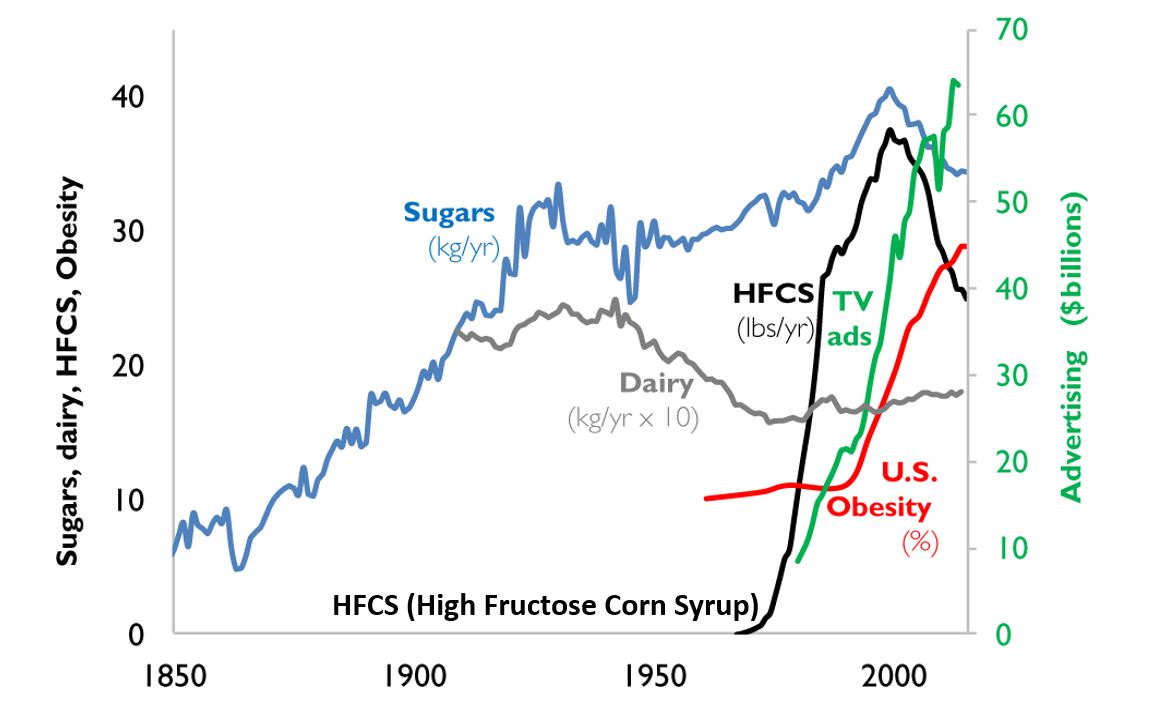
Figure 2. A timeline from 1850 to 2000 reflects the increase in use of refined sugar and high fructose corn syrup (HFCS) to the U.S. diet, together with the increase in U.S. obesity rate. The data for sugar, dairy and HFCS consumption per capita are from USDA Economic Research Service (Johnson et al., 2009) and reflects historical estimates before 1967 (Guyenet et al., 2017). The obesity data (% of U.S. adult population) are from the Robert Wood Johnson Foundation’s Trust for America’s Health. (stateofobesity.org). Total U.S. television advertising data are from the World Advertising Research Center (www.warc.com). The vertical measure (y–axis) for kilograms per year (kg/yr) on the left covers all data except advertising expenditures, which uses the vertical measure for advertising on the right. Reproduced by permission from Bentley et al, 2018.
This graph clearly shows a close association between the years that high fructose corn syrups (HFCS) were introduced into the American diet and an increase in TV advertising with corresponding increase in obesity. HFCS is an ultra-processed food and is a surrogate marker for all other ultra-processed foods. The best interpretation is that ultra-processed foods, which often contain HFCS, are a causal factor of the increase in obesity, and diabetes and in turn are risk factors for heart disease, cancers and dementias.
Ultra-processed foods are novel from an evolutionary perspective.
The human digestive system has only recently encountered sources of calories which are filled with so many unnatural chemicals, textures and flavors. Ultra-processed foods have been engineered, developed and product tested to increase the likelihood they are wanted by consumers and thereby increase sales and profits for the producers. These foods contain the ‘right amount’ processed materials to evoke the taste, flavor and feel of desired foods that ‘trick’ the consumer it eat them because they activate evolutionary preference for survival. Thus, these ultra-processed foods have become an ‘evolutionary trap’ where it is almost impossible not to eat them. We eat the food because it capitalized on our evolutionary preferences even though doing so is ultimately harmful for our health (for a detailed discussion on evolutionary traps, see Peper, Harvey & Faass, 2020).
An example is a young child wanting the candy while waiting with her parents at the supermarket checkout line. The advertised images of sweet foods trigger the cue to eat. Remember, breast milk is sweet and most foods in nature that are sweet in taste, provide calories for growth and survival and are not harmful. Calories are essential of growth. Thus, we have no intrinsic limit on eating sweets unlike foods that taste bitter.
As parents, we wish that our children (and even adults) have self-control and no desire to eat the candy or snacks that is displayed at eye level (eye candy) especially while waiting at the cashier. When reflecting about food advertising and the promotion of foods that are formulated to take advantage of ‘evolutionary traps’, who is responsible? Is it the child, who does not yet have the wisdom and self-control or, is it the food industry that ultra-processes the foods and adds ingredients into foods which can be harmful and then displays them to trigger an evolutionary preference for food that have been highly processed?
Every country that has adapted the USA diet of ultra-processed foods has experienced similar trends in increasing obesity, diabetes, cardiovascular disease, etc. The USA diet is replacing traditional diets as illustrated by the availability of Coca-Cola. It is sold in over 200 countries and territories (Coca-Cola, 2023).
An increase in ultra-processed foods by 10 percent was associated with a 25 percent increase in the risk of dementia and a 14 per cent increase in the risk of Alzheimers’s (Li et al., 2022). More importantly, people who eat the highest proportion of their diet in ultra-processed foods had a 22%-62% increased risk of death compared to the people who ate the lowest proportion of processed foods (van Tulleken, 2023). In the USA, counties with the highest food swamp scores (the availability of fast food outlets in a county) had a 77% increased odds of high obesity-related cancer mortality (Bevel et al., 2023). The increase risk has also been observed for cardiovascular disease, coronary heart disease, cerebrovascular disease and all cause mortality as is shown in figure 3 (Srour et al., 2019; Rico-Campà et al., 2019).

Figure 3. Association between consumption of ultra-processed foods and all cause mortality. Reproduced from Rico-Campà et al, 2019.
The harmful effects of UPF holds up even when correcting for the amount of sugars, carbohydrates or fats in the diet and controlling for socio economic variables.
The logic that underlies this perspective is based upon the writing by Nassim Taleb (2012) in his book, Antifragile: Things That Gain from Disorder (Incerto). He provides an evolutionary perspective and offers broad and simple rules of health as well as recommendations for reducing UPF risk factors:
- Assume that anything that was not part of our evolutionary past is probably harmful.
- Remove the unnatural/unfamiliar (e.g. smoking/ e-cigarettes, added sugars, textured proteins, gums, stabilizers (guar gum, sodium alginate), emulsifiers (mono-and di-glycerides), modified starches, dextrose, palm stearin, and fats, colors and artificial flavoring or other ultra-processed food additives).
What can we do?
The solutions are simple and stated by Michael Pollan in his 2007 New York Times article, “Eat food. Not too much. Mostly Plants.” Eat foods that your great grandmother would recognize as foods (Pollan, 2009). Do not eat any of the processed foods that fill a majority of a supermarket’s space.
- Buy only whole organic natural foods and prepare them yourself.
- Request that food companies only buy and sell non-processed foods.
- Demand government action to tax ultra-processed food and limit access to these foods. In reality, it is almost impossible to expect people to choose healthy, organic foods when they are more expensive and not easily available in the American ‘food swamps and deserts’ (the presence of many fast food outlets or the absence of stores that have fresh produce and non-processed foods). We do have a choice. We can spend more money now for organic, health promoting foods or, pay much more later to treat illness related to UPF.
- It is time to take our cues from the tobacco wars that led to regulating tobacco products. We may even need to start class action suits against producers and merchants of UPF for causing increased illness and premature morbidity.
For more background information and the science behind this blog, read, the book, Ultra-processed people, by Chris van Tulleken.

Look at the following blogs for more background information.
References
Bentley, R.A., Ormerod, P. & Ruck, D.J. (2018). Recent origin and evolution of obesity-income correlation across the United States. Palgrave Commun 4, 146. https://doi.org/10.1057/s41599-018-0201-x
Bero, L. A. (2005). Tobacco Industry Manipulation of Research. Public Health Reports (1974-), 120(2), 200–208. http://www.jstor.org/stable/20056773
Bevel, M.S., Tsai, M., Parham, A., Andrzejak, S.E., Jones, S., & Moore, J.X. (2023). Association of Food Deserts and Food Swamps With Obesity-Related Cancer Mortality in the US. JAMA Oncol. 9(7), 909–916. https://doi.org/10.1001/jamaoncol.2023.0634
Coca-Cola. (2023). More on Coca-Cola. Accessed July 14, 2023. https://www.coca-cola.co.uk/our-business/faqs/how-many-countries-sell-coca-cola-is-there-anywhere-in-the-world-that-doesnt
Johnson, R.K., Appel, L.J., Brands, M., Howard, B.V., Lefevre, M., Lustig, R.H., Sacks, F., Steffen, L.M., & Wylie–Rosett, J. (2009). Dietary sugars intake and cardiovascular health: a scientific statement from the American Heart Association. Circulation, 120(10), 1011–1020. https://doi.org/10.1161/CIRCULATIONAHA.109.192627
Li, H., Li, S., Yang, H., et al, 2022. Association of ultraprocessed food consumption with the risk of dementia: a prospective cohort study. Neurology, 99, e1056-1066. https://doi.org/10.1212/WNL.0000000000200871
Peper, E., Harvey, R. & Faass, N. (2020). TechStress: How Technology is Hijacking Our Lives, Strategies for Coping, and Pragmatic Ergonomics. Berkeley: North Atlantic Books, pp 18-22, 151. https://www.amazon.com/Beyond-Ergonomics-Prevent-Fatigue-Burnout/dp/158394768X/ref=sr_1_1?crid=1U9Y82YO4DKKP&keywords=erik+peper&qid=1689372466&sprefix=erik+peper%2Caps%2C187&sr=8-1
Pollan, M. (2007). Unhappy meals. The New York Times Magazine. https://www.nytimes.com/2007/01/28/magazine/28nutritionism.t.html
Pollan, M. (2009). Food Rules: An Eater’s Manual. New York: Penguin Books. https://www.amazon.com/Food-Rules-Eaters-Michael-Pollan/dp/014311638X/ref=tmm_pap_swatch_0?_encoding=UTF8&qid=1689373484&sr=8-2
Rico-Campà, A., Martínez-González, M. A., Alvarez-Alvarez, I., de Deus Mendonça, R., Carmen de la Fuente-Arrillaga, C., Gómez-Donoso, C., & Bes-Rastrollo, M. (2019). Association between consumption of ultra-processed foods and all cause mortality: SUN prospective cohort study. BMJ; 365: l1949 https://doi.org/10.1136/bmj.l1949
Roser, M. (2021).Smoking: How large of a global problem is it? And how can we make progress against it? Our world in data. Assessed July 13, 2023. https://ourworldindata.org/smoking-big-problem-in-brief
Srour, B., Fezeu, L.K., Kesse-Guyot, E.,Alles, B., Mejean, C…(2019). Ultra-processed food intake and risk of cardiovascular disease: prospective cohort study (NutriNet-Santé) BMJ,365:l1451. https://doi.org/10.1136/bmj.l1451
Srour, B., Kordahi, M. C., Bonazzi, E., Deschasaux-Tanguy, M., Touvier, M., & Chassaing, B. (2022). Ultra-processed foods and human health: from epidemiological evidence to mechanistic insights. The Lancet Gastroenterology & Hepatology. https://doi.org/10.1016/S2468-1253(22)00169-8
Taleb, N. N. (2012). Antifragile: Things That Gain from Disorder (Incerto). New York: Random House Publishing Group. (Kindle Locations 5906-5908). https://www.amazon.com/Antifragile-Things-Disorder-ANTIFRAGILE-Hardcover/dp/B00QOJ6MLC/ref=sr_1_4?crid=3BISYYG0RPGW5&keywords=Antifragile%3A+Things+That+Gain+from+Disorder+%28Incerto%29&qid=1689288744&s=books&sprefix=antifragile+things+that+gain+from+disorder+incerto+%2Cstripbooks%2C158&sr=1-4
Van Tulleken, C. (2023). Ultra-processed people. The science behind food that isn’t food. New Yoerk: W.W. Norton & Company. https://www.amazon.com/gp/product/1324036729/ref=ox_sc_act_title_1?smid=ATVPDKIKX0DER&psc=1
United States Public Health Service. (1964). The 1964 Report on Smoking and Health. United States. Public Health Service. Office of the Surgeon General. https://profiles.nlm.nih.gov/spotlight/nn/catalog?f%5Bexhibit_tags%5D%5B%5D=smoking
Mouth breathing and tongue position: a risk factor for health
Posted: June 8, 2023 Filed under: ADHD, behavior, Breathing/respiration, cognitive behavior therapy, Evolutionary perspective, healing, health, Nutrition/diet, self-healing, Uncategorized | Tags: babies, breastfeedging, development, infants, jaw, mouth breathing, neurocognitive develoment, nose breathing, sleep, tongue-tie Leave a commentErik Peper, PhD, BCB and Ron Swatzyna, PhD, LCSW, BCB, BCN
Adapted from: Peper, E., Swatzyna, R., & Ong, K. (2023). Mouth breathing and tongue position: a risk factor for health. Biofeedback. 51(3), 74–78 https://doi.org/10.5298/912512

Breathing usually occurs without awareness unless there are problems such as asthma, emphysema, allergies, or viral infections. Infant and child development may affect how we breathe as adults. This blog discusses the benefits of nasal breathing, factors that contribute to mouth breathing, how babies’ breastfeeding and chewing decreases the risk of mouth breathing, recommendations that parents may implement to support healthy development of a wider palate, and the embedded video presentation, How the Tongue Informs Healthy (or Unhealthy) Neurocognitive Development, by Karindy Ong, MA, CCC-SLP, CFT, .
Benefits of nasal breathing
Breathing through the nose filters, humidifies, warms, or cools the inhaled air as well as reduces the air turbulence in the upper airways. In addition, the epithelial cells of the nasal cavities produce nitric oxide that are carried into the lungs when inhaling during nasal breathing (Lundberg & Weitzberg, 1999). The nitric oxide contributes to healthy respiratory function by promoting vasodilation, aiding in airway clearance, exerting antimicrobial effects, and regulating inflammation. Breathing through the nose is associated with deeper and slower breathing rate than mouth breathing. This slower breathing also facilitates sympathetic parasympathetic balance and reduces airway irritation.
Mouth breathing
Some people breathe predominantly through their mouth although nose breathing is preferred and health promoting. Mouth breathing negatively impacts the ability to perform during the day as well as affect our cognitions and mood (Nestor, 2020). It contributes to disturbed sleep, snoring, sleep apnea, dry mouth upon waking, fatigue, allergies, ear infections, attention deficit disorders, crowded mis-aligned teeth, and poorer quality of life (Kahn & Ehrlich, 2018). Even the risk of ear infections in children is 2.4 time higher for mouth breathers than nasal breathers (van Bon et al, 1989) and nine and ten year old children who mouth breath have significantly poorer quality of life and have higher use of medications (Leal et al, 2016).
One recommendation to reduce mouth breathing is to tape the mouths closed with mouth tape (McKeown, 2021). Using mouth tape while sleeping bolsters nose breathing and may help people improve sleep, reduce snoring, and improves alertness when awake (Lee et al, 2022).
Experience how mouth breathing affects the throat and upper airway
Inhale quickly, like a gasp, as much air as possible through your open mouth. Exhale letting the air flow out through your mouth. Repeat once more.
Inhale quickly as much air through the nose, then exhale by allow the airflow out through the nose. Repeat once more.
What did you observe? Many people report that rapidly inhaling through the mouth causes the back of the throat and even upper airways to feel drier and irritated. This does not occur when inhaling through the nose. This simple experiment illustrates how habitual mouth breathing may irritate the airways.
Developmental behavior that contributes to mouth breathing
The development of mouth breathing may begin right at birth when the mouth, tongue, jaw and nasal area are still developing. The arch of the upper palate forms the roof of the oral cavity that separates the oral and nasal cavities. When the palate and jaw narrows, the arch of the palate increases and pushes upwards into the nasal area. This reduces space in the nasal cavity for the air to flow and obstructs nasal breathing. The highly vaulted palate is not only genetically predetermined but also by how we use our tongue and jaw from birth. The highly arched palate is only a recent anatomical phenomena since the physical structure of the upper palate and jaw from the pre- industrial era was wider (less arched upper palate) than many of our current skulls (Kahn & Ehrlich, 2018).
The role of the tongue in palate development
After babies are born, they breastfeed by sucking with the appropriate tongue movements that help widen the upper palate and jaw. On the other hand, when babies are bottle fed, the tongue tends to move differently which causes the cheek to pull in and the upper palate to arch which may create a high narrow upper palate and making the jaw narrower. There are many other possible factors that could cause mouth breathing such as tongue-tie (ankyloglossia), septal deviation, congenital malformation, enlarged adenoids and tonsils (Aden tonsillar hyperplasia), inflammatory diseases such as allergic rhinitis (Trabalon et al, 2012). Whatever the reasons, the result of the impoverished tongue movement and jaw increases the risk for having a higher arched upper palate that impedes nasal breathing and contributes to habitual mouth breathing.
The forces that operate on the mouth, jaw and palate during bottle feeding may be similar to when you suck on straw and the cheeks coming in with the face narrowing. The way the infants are fed will change the development of the physical structure that may result in lifelong problems and may contribute to developing a highly arched palate with a narrow jaw and facial abnormalities such as long face syndrome (Tourne, 1990).
To widen the upper palate and jaw, the infant needs to chew, chew and tear the food with their gums and teeth. Before the industrialization of foods, children had to tear food with their teeth, chew fibrous foods or gnaw at the meat on bones. The chewing forces allows the jaw to widen and develop so that when the permanent teeth are erupting, they would more likely be aligned since there would be enough space–eliminating the need for orthodontics. On the other hand, when young children eat puréed and highly processed soft foods (e.g., cereals soaked in milk, soft breads), the chewing forces are not powerful enough to encourage the widening of the palate and jaw.
Although the solution in adults can be the use of mouth tape to keep the mouth closed at night to retrain the breathing pattern, we should not wait until we have symptoms. The focus needs to be on prevention. The first step is an assessment whether the children’s tongue can do its job effectively or limited by tongue-tie and the arch of the palate. These structures are not totally fixed and can change depending on our oral habits. The field of orthodontics is based upon the premise that the physical structure of the jaw and palate can be changed, and teeth can be realigned by applying constant forces with braces.
Support healthy development of the palate and jaw
Breastfeed babies (if possible) for the first year of life and do NOT use bottle feeding. When weaning, provide chewable foods (fruits, vegetable, roots, berries, meats on bone) that was traditionally part of our pre-industrial diet. These foods support in infants’ healthy tongue and jaw development, which helps to support the normal widening of the palate to provide space for nasal breathing.
Provide fresh organic foods that children must tear and chew. Avoid any processed foods which are soft and do not demand chewing. This will have many other beneficial health effects since processed foods are high in simple carbohydrates and usually contain color additives as well as traces of pesticides and herbicides. The highly processed foods increase the risk of developing depression, type 2 diabetes, inflammatory disease, and colon cancer (Srour et al., 2019).
Sadly, the USA allows much higher residues of pesticide and herbicides that act as neurotoxins than are allowed in by the European Union. For example, the acceptable level of the herbicide glyphosate (Round-Up) is 0.7 parts per million in the USA while in the acceptable level is 0.01 parts per million in European countries (Tano, 2016; EPA, 2023; European Commission, 2023). The USA allows this higher exposure even though about half of the human gut microbiota are vulnerable to glyphosate exposure (Puigbò et al., 2022).
The negative effects of herbicides and pesticides are harmful for growing infants. Even fetal exposure from the mother (gestational exposure) is associated with an increase in behaviors related to attention-deficit/hyperactivity disorders and executive function in the child when they are 7 to 12 years old (Sagiv et al., 2021) and organophosphate exposure is correlated with ADHD prevalence in children (Bouchard et al., 2010).
To implement these basic recommendations are very challenging. It means the mother has to breastfeed her infant during the first year of life. This is often not possible because of socioeconomic inequalities; work demands and medical complications. It also goes against the recent cultural norm that fathers should participate in caring for the baby by giving the baby a bottle of stored breast milk or formula.
From our perspective, women who give birth must have a year paid maternity leave to provide their infants with the best opportunity for health (e.g., breast-feeding, emotional bonding, and reduced financial stress). As a society, we have the option to pay the upfront cost now by providing a year- long maternity leave to mothers or later pay much more costs for treating chronic conditions that may have developed because we did not support the natural developmental process of babies.
Relevance to the field of neurofeedback and biofeedback
Clinicians often see clients, especially children with diagnostic labels such as ADHD who have failed to respond to numerous psychotherapies and pharmacotherapies. In the recent umbrella review and meta-analytic evaluation of recent meta-analyses, Leichsenring et al. (2022) found only small benefits overall for both types of intervention. They suggest that a paradigm shift in research seems to be required to achieve further progress in resolving mental health issues. As the past director of National Institute of Health, Dr. Thomas Insel pointed out that the Diagnostic and Statistical Manual of Mental Disorders (DSM) is not a valid instrument and should be a big wake up call for all of us to think outside the box (Insel, 2009). One factor that starts right at birth is the oral cavity development by dysfunctional tongue movements.
We want to make all of you aware of a serious issue in children that you may come across. For those of us who work with children children, we need to ask their parents about the following: tongue-tie, mouth breathing, bedwetting, high-vaulted palate, thumb sucking, abnormal eating issues, apraxia, dysarthria, and hypotonia. Research suggests that the palates of these children are so arched that the tongue cannot do its job effectively, causing multiple issues which may be related.
Please view the webinar from May 17, 2023. Presented by Karindy Ong, MA, CCC-SLP, CFT, How the Tongue Informs Healthy (or Unhealthy) Neurocognitive Development. The presentation explains the developmental process of the role the tongue plays and how it contributes to nasal breathing. Please pass it on to others who may have interest.
References
Bouchard, M.F., Bellinger, D.C., Wright, R.O., & Weisskopf, M.G. (2010). Attention-deficit/hyperactivity disorder and urinary metabolites of organophosphate pesticides. Pediatrics, 125(6), e1270-7. https://doi.org/10.1542/peds.2009-3058
EPA. (2023). Glyphosate. United States Environmental Protection Agency. Accessed April 1, 2023. https://www.epa.gov/ingredients-used-pesticide-products/glyphosate
European Commission. (2023). EU legislation on MRLs.Food Safety. Assessed April 1, 2023. https://food.ec.europa.eu/plants/pesticides/maximum-residue-levels/eu-legislation-mrls_en#:~:text=A%20general%20default%20MRL%20of,e.g.%20babies%2C%20children%20and%20vegetarians.
Insel, T.R. (2009). Translating scientific opportunity into public health impact: a strategic plan for research on mental illness. Arch Gen Psychiatry, 66(2), 128-133. https://doi.org/10.1001/archgenpsychiatry.2008.540
Kahn, S. & Ehrlich, P.R. (2018). Jaws. Stanford, CA: Stanford University Press. https://www.amazon.com/Jaws-Hidden-Epidemic-Sandra-Kahn/dp/1503604136/ref=tmm_hrd_swatch_0?_encoding=UTF8&qid=1685135054&sr=1-1
Leal, R.B., Gomes, M.C., Granville-Garcia, A.F., Goes, P.S.A., & de Menezes, V.A. (2016). Impact of Breathing Patterns on the Quality of Life of 9- to 10-year-old Schoolchildren. American Journal of Rhinology & Allergy, 30(5):e147-e152. https://doi.org/10.2500/ajra.2016.30.4363
Lee, Y.C., Lu, C.T., Cheng, W.N., & Li, H.Y. (2022).The Impact of Mouth-Taping in Mouth-Breathers with Mild Obstructive Sleep Apnea: A Preliminary Study. Healthcare (Basel), 10(9), 1755. https://doi.org/10.3390/healthcare10091755
Leichsenring, F., Steinert, C., Rabung, S. and Ioannidis, J.P.A. (2022), The efficacy of psychotherapies and pharmacotherapies for mental disorders in adults: an umbrella review and meta-analytic evaluation of recent meta-analyses. World Psychiatry, 21: 133-145. https://doi.org/10.1002/wps.20941
Lundberg, J.O. & Weitzberg, E. (1999). Nasal nitric oxide in man. Thorax. (10):947-52. https://doi.org/10.1136/thx.54.10.947
McKeown, P. (2021). The Breathing Cure: Develop New Habits for a Healthier, Happier, and Longer Life. Boca Raton, Fl “Humanix Books. https://www.amazon.com/BREATHING-CURE-Develop-Healthier-Happier/dp/1630061972/
Nestor, J. (2020). Breath: The New Science of a Lost Art. New York: Riverhead Books. https://www.amazon.com/Breath/dp/0593191358/ref=tmm_pap_swatch_0?_encoding=UTF8&qid=1686191995&sr=8-1
Puigbò, P., Leino, L. I., Rainio, M. J., Saikkonen, K., Saloniemi, I., & Helander, M. (2022). Does Glyphosate Affect the Human Microbiota?. Life, 12(5), 707. https://doi.org/10.3390/life12050707
Sagiv, S.K., Kogut, K., Harley, K., Bradman, A., Morga, N., & Eskenazi, B. (2021). Gestational Exposure to Organophosphate Pesticides and Longitudinally Assessed Behaviors Related to Attention-Deficit/Hyperactivity Disorder and Executive Function, American Journal of Epidemiology, 190(11), 2420–2431. https://doi.org/10.1093/aje/kwab173
Srour, B. et al. (2019). Ultra-processed food intake and risk of cardiovascular disease: prospective cohort study (NutriNet-Santé).BMJ, 365. https://doi.org/10.1136/bmj.l1451
Tano, B. (2016). The Layman’s Guide to Integrative Immunity. Integrative Medical Press. https://www.amazon.com/Laymans-Guide-Integrative-Immunity-Discover/dp/0983419299/_
Tourne, L.P. (1990). The long face syndrome and impairment of the nasopharyngeal airway. Angle Orthod, 60(3):167-76. https://doi.org/10.1043/0003
Trabalon, M. & Schaal, B. (2012). It takes a mouth to eat and a nose to breathe: abnormal oral respiration affects neonates’ oral competence and systemic adaptation. Int J Pediatr, 207605. https://doi.org/10.1155/2012/207605
van Bon, M.J., Zielhuis, G.A., Rach, G.H., & van den Broek, P. (1989). Otitis media with effusion and habitual mouth breathing in Dutch preschool children. Int J Pediatr Otorhinolaryngol, (2), 119-25. https://doi.org/10.1016/0165-5876(89)90087-6
Healing from vulvodynia
Posted: May 4, 2023 Filed under: behavior, biofeedback, Breathing/respiration, emotions, healing, health, Pain/discomfort, relaxation, self-healing, Uncategorized | Tags: muscle tension, pelvic floor pain, therapeutic relationship, triggers for illness, vulvodynia 1 CommentPamela Jertberg and Erik Peper
Adapted from: Jertberg, P. & Peper, E. (2023). The healing of vulvodynia from the client’s perspective. Biofeedback, 51 (1), 18–21. https://doi.org/10.5298/1081-5937-51.01.02

This introspective report describes how a young woman who experienced a year-long struggle with vulvodynia, or vulvar vestibulitis, regained her health through biofeedback training and continues to be symptom-free 7 years after the intervention. This perspective may offer insight into factors that promote health and healing and provide an approach to reduce symptoms and promote health. The methodology of this case was described previously by Peper et al. (2015).
The Client’s Experience
I have been a healthy young woman my whole life. Growing up in a loving, dedicated family, I always ate home-cooked meals, went to bed at a reasonable time, and got plenty of exercise by playing with my family members and friends. I never once thought that at age 23 I might be at risk of undergoing vulvar surgery. There are many factors that contributed to the genesis of my vulvar pain, and many other factors that worsened this pain. Traditional medicine did not help me, and I did not find relief until I met my biofeedback practitioner, who taught me biofeedback. Through the many strategies I learned, such as visualization, diaphragmatic breathing techniques, diet tips, and skills to reframe my thoughts, I finally began to feel relief and hope. Practicing all these elements every day helped me overcome my physical pain and enjoy a normal life once again. Today, I do not have any vulvar discomfort. I am so grateful to my biofeedback practitioner for the many skills he taught me. I can enjoy my daily activities once again without experiencing pain. I have been given a second chance at loving life, and now I have learned the techniques that will help me sustain a more balanced path for the rest of my life. Seven years later, I am healthy and have no symptoms.
Triggers for Illness
Not Having a Positive Relationship with the Doctor
The first factor that aggravated my pain was having a doctor with whom I did not have a good relationship. Although the vulvar specialist I was referred to had treated hundreds of women with vulvar vestibulitis, his methods were very traditional: medicine, low oxalate diet, ointments, and surgery. Whenever I left his office, I would cry and feel like surgery was the only option. Vaginal surgery at 23 was one of the scariest and most unexpected thoughts my brain had ever considered. The doctor never thought of the impact that his words and treatment would have on my mental state.
Depression
Being depressed also triggered more pain. Whenever I would have feelings of hopelessness and create irrational beliefs in my mind (“I will never get better,” “I will never have sex again,” “I am not a woman anymore”), my physical pain would increase. Having depression only triggered more depression and pain, and this became a vicious cycle. The depression deeply affected my relationships with my boyfriend, friends, and family and my performance in my college classes.
Being Sedentary
Being sedentary and not exercising also increased my pain. At first, I believed that the mere act of sitting down hurt me due to the direct pressure on the area, but after a few months I came to realize that it was inactivity itself that triggered pain. Whenever I would sit for too long writing a paper or I would stay home all day because of my depression, my pain would increase, perhaps because I was inhibiting circulation. Still, when I am inactive most of the day, I feel lethargic and bloated. When I exercise, the pain goes away 100%. Exercise is almost magical.
Stress
Stress is the worst trigger for pain. Throughout my life, I always strived to be perfect in every way, meaning I was stressed about the way I looked, performed in school, drove, etc. Through the sessions with my biofeedback practitioner, I learned that my body was in a state of perpetual stress and tightness, which induced pain in certain areas. My body’s way of releasing such tension was to send pain signals to my vulvar area, perhaps because of a yeast infection a couple of months back. Still, if I become very stressed, I will feel pain or tightness in certain parts of my body, but now I have strategies for performing proper stress-relieving techniques.
Processed Foods
Junk food affects me instantly. When I eat processed foods for a week straight, I feel groggy, bloated, lethargic, and in pain. Processed sugar, white flour, and salt are a few of the foods that make the pain increase. I used to love sugar, so I would enjoy the occasional milkshake and cheeseburger and feel mostly okay. However, in times of stress it became crucial for me to learn to refrain from any junk food, because it would worsen my vulvar pain and increase my overall stress levels.
Menstruation
Menstruation is unavoidable, and unfortunately it would always worsen my vulvar pain. Right about the time of my period, my sensitivity and pain would massively increase. Sometimes as my pain would increase incredibly, I would question myself: “What am I doing wrong?” Then, I would remember: “Oh yes, I am getting my period in a few days.” The whole area became very sensitive and would get irritated easily. It became imperative to listen to my body and nurture myself especially around that time of the month.
Triggers for Healing
A Good Doctor
Just as I learned which factors triggered the pain, I also learned how to reduce it. The most important factor that helped me find true relief was meeting a good health professional (which could be a healer, nurse, or professor). The first time I met my biofeedback practitioner and told him about my issues, he really listened, gave me positive feedback, and even made jokes with me. To this day we still have a friendship, which has really aided me in getting better. In contrast to the vulvar specialist, I would leave the biofeedback practitioner’s office feeling powerful, able to defeat vulvodynia, and truly happy. Just having this support from a professional (or a friend, boyfriend, or relative) can make all the difference in the world. I don’t know where I would be right now if I hadn’t worked with him.
Positive Thoughts and Beliefs
Along with having a good support group, having positive thoughts and believing in a positive result helped me greatly. When I actually set my mind to feel “happy” and to believe that I was getting better, I began to really heal. After months of being depressed and feeling incomplete, when I began to practice mantras such as “I am healing,” “I am healthy,” and “I am happy,” my pain began to go away, and I was able to reclaim my life.
Journaling
One of the ways in which “happiness” became easier to achieve was to journal every day. I would write everything: from my secrets to what I ate, my pain levels, my goals for the day, and my symptoms. Writing down everything and knowing that no one would ever read it but me gave me relief, and my journal became my confidante. I still journal every day, and if I forget to write, the next day I will write twice as much. Now that writing has become a habit and a hobby, it is hard to imagine my life without that level of introspection.
Meditation
Although I would do yoga often, I would never sit and meditate. I began to use Dr. Peper’s guided meditations and Dr. Kabat-Zinn’s CD (Kabat-Zinn, 2006; Peper et al., 2002). The combination of these meditation techniques, whether on different days or on the same day, helped me focus on my breathing and relax my muscles and mind. Today, I meditate at least 20 min each day, and I feel that it helps me see life through a more willing and patient perspective. In addition, through meditation and deep breathing I have learned to control my pain levels, concentration, and awareness.
Imagery and Visualization
Imagery is a powerful tool that allowed me to heal faster. My biofeedback practitioner instructed me to visualize how I wanted to feel and look. In addition, he suggested that I draw and color how I was feeling at any given moment, my imagined healing process, and how I would look and feel after the healing process had traveled throughout my body (Peper et al., 2022). It is still amazing to me how much imagery helped me. Even visualizing here and there throughout the day helped. Now I envision how I want to feel as a healthy woman, I take a deep breath, and as a I breathe out I let my imagined healing process go through my body into all my tight areas along with the exhalation.
Biofeedback
Biofeedback is the single strategy that helped me the most. During my first session with my biofeedback practitioner, he pointed out that my muscles were always contracted and stressed and that I was not breathing diaphragmatically. As I learned how to take deep belly breaths, I began to feel the tight areas in my body loosen up. I started to practice controlled breathing 20 min every day. Through biofeedback, my body and muscles became more relaxed, promoting circulation and ultimately reducing the vulvar pain.
Regular Exercise and Yoga
Exercising daily decreased my pain and improved the quality of my life greatly. When I first started experiencing significant vulvar pain, I stopped exercising because I felt that movement would aggravate the pain. To my surprise, the opposite was true. Being sedentary increased the feelings of discomfort, whereas exercising released the tension. The exercise I found most helpful was yoga because it is meditation in movement. I became so focused on my breathing and the poses that my brain did not have time to think about anything else. After attending every yoga class, I felt like I could take on anything. Swimming, Pilates, and gentle cardiovascular exercises have also helped me greatly in reducing stress and feeling great.
Sex
Although sex was impossible for almost a year due to the pain, it became possible and even enjoyable after implementing other relaxation strategies. When I first reintroduced sex back into my life, my partner at the time and I would go gently and stop if it hurt my vulvar area at all. Today, sex again is joyful. Being able to engage in intercourse has boosted my self-esteem and helped me feel sexy again, which empowers me to keep practicing the relaxation techniques.
Listening to the Mind-Body Connection
The mind-body connection is present in all of us, but I am fortunate to have a very strong connection. My thoughts influence my body almost instantly, which is why when I would get depressed my pain would increase, and when I would see my biofeedback practitioner or believe in a good outcome, my pain would decrease. Being aware of this connection is crucial because it can help me or hurt me greatly. After a few months of practicing the relaxation strategies, I saw a different gynecologist and one dermatologist. Both professionals said that there was nothing wrong with my vulvar area—that maybe I just felt some irritation due to the medicines I had previously taken and my current stress. They said that there was no way I needed surgery. When I heard these opinions, I began to feel instantly better—thus proving that my thoughts (and even others’ thoughts) affect my body in significant ways.
Although today I am 100% better, I still experience pain and tightness in my body when I experience the “illness factors” I mentioned above. I still have to remember that feeling healthy and good is a process, not a result, and that even if I feel better one day that does not mean I can stop all my new healthy habits. To completely cure vulvodynia, I needed to change my life habits, perspective, and attitude toward the illness and life. I needed to make significant changes, and now my biggest challenge is to stick to those changes. Biofeedback, imagery, meditation, good food, and exercise are not just treatments that I begin and end on a certain day, but rather they have become essential components of my life forever.
My life with vulvodynia was ultimately a journey of introspection, decision making, and life-changing habits. I struggled with vulvar pain for over a year, and during that year I experienced severe symptoms, depression, and the loss of several friendships and relationships. I felt old, hopeless, useless, and powerless. When I began to incorporate biofeedback, relaxation techniques, journaling, visualization, a proper diet, and regular exercise, life took a turn for the better. Not only did my vulvar pain begin to decrease, but the quality of my overall life improved and I regained the self-confidence I had lost. I became happy, hopeful, and proactive. Even though I practiced the relaxation strategies every day, the pain did not go away in a day or even a month. It took me several months of diligent practice to truly heal my vulvar pain. Even today, such practices have carried on to all areas of my life, and now there is not a day when I do not meditate, even for 5 min.
As paradoxical as it may seem, vulvodynia was a blessing in disguise. I believe that vulvodynia was my body’s way of signaling to me that many areas of my life were in perpetual stress: my pelvic floor, my thoracic breathing, my romantic relationship at the time, etc. When I learned to let go and truly embrace my life, I began to feel relief. I became less irritable and more patient and understanding, with both my body and the outside world. The best advice I can give a woman with vulvar symptoms or any person with otherwise inexplicable chronic pain is to apply the strategies that work for you and stick to them every day—even on the days when you want to go astray. When I started to focus on what my body needed to be nurtured and to live my life and do the things I truly wanted to do, I became free. Today, I live in a way that allows me to find peace, serenity, pride, and fun. I live exactly the way I want to, and I find the time to follow my passions. Vulvodynia, or any kind of chronic pain, does not define who we are. We define who we are.
Conclusion
This introspective account of the client’s personal experience with biofeedback suggests that healing is multidimensional. We suggest that practitioners use a holistic approach, which can provide hope and relief to clients who suffer from vulvodynia or other disorders that are often misunderstood and underreported.
Useful blogs
References
Kabat-Zinn, J. (2006). Coming to our senses: Healing ourselves and the world through mindfulness. Hachette Books
Peper, E., Cosby, J. & Almendras, M. (2022). Healing chronic back pain. NeuroRegulation, 9(3), 164–172. https://doi.org/10.15540/nr.9.3.164
Peper, E., Gibney, K.H, & Holt, C.F. (2002. Make health happen: Training yourself to create wellness. Kendall/Hunt.
Peper, E. Martinex, Aranda, P. & Moss, D. (2015). Vulvodynia treated successfully with breathing biofeedback and integrated stress reduction: A case report. Biofeedback, 43(2), 103–109. https://doi.org/10.5298/1081-5937-43.2.04
Hope for menstrual cramps (dysmenorrhea) with breathing
Posted: April 22, 2023 Filed under: behavior, biofeedback, Breathing/respiration, healing, health, meditation, Pain/discomfort, posture, relaxation, self-healing, stress management, Uncategorized | Tags: dysmenorrhea, Imagery, menstrual cramps, stroking, visualization 6 CommentsAdapted from: Peper, E., Chen, S., Heinz, N., & Harvey, R. (2023). Hope for menstrual cramps (dysmenorrhea) with breathing. Biofeedback, 51(2), 44–51. https://doi.org/10.5298/1081-5937-51.2.04; Republished in Townsend E-Letter – 18 November, 2023 https://www.townsendletter.com/e-letter-22-breath-affects-stress-and-menstrual-cramps/ Google NotebookLM generated podcast:

“I have always had extremely painful periods. They would get so painful that I would have to call in sick and take some time off from school. I have been to many doctors and medical professionals, and they told me there is nothing I could do. I am currently on birth control, and I still get some relief from the menstrual pain, but it would mess up my moods. I tried to do the diaphragmatic breathing so that I would be able to continue my life as a normal woman. And to my surprise it worked. I was simply blown away with how well it works. I have almost no menstrual pain, and I wouldn’t bloat so much after the diaphragmatic breathing.” -22 year old student
Each semester numerous students report that their cramps and dysmenorrhea symptoms decrease or disappear during the semester when they implement the relaxation and breathing practices that are taught in the semester long Holistic Health class. Given that so many young women suffer from dysmenorrhea, many young women could benefit by using this integrated approach as the first self-care intervention before relying on pain reducing medications or hormones to reduce pain or inhibit menstruation. Another 28-year-old student reported:
“Historically, my menstrual cramps have always required ibuprofen to avoid becoming distracting. After this class, I started using diaphragmatic breath after pain started for some relief. True benefit came when I started breathing at the first sign of discomfort. I have not had to use any pain medication since incorporating diaphragmatic breath work.”
This report describes students practicing self-regulation and effortless breathing to reduce stress symptoms, explores possible mechanisms of action, and suggests a protocol for reducing symptoms of menstrual cramps. Watch the short video how diaphragmatic breathing eliminated recurrent severe dysmenorrhea (pain and discomfort associated with menstruation).
Background: What is dysmenorrhea?
Dysmenorrhea is one of the most common conditions experienced by women during menstruation and affects more than half of all women who menstruate (Armour et al., 2019). Most commonly dysmenorrhea is defined by painful cramps in the lower abdomen often accompanied by pelvic pain that starts either a couple days before or at the start of menses. Symptoms also increase with stress (Wang et al., 2003) with pain symptoms usually decreasing in severity as women get older and, after pregnancy.
Economic cost of dysmenorrhea
Dysmenorrhea can significantly interfere with a women’s ability to be productive in their occupation and/or their education. It is “one of the leading causes of absenteeism from school or work, translating to a loss of 600 million hours per year, with an annual loss of $2 billion in the United States” (Itani et al, 2022). For students, dysmenorrhea has a substantial detrimental influence on academic achievement in high school and college (Thakur & Pathania, 2022). Despite the frequent occurrence and negative impact in women’s lives, many young women struggle without seeking or having access to medical advice or, without exploring non-pharmacological self-care approaches (Itani et al, 2022).
Treatment
The most common pharmacological treatments for dysmenorrhea are nonsteroidal anti-inflammatory drugs (NSAIDs) (e.g., Ibuprofen, Aspirin, and Naproxen Sodium) along with hormonal contraceptives. NSAIDs act by preventing the action of cyclooxygenase which prevents the production of prostaglandins. Itani et al (2022) suggested that prostaglandin production mechanisms may be responsible for the disorder. Hormonal contraceptives also prevent the production of prostaglandins by suppressing ovulation and endometrial proliferation.
The pharmacological approach is predominantly based upon the model that increased discomfort appears to be due to an increase in intrauterine secretion of prostaglandins F2α and E2 that may be responsible for the pain that defines this condition (Itani et al, 2022). Pharmaceuticals which influence the presence of prostaglandins do not cure the cause but mainly treat the symptoms.
Treatment with medications has drawbacks. For example, NSAIDs are associated with adverse gastrointestinal and neurological effects and also are not effective in preventing pain in everyone (Vonkeman & van de Laar, 2010). Hormonal contraceptives also have the possibility of adverse side effects (ASPH, 2023). Acetaminophen is another commonly used treatment; however, it is less effective than other NSAID treatments.
Self-regulation strategies to reduce stress and influence dysmenorrhea
Common non-pharmacological treatments include topical heat application and exercise. Both non-medication approaches can be effective in reducing the severity of pain. According to Itani et al. (2022), the success of integrative holistic health treatments can be attributed to “several mechanisms, including increasing pelvic blood supply, inhibiting uterine contractions, stimulating the release of endorphins and serotonin, and altering the ability to receive and perceive pain signals.”
Although less commonly used, self-regulation strategies can significantly reduce stress levels associated menstrual discomfort as well as reduce symptoms. More importantly, they do not have adverse side effects, but the effectiveness of the intervention varies depending on the individual.
- Autogenic Training (AT), is a hundred year old treatment approach developed by the German psychiatrist Johannes Heinrich Schultz that involves three 15 minute daily practice of sessions, resulted in a 40 to 70 percent decrease of symptoms in patient suffering from primary and secondary dysmenorrhea (Luthe & Schultz, 1969). In a well- controlled PhD dissertation, Heczey (1978) compared autogenic training taught individually, autogenic training taught in a group, autogenic training plus vaginal temperature training and a no treatment control in a randomized controlled study. All treatment groups except the control group reported a decrease in symptoms and the most success was with the combined autogenic training and vaginal temperature training in which the subjects’ vaginal temperature increased by .27 F degrees.
- Progressive muscle relaxation developed by Edmund Jacobson in the 1920s and imagery are effective treatments for dysmenorrhea (Aldinda et al., 2022; Chesney & Tasto, 1975; Çelik, 2021; Jacobson, 1938; Proctor et al., 2007).
- Rhythmic abdominal massage as compared to non-treatment reduces dysmenorrhea symptoms (Suryantini, 2022; Vagedes et al., 2019):
- Biofeedback strategies such as frontalis electromyography feedback (EMG) and peripheral temperature training (Hart, Mathisen, & Prater, 1981); trapezius EMG training (Balick et al, 1982); lower abdominal EMG feedback training and relaxation (Bennink, Hulst, & Benthem, 1982); and integrated temperature feedback and autogenic training (Dietvorts & Osborne, 1978) all successfully reduced the symptoms of dysmenorrhea.
- Breathing relaxation for 5 to 30 minutes resulted in a decrease in pain or the pain totally disappeared in adolescents (Hidayatunnafiah et al., 2022). While slow deep breathing in combination with abdominal massage is more effective than applying hot compresses (Ariani et al., 2020). Slow pranayama (Nadi Shodhan) breathing the quality of life and pain scores improved as compared to fast pranayama (Kapalbhati) breathing and improved quality of life and reduces absenteeism and stress levels (Ganesh et al. 2015). When students are taught slow diaphragmatic breathing, many report a reduction in symptoms compared to the controls (Bier et al., 2005).
Observations from Integrated stress management program
This study reports on changes in dysmenorrhea symptoms by students enrolled in a University Holistic Health class that included homework assignment for practicing stress awareness, dynamic relaxation, and breathing with imagery.
Respondents: 32 college women, average age 24.0 years (S.D. 4.5 years)
Procedure: Students were enrolled in a three-unit class in which they were assigned daily home practices which changed each week as described in the book, Make Health Happen (Peper, Gibney & Holt, 2002). The first five weeks consisted of the following sequence: Week 1 focused on monitoring one’s reactions to stressor; week 2 consisted of daily practice for 30 minutes of a modified progressive relaxation and becoming aware of bracing and reducing the bracing during the day; Week 3 consisted of practicing slow diaphragmatic breathing for 30 minutes a day and during the day becoming aware of either breath holding or shallow chest breath and then use that awareness as cue to shift to lower slower diaphragmatic breathing; week 4 focused on evoking a memory of wholeness and relaxing; and week 5 focused on learning peripheral hand warming.
During the class, students observed lectures about stress and holistic health and met in small groups to discuss their self-regulation experiences. During the class discussion, some women discussed postures and practices that were beneficial when experiencing menstrual discomfort, such as breathing slowly while lying on their back, focusing on slow abdominal awareness in which their abdomen expanded during inhalation and contracted during exhalation. While exhaling they focused on imagining a flow of air initially going through their arms and then through their abdomen, down their legs and out their feet. This kinesthetic feeling was enhanced by first massaging down the arm while exhaling and then massaging down their abdomen and down their thighs when exhaling. In most cases, the women also experienced that their hands and feet warmed. In addition, they were asked to shift to slower diaphragmatic breathing whenever they observed themselves gasping, shallow breathing or holding their breath. After five weeks, the students filled out a short assessment questionnaire in which they rated the change in dysmenorrhea symptoms since the beginning of the class.
Results.
About two-thirds of all respondents reported a decrease in overall discomfort symptoms. In addition to any ‘treatment as usual’ (TAU) strategies already being used (e.g. medications or other treatments such as NSAIDs or birth control pills), 91% (20 out 22 women) who reported experiencing dysmenorrhea reported a decrease in symptoms when they practiced the self-regulation and diaphragmatic breathing techniques as shown in Figure 1.

Figure 1. Self-report in dysmenorrhea symptoms after 5 weeks.
Discussion
Many students reported that their symptoms were significantly reduced and they could be more productive. Generally, the more they practiced the relaxation and breathing self-regulation skills, the more they experienced a decrease in symptoms. The limitation of this report is that it is an observational study; however, the findings are similar to those reported by earlier self-care and biofeedback approaches. This suggests that women should be taught the following simple self-regulation strategies as the first intervention to prevent and when they experience dysmenorrhea symptoms.
Why would breathing reduce dysmenorrhea?
Many women respond by ‘curling up’ a natural protective defense response when they experience symptoms. This protective posture increases abdominal and pelvic muscle tension, inhibits lymph and blood flow circulation, increases shallow breathing rate, and decreases heart rate variability. Intentionally relaxing the abdomen with slow lower breathing when lying down with the legs extended is often the first step in reducing discomfort.
By focusing on diaphragmatic breathing with relaxing imagery, it is possible to restore abdominal expansion during inhalation and slight constriction during exhalation. This dynamic breathing while lying supine would enhance abdominal blood and lymph circulation as well as muscle relaxation (Peper et al., 2016). While practicing, participants were asked to wear looser clothing that did not constrict the waist to allow their abdomen to expand during inhalation; since, waist constriction by clothing (designer jean syndrome) interferes with abdominal expansion. Allowing the abdomen to fully extend also increased acceptance of self, that it was okay to let the abdomen expand instead of holding it in protectively. The symptoms were reduced most likley by a combination of the following factors.
- Abdominal movement is facilitated during the breathing cycle. This means reducing the factors that prevent the abdomen expanding during inhalation or constricting during exhalation (Peper et al., 2016).
- Eliminate‘Designer jean syndrome’ (the modern girdle). Increase the expansion of your abdomen by loosening the waist belt, tight pants or slimming underwear (MacHose & Peper, 1991).
- Accept yourself as you are. Allow your stomach to expand without pulling it in.
- Free up learned disuse: Allow the abdomen to expand and constrict instead of inhibiting movement to avoid pain that occurred following a prior abdominal injury/surgery (e.g., hernia surgery, appendectomy, or cesarean operation), abdominal pain (e.g., irritable bowel syndrome, recurrent abdominal pain, ulcers, or acid reflux), pelvic floor pain (e.g., pelvic floor pain, pelvic girdle pain, vulvodynia, or sexual abuse).
- The ‘defense response’ is reduced. Many students described that they often would curl up in a protective defense posture when experiencing menstrual cramps. This protective defense posture would maintain pelvic floor muscle contractions and inhibit blood and lymph flow in the abdomen, increase shallow rapid thoracic breathing and decrease pCO2 which would increase vasoconstriction and muscle constriction (Peper et al., 2015; Peper et al., 2016). By having the participant lie relaxed in a supine position with their legs extended while practicing slow abdominal breathing, the pelvic floor and abdominal wall muscles can relax and thereby increase abdominal blood and lymph circulation and parasympathetic activity. The posture of lying down implies feeling safe which is a state that facilitates healing.
- The pain/fear cycle is interrupted. The dysmenorrhea symptoms may trigger more symptoms because the person anticipates and reacts to the discomfort. The breathing and especially the kinesthetic imagery where the attention goes from the abdomen and area of discomfort to down the legs and out the feet acts as a distraction technique (not focusing on the discomfort).
- Support sympathetic-parasympathetic balance. The slow breathing and kinesthetic imagery usually increases heart rate variability and hand and feet temperature and supports sympathetic parasympathetic balance.
- Interrupt the classical conditioned response of the defense reaction. For some young girls, the first menstruation occurred unexpectedly. All of a sudden, they bled from down below without any understanding of what is going on which could be traumatic. For some this could be a defense reaction and a single trial condition response (somatic cues of the beginning of menstruation triggers the defense reaction). Thus, when the girl later experiences the initial sensations of menstruation, the automatic conditioned response causes her to tense and curl up which would amplify the discomfort. Informal interviews with women suggests that those who experienced their first menstruation experience as shameful, unexpected, or traumatic (“I thought I was dying”) thereafter framed their menstruation negatively. They also tended to report significantly more symptoms than those women who reported experiencing their first menstruation positively as a conformation that they have now entered womanhood.
How to integrate self-care to reduce dysmenorrhea
Be sure to consult your healthcare provider to rule out treatable underlying conditions before implementing learning effortless diaphragmatic breathing.
- Allow the abdomen to expand during inhalation and become smaller during exhalation. This often means, loosen belt and waist constriction, acceptance of allowing the stomach to be larger and reversing learned disuse and protective response caused by stress.
- Master diaphragmatic breathing (see: Peper & Tibbetts, 1994 and the blogs listed at the end of the article).
- Practice slow effortless diaphragmatic breathing lying down with warm water bottle on stomach in a place that feels safe.
- Include kinesthetic imagery as you breathe at about 6 breaths per minute (e.g. slowly inhale for 4 or 5 seconds and then exhale for 5 or 6 seconds, exhaling slightly longer than inhaling). Imaging that when you exhale you can sense healing energy flow through your abdomen, down the legs and out the feet.
- If possible, integrate actual touch with the exhalation can provide added benefit. Have a partner first stroke or massage down the arms from the shoulder to your fingertips as you exhale and, then on during next exhalation stroke gently from your abdomen down your legs and feet. Stroke in rhythm the exhalation.
- Exhale slowly and shift to slow and soft diaphragmatic breathing each time you become aware of neck and shoulder tension, breath holding, shallow breathing, or anticipating stressful situations. At the same time imagine /sense when exhaling a streaming going through the abdomen and out the feet when exhaling. Do this many times during the day.
- Practice and apply general stress reduction skills into daily life since stress can increase symptoms. Anticipate when stressful event could occur and implement stress reducing strategies.
- Be respectful of the biological changes that are part of the menstrual cycle. In some cases adjust your pace and slow down a bit during the week of the menstrual cycle; since, the body needs time to rest and regenerate. Be sure to get adequate amount of rest, hydration, and nutrition to optimize health.
- Use self-healing imagery and language to transform negative association with menstruation to positive associations (e.g., “curse” to confirmation “I am healthy”).
Conclusion
There are many ways to alleviate dysmenorrhea. Women can find ways to anticipate and empower themselves by practicing stress reduction, wearing more comfortable clothing, using heat compression, practicing daily diaphragmatic breathing techniques, visualizing relaxed muscles, and positive perception towards menstrual cycles to reduce the symptoms of dysmenorrhea. These self-regulation methods should be taught as a first level intervention to all young women starting in middle and junior high school so that they are better prepared for the changes that occur as they age.
“I have been practicing the breathing techniques for two weeks prior and I also noticed my muscles, in general, are more relaxed. Of course, I also avoided the skinny jeans that I like to wear and it definitely helped.
I have experienced a 90% improvement from my normal discomfort. I was still tired – and needed more rest and sleep but haven’t experienced any “terrible” physical discomfort. Still occasionally had some sharp pains or bloating but minor discomfort, unlike some days when I am bedridden and unable to move for half a day. – and this was a very positive experience for me “ — Singing Chen (Chen, 2023)
Useful blogs to learn diaphragmatic breathing
References
Aldinda, T. W., Sumarni, S., Mulyantoro, D. K., & Azam, M. (2022). Progressive muscle relaxation application (PURE App) for dysmenorrhea. Medisains Jurnal IlmiahLlmiah LLmu-LLmu Keshatan, 20(2), 52-57. https://doi.org/10.30595/medisains.v20i2.14351
Ariani, D., Hartiningsih, S.S., Sabarudin, U. Dane, S. (2020). The effectiveness of combination effleurage massage and slow deep breathing technique to decrease menstrual pain in university students. Journal of Research in Medical and Dental Science, 8(3), 79-84. https://www.jrmds.in/articles/the-effectiveness-of-combination-effleurage-massage-and-slow-deep-breathing-technique-to-decrease-menstrual-pain-in-university-stu-53607.html
Armour, M., Parry, K., Manohar, N., Holmes, K., Ferfolja, T., Curry, C., MacMillan, F., & Smith, C. A. (2019). The prevalence and academic impact of dysmenorrhea in 21,573 young women: a systematic review and meta-analysis. Journal of women’s health, 28(8), 1161-1171.https://doi.org/10.1089/jwh.2018.7615
ASPH. (2023). Estrogen and Progestin (Oral Contraceptives). MedlinePlus. Assessed March 3, 2023. https://medlineplus.gov/druginfo/meds/a601050.html
Balick, L., Elfner, L., May. J., Moore, J.D. (1982). Biofeedback treatment of dysmenorrhea. Biofeedback Self Regul, 7(4), 499-520. https://doi.org/10.1007/BF00998890
Bennink, C.D., Hulst, L.L. & Benthem, J.A. (1982). The effects of EMG biofeedback and relaxation training on primary dysmenorrhea. J Behav Med, 5(3), 329-341.https://doi.org/10.1007/BF00846160
Bier, M., Kazarian, D. & Peper, E. (2005). Reducing PMS through biofeedback and breathing. Poster presentation at the 36th Annual Meeting of the Association for Applied Psychophysiology and Biofeedback. Abstract published in: Applied Psychophysiology and Biofeedback. 30 (4), 411-412.
Çelik, A.S. & Apay, S.E. (2021). Effect of progressive relaxation exercises on primary dysmenorrhea in Turkish students: A randomized prospective controlled trial. Complement Ther Clin Pract, Feb 42,101280. https://doi.org/10.1016/j.ctcp.2020.101280
Chen, S. (2023). Diaphragmatic breathing reduces dysmenorrhea symptoms-a testimonial. YouTube. Accessed March 3, 2023. https://youtu.be/E45iGymVe3U
De Sanctis, V., Soliman, A., Bernasconi, S., Bianchin, L., Bona, G., Bozzola, M., Buzi, F., De Sanctis, C., Tonini, G., Rigon, F., & Perissinotto, E. (2015). Primary Dysmenorrhea in Adolescents: Prevalence, Impact and Recent Knowledge. Pediatr Endocrinol Rev. 13(2), 512-20. PMID: 26841639. https://pubmed.ncbi.nlm.nih.gov/26841639/
De Sanctis, V., Soliman, A. T., Daar, S., Di Maio, S., Elalaily, R., Fiscina, B., & Kattamis, C. (2020). Prevalence, attitude and practice of self-medication among adolescents and the paradigm of dysmenorrhea self-care management in different countries. Acta Bio Medica: Atenei Parmensis, 91(1), 182. https://doi.org/10.23750/abm.v91i1.9242
Dietvorst, T.F. & Osborne, D. (1978). Biofeedback-Assisted Relaxation Training
for Primary Dysmenorrhea: A Case Study. Biofeedback and Self-Regulation, 3(3), 301-305. https://doi.org/10.1007/BF00999298
Chesney, M. A., & Tasto, D. L. (1975).The effectiveness of behavior modification with spasmodic and congestive dysmenorrhea. Behaviour Research and Therapy, 13, 245-253. https://doi.org/10.1016/0005-7967(75)90029-7
Ganesh, B.R., Donde, M.P., & Hegde, A.R. (2015). Comparative study on effect of slow and fast phased pranayama on quality of life and pain in physiotherapy girls with primary dysmenorrhea: Randomize clinical trial. International Journal of Physiotherapy and Research, 3(2), 960-965. https://doi.org/10.16965/ijpr.2015.115
Hart, A.D., Mathisen, K.S. & Prater, J.S. A comparison of skin temperature and EMG training for primary dysmenorrhea. Biofeedback and Self-Regulation 6, 367–373 (1981). https://doi.org/10.1007/BF01000661
Heczey, M. D. (1978). Effects of biofeedback and autogenic training on menstrual experiences: relationship among anxiety, locus of control and dysmenorrhea. City University of New York ProQuest Dissertations Publishing, 7805763. https://www.proquest.com/openview/088e0d68511b5b59de1fa92dec832cc8/1?pq-origsite=gscholar&cbl=18750&diss=y
Hidayatunnafiah, F., Mualifah, L., Moebari, M., & Iswantiningsih, E. (2022). The Effect of Relaxation Techniques in Reducing Dysmenorrhea in Adolescents. The International Virtual Conference on Nursing. in The International Virtual Conference on Nursing, KnE Life Sciences, 473–480. https://doi.org/10.18502/kls.v7i2.10344
Itani, R., Soubra, L., Karout, S., Rahme, D., Karout, L., & Khojah, H.M.J. (2022). Primary Dysmenorrhea: Pathophysiology, Diagnosis, and Treatment Updates. Korean J Fam Med, 43(2), 101-108. https://doi.org/10.4082/kjfm.21.0103
Jacobson, E. (1938). Progressive Relaxation: A Physiological and Clinical Investigation of Muscular States and Their Significance in Psychology and Medical Practice. Chicago: University of Chicago Press
Ju, H., Jones, M., & Mishra, G. (2014). The prevalence and risk factors of dysmenorrhea. Epidemiol Rev, 36, 104-13. https://doi.org/10.1093/epirev/mxt009
Karout, S., Soubra, L., Rahme, D. et al. Prevalence, risk factors, and management practices of primary dysmenorrhea among young females. BMC Women’s Health 21, 392 (2021). https://doi.org/10.1186/s12905-021-01532-w
Iacovides, S., Avidon,I, & Baker, F.C. (2015).What we know about primary dysmenorrhea today: a critical review, Human Reproduction Update, 21(6), 762–778. https://doi.org/10.1093/humupd/dmv039
Luthe, W. & Schultz, J.H. (1969). Autogenic Therapy, Volume II Medical Applications. New York: Grune & Stratton, pp144-148.
MacHose, M. & Peper, E. (1991). The effect of clothing on inhalation volume. Biofeedback and Self-Regulation, 16(3), 261–265. https://doi.org/10.1007/BF01000020
Peper, E., Booiman, A., Lin, I-M, Harvey, R., & Mitose, J. (2016). Abdominal SEMG Feedback for Diaphragmatic Breathing: A Methodological Note. Biofeedback. 44(1), 42-49. https://doi.org/10.5298/1081-5937-44.1.03
Peper, E., Gibney, H. K. & Holt, C. (2002). Make Health Happen. Dubuque, Iowa: Kendall-Hunt. ISBN: 978-0787293314 https://he.kendallhunt.com/make-health-happen
Peper, E., Gilbert, C.D., Harvey, R. & Lin, I-M. (2015). Did you ask about abdominal surgery or injury? A learned disuse risk factor for breathing dysfunction. Biofeedback. 34(4), 173-179. https://doi.org/10.5298/1081-5937-43.4.06
Peper, E. & Tibbetts, V. (1994). Effortless diaphragmatic breathing. Physical Therapy Products. 6(2), 67-71. Also in: Electromyography: Applications in Physical Therapy. Montreal: Thought Technology Ltd. https://biofeedbackhealth.files.wordpress.com/2011/01/peper-and-tibbets-effortless-diaphragmatic.pdf
Proctor, M. & Farquhar, C. (2006). Diagnosis and management of dysmenorrhoea. BMJ. 13, 332(7550), 1134-8. https://doi.org/10.1136/bmj.332.7550
Proctor, M.L, Murphy, P.A., Pattison, H.M., Suckling, J., & Farquhar, C.M. (2007). Behavioural interventions for primary and secondary dysmenorrhoea. Cochrane Database Syst Rev, (3):CD002248. https://doi.org/10.1002/14651858.CD002248.pub3
Suryantini, N. P. (2022). Effleurage Massage: Alternative Non-Pharmacological Therapy in Decreasing Dysmenorrhea Pain. Women, Midwives and Midwifery, 2(3), 41-50. https://wmmjournal.org/index.php/wmm/article/view/71/45
Thakur, P. & Pathania, A.R. (2022). Relief of dysmenorrhea – A review of different types of pharmacological and non-pharmacological treatments. MaterialsToday: Proceedings.18, Part 5, 1157-1162. https://doi.org/10.1016/j.matpr.2021.08.207
Vagedes, J., Fazeli, A., Boening, A., Helmert, E., Berger, B. & Martin, D. (2019). Efficacy of rhythmical massage in comparison to heart rate variability biofeedback in patients with dysmenorrhea—A randomized, controlled trial. Complementary Therapies in Medicine, 42, 438-444. https://doi.org/10.1016/j.ctim.2018.11.009
Vonkeman, H.E. & van de Laar, M,A. (2010). Nonsteroidal anti-inflammatory drugs: adverse effects and their prevention, Semin Arthritis Rheum, 39(4), 294-312. https://doi.org/10.1016/j.semarthrit.2008.08.001
Wang, L., Wand, X., Wang, W., Chen, C. Ronnennberg, A.G., Guang, W. Huang, A. Fang, Z. Zang, T., Wang, L. & Xu, X. (2003).Stress and dysmenorrhoea: a population based prospective study. Occupation and Environmental Medicine, 61(12). http://dx.doi.org/10.1136/oem.2003.012302
Compassion supports healing: Case report how a “bad eye” became an “amazing eye”*
Posted: April 11, 2023 Filed under: behavior, cognitive behavior therapy, healing, health, mindfulness, Pain/discomfort, self-healing, stress management, Uncategorized, vision | Tags: compassion, self-image 3 CommentsErik Peper, PhD and Dana Yirmiyahu

“I completely changed my perception of having a bad eye, to having an amazing eye. After two months, my eye is totally normal and healthy”
When experiencing chronic discomfort or reduced function, we commonly describe that part of our body that causes problems as broken or bad. Sometimes we even wish that it did not exist. In other cases, especially if there is pain or disfigurement, the person may attempt to dissociate from that body part. The language the person uses creates a graphic imagery that may impact the healing process; since, language can also be seen as a self-hypnotic suggestion.
The negative labeling, plus being disgusted or frustrated with that part of the body that is the cause of discomfort, often increases stress, tension and sympathetic activity. This reduces our self-healing potential. In many cases, the language is both the description and the prognosis-a self-fulfilling prophecy. If the description is negative and judgmental, it may interfere with the healing/treatment process. The negative language may activate the nocebo process that inhibits regeneration. On the other hand, positive affirming language may implicitly activate the placebo process that enhances healing.
By reframing the experience as positive and appreciating what the problem area of the body had done for you in the past as well as incorporating a healing compassionate process, healing is supported. Our limiting beliefs limit our possibilities. See the TED talk, A broken body isn’t a broken person, by Janine Shepherd (2014) who, after a horrendous accident and being paralyzed, became an acrobatic pilot instructor. Another example of a remarkable recovery is that of Madhu Anziani. After falling from a second floor window, he was a quadriplegic and used Reiki, toning, self-compassion and hope to improve his health. He reframed the problem as an opportunity for growth. He can now walk, talk and play the most remarkable music (Anziani and Peper, 2021).
When a person can focus on what they can do instead of focusing on what they cannot do or on their suffering, pain may be reduced. For example, Jill Cosby describes undergoing two surgeries to replace her shattered L3 with a metal “cage” and fused this cage to the L4 and L2 vertebrae with bars. She used imagery to eliminate the pains in her back and stopped her pain medications (Peper et al., 2022). The healing process is similar to how children develop, growth, and learn–a process that is promoted through playfulness and support with an openness to possibilities.
Healing only goes forwards in time
After an injury, most people want to be the same as they were before the injury, and they keep comparing themselves to how they were. The person can never be what they were in the past, butthey can be different and even better.. Time flows only in a forward direction, and the person already has been changed by the experience. Instead, the person explores ways to accept where they are, appreciate how much the problem area has done for them in the past, and continue to work to improve. This is a dynamic process in which the person appreciates the very small positive changes that are occurring without setting limits on how much change can occur.
A useful tool while working with clients is to explore ways by which they can genuinely transform their negative beliefs and self-talk about the problem to appreciation and growth. This process is illustrated in the following report about the rapid healing of a 15-year problem with an eye that had become smaller following severe corneal abrasion.
Case report
On January 18th, 2023, I attended a workshop/ lecture by Professor Erik Peper.
During the break, I spoke to him and expressed my concern regarding my right eye. 15 years ago, the cornea of my eye was accidently scratched by my 3-year-old daughter. The eye suffered a trauma and was treated at the hospital. In addition, I had a patch over my eye for 3 weeks and suffered extrusion pain during the first 2 weeks. A scar remained on my eye, and doctors were not able to say if it would be permanent or whether the eye would heal itself eventually. An invasive operation was also suggested, which I refused. The trauma affected my eyesight for a few months, but after a year, the scar was gone and physically no permanent damage has remained.
Although it was certainly determined that my eye had healed completely, it didn’t feel that way at all. I always considered it ‘my bad eye’ and suffered irritation and pain every time I experienced tiredness, anxiety, or any other emotional discomfort. My eye was the first and only organ to reflect pain/itchiness/irritation. Over time, my eye ‘shrank’ as well. It became visibly smaller and it felt tense at all times.
For 15 years, that was my reality! I coped with it and haven’t thought of it much, until January 18, when I attended the workshop.
Professor Peper asked me to the front of the stage when we returned from break and conducted an exercise with me, where I used my imagination and words to comfort my eye and embrace it rather than call it ‘the defective/bad eye’. He pointed out that if you only describe your children as bad or evil, how can you expect them to grow? Then, he explored with me a few exercises such as evoking self-healing imagery. The self-healing imagery did not totally resonate; however, I felt I just needed to hug my eye. I thanked my eye for its being and stroked it gently in my mind. On stage and during the rest of the lecture I felt a sense of comfort. I felt if the muscles around my eye had finally loosened–a feeling I haven’t experienced for years. I continued to follow the instructions I got at the workshop for a couple of days, but unfortunately, I did not persist, and the negative sensations returned.
On a follow-up zoom meeting 10 days after the lecture with Prof. Peper, I received additional tools to practice ‘eye physiotherapy’ as well as mindfulness regarding the eye. This practice consisted of closing my eyes and covering the non-problem eye and then as I exhaled gently and softly opening my eyes, opening them more and more while looking all around. I completely changed my perception of having a bad eye, to having ‘an amazing eye’. At first talking to it didn’t come naturally to me but as I persisted it became easier and easier. I did it in the car, before going to sleep and when waking up in the morning. In addition, I practiced the exercises I got over zoom, where I covered my left eye (the undamaged one) and had my right eye look up and down to both sides.
It has been about three months since this zoom meeting and I am awed by the results. My eye has opened more, and no longer feels shrunk and small, I rarely feel negative sensations in it and when I do, I immediately know how to handle it.
I can say that attending this workshop has definitely been a life-changing event for my amazing right eye and for me.
Why did the healing occur?
The “bad eye” symptoms were most likely caused by “learned disuse”; namely, the chronic eye tension was the result of the protective response to reduce the discomfort after the injury to the cornea (Uswatte & Taub, 2005). After the injury and medical treatment, she would have unknowingly tensed her muscles around the eye to protect it. This process occurs automatically without conscious awareness. This protective response became her “new normal” and once her eye had healed, the bracing continued. The bracing pattern was amplified by the ongoing self-labeling of having a “bad eye.” By accepting the eye as it was, giving it compassionate caring and support, and following up with simple eye movement exercises to allow the eye to rediscover and experience the complete range of motion, the symptoms disappeared.
What can we take home from this case example?
Listen to the language a client uses to describe their problem. Does the language implicitly limit recovery, growth and hope (e.g., I will always have the problem)? Does the language inhibit caring and compassion for the problem area (e.g., I’m frustrated, angry, disgusted)? If that is the case, explore ways to reframe the language and emotional tone. A useful strategy is to incorporate self-healing imagery: the person first inspects the problem area, next imagines how it would look when it is healthy, and finally creates self-healing imagery that transforms what was observed to become well and whole. Then, each moment the client’s attention is drawn to the problem, he or she evokes the self-healing imagery (Peper, Gibney, & Holt, 2002). In many cases, combining this imagery with slower breathing to reduce stress promotes healing.
References
Anziani, M. & Peper, E. (2021). Healing from paralysis-Music (toning) to activate health. the peper perspective-ideas on illness, health and well-being from Erik Peper. Accessed March 22, 2023. https://peperperspective.com/2021/11/22/healing-from-paralysis-music-toning-to-activate-health/
Mullins, A. (2009). The opportunity of adversity. TEDMED. Accessed March 22, 2023. https://www.ted.com/talks/aimee_mullins_the_opportunity_of_adversity?language=en
Peper, E. Cosby, J. & Amendras, M. (2022). Healing chronic back pain. NeuroRegulation, 9(3), 165-172. https://doi.org/10.15540/nr.9.3.164
Peper, E., Gibney, H. K. & Holt, C. (2002). Make Health Happen. Dubuque, Iowa: Kendall-Hunt. pp. 193-236. https://he.kendallhunt.com/make-health-happen
Shepherd, J. (2014). A broken body isn’t a broken person. TEDxKC. Accessed March 20, 2023 https://www.ted.com/talks/janine_shepherd_a_broken_body_isn_t_a_broken_person?language=en
Uswatte, G. & Taub, E. (2005). Implications of the Learned Nonuse Formulation for Measuring Rehabilitation Outcomes: Lessons From Constraint-Induced Movement Therapy. Rehabilitation Psychology, 50(1), 34-42. https://doi.org/10.1037/0090-5550.50.1.34
*I thank Cathy Holt, MPH, for her supportive feedback.
Breathing: Informative YouTube videos and blogs
Posted: March 20, 2023 Filed under: behavior, Breathing/respiration, health, mindfulness, Pain/discomfort, relaxation, self-healing | Tags: anxiety, box breathing, carbon dioxide, exhaling, hickups 4 Comments
Breathing is a voluntary and involuntary process and affects our body, emotions, mind and performance. The focus of breathing is to bring oxygen into the body and eliminate carbon dioxide. This is the basic physiological process that underlies the concepts described in the videos; however, it does not included the concept as breathing as a pump to optimize abdominal venous and lymph circulation. The pumping action may reduce abdominal discomfort such as irritable bowel disease, acid reflux and pelvic floor discomfort. Effortless whole body breathing also supports pelvic floor muscle tone balance and spinal column dynamics. Effortless diaphragmatic breathing can only occur if the abdomen is able to expand and constrict in 360 degrees and not constricted by tight clothing around the waist (designer’s jean syndrome), self-image (holding the abdomen in to look slimmer), or learned disuse of abdominal movement (breathing shallowly and in the chest to avoid movement at the incisionsafter abdominal surgery).
The outstanding videos discuss the psychophysiology, mechanics, chemistry of respiration as well as useful practices practices to enhance health..
- How to Breathe Correctly for Optimal Health, Mood, Learning & Performance | Huberman Lab Podcast (Skip the advertisements embedded in this video)
- Dr. Jack Feldman: Breathing for Mental & Physical Health & Performance | Huberman Lab Podcast #54 (Skip the advertisements embedded in this video)
The videos provide additional approaches to improve breathing and health
- 5 Ways to Improve your Breathing with James Nestor
- Patrick McKeown-Why we breathe: How to improve your sleep, concentration, focus & performance
The blogs that explores how diaphragmatic breathing may reduce symptoms of irritable bowel syndrome, acid reflux, and pelvic floor pain.
- Healing irritable bowel syndrome with diaphragmatic breathing
- Breathing to reduce acid reflux and dysmenorrhea
- Enjoy sex: Breath away the pain
- Resolving pelvic floor pain-a casae report
Below are the descriptions of the youtube videos.
How to Breathe Correctly for Optimal Health, Mood, Learning & Performance | Huberman Lab Podcast
In this episode, I explain the biology of breathing (respiration), how it delivers oxygen and carbon dioxide to the cells and tissues of the body and how is best to breathe—nose versus mouth, fast versus slow, deliberately versus reflexively, etc., depending on your health and performance needs. I discuss the positive benefits of breathing properly for mood, to reduce psychological and physiological stress, to halt sleep apnea, and improve facial aesthetics and immune system function. I also compare what is known about the effects and effectiveness of different breathing techniques, including physiological sighs, box breathing and cyclic hyperventilation, “Wim Hof Method,” Prānāyāma yogic breathing and more. I also describe how to breath to optimize learning, memory and reaction time and I explain breathing at high altitudes, why “overbreathing” is bad, and how to breathe specifically to relieve cramps and hiccups. Breathwork practices are zero-cost and require minimal time yet provide a unique and powerful avenue to improve overall quality of life that is grounded in clear physiology. Anyone interesting in improving their mental and physical health or performance in any endeavor ought to benefit from the information and tools in this episode.
Dr. Jack Feldman: Breathing for Mental & Physical Health & Performance | Huberman Lab Podcast #54
This episode my guest is Dr. Jack Feldman, Distinguished Professor of Neurobiology at University of California, Los Angeles and a pioneering world expert in the science of respiration (breathing). We discuss how and why humans breathe the way we do, the function of the diaphragm and how it serves to increase oxygenation of the brain and body. We discuss how breathing influences mental state, fear, memory, reaction time, and more. And we discuss specific breathing protocols such as box-breathing, cyclic hyperventilation (similar to Wim Hof breathing), nasal versus mouth breathing, unilateral breathing, and how these each effect the brain and body. We discuss physiological sighs, peptides expressed by specific neurons controlling breathing, and magnesium compounds that can improve cognitive ability and how they work. This conversation serves as a sort of “Master Class” on the science of breathing and breathing related tools for health and performance.
5 Ways To Improve Your Breathing with James Nestor
James Nestor believes we’re all breathing wrong. Here he breaks down 5 ways to transform your breathing, from increasing your lung capacity to stopping breathing through your mouth. There is nothing more essential to our health and wellbeing than breathing: take air in, let it out, repeat 25,000 times a day. Yet, as a species, humans have lost the ability to breathe correctly, with grave consequences. In Breath, journalist James Nestor travels the world to discover the hidden science behind ancient breathing practices to figure out what went wrong and how to fix it. Modern research is showing us that making even slight adjustments to the way we inhale and exhale can: – jump-start athletic performance – rejuvenate internal organs – halt snoring, allergies, asthma and autoimmune disease, and even straighten scoliotic spines None of this should be possible, and yet it is. Drawing on thousands of years of ancient wisdom and cutting-edge studies in pulmonology, psychology, biochemistry and human physiology, Breath turns the conventional wisdom of what we thought we knew about our most basic biological function on its head. You will never breathe the same again.
Patrick McKeown – Why We Breathe: How to Improve Your Sleep, Concentration, Focus & Performance
Watch Oxygen Advantage founder and world-renowned breathing expert Patrick McKeown speak to an influential group of health professionals at the recent Health Optimisation Summit in London. Patrick was presenting his very well-received topic: ‘Why We Breathe: How to Improve Your Sleep, Concentration, Focus & Performance’. The aim of the event was to “unite the health, wellness and science disciplines”, and in doing so, it brought together thousands of industry professionals and members of the public. Patrick would like to take this opportunity to thank the organisers of The Health Optimisation Summit for an excellent event and for giving him the opportunity to speak among such luminaries of the health and wellbeing world and on a subject about which he is very passionate.
Breathing is more than gas exchange
Effortless diaphragmatic breathing is optimized when the abdomen is able to expand and constrict in 360 degrees like and not constricted by tight clothing (designer’s jean syndrome induced by the constriction of the waist), self-image (holding the abdomen in to look slimmer), or learned disuse of abdominal movement (breathing shallowly and in the chest to avoid movement at the incisions site after abdominal surgery).
Biofeedback, posture and breath: Tools for health
Posted: December 1, 2022 Filed under: ADHD, behavior, biofeedback, Breathing/respiration, CBT, cognitive behavior therapy, computer, digital devices, education, emotions, ergonomics, Evolutionary perspective, Exercise/movement, healing, health, laptops, mindfulness, Neck and shoulder discomfort, Pain/discomfort, posture, relaxation, screen fatigue, self-healing, stress management, Uncategorized, vision, zoom fatigue 3 CommentsTwo recent presentations that that provide concepts and pragmatic skills to improve health and well being.
How changing your breathing and posture can change your life.
In-depth podcast in which Dr. Abby Metcalf, producer of Relationships made easy, interviews Dr. Erik Peper. He discusses how changing your posture and how you breathe may result in major improvement with issues such as anxiety, depression, ADHD, chronic pain, and even insomnia! In the presentation he explain how this works and shares practical tools to make the changes you want in your life.
How to cope with TechStress
A wide ranging discussing between Dr. Russel Jaffe and Dr Erik that explores the power of biofeedback, self-healing strategies and how to cope with tech-stress.
These concepts are also explored in the book, TechStress-How Technology is Hijacking our Lives, Strategies for Coping and Pragmatic Ergonomics. You may find this book useful as we spend so much time working online. The book describes the impacts personal technology on our physical and emotional well-being. More importantly, “Tech Stress” provides all of the basic tools to be able not only to survive in this new world but also thrive in it.
Additiona resources:
Gonzalez, D. (2022). Ways to improve your posture at home.
Reversing Pandemic-Related Increases in Back Pain
Posted: August 30, 2022 Filed under: behavior, Breathing/respiration, digital devices, ergonomics, Exercise/movement, health, laptops, Neck and shoulder discomfort, Pain/discomfort, posture, relaxation, self-healing, stress management, Uncategorized | Tags: back pain 2 Comments
By: Chris Graf
Reproduced by permission from: https://www.paintreatmentdirectory.com/posts/reversing-pandemic-related-increases-in-back-pain
Back pain increased significantly during the pandemic
Google searches for the words “back pain” reached an all-time high in January 2022. In a Harris Poll in September 2021, 56% of respondents said they had chronic pain, up from about 30% before the pandemic. There are probably multiple reasons for the uptick in pain in general and back pain in particular related to COVID, including added stress and ongoing symptoms of long COVID. Poor posture while working at home is another likely contributor.
Back pain and Ergonomics
According to Dr. Erik Peper, co-author of Tech Stress: How Technology is Hijacking Our Lives, Strategies for Coping, and Pragmatic Ergonomics, It is likely that poor ergonomics in the home office are partially to blame for the apparent rise in back pain. “With COVID, ergonomics have become a disaster—especially with people who use laptops.” Peper, an internationally known expert in biofeedback and Professor of Holistic Health Studies at San Francisco State University, said that it is “almost impossible” to sit correctly when using a laptop. “In order for the hands to be at the correct level for the keyboard, the head must be tilted down. The more the head tilts forward, the most stress that is placed on the cervical spine,” he said, noting that the arms will no longer be in the proper position if the laptop is placed on a stand to raise it to eye level.
For laptop users, Peper recommends using either an external monitor or external keyboard. When using an external keyboard, a laptop stand can be used to elevate the screen to the proper eye level. University of California at Berkeley recommends other tips for ergonomic laptop positioning.
When using both laptops and desktops, attention should be focused on proper sitting posture. Ergonomic chairs are only part of the equation when it comes to achieving proper posture.
“A good chair only gives you the opportunity to sit correctly,” Peper said. The goal is to achieve anterior pelvic tilt by having the seat pan slightly lower in the front that in the back. He recommends using a seat insert or cushion to achieve proper positioning (see figure 1).

Figure 1. A small pillow or rolled up towel can be placed behind the back at kidney level in order to keep the spine slightly arched (see figure 2).

Figure 2. Sitting Disease: Cause of Back Pain and Much More
According to Peper, people who spend extended periods of time at their computers are at risk of developing sitting disease—a condition of increased sedentary behavior associated with adverse health effects. A study that appeared in the American Journal of Preventative Medicine found that prolonged sitting was associated with an increased risk of 34 chronic diseases and conditions including chronic back and musculoskeletal pain. According to the study, “Being seated alters the activation patterns of multiple weight-bearing muscles and, therefore, excessive desk use is associated with adverse back curvature, back pain and upper extremity problems such as carpel tunnel syndrome.”
To Avoid Back Pain, Don’t Slouch!
Sitting for prolonged periods of time can cause back, neck, arm, and leg pain, but slouching is even worse and can damage spinal structures. “Most people slouch at computer, and when you slouch, our spine becomes more like the letter C, our abdomen is compressed, the diaphragm goes up which causes us to shallow breathe in our upper chest,” Peper said. “That impacts our back and digestion and many other things.”
According to Peper, slouching can also impact our mood. “Slouching is the posture associated with depression and low energy. That posture collapse may evoke negative and hopeless emotions. If I sit up and look up, I have less of that. I can have more positive and uplifting thinking.”
Peper recommends a simple device to help people improve their posture. Called an Upright Go, it attaches to the neck and provides vibrational feedback when slouching occurs. “Every time it starts buzzing, it’s a reminder to stop slouching and to get up, wiggle, and move,” he said. “We have published some studies on it, but I have no investment in the company.”
Peper’s 4 Basic Tips for Avoiding Back Pain and Other Sitting Diseases:
#1 Get Up and Move
“Rule one is to take many breaks—wiggle and move,” he said. “People are unaware that they slightly raise their shoulders and their arm goes slightly forward—in their mousing especially. By the end of the day, they feel stiffness in their shoulders or back. So, you need to take many wiggly breaks. Get up from your chair every 15 minutes.”
Use Stretch Break or one of the other apps that remind people to get up out of their chairs and stretch.
Walk around while on the phone and wear a headset to improve posture while on the phone.
For back pain, skip in place or lift the right arm at the same time as the left knee followed by the left arm and right knee–exercises that cause a diagonal stretch along the back.
#2 Just Breathe
- “Learn to practice lower breathing,” Peper said. “When you sit, you are forced to breath higher in your chest. You want to practice slow diaphragmatic breathing. Breathe deeply and slowly to restore a natural rhythm. Take three deep breaths, inhaling for five seconds, then exhale very slowly for six seconds.” For more instructions on slower diaphragmatic breathing visit Peper’s blog on the subject.
#3 Take Visual Breaks:
- Our blinking rate significantly decreases while looking at a screen, which contributes to eye strain. To relax the eyes, look at the far distance. “Looking out into the distance disrupts constant near-focus muscle tension in the eyes,” he said. By looking into the distance, near-focus muscle tension in the eyes is disrupted.
- If you have children, make sure they are taking frequent visual breaks from their screens. According to Peper, there has been a 20 percent increase in myopia (nearsightedness) in young children as a result of COVID-related distance learning. “The eyes are being formed and shaped during childhood, and if you only focus on the screen, that changes the muscle structure of our eyes over time leading to more myopia.”
#4 Pay Attention to Ergonomics
- “If you are working on a desktop, the top of screen should be at eyebrow level,” Peper said. “Your feet should be on the ground, and the angle of the knees should be about 110 degrees. You should feel support in mid back and low back and be able to sit, lean back, and be comfortable.”
- Peper recommends adjustable sit/stand desks and regularly alternating between sitting and standing.
For more specific guidance on ergonomics for prolonged sitting, UCLA School of Medicine offers detailed guidelines. And don’t forget to check out Dr. Peper’s book on ergonomics as well as his blog, The Peper Perspective, where you can use the search feature to help you find exactly what you are looking for.
But in the meantime, Dr. Peper said, “It’s time for you to get up and wiggle!”
Find a Provider Who Can Help with Back Pain
Christine Graf is a freelance writer who lives in Ballston Lake, New York. She is a regular contributor to several publications and has written extensively about health, mental health, and entrepreneurship.
Healing chronic back pain
Posted: July 31, 2022 Filed under: behavior, Breathing/respiration, CBT, cognitive behavior therapy, education, healing, health, meditation, relaxation, self-healing, stress management, surgery | Tags: back pain, Imagery, self-care, visualization 4 CommentsErik Peper, PhD, BCB, Jillian Cosby, and Monica Almendras
Adapted from Peper, E. Cosby, J. & Amendras, M. (2022).Healing chronic back pain. NeuroRegulation, 9(3), 165-172. https://doi.org/10.15540/nr.9.3.164

In at the beginning of 2021, I broke my L3 vertebra during a motor cycle accident and underwent two surgeries in which surgeons replaced my shattered L3 with a metal “cage” (looks like a spring) and fused this cage to the L4 and L2 vertebrae with bars. I also broke both sides of my jaw and fractured my left shoulder. I felt so overwhelmed and totally discouraged by the ongoing pain. A year later, after doing the self-healing project as part of the university class assignment, I feel so much better all the time, stopped taking all prescription pain medications and eliminated the sharp pains in my back. This project has taught me that I have the skill set needed to be whole and healthy. –J.C., 28-year-old college student
Chronic pain is defined as a pain that persist or recurs for more than 3 months (Treede et al., 2019). It is exhausting and often associated with reduced quality of life and increased medical costs (Yong, Mullins, & Bhattacharyya, 2022). Pain and depression co-exacerbate physical and psychological symptoms and can lead to hopelessness (IsHak, 2018; Von Korff & Simon, 1996). To go to bed with pain and anticipate that pain is waiting for you as you wake up is often debilitating. One in five American adults experience chronic pain most frequently in back, hip, knee or foot (Yong, Mullins, & Bhattacharyya, 2022). Patients are often prescribed analgesic medications (“pain killers”) to reduce pain. Although, the analgesic medications can be effective in the short term to reduce pain, the efficacy is marginal for relieving chronic pain (Eriksen et al., 2006; Tan, & Jensen, 2007). Recent research by Parisien and colleagues (2022) reported that anti-inflammatory drugs were associated with increased risk of persistent pain. This suggest that anti-inflammatory treatments might have negative effects on pain duration. In addition, the long-term medication use is a major contributor to opioid epidemic and increased pain sensitivity (NIH– NIDA, 2022; Higgins, Smith, & Matthews, 2019; Koop, 2020). Pain can often be successfully treated with a multidisciplinary approach that incorporates non-pharmacologic approaches. These include exercise, acceptance and commitment therapy, as well as hypnosis (Warraich, 2022). This paper reports how self-healing strategies as taught as part of an undergraduate university class can be an effective approach to reduce the experience of chronic pain and improve health.
Each semester, about 100 to 150 junior and senior college students at San Francisco State University enroll in a holistic health class that focused on ‘whole-person’ Holistic Health curriculum. The class includes an assessment of complementary medicine and holistic health. It is based upon the premise that mind/emotions affect body and body affect mind/emotions that Green, Green & Walters (1970) called the psychophysiological principle.
“Every change in the physiological state is accompanied by an appropriate change in the mental emotional state, conscious or unconscious, and conversely, every change in the mental emotional state, conscious or unconscious, is accompanied by an appropriate change in the physiological state.”
The didactic components of the class includes the psychobiology of stress, the role of posture, psychophysiology of respiration, lifestyle and other health factors, reframing internal language, guided and self-healing imagery. Students in the class are assigned self-healing projects using techniques that focus on awareness of stress, dynamic regeneration, stress reduction imagery for healing, and other behavioral change techniques adapted from the book, Make Health Happen (Peper, Gibney, & Holt, 2002).
The self-practices during the last six weeks of the class focus on identifying, developing and implementing a self-healing project to optimize their personal health. The self-healing project can range from simple life style changes to reducing chronic pain. Each student identifies their project such as increasing physical activity, eating a healthy diet and reducing sugar and junk food, stopping vaping/smoking, reducing anxiety or depression, stopping hair pulling, reducing headaches, decreasing ezema, or back pain, etc. At the end of the semester, 80% or more of the students report significant reduction in symptoms (Peper, Sato-Perry, & Gibney, 2003; Peper, Lin, Harvey, Gilbert, Gubbala, Ratkovich, & Fletcher, 2014; Peper, Miceli, & Harvey, 2016; Peper, Harvey, Cuellar, & Membrila, 2022). During the last five semesters, 13 percent of the students focused reducing pain (e.g., migraines, neck and shoulder pain, upper or lower back pain, knee pain, wrist pain, and abdominal pain). The students successfully improved their symptoms an average of 8.8 on a scale from 0 (No benefit) to 10 (total benefit/improvement). The success for improving their symptoms correlates 0.63 with their commitment and persistence to the project (Peper, Amendras, Heinz, & Harvey, in prep).
The purposes of this paper is to describe a case example how a student with severe back pain reduced her symptoms and eliminated medication by implementing an integrated self-healing process as part of a class assignment and offer recommendations how this could be useful for others.
Participant: A 28-year-old female student (J.C.) who on January 28, 2021 broke her L3 vertebra in a motor cycle accident. She underwent two surgeries in which surgeons replaced her shattered L3 with a metal “cage” (which she describes as looking like a spring) and fused this cage to the L2 and L4 vertebrae with bars. She also broke both sides of her jaw and fractured her left shoulder. More than a year later, at the beginning of the self-healing project, she continue to take 5-10 mgs of Baclofen and 300 mgs of Gabapentin three times a day to reduce pain.
Goal of the self-healing project: To decrease the sharp pain/discomfort in her lower back that resulted from the motor cycle accident and, although not explicitly listed, to decrease the pain medications.
Self-healing process
During the last six weeks of the 2022 Spring semester, the student implemented her self-healing practices for her personal project which consisted of the following steps.
1. Create a self-healing plan that included exploring the advantage and disadvantage of her illness.
2. Develop a step-by-step plan with specific goals to relief her tension and pain in her lower back. This practice allowed her to quantify her problem and the solutions. Like so many people with chronic pain, she focused on the problem and feelings (physical and emotional) associated with the pain. As a result, she often feel hopeless and worried that it would not change.
3. Observe and evaluate when pain sensations changed. She recognized that she automatically anticipated and focused on the pain and anxiety whenever she needed to bend down into a squat. She realized that she had been anticipating pain even before she began to squat. This showed that she needed to focus on healing the movement of this area of her body.
Through her detailed observations, she realized that her previous general rating of back pain could be separated into muscle tightness/stiffness and pain. With this realization, she changed the way she was recording her pain level. She changed it from “pain level” into into two categories: tightness and sharp pains.
4. Ask questions of her unconscious through a guided practice of accessing an inner guide through imagery (For detailed instructions, see Peper, Gibney, & Holt, 2002, pages 197-206). In this self-guided imagery the person relaxes and imagines being in a special healing place where you felt calm, safe and secure. Then as you relaxed, you become aware of another being (wise one or guide) approaching you (the being can be a person, animal, light, spirit, etc.). The being is wise and knows you well. In your mind, you ask this being or guide questions such as, “What do I need to do to assist in my own healing?” Then you wait and listen for an answer. The answer may take many forms such as in words, a pictures, a sense of knowing, or it may come later in dreams or in other forms. When students are assigned this practice for a week, almost all report experiencing some form of guide and many find the answers meaningful for their self-healing project.
Through this imagery of the inner guide script, she connected with her higher self and the wise one told her to “Wait.” This connecting with the wise one was key in accepting that the project was not as daunting as she initially thought. She realized that pain was not going to be forever in her future. She also interpreted that as reminder to have patience with herself. Change takes practice, time and practice such as she previously experienced while correcting her posture to manage her emotions and edit her negative thoughts into positive ones (Peper, Harvey, Cuellar, & Membrila, 2022). Whenever she would have pain or feel discouraged because of external circumstances, she would remind herself of three things:
A. I need to have patience with myself.
B. I have all the healing tools inside me and I am learning to use them.
C. If I do not make time for my wellness, I’ll be forced to make time for my illness.
5. Practice self-healing imagery as described by Peper, Gibney, & Holt (2002) and adapted from the work by Dr. Martin Rossman (Rossman, 2000). Imagery can be the communication channel between the conscious/voluntary and the unconscious/autonomic/involuntary nervous system (Bressler, 2005; Hadjibalassi et al, 2018; Rossman, 2019). It appears to act as the template and post-hypnotic suggestion to implement behavior change and may offer insight and ways to mobilize the self-healing potential (Battino, 2020). Imagery is dynamic and changeable.
The process of self-healing imagery consists of three parts.
- Inspection the problem and drawing a graphic illustration of the problem as it is experienced at that moment of time.
- Drawing of how that area/problem would look when being completely well/whole or disappeared.
- Creation of a self-healing process by which the problem would become transformed into health (Peper, Gibney & Holt, 2002, pp. 217-236). The process focused on what the person could do for themselves; namely, each time they became aware of, anticipated, or felt the problem, they would focus on the self-healing process. It provideshope; since, the person now focuses on the healing of the problem and becoming well.
The drawings of inspection of the pain and problem she experienced at that moment of time are shown in Figure 1.

Figure 1. Illustration of the problem of the pain. Thorns dug deep, muscles tight, and frozen vertebrates grinding.
The resolution of the problem and being well/whole are illustrated in Figure 2.

Figure 2. Resolution of the problem in which her muscles are warm, full of blood, free of thorns, relaxed and flexible and being whole happy and healthy in which her spine is warm, her muscles are warm, her back is flexible and full of movement.
Although she utilized the first image of the muscles warm, full of blood, free of thorns and the muscles relaxed and flexible, her second image of her fully being healed was inspired through a religious statue of Yemaya that she had in her room (Yemaya is a major water spirit from the Yoruba religion Santeria and Orisha of the seas and protector of women). Each time she saw the statue, she thought of the image of herself fully healed and embodying the spirit Orisha. Therefore, this image remained important to her all the time.
Her healing imagery process by which she transforms the image of inspecting of the problem to being totally well are illustrated in Figure 3.

Figure 3. The healing process: The sun’s warm fingers thaw my muscles, lubricate my vertebra, thorns fall out, and blood returns.
For five weeks as she implemented her self-healing project by creating a self-healing plan, asking questions of her unconscious, drawing her self-healing imagery. She also incorporated previously learned skills from the first part of the semester such diaphragmatic breathing, hand warming, shifting slouching to upright posture, and changing language. Initially she paired hand warming with the self-healing imagery and she could feel an increase in body warmth each time she practiced the imagery. She practiced the self-healing imagery as an in-depth daily practice and throughout the day when she became aware of her back as described in one of her log entries.
I repeated the same steps as the day prior today. I did my practice in the early morning but focused on the details of the slowed down movements of the sun’s hands. I saw them as they stretched out to my back, passed through my skin, wrapped around my muscles, and began to warm them. I focused on this image and tried to see, in realistic detail, my muscles with a little ice still on them, feeling hard through and through, the sun’s glowing yellow-orange fingers wrapped around my muscles. I imaged the thorns still in my muscles, though far fewer than when I started, and then I imaged the yellow-orange glow start to seep out from the sun’s palms and fingers and spread over my muscles. I imaged the tendons developing as the muscle tissue thawed and relaxed, the red of the muscle brightened, the ice on and within my muscles started to melt, and the condensation formed as it ran down into collected droplets at the bottom of my muscles. I imaged the thorns lose their grip and fall out, one at a time, in tandem with the droplets falling. I continued this process and imaged my muscles expanding with warmth and relaxation as they stayed engulfed in the warmth of the sun.
At the end of my practice, I did a small stretch session. I felt extremely refreshed and ready for yet another extremely busy day between internship, graduation, and school. I would say I felt warm and relaxed all the way into the afternoon, about 6 hours after my practice. This was by far the most detailed and impactful imagery practice I have had.
The self-healing imagery practice provided me with the ability to conceptualize more than my problem as it showed me the tools to (and the importance of) conceptualizing my solution, both the tool and end result.
Results
Pain and tightness decreased and she stopped her medication by the third week as shown in Figure 4.

Figure 4. Self-rating of sharp pains and tightness during the self-healing project.
At the 14-week follow-up, she has continued to improve, experiences minimal discomfort, and no longer takes medication. As she stated, I was so incredibly shocked how early on [in the project] I was able to stop taking pain medications that I had already taken every day for over a year.
Discussion
This individual case example provides hope that health can be improved when shifting the focus from pain and discomfort to focusing on actively participating in the self-healing process. As she wrote, The lesson was self- empowerment in regard to my health. I brought comfort to my back. There is metal in my back for the rest of my life and this is something I have accepted. I used to look at that as a horrible thing to have to handle forever. I now look at it as a beautiful contraption that has allowed me to walk across a graduation stage despite having literally shattered a vertebra. I am reintegrating these traumatized parts of my body back into a whole health state of mind and body. Doctors did not do this, surgeries did not, PT didn’t and neither did pain medications. MY body and MY mind did it. I did this.
Besides the self-healing imagery and acting upon the information she received from the asking questions from the unconscious there were many other factors contributed to her healing. These included the semester long self-practices and mastery of different stress management techniques, learning how stress impacts health and what can the person can do to self-regulate, as well as being introduced to the many case examples and research studies that suggested healing could be possible even in cases where it seemed impossible.
The other foundational components that was part of the class teachings included attending the weekly classes session and completing the assign homework practices. These covered discussion about placebo/nocebo, possibilities and examples of self-healing with visualization, the role of nutrition, psychophysiology of stress and factors are associated with healthy aging across cultures. The asynchronous assignments investigated factors that promoted or inhibited health and the role of hope. The discussions pointed out that not everyone may return to health; however, they can always be whole. For example, if a person loses a limb, the limb will not regrow. The healing process includes acceptance and creating new goals to achieve and live a meaningful life.
The possibility that students could benefit by implementing the different skills and concepts taught in the class were illustrated by sharing previous students’ successes in reversing disorders such as hair pulling, anxiety, psoriasis, and pain. In addition, students were assigned to watch and comment on videos of people who had overcome serious illness. These included Janine Shepherd’s 2012 TED talk, A broken body isn’t a broken person, and Dr. Terry Wahl’s 2011 TEDxIowaCity talk, Minding your mitochondria. Janine Shepard shared how she recovered from a very serious accident in which she became paralyzed to becoming an aecrobatic pilot instructor while Dr. Terry Wahl shares how she he used diet to cure her MS and get out of her wheelchair (Shepherd, 2012; Wahl, 2011). Other assignments included watching Madhu Anziani’s presentation, Healing from paralysis-Music (toning) to activate health, in which he discussed his recovery from being a quadriplegic to becoming an inspirational musician (Anziani, & Peper, 2021). The students as read and commented on student case examples of reversing acid reflux, irritable bowel and chronic headaches (Peper, Mason, & Huey, 2017a; Peper, Mason, & Huey, 2017b; Peper, 2018; Peper et al., 2020; Peper, Covell, & Matzembacker, 2021; Peper, 2022).
Although self-healing imagery appears to be the major component that facilitated the healing, it cannot be separated from the many other concepts and practices that may have contributed. For example, the previous practices of learning slow diaphragmatic breathing and hand warming may have allowed the imagery to become a real kinesthetic experience. In addition, by seeing how other students overcame chronic disorders, the class provided a framework to mobilize one’s health.
Lessons extracted from this case example that others may be able use to mobilize health.
- Take action to shifts from being hopeless and powerless to becoming empowered and active agent in the healing process.
- Change personal beliefs through experiential practices and storytelling that provides a framework that healing and improvement are possible.
- Teach the person self-regulation skills such as slower breathing, muscle relaxation, cognitive internal language changes, hand warming by which the person experiences changes.
- Provide believable role models who shared their struggle in overcoming traumatic injury, watch inspirational talks, and share previous clients or students’ self-reports who had previously improved.
- Transform the problem from global description into behavioral specific parts. For example, being depressed is a global statement and too big to work on. Breaking the global concept into specific behaviors such as, my energy is too low to do exercise or I have negative thoughts, would provide specific interventions to work on such as, increasing exercise or changing thoughts. In JC’s case, she changed the general rating of pain into ratings of muscle tightness and sharp pains. This provided the bases for strategies to relax and warm her muscles.
- Focus on what you can do at that moment versus focusing on the past, what happened, who caused it, or blaming yourself and others. Explore and ask what you now can do now to support your healing process and reframe the problem as a new opportunity for growth and development.
- Practice, practice, and practice with a childlike exploratory attitude. Focus on the small positive benefits that occur as a result of the practices. It is not mindless practice; it is practice while being present and being gentle with yourself. Do not discard very small changes. The benefits accrue as you practice more and more, just many people have experienced when learning to play a musical instrument or mastering a sport. Even though many participants think that practicing 15 minutes a day is enough, it usually takes much more time. Reflect on how a baby learns to walk or climb. The toddler practices day-long and takes naps to regenerate and grow. When the toddler is not yet successful in walking or climbing, it does not give up or interpret it as failure or blaming himself that he cannot do it, it just means more practice.
- Have external reminders to evoke the self-healing practices. In JC’s case, the small statue of Yemaya in her room was the reminder. It reminded her to thinks of the image of herself fully healed each time she saw it.
- Guide yourself through the wise one imagery, ask yourself a question and listen and act on the intuitional answers.
- Develop a self-healing imagery process that transforms the dysfunction to health or wholeness. Often the person only perceives the limitations and focusses on describing the problem. Instead, acknowledge, accept what was and is, and focus on developing a process to promote healing. What many people do not realize that if they think/imagine how their injury/illness was caused, it may reactivate and recreate the initial trauma. This can be illustrated through imagery. When we think or imagine something, it changes our physiology. For example, when one imagines eating a lemon, many people will salivate. The image affects physiology. Thus, focus on processes that support healing.
- While practicing the imagery, experience it as if it is real and feel it happening inside yourself. Many people initially find this challenging as they see it outside themselves. One way to increase the “felt sense” is to incorporate more body involvement such as acting out the imagery with hand and body movements.
- When having a relapse, remind yourself to keep going. Every morning is the beginning of a new day, do each practices anew. In addition, reflect of something that was challenging in the past but that you successfully overcame. Focus on that success. As JC wrote, I was also successful in that I gave myself slack and reminded myself that relapses will happen and what matters more is the steps I take to move forward.
- Make your healing a priority that means doing it often during the day. Allow the self-healing imagery and process to run in the back of the head all the time just as a worry can be present in the background. So often people practice for a few minutes (which is great and better than not practicing at all); however, at other times during the day they are captured by their worry, negative thoughts or focus on the limitations of the disorder. When a person focuses on the limitations, it may interrupt the self-healing process. The analogy we often use is that the healing process is similar to healing from a small cut in the skin. Initially a scab forms and eventually the scab falls off and the skin is healed. On the other hand, if you keep moving the skin or pick on the scab, healing is much slower. By focusing on the limitations and past visualization of the injury, self-healing is reduced. This is similar to removing the scab before the skin has healed. As JC stated, “If you don’t make time for your wellness, you’ll be forced to make time for your illness” was 100% a motivating factor in my success.
- Explore resources for providers and people living with pain. See Dr. Rachel Zoffness website which provides a trove of high quality articles, books, videos, apps, and podcasts. https://www.zoffness.com/resources
In summary, we do not know the limits of self-healing; however, this case example illustrates that by implementing self-healing strategies health and recovery occurred. As JC wrote:
To have broken a vertebra in my back and experience all the injuries that came with the accident when I already did not have the strongest mind-body connection was incredibly intense and really heartbreaking and discouraging in my life. And, that made things difficult because I was not able to 100% focus on my healing because I felt so overwhelmed by the feeling of discouragement that I felt. Experiencing this self-healing project, seeing the imagery that helped me not just feel so much better all the time but be able to stop taking all prescription pain medications and eliminate the sharp pains in my back has taught me that I have the skill set needed to be whole and healthy.
Watch the interview will Jillian Cosby inwhich she describes her self-healing process.
References
Anziani, M. & Peper, E. (2021). Healing from paralysis-Music (toning) to activate health. The peperperspective. https://peperperspective.com/2021/11/22/healing-from-paralysis-music-toning-to-activate-health/
Battino, R. (2020). Using Guided Imagery and Hypnosis in Brief Therapy and Palliative Care. New York: Routledge.
Bresler, D. (2005).Physiological Consequences of Guided Imagery. Pract Pain Manag, 5(6). https://www.practicalpainmanagement.com/treatments/complementary/biobehavioral/physiological-consequences-guided-imagery
Eriksen, J., Sjøgren, P., Bruera, E., et al. (2006). Critical issues on opioids in chronic non-cancer pain: An epidemiologic study. Pain, 125,172–179. https://doi.org/10.1016/j.pain.2006.06.009
Green, E. E., Green, A. M., & Walters, E. D. (1970). Voluntary control of internal states: Psychological and physiological. The Journal of Transpersonal Psychology, 2(1), 1. https://atpweb.org/jtparchive/trps-02-70-01-001.pdf
Hadjibalassi, M., Lambrinou, E.., Papastavrou,E., & Papathanassoglou, E. (2018). The effect of guided imagery on physiological and psychological outcomes of adult ICU patients: A systematic literature review and methodological implications, Australian Critical Care, 31(2), 73-86. https://doi.org/10.1016/j.aucc.2017.03.001
Higgins, C, Smith, B.H., & Matthews, K. (2019). Evidence of opioid-induced hyperalgesia in clinical populations after chronic opioid exposure: a systematic review and meta-analysis, British Journal of Anaesthesia, 122(6), e114-e126. https://doi.org/10.1016/j.bja.2018.09.019
IsHak, W.W., Wen, R.Y., Naghdechi, L., Vanle, B., Dang, J., Knosp, M., Dascal, J., Lobsang, Gohar, Y.,; Eskander, L., Yadegar, J., Hanna, S., Sadek, A., Aguilar-Hernandez, L., Danovitch, I., Louy, C. (2018). Pain and Depression: A Systematic Review, Harvard Review of Psychiatry, 11/12, 26(6), 352-363. https://doi.org/10.1097/HRP.0000000000000198
Koob, G.F. (2020). Neurobiology of Opioid Addiction: Opponent Process, Hyperkatifeia, and Negative Reinforcement, Biological Psychiatry, 87(1), 44-53. https://doi.org/10.1016/j.biopsych.2019.05.023
Mullins, P.M., & Bhattacharyya, N. (2022). Prevalence of chronic pain among adults in the United States, Pain, 163(2), e328-e332. https://doi.org/10.1097/j.pain.0000000000002291NIH–
NIDA (2022). Opioid Overdose Crisis. Downloaded June 30, 2022. https://nida.nih.gov/research-topics/opioids/opioid-overdose-crisis
Parisien, M., Lima, L.V., Dagostino, C., El-Hachem, N., Drury, G.L., Grant, A.V., Huising, J., Verma, V…. .(2022). Acute inflammatory response via neutrophil activation protects against the development of chronic pain. Science Translational Medicine, 14(644). https://doi.org/10.1126/scitranslmed.abj99
Peper, E. (2018). Breathing reduces acid reflux and dysmenorrhea discomfort. the peperperspective. https://peperperspective.com/2018/10/04/breathing-reduces-acid-reflux-and-dysmenorrhea-discomfort/
Peper, E. (2022). Resolving a chronic headache with posture feedback and breathing. the peperperspective. https://peperperspective.com/2022/01/04/resolving-a-chronic-headache-with-posture-feedback-and-breathing/
Peper, E., Almedras, M., Heinz, N. & Harvey, R. (in prep). How attending a Holistic Health class reduced symptoms.
Peper, E. Cosby, J. & Amendras, M. Healing chronic back pain. NeuroRegulation, 9I(3), 165-172. https://doi.org/10.15540/nr.9.3.164
Peper, E., Covell, A., & Matzembacker, N. (2021). How a chronic headache condition became resolved with one session of breathing and posture coaching. NeuroRegulation, 8(4), 194–197. https://doi.org/10.15540/nr.8.4.194
Peper, E., Gibney, K.H. & Holt. C. (2002). Make Health Happen: Training Yourself to Create Wellness. Dubuque, IA: Kendall-Hunt.ISBN: 978-0787293314 https://he.kendallhunt.com/make-health-happen
Peper, E., Harvey, R., Cuellar, Y., & Membrila, C. (2022). Reduce anxiety. NeuroRegulation, 9(2), 91–97. https://doi.org/10.15540/nr.9.2.91 https://www.neuroregulation.org/article/view/22815/14575
Peper, E., Lin, I-M., Harvey, r., Gilbert, M. Gubbala, P, Ratkovich, A., & Fletcher, L. (2014). Transforming Chained Behaviors: Case Studies of Overcoming Smoking, Eczema, and Hair Pulling (Trichotillomania), Biofeedback, 42 (4), 154–160. https://doi.org/10.5298/1081-5937-42.4.06
Peper, E., Mason, L, & Huey, C. (2017a). Healing irritable bowel syndrome with diaphragmatic breathing. the peperperspective. https://peperperspective.com/2017/06/23/healing-irritable-bowel-syndrome-with-diaphragmatic-breathing/
Peper, E., Mason, L., Huey, C. (2017b). Healing irritable bowel syndrome with diaphragmatic breathing. Biofeedback. (45-4). https://doi.org/10.5298/1081-5937-45.4.04
Peper, E., Mason, L., Harvey, R., Wolski, L, & Torres, J. (2020). Can acid reflux be reduced by breathing? Townsend Letters-The Examiner of Alternative Medicine, 445/446, 44-47. https://www.townsendletter.com/article/445-6-acid-reflux-reduced-by-breathing/
Peper, E., Miceli, B., & Harvey, R. (2016). Educational Model for Self-healing: Eliminating a Chronic Migraine with Electromyography, Autogenic Training, Posture, and Mindfulness. Biofeedback, 44(3), 130–137. https://doi.org/10.5298/1081-5937-44.3.03
Peper, E., Sato-Perry, K & Gibney, K. H. (2003). Achieving Health: A 14-Session Structured Stress Management Program—Eczema as a Case Illustration. 34rd Annual Meeting of the Association for Applied Psychophysiology and Biofeedback. Abstract in: Applied Psychophysiology and Biofeedback, 28(4), 308. https://biofeedbackhealth.files.wordpress.com/2013/12/2003-aapb-poster-peper-keiko-long1.pdf
Peper, E., Lin, I-M, Harvey, R., Gilbert, M., Gubbala, P., Ratkovich, A., & Fletcher, F. (2014). Transforming chained behaviors: Case studies of overcoming smoking, eczema and hair pulling (trichotillomania). Biofeedback, 42(4), 154-160. https://doi.org/10.5298/1081-5937-42.4.06
Rossman, M. L.(2000). Guided imagery for self-healing. New York: New World Library. https://www.amazon.com/Guided-Imagery-Self-Healing-Martin-Rossman/dp/091581188X/ref=sr_1_3?crid=3M8I1Y1NV3A5N&keywords=martin+rossman&qid=1657649675&s=books&sprefix=rossman%2C+M%2Cstripbooks%2C131&sr=1-3
Rossman, M. L. (2019). Imagine health! Imagery in medical self-care. InSheikh, A.A. (ed). Imagination and healing (pp. 231-258). Routledge. https://www.amazon.com/Imagination-Healing-Imagery-Human-Development-ebook/dp/B07QB4RGSW/ref=sr_1_9?crid=3C7V3E5ZN92R&keywords=Imagination+and+healing&qid=1657818303&s=books&sprefix=imagination+and+healing+%2Cstripbooks%2C105&sr=1-9
Sheng, J., Liu, S., Wang, Y., Cui, R., & Zhang, X. (2017). The link between depression and chronic pain: Neural mechanisms in the brain. Neural Plasticity, 2017, Article 9724371. https://doi.org/10.1155/2017/9724371
Shepherd, Janine. (2012). A broken body isn’t a broken person. TEDxKC. https://www.ted.com/talks/janine_shepherd_a_broken_body_isn_t_a_broken_person
Tan, G., & Jensen, M. P. (2007). Integrating complementary and alternative medicine into multidisciplinary chronic pain treatment. In Chronic Pain Management (pp. 75-99). CRC Press. https://www.taylorfrancis.com/chapters/edit/10.3109/9781420045130-6/integrating-complementary-alternative-medicine-multidisciplinary-chronic-pain-treatment-gabriel-tan-mark-jensen
Treede, R-D., Rief, W., Barke, A., Aziz, Q., Bennett, M.I., Benoliel, R., Cohen, M., Evers, S., Finnerup, N.B., First, M.B., Giamberardino, M.A., Kaasa, S., Korwisi, B., Kosek, E., Lavand’homme, P., ; Nicholas, M., Perrot, S., Scholz, J., Schug, S., Smith, B.H., ; Svensson, P., Vlaeyen, J.S., & Wang, S-J. (2019). Chronic pain as a symptom or a disease: the IASP Classification of Chronic Pain for the International Classification of Diseases (ICD-11), Pain, 160(1), 19-27. https://do.org/10.1097/j.pain.0000000000001384
Von Korff, M. & Simon, G. (1996). The relationship between pain and depression. British Journal of Psychiatry, 168(S30), 101-108. https://doi.org/10.1192/S0007125000298474
Wahl, T. (2011). Minding your mitochondria. TEDzIowaCity. https://www.youtube.com/watch?v=KLjgBLwH3Wc
Warraich, H. (2022). Medicine has failed chronic pain patients. Here’s what they need. Pscyhe, Aeon, https://psyche.co/ideas/medicine-has-failed-chronic-pain-patients-heres-what-they-need
Yong, R. J., Mullins, P. M., & Bhattacharyya, N. (2022). Prevalence of chronic pain among adults in the United States. Pain, 163(2), e328-e332. https://doi.org/10.1097/j.pain.0000000000002291
Meditation Myths and Tips for Practice
Posted: May 19, 2022 Filed under: behavior, Breathing/respiration, cognitive behavior therapy, emotions, healing, health, meditation, mindfulness, self-healing | Tags: Mindfulness-based cognitive therapy, mindfulness-based stress reduction, TM, transcendental meditation Leave a commentMindfulness-based strategies are drawn from ancient Buddhist practices and have found acceptance as one of the major behavioral medicine techniques of today (Hilton et al, 2016; Khazan, 2013). Throughout this blog the term mindfulness will refer broadly to a mental state of paying total attention to the present moment, with a non-judgmental awareness of inner and outer experiences (Baer, Smith, & Allen, 2004; Kabat-Zinn, 1994). This approach is the common core for many stress management approaches (Peper, Harvey, & Lin, 2019).
Background
Transcendental meditation (TM), a form of concentrative meditation involving repetition of a sacred word or phrase known as a mantra, was a popular meditation technique introduced in the United States from India and participants reported improvement of mental and physical health (Wallace, 1970; Paul-Labrador et al, 2006; Rainforth et al, 2007; Hawkins, 2003). To make TM more acceptable for the western audience, Herbert Benson, MD, adapted and simplified the TM process and then labelled a core element, the ‘relaxation response’ (Benson, Beary, & Carol, 1974; Benson & Clipper, 1992). Instead of giving people a secret mantra and part of a spiritual tradition, he recommend using the word “one” as the mantra. Since that time numerous studies have demonstrated that when patients practice the relaxation response, many clinical symptoms were reduced.
In 1979, Jon Kabat-Zinn introduced a manual for a standardized Mindfulness-Based Stress Reduction (MBSR) program at the University of Massachusetts Medical Center (Kabat-Zinn, 1994; Kabat-Zin, 2003). The eight-week program combined mindfulness as a form of insight meditation with mindful yogic movement exercises designed to focus awareness on body sensations, thoughts, feelings, and behaviors. Mindfulness based programs have become a predominant approach used in behavioral medicine.
Mindfulness-based cognitive therapy (MBCT) and mindfulness-based stress reduction (MBSR) combine mindfulness meditation training with cognitive therapy and is a useful approach to reduce a variety of mental and physical conditions such as stress, anxiety, depression, addiction, disordered eating, chronic pain, sleep disturbances, and high blood pressure (Andersen et al., 2013; Carlson, Speca, Patel, & Goodey, 2003; Fjorback, Arendt, Ørnbøl, Fink, & Walach, 2011; Greeson, & Eisenlohr-Moul, 2014; Hoffman et al., 2012; Marchand, 2012; Baer, 2015; Demarzo et al, 2015; Khoury et al, 2013; Khoury et al, 2015; Teasdale, Segal, & Williams, 1995; Kabat-Zinn, 1994; Kabat-Zin, 2003; Zimmermann, Burrell, , & Jordan, 2018). Although in most cases, MBSR is helpful, in some cases meditation can evoke negative physical and/or psychological outcomes and inhibit prosocial behavior (Kreplin et al, 2018; Lindahl et al, 2017). Based on this encouraging research, many people are learning to meditate on their own using meditation apps. However, there are many questions that can arise for people new to meditation – such as what is meditation, how do I do it, what are the challenges, and how is it helpful? Some people also develop misconceptions about what meditation is and can become discouraged.
Watch the outstanding presentation by Professor Jennifer Daubenmier presented for the Holistic Health Lecture Series, in which she discusses meditation myths and pragmatic tips for practice.
References
Andersen, S. R., Würtzen, H., Steding-Jessen, M., Christensen, J., Andersen, K. K., Flyger, H., … & Dalton, S. O. (2013). Effect of mindfulness-based stress reduction on sleep quality: Results of a randomized trial among Danish breast cancer patients. Acta Oncologica, 52(2), 336-344. https://doi.org/10.3109/0284186X.2012.745948
Baer, R., Smith, G., & Allen, K. (2004). Assessment of mindfulness by self-report: The Kentucky Inventory of Mindfulness Skills. Assessment, 11, 191–206. https://doi.org/10.1177/1073191104268029
Benson, H., Beary, J. F., & Carol, M. P. (1974).The Relaxation Response. Psychiatry, 37(1), 37-46. https://www.tandfonline.com/loi/upsy20
Benson, H. & Clipper, M.Z. (1992). The Relaxation Response. Wings Books.
Carlson, L. E., Speca, M., Patel, K. D., & Goodey, E. (2003). Mindfulness‐based stress reduction in relation to quality of life, mood, symptoms of stress, and immune parameters in breast and prostate cancer outpatients. Psychosomatic Medicine, 65(4), 571-581. https://doi.org/10.1097/01.psy.0000074003.35911.41
Demarzo, M. M., Montero-Marin, J., Cuijpers, P., Zabaleta-del-Olmo, E., Mahtani, K. R., Vellinga, A., Vicens, C., López-del-Hoyo, Y., & García-Campayo, J. (2015). The Efficacy of Mindfulness-Based Interventions in Primary Care: A Meta-Analytic Review. Annals of family medicine, 13(6), 573–582. https://doi.org/10.1370/afm.1863
Fjorback, L. O., Arendt, M., Ørnbøl, E., Fink, P., & Walach, H. (2011). Mindfulness‐Based Stress Reduction and Mindfulness‐Based Cognitive Therapy–A systematic review of randomized controlled trials. Acta Psychiatrica Scandinavica, 124(2), 102-119. https://doi.org/10.1111/j.1600-0447.2011.01704.x
Greeson, J., & Eisenlohr-Moul, T. (2014). Mindfulness-based stress reduction for chronic pain. In R. A. Baer (Ed.), Mindfulness-Based Treatment Approaches: Clinician’s Guide to Evidence Base and Applications, 269-292. San Diego, CA: Academic Press. https://www.academia.edu/8092878/Mindfulness_Based_Stress_Reduction_for_Chronic_Pain
Hawkins, M. A. (2003). Effectiveness of the Transcendental Meditation program in criminal rehabilitation and substance abuse recovery, Journal of Offender Rehabilitation, 36(1-4), 47-65. https://doi.org/10.1300/J076v36n01_03
Hilton, L., Hempel, S., Ewing, B. A., Apaydin, E., Xenakis, L., Newberry, S., …Maglione, M. A. (2016). Mindfulness meditation for chronic pain: Systematic review and meta-analysis. Annals of Behavioral Medicine, 51(2), 199-213. https://doi.org/10.1007/s12160-016-9844-2
Hoffman, C. J., Ersser, S. J., Hopkinson, J. B., Nicholls, P. G., Harrington, J. E., & Thomas, P. W. (2012). Effectiveness of mindfulness-based stress reduction in mood, breast-and endocrine-related quality of life, and well-being in stage 0 to III breast cancer: A randomized, controlled trial. Journal of Clinical Oncology, 30(12), 1335-1342. https://doi.org/10.1200/JCO.2010.34.0331
Kabat-Zinn, J. (1994). Wherever you go, there you are: Mindfulness meditation in everyday life. New York: Hyperion.
Kabat-Zinn, J. (2003). Mindfulness-based stress reduction (MBSR). Constructivism in the Human Sciences, 8, 73–107. https://www.proquest.com/openview/fef538e3ed2210c1201ef2a946faed43/1?pq-origsite=gscholar&cbl=29080
Khazan, I. Z. (2013). The clinical handbook of biofeedback: A step-by-step guide for training and practice with mindfulness. John Wiley & Sons.
Khoury, B., Lecomte, T., Fortin, G., Masse, M., Therien, P., Bouchard, V., Chapleau, M., Paquin, K., & Hofmann, S. G. (2013). Mindfulness-based therapy: A comprehensive meta-analysis. Clinical Psychology Review, 33(6), 763-771. https://doi.org/10.1016/j.cpr.2013.05.005
Khoury, B., Sharma, M., Rush, S. E., & Fournier, C. (2015). Mindfulness-based stress reduction for healthy individuals: A meta-analysis. Journal of Psychosomatic Research, 78(6), 519-528. https://doi.org/10.1016/j.jpsychores.2015.03.009
Kreplin, U., Farias, M., & Brazil, I. A. (2018). The limited prosocial effects of meditation: A systematic review and meta-analysis. Sci Rep, 8, 2403. https://doi.org/10.1038/s41598-018-20299-z
Lindahl, J. R., Fisher, N. E., Cooper, D. J., Rosen, R. K, & Britton, W. B. (2017) The varieties of contemplative experience: A mixed-methods study of meditation-related challenges in Western Buddhists. PLoSONE, 12(5): e0176239. https://doi.org/10.1371/journal.pone.0176239
Marchand, W. R. (2012). Mindfulness-based stress reduction, mindfulness-based cognitive therapy, and Zen meditation for depression, anxiety, pain, and psychological distress. Journal of Psychiatric Practice, 18(4), 233-252. https://doi.org/10.1097/01.pra.0000416014.53215.86
Paul-Labrador, M., Polk, D., Dwyer, J.H. et al. (2006). Effects of a randomized controlled trial of Transcendental Meditation on components of the metabolic syndrome in subjects with coronary heart disease. Archive of Internal Medicine, 166(11), 1218-1224. https://doi.org/10.1001/archinte.166.11.1218
Peper, E., Harvey, R., & Lin, I-M. (2019). Mindfulness training has themes common to other technique. Biofeedback. 47(3), 50-57. https://doi.org/10.5298/1081-5937-47.3.02
Rainforth, M.V., Schneider, R.H., Nidich, S.I., Gaylord-King, C., Salerno, J.W., & Anderson, J.W. (2007). Stress reduction programs in patients with elevated blood pressure: A systematic review and meta-analysis. Current Hypertension Reports, 9(6), 520–528. https://doi.org/10.1007/s11906-007-0094-3
Teasdale, J. D., Segal, Z., & Williams, J. M. (1995). How does cognitive therapy prevent depressive relapse and why should attentional control (mindfulness) training help? Behaviour Research and Therapy, 33, 25–39. https://doi.org/10.1016/0005-7967(94)e0011-7
Wallace, K.W. (1970). Physiological Effects of Transcendental Meditation. Science, 167 (3926), 1751-1754. https://doi.org/10.1126/science.167.3926.1
 the peper perspective
